










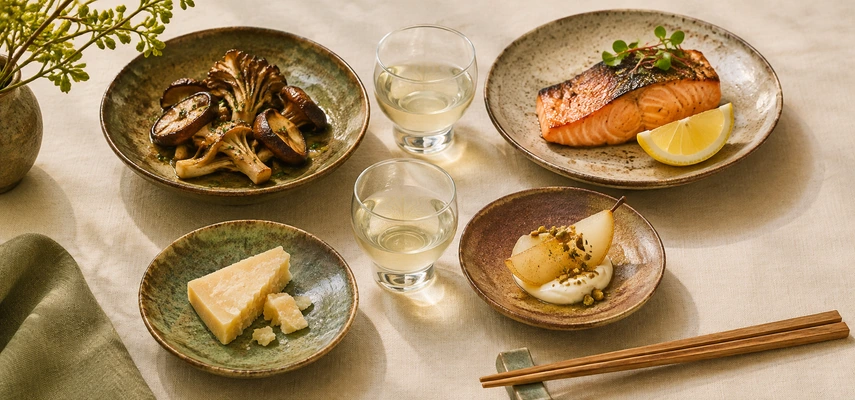

A useful sake pairing recommendation explains what happens when the guest takes a bite and then a sip. Naming a famous category beside a famous dish isn’t enough. Sweetness, acidity, umami, aroma, texture and alcohol all contribute, while the sauce or seasoning can matter more than the main ingredient.
Start with the actual food and sake, then identify a likely interaction worth testing. A delicate fish with lemon is a different pairing problem from the same fish with sweet glaze and chilli. Likewise, two junmai products can differ enough that the category alone doesn’t settle the recommendation.
Sake pairing starts with the whole dish
The WSET specification asks you to consider sweetness, acidity, fruitiness, umami, intensity and alcohol in sake. Food adds sweetness, acidity, umami, salt, bitterness, chilli heat, fat and flavor intensity. Learn these as interacting features rather than a list that must all be mentioned in every answer.
Identify the dominant elements first. A lightly cooked ingredient can be overwhelmed by a powerful sauce, while a simple garnish may add enough acidity or heat to change the pairing. Ask how the dish is prepared and seasoned before deciding which beverage characteristics matter most.
Also ask the guest’s preference. Some want a refreshing contrast, others a continuous savory impression or a prominent aromatic match. A pairing can be technically plausible and still miss the experience the guest wanted. Explain the proposed effect rather than promising universal agreement.
Sweetness in food changes the comparison
A sweet dish can make a less sweet drink seem drier, sharper or less fruity by comparison. A useful starting principle is to choose enough sake sweetness for the actual food, especially with desserts and pronounced sweet glazes. The relevant comparison is relative sweetness, not whether the label sounds luxurious.
Don’t use nigori as a synonym for sweet. Retained solids influence appearance and texture, but actual sugar balance varies. Similarly, an aromatic ginjo can smell fruity without being sweet enough for a dessert. Fruitiness and sweetness need separate observations.
In an original hypothetical pairing, a very sweet caramel dessert overwhelms a delicate dry sake. A richer sweet kijoshu might be a better candidate, but its acidity, intensity and alcohol still need consideration. The recommendation should explain what improves, not merely exchange one category name for another.
Acidity can support balance and refreshment
Food acidity changes how the accompanying drink is perceived. A sake with insufficient supporting freshness may seem flat beside a strongly acidic dressing, while an appropriate balance can make the combination more convincing. Assess the actual level rather than assuming all sake has identical low acidity.
The WSET pairing discussion encourages looking across the dish and drink. A contrast between a rounded sake and bright salty food may be attractive, while another situation calls for more acidity in the sake itself. Complement and contrast are strategies, not mutually exclusive doctrines.
Acidity can also contribute a refreshing impression with fatty food. That doesn’t mean it literally dissolves the fat or removes every coating sensation. Describe the sensory contrast and the result in the mouth instead of replacing it with an inaccurate chemical slogan.
Fruitiness is aroma, not an ingredient declaration
Apple, melon or pear-like aromas can connect with a dish’s aromatic character or provide a lively contrast to savory ingredients. They can also be overwhelmed by strongly flavored food. Match their intensity and suitability rather than assuming any fruity sake improves any fruit-containing dish.
The fruit note may come from fermentation compounds, not added fruit. That distinction matters when explaining the recommendation. A guest asking for a dry drink can enjoy fruit-like aroma, so don’t reject the possibility before checking sweetness on the palate.
For a tasting exercise, compare the aroma before and after a bite. If the dish makes the sake seem less expressive, consider whether flavor intensity, sweetness or temperature is responsible. Record what changed rather than deciding in advance that the aromatic match must work.
Umami creates opportunities and questions
Sake contains amino acids and other components contributing to savory impressions. The JSS advanced pairing account discusses the relationship with umami-rich foods, including the interaction of different savory components. This helps explain its versatility with mushrooms, aged cheese, broth and many other dishes.
Do not transfer every wine-pairing difficulty automatically to sake. Its composition differs, and a savory combination can become richer and more integrated rather than simply harsh. Equally, the presence of umami doesn’t guarantee success regardless of bitterness, salt, sweetness and intensity.
Consider roasted mushrooms with a fuller savory sake. Shared savory character may connect them, while the preparation’s fat and browning add other dimensions. If the mushrooms are covered in a very sweet sauce, the sweetness question returns. One attractive link doesn’t cancel the rest of the dish.
Salt and bitterness change the balance
Salt can alter the perception of bitterness and other tastes, sometimes making a combination seem softer or more integrated. Evaluate the actual seasoning level; a small salty element and an intensely salty dish are not equivalent. A general interaction isn’t permission to ignore quantity.
Bitterness in food or sake can also become more prominent in a combination. Consider charred vegetables, bitter greens or heavily browned components alongside the drink’s own finish. A contrasting rounded or sweeter expression may help, but the result needs testing rather than an automatic category rule.
The JSS basic guide presents both matching and contrasting approaches. Use it to generate a candidate, then assess whether the whole feels balanced. A proposal is a reason to taste, not proof that every person will prefer the same result.
Alcohol and chilli heat need particular attention
Alcohol can increase the sensation of chilli heat, especially when the drink already feels powerful or warm. A lower-alcohol, suitably cool and somewhat sweeter candidate may be more comfortable for a guest seeking less burn. This is a starting strategy, not a promise that sweetness chemically neutralizes the chilli.
WSET’s discussion of spice distinguishes the relevant drink components. Aromatic spices and chilli heat also aren’t identical: fragrant coriander or cumin presents a different question from strong capsaicin heat.
Ask whether the guest wants to soften the heat or emphasize it. A high-strength warmed sake may be a poor choice for someone seeking relief, even if its savory flavor matches the food. Serving water and allowing preference to guide the trial are more useful than defending a theoretical match the guest finds uncomfortable.
Fat, texture and intensity complete the picture
Fat and richness can call for enough palate presence to avoid the sake disappearing, or for a refreshing contrast. Texture matters alongside aroma. A delicate floral nose may be attractive before the meal but barely register against a heavily dressed, rich dish.
Match intensity thoughtfully. A powerful matured sake can overwhelm a subtle preparation, while a restrained sake can leave a strongly flavored dish effectively unaccompanied. Neither mismatch proves poor quality; it means the two expressions may not suit the intended role together.
The JSS service manual offers style-based examples. Treat those as useful possibilities and return to the actual bottle. Grade, age and aroma descriptions help narrow choices without becoming a universal menu algorithm.
Work through two contrasting recommendations
Imagine grilled salmon with lemon and moderate salt. Consider the food’s fat, acidity and intensity, then choose a sake with enough presence and a convincing refreshing or complementary balance. Explain why it suits that preparation, rather than claiming all salmon requires the same junmai.
Now change the dish to salmon with sweet glaze and strong chilli. Reassess sweetness and alcohol first. The previous candidate may become too dry or too hot in perception. Changing the sauce changes the problem, even though the protein hasn’t changed.
For a rich mushroom-and-cheese dish, a savory fuller candidate may provide continuity, while suitable acidity or service temperature can keep the combination lively. Avoid using warmed automatically: test whether it improves integration or makes alcohol too prominent alongside the dish.
Run a small controlled pairing trial
Taste a modest sake sample alone and record its balance. Take a small bite of the prepared food, then repeat the sip and note changes in sweetness, acidity, aroma, bitterness, heat and persistence. Use water and a pause between trials where needed.
Change one variable at a time where practical: a different sake, a temperature adjustment or a seasoning change. If everything changes together, you may enjoy the result without knowing why. Label all examples as trials, and do not invent personal tasting results when explaining hypothetical cases.
Keep a short record of what the guest liked as well as the proposed mechanism. A technically elegant explanation is useful only when it helps select a satisfying experience. Preference provides practical feedback, while the structured notes help you adapt the next recommendation intelligently.
A recommendation depends on the expression described in specialty styles and the choices in temperature and service. Use systematic tasting to identify the actual sweetness, umami and intensity before predicting the interaction.
One-page revision summary
Describe the dish and sake before naming a match. Consider sweetness, acidity, fruitiness, umami, intensity and alcohol alongside salt, bitterness, chilli and fat. Explain complement or contrast through a likely sensory interaction, test the actual combination and adapt to the guest. A strong recommendation gives reasons and recognizes limits rather than promising a universal perfect pairing.
Written practice: original TFE exercises
These suggested marks and indicative points are independent teaching guidance, not official WSET marking schemes.
Exercise 1: 5 suggested marks
Recommend a sake profile for a sweet chilli-glazed dish when the guest wants to soften the heat. Mapping: Unit 1 LO4.
Indicative marking points:
- Recognize food sweetness and chilli as dominant considerations.
- Choose enough sake sweetness to avoid an excessively dry impression.
- Consider lower alcohol to reduce extra burning sensation.
- Use suitable cool service if it supports comfort and expression.
- Test intensity and guest preference rather than claiming sweetness neutralizes chilli.
Model answer: The glaze makes sweetness and chilli central. Consider a suitably sweet, lower-alcohol sake served cool, with enough flavor to remain present. This can avoid an overly dry impression and reduce extra alcohol heat. Test the actual combination and guest response rather than promising the sweetness will chemically cancel the chilli.
Why it works: It links the recommendation to the guest’s objective and distinguishes sensory comfort from a false neutralization claim.
Common mistake: Choosing high-strength hot sake solely because its savory aroma matches, while ignoring the guest’s wish for less burn.
Exercise 2: 5 suggested marks
Explain why grilled salmon with lemon and the same fish with sweet chilli glaze may need different recommendations. Mapping: Unit 1 LO4.
Indicative marking points:
- The protein name alone does not define the dish.
- Lemon introduces acidity alongside fat and intensity.
- Sweet glaze changes relative sweetness requirements.
- Chilli makes alcohol sensation important.
- The final choice should be tested through the actual balance and guest preference.
Model answer: Lemon-dressed salmon presents acidity, fat and intensity, while sweet chilli glaze adds dominant sweetness and heat. A sake suitable for the first may seem too dry or alcoholic with the second. Reassess the complete dish, test the interaction and explain the result through the guest’s preference rather than using salmon as a fixed pairing category.
Why it works: It identifies how preparation changes the relevant variables and why the recommendation must be reconsidered.
Common mistake: Repeating one universal fish-and-junmai rule without considering sauce or seasoning.
Knowledge check: 10 original practice questions
Independent TFE questions, not official WSET examination items. Choose one answer per question; explanations follow separately.
1. Which conclusion is most defensible?
2. What improves a pairing trial?
3. Which is the best first step in a pairing recommendation?
4. Which is a reasonable consideration with fatty food?
5. Why can a sweet dessert make a dry sake seem less suitable?
6. Which distinction is correct?
7. What is a useful umami approach?
8. What can sweetness do in a chilli pairing?
9. Why consider alcohol with chilli?
10. Why can the same salmon need a different sake after changing its sauce?
Answers and explanations
1. C — A reasoned candidate should be tested and adapted to the dish and guest.. Mechanisms help generate useful choices without universal guarantees. Mapping: Unit 1 LO4 food pairing.
2. B — Recording the sake alone and after a bite, then adjusting deliberately.. A structured comparison makes the observed interaction easier to explain. Mapping: Unit 1 LO4 food pairing.
3. B — Describe the actual dish and sake, including sauce and seasoning.. The whole preparation determines which interactions matter most. Mapping: Unit 1 LO4 food pairing.
4. A — Enough presence or a refreshing sensory contrast.. The useful explanation describes the experience rather than inaccurate chemistry. Mapping: Unit 1 LO4 food pairing.
5. C — Relative sweetness can make the drink seem drier or sharper.. Perception in the combination differs from the drink tasted alone. Mapping: Unit 1 LO4 food pairing.
6. A — Fruitiness and sweetness are separate observations.. Fermentation aroma and palate sugar balance require separate assessment. Mapping: Unit 1 LO4 food pairing.
7. D — Explore savory continuity while checking the whole balance.. Umami creates opportunities without cancelling other food and drink features. Mapping: Unit 1 LO4 food pairing.
8. C — Offer a sensory balancing strategy without cancelling capsaicin.. The recommendation needs qualification and an actual trial. Mapping: Unit 1 LO4 food pairing.
9. B — It can increase the burning sensation.. A powerful warm drink may conflict with a guest seeking less heat. Mapping: Unit 1 LO4 food pairing.
10. D — Sweetness, acidity, heat and intensity can change substantially.. Preparation can dominate the pairing problem more than the protein name. Mapping: Unit 1 LO4 food pairing.












