










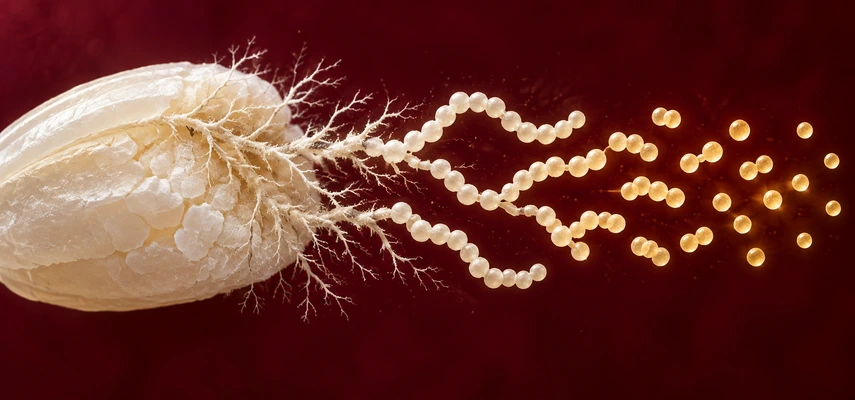

Why does a sake brewery cultivate a mould before asking yeast to make alcohol? Kōji mould and enzymes solve the problem that yeast cannot solve efficiently on its own: turning rice starch into usable sugar. Yet sugar production is only part of their contribution. The same biological preparation also affects nitrogen compounds, nutrients and the conditions in which fermentation proceeds.
The WSET Level 3 specification requires several named enzymes and outputs. Learn their jobs before learning how the kōji room is managed. This lesson follows the chemistry; the next examines cultivation. Neither substitutes a memorized list for an explanation of how the rice becomes useful brewing material.
Kōji mould and enzymes are not yeast by another name
Kōji is a material cultivated with selected mould; in conventional sake production, that material is steamed rice. Kōji-kin refers to the mould, while tane-kōji is the seed starter used to inoculate the rice. The resulting rice kōji carries enzymes and other compounds into later brewing stages. Keeping organism, starter and finished cultivated material separate prevents confusion.
Yeast performs alcoholic fermentation, consuming available fermentable sugars and producing ethanol and carbon dioxide. Kōji mould supplies enzymes that help release those sugars from rice starch. The NRIB explanation of kōji also emphasizes protein breakdown and flavor contributions. These are complementary jobs, not competing names for the same microorganism.
For a revision diagram, draw rice starch, available glucose and ethanol as three separate stages. Label the intervening biological activities instead of placing one vague fermentation arrow across the entire sequence.
An enzyme is a biological catalyst: it helps a particular reaction proceed without being used up as an ordinary ingredient in that reaction. Enzymes have different activities and work best under suitable conditions. Producing more mould growth does not automatically mean producing exactly the enzyme balance that every sake style requires. Quantity, type and subsequent activity all matter.
Alpha-amylase opens up starch chains
Rice starch includes amylose and branched amylopectin, both built from glucose units. After suitable preparation, alpha-amylase can cut internal alpha-1,4 linkages along accessible chains. This produces shorter fragments and helps the rice material break down. It is especially useful to associate the enzyme with internal chain cutting and rice dissolution rather than with a claim of instant complete glucose production.
Imagine reducing a long linked structure into shorter sections. That makes more manageable pieces and chain ends available for further reactions. The analogy explains cooperation between enzymes, although chemical specificity is more precise than chopping a rope at arbitrary points. Alpha-amylase cannot simply cut every bond in every position equally well.
The consequence for brewing is easier access to smaller starch-derived material within a changing mash. However, a very strong single enzyme activity is not a universal quality target. The brewer needs starch dissolution, sugar production and yeast fermentation to work together. Optimizing one rate without considering the others can create a different balance from the one intended.
Glucoamylase helps provide glucose for yeast
Glucoamylase acts from chain ends to release glucose. This makes it particularly important when explaining the supply of fermentable sugar. A short answer that merely says “amylase makes alcohol” loses both the specific glucose-releasing step and the separate role of yeast. Name the enzyme function, then connect its output to fermentation.
For example, suitable glucoamylase activity → release of glucose from starch-derived chains → sugar available for yeast. Yeast may consume that glucose as it becomes available, so the glucose concentration measured at one moment is not the same as the total quantity produced. A small standing pool can coexist with substantial ongoing production and consumption.
The brewing research account Enzymes Participating in Sake Fermentation separates rice dissolution, glucose production and alcohol production. That division is a useful study framework. Each stage influences the next, but a change in one does not guarantee an identical proportional change in the finished sake.
Alpha-glucosidase completes the required enzyme picture
Alpha-glucosidase acts on suitable smaller alpha-linked sugar substrates, releasing glucose. It belongs in the explanation alongside alpha-amylase and glucoamylase, not in a footnote that disappears after the first revision session. The three names refer to different activities within the conversion system, even though their contributions overlap in the broad goal of making glucose available.
The Tohoku University presentation on kōji science, hosted by the Embassy of Japan, identifies all three amylolytic activities. For examination study, distinguish internal chain cutting from glucose release and recognize that multiple enzymes cooperate. You don’t need to invent a universal enzyme percentage or claim a single activity exclusively determines sweetness.
Limit dextrins are residual branched fragments that remain when a particular amylase cannot continue degrading the structure in the same manner. They illustrate enzyme specificity. They are not a synonym for glucose, a yeast nutrient mineral or the solid sake lees removed at pressing. Also avoid claiming that every branch point disappears immediately once alpha-amylase enters the picture.
Proteases connect rice protein to nutrition and flavor
Proteases break down proteins into smaller components, including peptides; the broader proteolytic enzyme system releases amino acids as breakdown proceeds. Peptides are shorter chains of amino acids. This is separate from starch hydrolysis, although both activities occur within the same brewing system. Sugar and nitrogen compounds have different roles and should not be merged into one generic category called nutrients.
A useful chain is protein breakdown → peptides and amino acids become available → effects on microbial nutrition and potential sake taste. Some amino acids contribute to umami, but not every amino acid tastes the same. Greater total amino-acid content therefore doesn’t establish that every sensory dimension improves or that the sake automatically becomes more complex.
Protein breakdown can also influence access within the rice material. The practical consequence is that proteolytic and amylolytic actions aren’t isolated compartments. Nevertheless, explain each reaction accurately before discussing interaction. Saying that protease turns protein into glucose would replace an interesting connection with the wrong chemistry.
Vitamins, lipids, fatty acids and aroma belong to the system
Kōji cultivation also changes the supply of vitamins, lipids, fatty acids and aroma-related compounds. These contribute to the brewing environment and can influence the behavior of other microorganisms. They are not all products of amylase action. Different compounds arise through different biological pathways, and the rice substrate also supplies material to the process.
Meanwhile, yeast nutrition and metabolism help shape fermentation-derived aroma. That is why kōji can influence an aromatic style without being the organism responsible for alcoholic fermentation. The reasoning passes through substrate breakdown and the chemical environment before reaching the sensory result. Avoid claiming that one fatty acid or vitamin gives every sake the same recognizable smell.
Commercial starter descriptions from Akita Konno show how producers distinguish strains by enzyme and other characteristics. Such descriptions demonstrate that selection has a practical purpose. Their suggested flavor outcomes still require brewery management and sensory confirmation; a supplier’s intended application is not a guaranteed result in every mash.
Yellow, white and black moulds offer different possibilities
Yellow kōji mould, conventionally Aspergillus oryzae in sake, is the standard starting point for this discussion. “Yellow” refers to the mould’s sporulating color, not a requirement that finished sake be yellow. The rice kōji used in brewing also shouldn’t be judged solely by a dramatic colored photograph. Growth stage and production purpose affect what is visible.
White and black kōji moulds are particularly associated with shōchū and awamori production, but also appear in some sake. Modern terminology includes Aspergillus luchuensis for black kōji and its white variant associated with the name kawachii. Historical names differ, so focus first on the brewing distinction rather than treating every taxonomic label as a separate sensory style.
NRIB explains that these white and black moulds can produce substantial citric acid and acid-resistant amylases. Consequently, their use can change mash acidity and microbial conditions as well as the enzyme supply. A sake made with them may show a different acid balance from a conventional yellow-kōji example. The outcome depends on the whole production plan, not spore color alone.
Powdered and granulated starter formats need careful naming
Powdered and granulated preparations are formats in which kōji starter can be supplied. They concern inoculation and distribution of the selected mould, not two premium sake grades. Akita Konno lists both formats for brewing applications. Once the starter has been distributed and cultivation managed, the brewery obtains rice kōji for later use.
Therefore, don’t confuse powdered seed starter with a bag of pure enzymes, and don’t describe every grain of finished rice kōji as a starter granule. The distinction matters when explaining what the brewer adds at inoculation and what later enters the starter or mash. Similar English shorthand can conceal different stages of the process.
Enzyme supply begins with the conditions and stages of koji cultivation, while so-haze and tsuki-haze illustrate different approaches to growth. Follow their products into the parallel processes in the main mash.
One-page revision summary
Associate alpha-amylase with internal starch-chain cutting, glucoamylase and alpha-glucosidase with suitable glucose-releasing activities, and proteases with protein breakdown. Explain limit dextrins through enzyme specificity and connect amino acids, peptides and other compounds to the brewing environment. Distinguish yellow, white and black mould choices, then keep seed-starter format separate from finished rice kōji. Yeast still makes the alcohol from available sugar.
Written practice: original TFE exercises
These suggested marks and indicative points are independent teaching guidance, not official WSET marking schemes.
Exercise 1: 5 suggested marks
Explain how alpha-amylase and glucoamylase contribute differently to the supply of fermentable sugar. Mapping: Unit 1 LO1.
Indicative marking points:
- Rice starch consists of glucose polymers.
- Alpha-amylase cuts suitable internal alpha-1,4 bonds.
- This yields shorter fragments and assists dissolution.
- Glucoamylase releases glucose from chain ends.
- Yeast can ferment the available glucose; neither enzyme is yeast.
Model answer: Rice starch is a glucose polymer rather than free fermentable sugar. Alpha-amylase cuts suitable internal alpha-1,4 linkages, producing shorter fragments and helping rice dissolution. Glucoamylase acts from chain ends to release glucose. The released glucose becomes available to yeast for alcoholic fermentation, so the enzymes support a separate microbial process.
Why it works: The answer distinguishes locations and consequences of enzyme action before connecting the combined result to yeast.
Common mistake: Claiming that alpha-amylase alone converts every starch molecule directly into ethanol.
Exercise 2: 5 suggested marks
Explain why using white or black kōji mould can change the brewing environment compared with a conventional yellow-kōji approach. Mapping: Unit 1 LO1 and LO2.
Indicative marking points:
- Conventional yellow sake kōji uses selected mould such as A. oryzae.
- White or black moulds provide different biological capabilities.
- They can produce substantial citric acid.
- That changes acidity and conditions for microorganisms.
- Enzyme properties and overall production decisions determine the eventual style, not color alone.
Model answer: Conventional yellow sake kōji is based on selected mould such as A. oryzae. White and black moulds associated with shōchū production can provide substantial citric acid and enzymes suited to acidic conditions. Their use therefore changes the mash environment and can influence its eventual acid balance. The final sensory result still depends on strain, use and the wider brewing plan.
Why it works: It identifies a biochemical difference, traces its environmental consequence and qualifies the final sensory claim.
Common mistake: Assuming black spores make the finished sake black or that all three moulds are alcoholic-fermentation yeasts.
Knowledge check: 10 original practice questions
Independent TFE questions, not official WSET examination items. Choose one answer per question; explanations follow separately.
1. Which activity best describes alpha-amylase?
2. Which statement correctly distinguishes kōji mould and yeast?
3. Which required activity also releases glucose from suitable smaller alpha-linked substrates?
4. What is a central contribution of glucoamylase?
5. What do powdered and granulated starter formats describe?
6. What is particularly relevant to white and black kōji moulds?
7. Why does one glucose measurement not reveal all glucose produced during moromi?
8. Which pair is associated with protein breakdown?
9. What do limit dextrins illustrate?
10. Which mould is conventional for yellow sake kōji?
Answers and explanations
1. A — Internal cutting of suitable starch-chain linkages.. Alpha-amylase contributes to starch breakdown and rice dissolution through suitable internal chain cleavage. Mapping: Unit 1 LO1 Range 1; LO2 Range 4.
2. B — Kōji mould supplies enzymes; yeast ferments available sugar into alcohol.. The organisms have distinct but connected functions in converting starchy rice into sake. Mapping: Unit 1 LO1 Range 1; LO2 Range 4.
3. C — Alpha-glucosidase.. Alpha-glucosidase belongs alongside alpha-amylase and glucoamylase in the prescribed enzyme picture. Mapping: Unit 1 LO1 Range 1; LO2 Range 4.
4. D — Releasing glucose from starch-derived chain ends.. Glucose release supplies fermentable sugar, which yeast then uses in a separate process. Mapping: Unit 1 LO1 Range 1; LO2 Range 4.
5. B — Different ways of supplying inoculation material for kōji cultivation.. Seed-starter format must be distinguished from the finished cultivated rice and from pure enzyme preparations. Mapping: Unit 1 LO1 Range 1; LO2 Range 4.
6. C — They can produce substantial citric acid and acid-resistant amylases.. Their acid production and enzyme capabilities change the brewing environment rather than simply coloring the sake. Mapping: Unit 1 LO1 Range 1; LO2 Range 4.
7. D — Glucose is produced and consumed concurrently in a changing system.. A measured concentration is a standing pool, not the cumulative amount released by enzymes. Mapping: Unit 1 LO1 Range 1; LO2 Range 4.
8. D — Peptides and amino acids.. Proteolysis yields smaller nitrogen-containing components, which have nutritional and potential taste roles. Mapping: Unit 1 LO1 Range 1; LO2 Range 4.
9. B — Limits imposed by enzyme specificity on residual branched structures.. Residual fragments can remain because a particular enzyme cannot continue through the structure in the same manner. Mapping: Unit 1 LO1 Range 1; LO2 Range 4.
10. A — Aspergillus oryzae.. Selected A. oryzae is the conventional yellow sake-kōji mould; yeast is a different organism. Mapping: Unit 1 LO1 Range 1; LO2 Range 4.












