










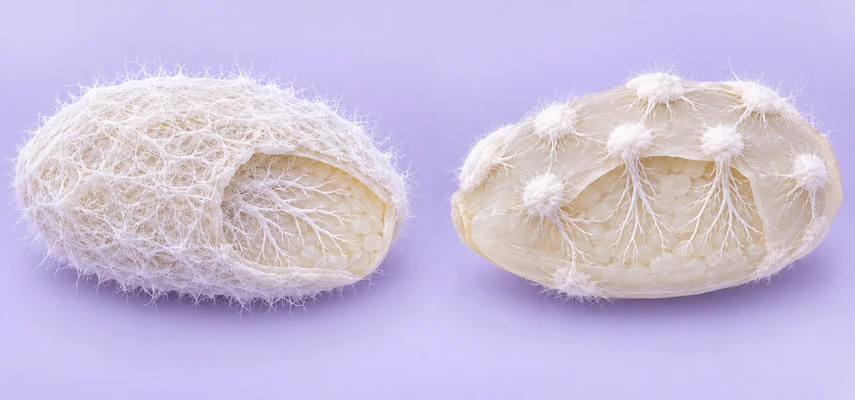

Does less visible mould mean less useful kōji? Not necessarily. Tsuki-haze kōji can show scattered patches at the surface while the mould penetrates inward. Sō-haze has more extensive coverage across the grain as well as inward development. The difference is a purposeful way to manage the material, not a competition to see which rice grain can wear the thickest white coat.
The WSET Level 3 specification includes both patterns. To explain them, connect growth location and cultivation choices to enzyme and nutrient supply, then connect those outputs to fermentation management. A photograph can introduce the distinction, but it cannot measure the entire brewing contribution by itself.
What sō-haze and tsuki-haze kōji actually describe
Haze concerns the development of mould on and within the rice during kōji making. The appearance reflects where fungal growth has established itself, but surface coverage and inward penetration are distinct observations. A grain can look extensively coated without that appearance telling you every detail of its internal development or enzyme profile.
Sō-haze describes broadly distributed growth across the grain’s surface with inward penetration. Tsuki-haze shows separated visible patches at the surface, associated with growth entering the grain from those areas. The Journal of Sakeology account of seed kōji distinguishes the surface patterns as one way of classifying kōji.
Consequently, “patchy” must not be mistaken for accidental neglect. A deliberately managed tsuki-haze batch is not simply an incomplete sō-haze batch. The brewer seeks a particular development and biochemical contribution. Whether that aim has been achieved requires more than counting the number of white patches visible on one representative grain.
Surface growth and inward penetration answer different questions
Surface growth is what a worker can observe around the outside of the grain. Inward penetration concerns how the fungal filaments develop within it. Since rice structure and preparation affect access, a cultivation result is partly inherited from the polishing, hydration and steaming stages. The grain doesn’t enter the room as a blank biological canvas.
For example, suppose rice has an exterior that permits conspicuous growth but its interior hasn’t been prepared as intended. An attractive surface wouldn’t establish that the internal material will behave correctly later. The causal question is how the mould and its enzymes gain useful access to the rice, not merely whether the outside becomes white.
The opposite error is to see limited surface coverage and conclude that no substantial inward growth exists. That would miss the defining point of tsuki-haze. Distinguish what is visible from what must be examined or measured. A good production description states the pattern and the relevant internal development rather than substituting one for the other.
Growth patterns influence an enzyme-producing material
Mould produces enzymes as it develops on the prepared rice. Where and how it grows influences the cultivated material that enters later stages. However, enzyme production also depends on strain, temperature, moisture and cultivation history. Pattern is useful information within that system; it is not a complete laboratory assay.
Amylolytic activities support rice dissolution and glucose supply, while proteolytic activities affect the release of peptides and amino acids. Their relative amounts and subsequent performance matter. Saying that one kōji has “more enzymes” leaves unanswered which activities are greater and whether that balance suits the intended mash.
The starter producer Akita Konno describes strains and applications with different growth and biochemical tendencies. Its examples include useful enzyme activity alongside different vitamin and fatty-acid characteristics. That illustrates why visually restrained surface growth need not mean a useless enzyme supply. Still, the product’s intended application is conditional on actual cultivation and brewing.
Nutrient supply connects cultivation to yeast behavior
Kōji contributes more than fermentable sugar. Amino acids, peptides, vitamins and lipid-related compounds are part of the chemical environment available during brewing. Differences in that contribution can affect yeast growth and metabolism. This provides a mechanism linking cultivation decisions to fermentation behavior without pretending that mould itself performs all alcoholic fermentation.
A more nutrient-rich contribution may suit a vigorous fermentation plan or a fuller style. A more restrained contribution may form part of a plan for a controlled aromatic expression. These are production strategies, not universal consequences of a single surface pattern. Rice polishing, yeast strain, additions, temperature and finishing still influence the result.
Therefore, avoid writing “tsuki-haze always has fewer nutrients” as if the name specified a fixed analytical composition. Explain the intended cultivation approach and the relevant tendency, then acknowledge the actual material and strain. Precision improves when the answer names the connection rather than asserting a permanent number that has never been measured.
Why sō-haze may suit one brewing objective
Suppose a brewery wants an assertive sake with a rounded palate and substantial savory character. A kōji plan with extensive development and an appropriate enzyme and nutrient contribution can support that goal. Sō-haze may be selected as part of such a plan because it offers a practical route to the desired cultivated material.
The complete chain is growth and cultivation decisions → enzyme and nutrient contribution → fermentation and potential taste effects. Each arrow needs the rest of the process to cooperate. A brewer can still create a restrained or precisely balanced sake using a method that doesn’t match a beginner’s simplified style chart.
Likewise, fuller flavor is not a defect that needs explaining away. It can be an intended and well-executed outcome. Judge whether the production choices support the goal and whether the finished sake shows balance. The method’s suitability comes from its use, rather than its position on an imagined ladder of refinement.
Why tsuki-haze is associated with ginjō production
Tsuki-haze is commonly associated with ginjō and daiginjō approaches seeking controlled fermentation and refined aromatic expression. Its patchy surface growth and inward development form part of a cultivation strategy that can provide suitable enzyme activity without the same overall growth and chemical contribution as another approach. That is a useful association, provided it remains a strategy rather than a definition of the legal grade.
For example, a brewer may combine highly polished rice, a chosen mould strain, controlled moisture, tsuki-haze cultivation and a suitable yeast. Those decisions can work together toward an aromatic style. Removing the other decisions from the explanation would make the kōji pattern seem responsible for effects that depend on the full system.
An equipment-maker interview with Tsukasabotan’s brewer provides a useful counterexample to rigid rules: the brewer describes a ginjō approach that does not adopt the conventional tsuki-haze pattern. This doesn’t invalidate the common association. It shows why an educational tendency should not be written as a compulsory recipe.
Cultivation decisions produce the pattern
The brewery influences development through prepared-rice condition, inoculation, temperature, humidity and handling. The amount and distribution of starter affect establishment, while water availability and environmental control affect growth. Mixing and rearrangement change local conditions as the mould generates heat. The outcome is managed through the sequence rather than selected afterward by giving a batch a flattering name.
However, no single intervention guarantees the result. A particular spore dose used with one rice and room plan may behave differently with another. Similarly, a room-temperature target doesn’t establish the same rice temperature throughout a thicker and thinner layer. The physical and biological parts of cultivation remain connected.
The primary tray-and-box comparison found differences in environment, mycelium and enzyme activity under the studied arrangements. Its value here is methodological: measure the conditions and outputs rather than assuming a container or visible pattern explains everything. A method name is the beginning of an investigation, not its final analytical result.
Use a practical comparison without overclaiming
Imagine two well-made kōji batches from the same rice lot. One shows extensive surface coverage; the other shows distinct patches with inward growth. First describe the difference accurately. Next ask whether their strain, inoculation, temperature and moisture histories were the same. Then examine relevant enzyme activities and the conditions in which the kōji will be used.
If the two subsequently produce different fermentation behavior, that is evidence to interpret. It doesn’t establish that appearance alone caused every difference. A useful record includes the kōji’s physical condition, biochemical information where available and the downstream brewing plan. The exercise teaches how to reason about a relationship without pretending it has been isolated experimentally.
For examination answers, build two short comparisons: growth pattern and intended brewing implication. Mention both surface and inward development, then discuss an appropriately qualified enzyme or nutrient consequence. Don’t repeat an entire enzyme textbook when the question asks for a focused contrast. Relevance matters as much as the quantity of remembered information.
When reviewing a causal answer, underline the measured observation and circle the proposed consequence. If no sentence connects them through an enzyme, nutrient or process mechanism, the response still needs its most useful explanatory step.
Growth patterns gain meaning through the cultivation process and enzyme pathways. Keep their stylistic implications qualified when comparing the coordinated choices behind ginjo and daiginjo.
One-page revision summary
Sō-haze and tsuki-haze describe growth patterns, not legal sake grades or universal quality rankings. Compare extensive surface growth with separated surface patches, while recognizing inward development in both. Connect cultivation to enzyme and nutrient contribution, then to fermentation strategy. Finally, keep common ginjō associations flexible enough to accommodate real brewery choices and actual sensory evidence.
Written practice: original TFE exercises
These suggested marks and indicative points are independent teaching guidance, not official WSET marking schemes.
Exercise 1: 5 suggested marks
Compare sō-haze and tsuki-haze kōji, then explain why surface coverage alone cannot specify their brewing contribution. Mapping: Unit 1 LO1.
Indicative marking points:
- Sō-haze has extensive surface coverage.
- Tsuki-haze has separated visible surface patches.
- Inward penetration is relevant to both patterns.
- Strain and cultivation conditions also affect enzyme and nutrient production.
- Actual properties and downstream use must be considered rather than inferring a fixed contribution from appearance.
Model answer: Sō-haze develops extensively across the rice surface, while tsuki-haze shows separated visible patches. Both involve inward development, so patchiness does not mean the interior is uncolonized. The strain and cultivation history also affect enzyme and nutrient production. Consequently, appearance helps describe the material but does not establish a fixed analytical contribution or final sake style.
Why it works: The answer makes the physical comparison and explains the limit of that observation using relevant process variables.
Common mistake: Calling tsuki-haze failed or incomplete kōji simply because less surface is covered.
Exercise 2: 5 suggested marks
Explain why a brewer might include tsuki-haze cultivation in a ginjō production plan without claiming that all ginjō requires it. Mapping: Unit 1 LO1 and LO2.
Indicative marking points:
- Identify a controlled aromatic or refined style objective.
- Tsuki-haze provides a chosen growth pattern.
- Cultivation can supply appropriate enzyme activity and a managed nutrient contribution.
- That contribution interacts with yeast and fermentation conditions.
- It is a common strategy, not a complete legal definition or universal quality requirement.
Model answer: A brewer pursuing a controlled aromatic ginjō style may use tsuki-haze as part of a cultivation plan that supplies suitable enzyme activity and a managed chemical contribution. Those properties interact with polished rice, yeast and fermentation management. The pattern is therefore a useful strategy within a complete process, rather than a compulsory condition that defines every ginjō sake.
Why it works: It connects an objective to a cultivation mechanism while explicitly limiting the claim to a strategy rather than a universal rule.
Common mistake: Saying the surface pattern alone creates fruit aroma or determines the premium grade.
Knowledge check: 10 original practice questions
Independent TFE questions, not official WSET examination items. Choose one answer per question; explanations follow separately.
1. How should fuller sake styles be treated in this comparison?
2. Which production explanation is strongest?
3. What most directly distinguishes the surface appearance of tsuki-haze?
4. Which statement about tsuki-haze and ginjō is accurate?
5. What additional information helps assess biochemical contribution?
6. Which classification do sō-haze and tsuki-haze belong to?
7. Why is inward penetration relevant?
8. Which experiment would most improve interpretation of a pattern comparison?
9. Why might nutrient contribution matter downstream?
10. Which description fits sō-haze?
Answers and explanations
1. C — As possible intended outcomes whose balance must be assessed.. Richness is a stylistic possibility, not a defect or a complete quality judgment. Mapping: Unit 1 LO1 Range 3; LO2 Range 4.
2. A — Growth decisions affect enzyme and nutrient supply, which interacts with the fermentation plan.. The explanation includes intervening mechanisms and preserves the role of the whole process. Mapping: Unit 1 LO1 Range 3; LO2 Range 4.
3. B — Separated visible growth patches.. Tsuki-haze is associated with patchy surface growth and inward development rather than absence of cultivation. Mapping: Unit 1 LO1 Range 3; LO2 Range 4.
4. B — It is a common strategy that works with other production decisions.. Common association is not a compulsory recipe or guarantee of sensory outcome. Mapping: Unit 1 LO1 Range 3; LO2 Range 4.
5. C — Mould strain and cultivation temperature and moisture history.. Strain and growing conditions affect enzyme and other outputs, so appearance is not a complete assay. Mapping: Unit 1 LO1 Range 3; LO2 Range 4.
6. D — Kōji growth patterns.. They describe development of cultivated material, rather than a legal or commercial classification of finished sake. Mapping: Unit 1 LO1 Range 3; LO2 Range 4.
7. D — It describes development within the rice beyond what surface coverage shows.. Surface and internal development are different observations that contribute to assessing the cultivated material. Mapping: Unit 1 LO1 Range 3; LO2 Range 4.
8. B — Document rice, strain, conditions and relevant outputs as well as appearance.. Records help distinguish the effects of cultivation from confounding factors and unsupported visual inference. Mapping: Unit 1 LO1 Range 3; LO2 Range 4.
9. D — They can influence yeast growth and metabolism.. The chemical environment helps connect kōji cultivation to fermentation behavior and potential aroma effects. Mapping: Unit 1 LO1 Range 3; LO2 Range 4.
10. A — Extensive surface development together with inward growth.. Sō-haze describes a cultivation pattern, not a grade or rice-polishing definition. Mapping: Unit 1 LO1 Range 3; LO2 Range 4.











