










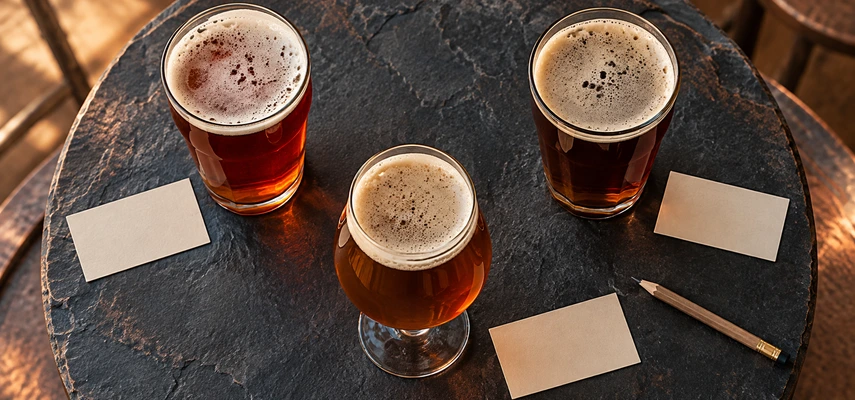

A red ale offers a little caramel at first, then finishes unexpectedly dry. A brown ale smells nutty without containing nuts. Red and brown ales are a useful next step after the lagers because they expose two persistent mistakes: color does not determine sweetness, and an aroma comparison does not identify an ingredient.
This lesson covers Irish red ale, British-style brown ale and American-style brown ale, the three prescribed Level 2 entries. Their shared malt emphasis provides a foundation, but hopping, fermentation expression and the degree of roast change the balance. Learn the whole profile rather than treating brown as a flavor.
Start with what the color cannot tell you
Amber, copper, red-brown and chestnut appearances can arise through different combinations of base and specialty ingredients. A small amount of very dark material can change color without making intense roast the dominant flavor. A larger share of developed malt can create toast, caramel or nutty associations by a different route.
These choices interact with fermentability and yeast. Sugar-like aroma associations may remain after much fermentable sugar has disappeared, while bitterness and roast can make the finish seem drier. The beer’s first aromatic impression is therefore not a substitute for assessing palate sweetness.
Nor does dark color establish strength. Starting extract and fermentation determine alcohol potential and outcome. Across this group, everyday moderate strength is a more useful starting expectation than assuming every deeper shade means a stronger drink. Stronger specialty interpretations need their own context.
Irish red ale: an early impression and a different finish
Irish red ale usually appears clear amber to reddish copper, with an off-white or pale tan head. Aroma is restrained, with grain, light caramel, toast or toffee possibilities. Hop aroma may be low and earthy or floral; fermentation is generally clean or gently fruity rather than intensely yeast-driven.
The flavor can open softly malty, then move toward grain, biscuit and a touch of roasted dryness. Bitterness is medium-low to medium, body medium-light to medium, and carbonation moderate. Alcohol is usually unobtrusive. The useful feature is the changing impression across the sip, not a requirement for strong caramel sweetness.
Pale base malt supplies most of the working material, with small roasted-grain or dark-malt contributions helping color and the dry edge. Caramel malt use varies. Compared with a British bitter, Irish red is generally less hop-led; compared with stout, its roast is much lighter and does not define the entire drink.
Do not generalize Irish red into every beer marketed as red ale. Other red styles can emphasize hops, strength or different fermentation. The full label matters because the color adjective by itself cannot explain the beer’s intended balance.
British-style brown ale: a developed malt center
British-style brown ale typically ranges from dark amber to reddish brown, generally clear, with an off-white to light tan head. Aroma can suggest caramel, toffee, nuts, biscuit or gentle chocolate-like malt. Low fruitiness and quiet earthy or floral hops may add detail without dominating.
The palate is usually balanced toward malt, with medium-low to medium bitterness and a medium-to-dry finish despite some initial sweetness. Body tends to medium-light or medium, carbonation moderate or somewhat livelier, and alcohol remains moderate in impression. Strong burnt roast is not the central goal.
Pale or mild-ale base malt with caramel and small darker contributions helps explain the range. A little chocolate malt can provide color and nutty associations without turning the beer into a roast-heavy porter. British ale fermentation may supply supporting fruit, with strain and process affecting the amount.
Brown ale has broad historical and commercial usage. The particularly sweet, lower-strength London brown tradition is not a rule for every British brown ale. Here, concentrate on the prescribed family and the individual sample’s balance instead of insisting that all British brown must taste like one familiar bottle.
American-style brown ale: malt with a stronger hop conversation
American-style brown ale generally appears clear light to deep brown with a tan or off-white head. Malt can suggest caramel, chocolate, toast and nuts, while contemporary hop aroma may be more evident than in the British comparison. Citrus or resin can sit beside those darker grain notes.
Bitterness is commonly moderate to higher within this group, supporting a fuller flavored yet balanced profile. Body is medium to medium-full, carbonation moderate to moderately high, and alcohol is usually moderate rather than a dominant warming feature. The finish can be fairly dry or gently rounded; brown does not require a sugary ending.
A pale base with developed specialty malt supplies the grain profile, while more assertive hopping helps distinguish the style. Fermentation is often comparatively clean, though some fruitiness can occur. Compared with British brown, it generally has more hop and bitter emphasis; compared with American porter, its roast is typically less assertive.
The American term describes a style tradition, not an exclusive geographical production rule. A brewery elsewhere can make an American-style interpretation. To understand the beer, connect the term to its ingredient and balance expectations rather than assuming country of manufacture alone fixes its flavor.
Toast, caramel, nut and roast are not interchangeable
Those descriptors can overlap in one beer, but they point toward different sensory associations. Toast suggests browned bread; caramel and toffee suggest sugar-related aromas; nutty can resemble toasted nuts; roast can move toward coffee or burnt grain. Naming the distinction makes a comparison more useful.
The corresponding ingredient explanation should remain cautious. Nutty aroma need not come from added nuts, and chocolate-like malt need not contain cocoa. Conversely, a flavored interpretation might genuinely include either. Reliable recipe information helps separate a descriptor from an actual addition.
This is the same discipline introduced in Article #1. Observation and cause belong in separate steps until evidence connects them. A confident-sounding ingredient claim is less useful than a precise sensory note with an honest explanation of what is still unknown.
Hops can change a malt-driven beer without erasing it
British brown and American brown share a broad developed-malt territory, but different hop choices and doses can move the aromatic and bitter balance. Citrus or pine-like expression against chocolate-like grain creates a different result from gentle earthy hops against caramel and biscuit.
That does not make every American brown an IPA with dark coloring. The grain character remains part of the style’s identity, and balance matters. An extreme hop interpretation may approach other categories, but the standard comparison still needs both sides of the recipe.
Irish red offers another useful reference: modest hopping can let a small roasted contribution help shape the dry finish. Several mechanisms can produce an impression of dryness, and they should not all be described as a higher numerical bitterness.
Fermentation supports a different kind of complexity
These ales generally avoid the assertive clove or pepper profiles associated with some Belgian and German wheat-beer cultures. British examples may show gentle fruity esters; American brown often gives more room to malt and hops through a restrained fermentation profile. Neither tendency means every sample must be chemically or sensorially neutral.
Attenuation matters to the finish. A rich grain aroma with appropriate fermentation can coexist with a relatively dry palate, while a stalled process could leave unwanted sweetness. Style labels do not turn incomplete fermentation into a virtue.
Conditioning, carbonation and serving conditions also affect the final impression. Gas changes liveliness and texture; very cold service can reduce aromatic expression. Compare samples under similar conditions so the apparent difference between two brown ales does not merely reflect unequal temperatures.
Make the nearest comparison do the teaching
For Irish red, compare a little opening caramel with the drier grain-and-roast finish. For British brown, compare developed malt with restrained hops and a finish that need not be sugary. For American brown, look for the stronger hop conversation alongside deeper grain character.
Next compare each with a nearby style outside this lesson. Irish red versus bitter highlights hop emphasis; British brown versus porter highlights roast; American brown versus American amber highlights the darker malt contribution. Each pairing asks a more specific question than simply deciding which beer is darkest.
These exercises work with reliable written descriptions and require no alcohol consumption. Build a grid for color, clarity, aroma, bitterness, sweetness, body, alcohol and the likely production choices. Then explain one distinction without using the color word in the style name.
A note on faults and style permission
Some references allow very low buttery character in particular examples of Irish red, but that is not a requirement and does not excuse overwhelming diacetyl. The right judgment considers intensity and context. A faint optional trait should not be exaggerated into the defining feature candidates memorize.
Similarly, toast, nut or chocolate associations can be intended, while stale cardboard or unintended sourness is a separate concern. Brown appearance is not evidence that ageing damage belongs in the style. Keep condition and intended profile separate when reviewing a sample.
One-page revision summary
Irish red combines restrained malt and a possible small roast-derived dry edge. British-style brown emphasizes developed grain character with quieter hops. American-style brown commonly adds a more assertive contemporary hop and bitterness presence to caramel, toast, nut or chocolate-like malt.
Compare the entire sip, including its finish, rather than converting color into sweetness or strength. Then connect grain treatment, hopping and fermentation to the sensory result. That gives three distinct style explanations instead of one large category called darker ale.
Continue your beer studies
Explore the related lessons on malt explained alongside hops explained to extend the ingredient, process or sensory reasoning in this article.
Knowledge check: 10 original practice questions
Independent TFE questions, not official WSET examination items. Choose one answer per question; explanations follow separately.
1. What can help create Irish red ale’s characteristic dry edge?
- Mandatory cherries
- A small roasted-grain contribution
- Only tropical dry hopping
- Mandatory vinegar
2. How does American-style brown generally compare with British-style brown?
- It must have no hops
- It is always alcohol-free
- It commonly has more hop and bitter emphasis
- It must be paler than every lager
3. What does a nutty aroma establish by itself?
- A resemblance to nuts, not proof of a nut addition
- A mandatory allergen declaration based on aroma alone
- That fermentation did not occur
- That the beer contains no malt
4. Which statement about British brown is accurate?
- All examples must be intensely sweet London brown
- It must taste like burnt coffee
- It must contain no esters
- Its family includes variation and need not finish sugary
5. Why is red ale alone an incomplete style description?
- Different red styles can have different balances and processes
- Red color fixes every recipe
- All red ales use lager yeast
- No beer can actually appear red
6. Which difference is useful between brown ale and porter?
- Porter never contains malt
- Porter often has a stronger roast contribution
- Brown ale cannot be clear
- Porter is always weaker than brown ale
7. Which statement about caramel aroma and sweetness is correct?
- They are identical measurements
- Caramel aroma proves unfermented sugar remains
- They should be assessed separately
- Every caramel aroma is a fault
8. Which is a typical fermentation comparison in this group?
- All require weizen banana/clove
- All require spontaneous souring
- All must have no fermentation character at all
- British brown may show supporting fruit while American brown is often restrained
9. Why can equally brown ales differ in alcohol?
- Starting extract and fermentation differ independently of color
- Brown color fixes strength exactly
- Hops remove all alcohol
- Only glass shape changes ABV
10. Which statement about mild optional buttery character is most accurate?
- It must define all Irish red ale
- Low-level allowance in context does not justify overwhelming diacetyl
- It proves every sample is faulty
- It always comes from added butter
Answers and explanations
1. B — A small roasted-grain contribution. Small roasted-grain or dark-malt contributions can add color and a dry impression without creating a stout-like dominant roast profile. Mapping: LO3 AC2/AC3.
2. C — It commonly has more hop and bitter emphasis. American brown often combines developed malt with a more assertive contemporary hop profile. Actual examples still vary within the style territory. Mapping: LO3 AC1/AC2.
3. A — A resemblance to nuts, not proof of a nut addition. Nutty is a sensory comparison that can arise from malt processing. Actual additions require reliable ingredient or producer evidence. Mapping: LO3 AC1/AC2.
4. D — Its family includes variation and need not finish sugary. Brown ale has varied traditions and commercial expressions. A particular sweet London interpretation should not define every British-style brown. Mapping: LO3 AC1.
5. A — Different red styles can have different balances and processes. The full style name and profile matter. Color alone cannot establish hopping, fermentation, strength or residual sweetness. Mapping: LO3 AC1.
6. B — Porter often has a stronger roast contribution. Roast intensity and type can help compare styles, while strength and boundaries vary. Color alone is insufficient. Mapping: LO3 AC1/AC2.
7. C — They should be assessed separately. Aroma associations can suggest sweetness but do not directly measure palate sweetness. Fermentation and balance affect the finished impression. Mapping: LO3 AC1/AC3.
8. D — British brown may show supporting fruit while American brown is often restrained. The strain and process influence ester expression. The group generally avoids the overt spicy signatures of particular yeast-driven styles. Mapping: LO3 AC2/AC3.
9. A — Starting extract and fermentation differ independently of color. Grain color contribution and fermentable concentration are separate choices. Similar appearance does not establish identical strength. Mapping: LO3 AC3.
10. B — Low-level allowance in context does not justify overwhelming diacetyl. A low-level optional characteristic and an excessive defect are different judgments. Intensity, style and process context matter. Mapping: LO3 AC1/LO4 AC3.












