










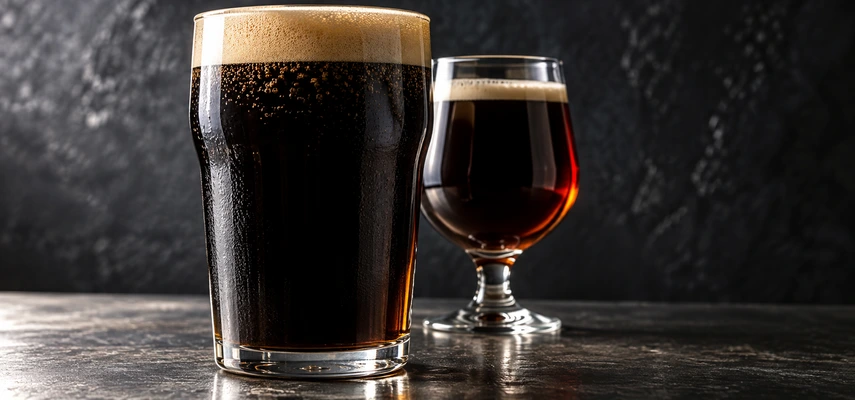

A black beer can be dry and relatively light. Another can be sweet and creamy. A third can put citrusy hops beside roasted grain. Porter and stout are not one flavor wearing several labels, and darkness hides enough visual detail that careful comparison becomes especially useful.
This lesson covers English-style porter, American-style porter, dark mild ale, Irish stout, oatmeal stout, American stout and sweet stout. All are in the prescribed Level 2 range. Imperial stout belongs in the next lesson, where greater concentration and strength become the focus.
Begin with roast, not a strength assumption
Dark roasted malts and grains can contribute coffee, cocoa, toast or burnt impressions as well as deep color. Caramel and more moderately kilned materials add other layers. The finished character depends on which ingredients are used and how much they contribute to the overall grain bill.
Dark does not establish alcohol, body or sweetness. Those depend on starting extract, fermentability, yeast and balance. Nor does a coffee-like aroma prove coffee was added. Use the descriptor for perception, then seek recipe evidence before naming an actual flavoring.
Keep four questions separate: how intense is the roast, how sweet is the palate, how full is the body, and how strongly do hops contribute? These axes organize the seven profiles more usefully than trying to put every beer on one scale from light porter to heavy stout.
English-style porter: developed malt and gentle roast
English-style porter is typically brown to dark brown with ruby highlights and an off-white to tan head. Chocolate-like, caramel, nutty or toasted malt can combine with a moderate roast impression. Hop aroma is generally low, and gentle fruity fermentation character can fit.
The palate is malt-focused but balanced by medium-low to medium bitterness. Body is commonly medium-light to medium, carbonation moderate, and the finish can range from fairly dry to gently sweet. Alcohol stays moderate and usually unobtrusive. Pale base malt with darker and caramel contributions helps explain the layered grain expression.
Compared with British brown ale, porter has a clearer roast contribution. Compared with American porter, it is generally less assertive in bitterness, dark-grain intensity and strength. These are useful typical contrasts rather than a universally sharp border between every bottle bearing either name.
American-style porter: a more robust conversation
American-style porter ranges from medium to very dark brown, sometimes approaching black, with a tan head and possible ruby edges. Chocolate and coffee-like roast can meet caramel or toffee depth. Hop aroma may be quiet or more apparent, including resin, earth or floral notes.
Bitterness is typically medium to high, body medium to medium-full and carbonation variable within a moderate range. The finish may be dry or somewhat rounded. Strength is often greater than the English comparison, with possible slight warmth in stronger examples. Ale fermentation can be restrained or gently fruity.
Pale malt with crystal and darker malts provides the base, while hopping adds balance and potentially another aromatic layer. Roast should not become harshly acrid simply because the style is more robust. Compared with American stout, porter is generally less aggressively roasted and intense.
Dark mild ale: low strength can have plenty to say
Dark mild commonly appears copper-brown to dark brown with an off-white to tan head. Malt may suggest caramel, toast, nuts, chocolate or a little roast, with low hop aroma. Gentle fruity esters may support the grain character without dominating.
Bitterness is low, body light to medium, and carbonation often low to moderate. The finish can range from dry to sweet according to the example. Alcohol is low relative to many neighboring dark ales, so the beer should not be defined by warming strength. Pale or mild-ale base malt with darker contributions creates flavor without demanding high starting extract.
Mild here is a style term, not a promise that the beer has no flavor. Compared with porter, it generally has less strength and intensity. This is one of the clearest examination counterexamples to the claim that dark color automatically means powerful beer.
Irish stout: dry roast with a controlled body
Irish stout is typically very dark brown to black, with garnet highlights possible and a cream or tan head. Coffee-like roasted grain is central, supported by little hop aroma and a comparatively clean fermentation profile.
Bitterness and roast help create a dry finish. Body is commonly medium-light to medium-full depending on presentation, while carbonation is low to moderate. Alcohol is generally moderate rather than a dominant warming feature. Pale malt, roasted barley and sometimes other grain ingredients contribute the familiar dark dry profile.
Some draught examples use nitrogen-containing gas service for a fine creamy texture, but that is not a universal requirement for every Irish stout. Nitrogen presentation and residual sweetness are different matters. Compared with sweet stout, Irish stout usually finishes much drier; compared with American stout, it is generally less hop-forward and forceful.
Oatmeal stout: texture has a recipe explanation
Oatmeal stout ranges from brown to black with a creamy tan-to-brown head. Roast, coffee or chocolate-like malt can sit beside subtle grainy or nutty impressions. Hop aroma is generally low, and fermentation may contribute gentle fruit.
Body is medium-full to full with a smooth, sometimes silky or oatmeal-associated texture. Sweetness and roast balance vary, bitterness is commonly moderate, and carbonation moderate to moderately high. Alcohol usually remains moderate, though the beer can feel substantial. Oats contribute to the grain bill and texture alongside the base and dark malts.
Do not expect a bowl-of-porridge aroma in every example. Oats can matter most through texture and brewing composition. Compared with Irish stout, oatmeal stout often seems fuller and rounder; compared with sweet stout, it need not have the same residual sweetness.
American stout: roast and hops stand forward
American stout is commonly nearly black with a tan or brown head. Strong roasted-grain character can suggest coffee and dark chocolate, while American or other suitable hops may add citrus, resin or related aromatic contrast. Fermentation is usually restrained to moderately fruity.
Bitterness is medium-high to high, body medium to full, and carbonation moderate to moderately high. The finish is generally dry to moderately sweet, with stronger examples showing some warmth. Pale base malt, substantial dark grain and assertive hopping explain the combined impact.
Compared with American porter, this style is generally more roast-forward, bitter and intense. Yet calling a beer stout does not guarantee it is stronger than every porter. The useful comparison is between the named style profiles, with actual producer information taking precedence over an invented universal hierarchy.
Sweet stout: residual sweetness changes the roast
Sweet stout is dark brown to black, often with a creamy tan head. Roast, coffee or chocolate-like aroma can suggest a coffee-and-cream association. Low hop aroma and possible fruit sit behind the central relationship between dark grain and sweetness.
Body is medium-full to full, carbonation low to moderate, and bitterness is moderated in perception by residual sweetness. Alcohol is generally moderate rather than an imperial-stout-level defining feature. Lactose is often used because ordinary brewing yeast does not generally ferment it, although recipes vary and sweetness can have other sources.
Milk stout is a familiar related label, not proof that the beer contains liquid milk. Lactose is dairy-derived, so sensory words such as creamy cannot settle ingredient or dietary questions. Compared with oatmeal stout, sweet stout typically gives sweetness a more explicit role; compared with Irish stout, the contrast in finish is especially useful.
Why porter versus stout resists one universal boundary
The terms have overlapping histories and varied modern use. Rules such as porter always uses malted roast and stout always uses unmalted barley fail across actual brewing practice. Likewise, stout always means stronger confuses some historical naming relationships with every contemporary product.
For Level 2, compare the prescribed named profiles and their typical production choices. That is precise enough to be useful without pretending every commercial label follows one globally enforced recipe boundary. Where the evidence is only a name, acknowledge the limit.
Make the comparison practical
Use written descriptions to rank roast, bitterness, sweetness, body and alcohol separately. Dark mild should break the color-strength shortcut; sweet stout should break the assumption that all roast finishes dry; American stout should demonstrate that hops can remain relevant beside very dark grain.
An optional tasting can reinforce the same comparisons for legally eligible readers, but consuming alcohol is not required. Similar serving conditions help distinguish recipe from presentation. A nitrogen-served sample can feel different from a carbonated bottled comparison even when both belong to a related style family.
One-page revision summary
English and American porter differ in typical roast, hop and intensity emphasis, while dark mild offers dark malt at lower strength. Irish stout emphasizes a dry roasted balance; oatmeal stout adds a texture-led comparison; American stout raises roast and hop impact; sweet stout makes residual sweetness central.
Learn those relationships through ingredients, fermentation and presentation. Do not turn darkness into strength, aroma into proof of an addition, or the porter/stout names into a universal legal boundary.
Continue your beer studies
Explore the related lessons on malt explained alongside brewing adjuncts alongside beer fermentation to extend the ingredient, process or sensory reasoning in this article.
Knowledge check: 10 original practice questions
Independent TFE questions, not official WSET examination items. Choose one answer per question; explanations follow separately.
1. Which style most clearly challenges the claim that dark beer must be strong?
- Doppelbock
- Dark mild
- Double IPA
- Imperial stout
2. What commonly distinguishes American porter from English-style porter?
- Mandatory sourness
- Mandatory wheat yeast
- More roast, bitterness or strength emphasis
- Absence of malt
3. Why can lactose remain in a sweet stout?
- Ordinary brewing yeast generally does not ferment it
- It always turns into hops
- It is pure alcohol
- It cannot dissolve in beer
4. Which statement about oatmeal stout is accurate?
- It must smell strongly of porridge
- It is always sweeter than sweet stout
- It must be alcohol-free
- Oats can affect texture without dominating aroma
5. Which comparison is most useful between Irish stout and sweet stout?
- Irish stout generally finishes drier
- Sweet stout must be paler
- Both must have identical residual sweetness
- Irish stout always has higher alcohol
6. Does a coffee-like aroma prove actual coffee was added?
- Yes, in every dark beer
- No, roasted grain can create that association
- Only if the head is tan
- Only if served in a pint
7. Which style typically combines pronounced roast with more assertive hop bitterness?
- Only light lager
- Only Kölsch
- American stout
- Only dark mild
8. Which statement about porter and stout is most accurate?
- Stout is always stronger
- Porter can never use roasted barley
- Stout must always be nitrogen-served
- Their boundaries vary, so compare named profiles and actual evidence
9. What can nitrogen-containing service change in some draught stouts?
- Foam and texture presentation
- The barley species after fermentation
- The beer’s entire style into lager
- The source of all alcohol
10. Why does the term creamy not settle dietary suitability?
- Creamy always means no dairy
- It describes perception rather than a verified ingredient list
- Every creamy beer contains liquid milk
- All stout is lactose-free
Answers and explanations
1. B — Dark mild. Dark mild can offer developed dark-malt flavor at relatively low alcohol. Grain color and alcohol potential are separate variables. Mapping: LO3 AC1/AC3.
2. C — More roast, bitterness or strength emphasis. American porter generally occupies more robust territory, although commercial boundaries overlap and no single absolute applies to every product. Mapping: LO3 AC1.
3. A — Ordinary brewing yeast generally does not ferment it. Lactose is generally unfermented by ordinary brewing Saccharomyces, allowing residual sweetness and body contribution. Mixed organisms can behave differently. Mapping: LO3 AC2/AC3.
4. D — Oats can affect texture without dominating aroma. The oat contribution may be especially apparent in mouthfeel and grain composition. A strong oatmeal aroma is not required. Mapping: LO3 AC1/AC2.
5. A — Irish stout generally finishes drier. Irish stout commonly emphasizes dry roast, while sweet stout makes residual sweetness more central. Color alone does not express that contrast. Mapping: LO3 AC1.
6. B — No, roasted grain can create that association. Coffee-like is a sensory comparison that may arise from grain processing. An actual addition needs ingredient or producer evidence. Mapping: LO3 AC1/AC2.
7. C — American stout. American stout commonly foregrounds roasted grain and a stronger hop/bitter presence than several traditional dark-ale comparisons. Mapping: LO3 AC1/AC2.
8. D — Their boundaries vary, so compare named profiles and actual evidence. Historical and modern usage overlap. Rigid universal ingredient, alcohol or service rules fail across the two families. Mapping: LO3 AC1.
9. A — Foam and texture presentation. Gas and dispensing conditions influence foam and mouthfeel. They do not independently define every stout or change the original fermentation culture. Mapping: LO3 AC3/LO4 AC2.
10. B — It describes perception rather than a verified ingredient list. Texture language is not an ingredient declaration. Lactose and other actual additions require producer information rather than inference from mouthfeel. Mapping: LO3 AC1/AC2.












