










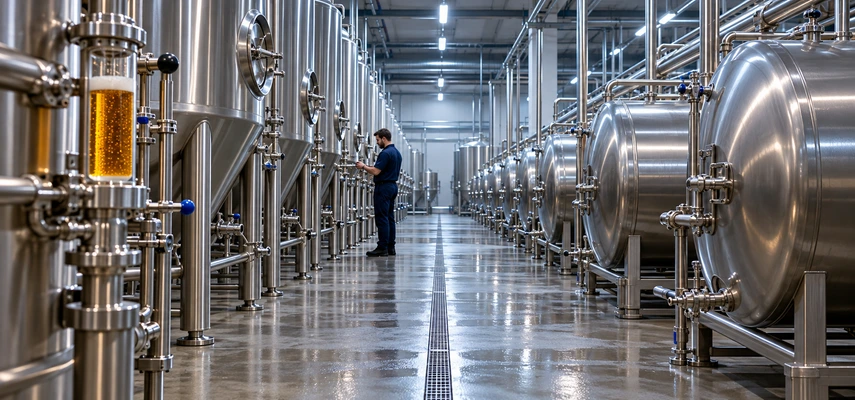

The bubbling slows down, but the beer still tastes unfinished. Beer fermentation has done its most visible work, yet the yeast may have useful business left. A production schedule has to account for that quieter work as well as the dramatic part when sugar disappears and foam rises.
Fermentation and maturation connect the wort you learned about in Articles #6–7 to the beer’s alcohol, aroma, body and texture. Strain sets possibilities; temperature, time and handling influence the outcome. Understanding those relationships makes attenuation and conditioning practical ideas rather than terms to memorize beside a tank diagram.
What alcoholic fermentation makes
Yeast consumes fermentable sugars and produces alcohol and carbon dioxide. It also releases heat and forms many aroma-active compounds. The beer therefore changes chemically, physically and sensorially at the same time. A fermentation vessel is not a passive container holding a liquid whose flavor was settled on brew day.
The carbon dioxide may escape through a controlled outlet or be retained under appropriate conditions. Heat must be managed if the beer is to follow its intended temperature profile. Alcohol changes density and perception, while aroma compounds help distinguish one yeast-driven result from another.
The official syllabus expects all these products, not just alcohol, in your explanation. A good revision question is to name one practical consequence of each: strength, gas handling, temperature control and sensory character.
Starting well: wort, culture and environment
The brewer cools wort to a suitable pitching temperature before adding the selected culture. Pitching introduces yeast to the material it will use. The amount and health of the yeast, available nutrients and process conditions influence how the fermentation develops.
Appropriate oxygen management early in the process can support yeast physiology, but that does not justify uncontrolled oxygen pickup throughout beer production. The organism’s needs at the start differ from the finished beer’s need for protection against unwanted oxidation.
The BJCP fermentation guide discusses strain and process factors together. For Level 2, the central point is that good performance needs suitable wort and handling. A strain’s advertised behavior is not a promise that it will rescue any poorly managed fermentation.
Ale fermentation: useful tendencies, flexible practice
Conventional ale fermentation commonly uses Saccharomyces cerevisiae strains at warmer temperatures than traditional lager production. Many ale strains contribute noticeable fruity esters or, in relevant families, spicy phenolic expression. Others are selected for a comparatively restrained profile.
Temperature influences both the pace of fermentation and the formation or balance of compounds. Within a strain’s useful operating range, a warmer process can shift aroma and performance. This does not mean warmer always tastes better, or that one change has the same effect with every strain.
An American ale strain emphasizing grain and hops serves a different aim from a weizen strain emphasizing banana and clove. Calling both ale is accurate but insufficient. Article #5 supplies those strain distinctions; fermentation planning determines how their potential develops in a particular batch.
Lager fermentation: lower working temperatures need planning
Conventional lager production commonly uses Saccharomyces pastorianus and cooler fermentation than typical ale practice. It often aims for relatively restrained fruity expression and clear presentation of malt and hops. That profile depends on managing the process rather than simply putting any yeast into a cold room.
Cooler conditions generally slow microbial activity, so yeast health, amount and time need attention. Different lager strains and modern brewing approaches use different schedules. The meaningful contrast is not a universal number of days, but how the chosen culture performs under the intended conditions.
Some sulfur-related and other young-beer compounds change during fermentation and maturation. A sample early in production may therefore differ significantly from the eventual beer. Do not label every intermediate aroma as a permanent defect before considering the stage of the process.
Fermentation temperature is the liquid’s condition
Yeast generates heat, so the beer can become warmer than the surrounding room. A brewer measuring only ambient air could miss what is happening inside the vessel. Tank cooling and suitable sensing help keep the liquid on its intended temperature path.
Too cold can slow a fermentation or leave it incomplete for the planned schedule. Excessive warmth can create unwanted expression or stress, depending on strain and conditions. Temperature control is therefore about steering biological activity, not merely making the cellar comfortable for its visitors.
KROHNE’s brewing-process overview connects cooling, fermentation and storage with process measurement. The instrument details are less important here than the reason to monitor the beer itself rather than assume the room tells you everything.
Attenuation: how far did fermentation take the wort?
Attenuation describes the reduction in extract or gravity associated with fermentation. Imagine two comparable worts with the same starting concentration, fermented so that one finishes with more residual material. The more attenuated result will often seem drier, all else equal.
But attenuation is not simply the alcohol percentage. Starting concentration matters too. A highly attenuated modest-strength wort can produce less alcohol than a stronger wort with lower attenuation. Keep the starting material and the extent of its transformation as two separate pieces of information.
Brewers commonly discuss apparent attenuation calculated from gravity readings. It is apparent because alcohol changes density, so a hydrometer-based reduction is not a direct percentage measurement of actual sugar molecules consumed. You can understand the practical concept without confusing the instrument’s result with a complete chemical inventory.
What determines attenuation?
Wort composition determines what substrates are available. Mash decisions and ingredients can make that mix more or less fermentable for the selected yeast. Strain capability then determines what it can use, while health, temperature and other conditions influence whether it completes that work successfully.
That means a recipe and a yeast strain interact. A high-attenuating strain cannot necessarily consume every carbohydrate in every wort. Likewise, fermentable material left by a stalled process is not proof that the brewer designed a full-bodied beer. Intention and actual completion are different questions.
Perceived dryness and body are related to residual composition but remain sensory judgments. Alcohol, acidity, bitterness and carbonation also influence the impression. When an examination asks why a beer finishes dry, look for the relevant production relationship rather than treating one measurement as its entire taste.
Fermentation duration: activity is not a calendar guarantee
The required time depends on starting extract, strain, conditions and the desired result. Visible bubbling is useful evidence of activity, but a quiet outlet alone does not prove every intended fermentation or maturation change is complete. Gas behavior also depends on the vessel and pressure conditions.
Brewers use measurements and sensory or analytical checks to judge progress. A fixed number of days may suit a validated production process, but it is not a universal law for every batch sharing the same broad style name.
For study, connect duration to the work being done. Sugar use, reduction of certain flavor-active compounds and settling have different dependencies. A short successful fermentation is not automatically inferior, and a long unresolved one is not automatically more sophisticated.
Maturation: flavor cleanup before the cold finish
During maturation, beer develops toward the intended finished profile. Healthy yeast can reduce compounds such as diacetyl and acetaldehyde under suitable conditions. These changes help explain why rushing yeast removal or cooling too early can leave unwanted character.
White Labs’ diacetyl explanation identifies strain, temperature and maturation time as relevant factors. A buttery impression is not always solved by simply waiting in colder conditions, because the useful yeast activity itself depends on the environment.
Ale maturation can be comparatively short or include extended conditioning, depending on the beer. Lager production often includes a managed transition from active fermentation and cleanup toward cold storage. The aim is the required sensory and stability outcome, not a ceremony performed because a label says lager.
Lager maturation: cold storage has a different role
Cold maturation can support clarification and the development of the desired finished presentation after appropriate fermentation and cleanup. Cooling encourages some suspended material to settle and changes gas behavior. It should not be confused with a guarantee that yeast will perform all cleanup fastest at the lowest possible temperature.
Lallemand’s lagering technical paper illustrates why some processes include a warmer late-fermentation phase before cooling. The broad lesson is staged management. A particular strain or brewery protocol does not establish one mandatory schedule for every lager.
More storage time is not always an improvement. Time, oxygen exposure, temperature and the beer’s character influence whether it gains the intended refinement or loses freshness. Strong age-worthy styles and delicate fresh-hop beers need different expectations, a subject revisited in Article #27.
Vessels, carbonation and conditioning
A fermentation vessel supports yeast activity, gas management and temperature control. A maturation vessel supports the following conditioning work; some breweries use separate vessels, while others perform several stages in a suitably designed tank. Vessel names describe functions, not a requirement to transfer beer every time its task changes.
Carbonation can come from retained fermentation carbon dioxide, a controlled secondary fermentation or the introduction of carbon dioxide under suitable pressure. Natural and forced carbonation describe different routes, not automatic quality grades. Dissolved gas contributes liveliness, texture and the way aroma is released when served.
Conditioning is a broad production term that can encompass maturation and preparation for the final presentation, including carbonation. Be specific about which change you mean. Saying the beer was conditioned provides less information than explaining whether the process involved flavor cleanup, cold storage, secondary fermentation or gas adjustment.
One-page revision summary
Alcoholic fermentation produces alcohol, carbon dioxide, aroma compounds and heat. Strain, wort, temperature and time work together, with ale and lager production offering useful typical contrasts rather than rigid universal schedules. Attenuation describes how far fermentation reduces extract or gravity, not final strength by itself.
Maturation can involve yeast-mediated flavor changes, clarification and preparation for the desired carbonation and presentation. Active cleanup and cold storage are related but different jobs. Follow the organism’s work and the beer’s measured progress, and the reason for each stage becomes much clearer.
Continue your beer studies
Explore the related lessons on milling and mashing to extend the ingredient, process or sensory reasoning in this article.
Knowledge check: 10 original practice questions
Independent TFE questions, not official WSET examination items. Choose one answer per question; explanations follow separately.
1. Which set lists products associated with alcoholic fermentation?
- Only water and starch
- Alcohol, carbon dioxide, aroma compounds and heat
- Only bitterness and roast color
- Only lactic acid and husk
2. Why can the beer be warmer than the cellar during fermentation?
- All tanks contain heaters
- Steel creates alcohol
- Yeast activity releases heat
- The water evaporates entirely
3. What does attenuation help describe?
- The reduction in extract or gravity during fermentation
- Only the bottle size
- Only final alcohol percentage
- Only the serving temperature
4. Why is apparent attenuation not a direct measurement of the exact percentage of sugar consumed?
- Yeast cannot use sugar
- Gravity never changes
- Carbon dioxide is the only product
- Alcohol affects density readings
5. Which factor can influence whether a wort ferments more or less completely?
- The interaction of wort composition, strain and conditions
- Only the glass used later
- Only bottle color
- Only the country of service
6. Why might rapidly chilling a young beer too early leave unwanted diacetyl?
- Cold always creates all diacetyl
- It can slow useful yeast-mediated cleanup before completion
- Chilling converts hops into butter
- Maturation cannot affect flavor
7. Which statement about ale and lager fermentation is most accurate?
- All ales and lagers share one mandatory schedule
- Dark color proves lager yeast
- Traditional lager production is commonly cooler, with strain-specific variation
- Ale means beer is always served warm
8. How can a brewery use one suitably designed tank for several stages?
- By skipping fermentation
- By replacing yeast with glass
- By avoiding all temperature control
- By changing operating conditions as fermentation and maturation progress
9. Which statement about carbonation is accurate?
- It can arise through controlled fermentation or introduced carbon dioxide
- It is possible only in bottles
- Forced carbonation proves poor quality
- All fermentation gas must be discarded
10. Why does high attenuation not by itself prove high final alcohol?
- Alcohol never affects density
- Starting extract also determines alcohol potential
- Only darker beer contains alcohol
- Attenuation measures foam retention
Answers and explanations
1. B — Alcohol, carbon dioxide, aroma compounds and heat. Yeast fermentation creates alcohol and gas, releases heat and forms many compounds affecting aroma. It is more than an alcohol-only transformation. Mapping: LO2 AC1.
2. C — Yeast activity releases heat. Fermentation is heat-producing. The liquid may require controlled cooling even when ambient air seems suitably cool. Mapping: LO2 AC1/AC3.
3. A — The reduction in extract or gravity during fermentation. Attenuation concerns the extent of fermentation-related reduction. Starting extract and residual composition are also needed to interpret the resulting beer. Mapping: LO2 AC2.
4. D — Alcohol affects density readings. Gravity readings reflect density, which is influenced by alcohol as well as dissolved material. The apparent measurement is not a complete sugar inventory. Mapping: LO2 AC2.
5. A — The interaction of wort composition, strain and conditions. Fermentable substrate availability, yeast capability and successful operating conditions all influence the extent of fermentation. Mapping: LO2 AC3.
6. B — It can slow useful yeast-mediated cleanup before completion. Appropriate active yeast and conditions support reduction of diacetyl-related problems. Premature cooling can interfere with that work. Mapping: LO2 AC2/AC3.
7. C — Traditional lager production is commonly cooler, with strain-specific variation. Typical temperature contrasts help organize production knowledge, but real strain and process choices prevent a single universal schedule. Mapping: LO2 AC2/AC3.
8. D — By changing operating conditions as fermentation and maturation progress. Functional stages need not each require a separate vessel. Suitable tanks can support changes in temperature, pressure and process objectives. Mapping: LO2 AC2.
9. A — It can arise through controlled fermentation or introduced carbon dioxide. Brewers have several carbonation routes. Their suitability depends on the intended product and process, rather than a universal quality ranking. Mapping: LO2 AC2.
10. B — Starting extract also determines alcohol potential. A modest-strength wort can attenuate strongly yet produce less alcohol than a more concentrated wort with a lower attenuation rate. Mapping: LO2 AC2/AC3.












