










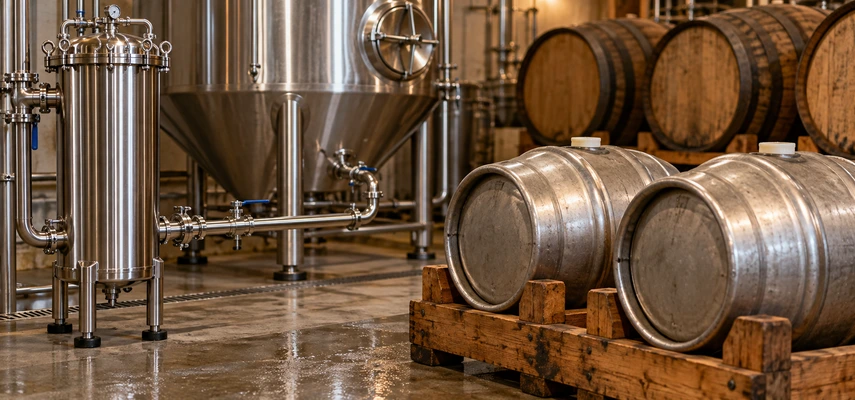

One brewer wants to stop a beer changing. Another wants yeast to keep working in the package. Both may be making a careful decision. Beer finishing is where the desired final character meets the practical question of what remains alive, suspended, dissolved or capable of changing during storage.
This lesson also introduces special fermentation methods that alter the route to that finished beer. Learn the methods here, then apply them to lambic, other sour styles and specialty beers in later articles. The point is to understand what each operation does, not collect an impressive list of equipment names.
Beer finishing starts with the intended product
A clear filtered lager, a hazy yeast-driven beer and a cask-conditioned ale do not need identical finishing plans. The brewer considers appearance, flavor, carbonation, microbiological stability and the distribution conditions the beer will face. Removing more material is not automatically better when that material has an intended role.
Conversely, leaving beer untreated is not automatically more authentic or more stable. An unwanted change is still unwanted when the label has attractive words on it. Quality comes from obtaining and preserving the intended result, with a process appropriate to the beer.
The official specification includes filtration, pasteurization, packaging and cask conditioning alongside special fermentation choices. Keep those operations distinct: they solve related problems through different mechanisms.
Filtration: a physical separation with a specific target
A filter separates material from the beer as liquid passes through an appropriate medium. Depending on the system, it may remove suspended yeast, haze-forming particles or microorganisms. The result depends on the filter’s design, retention performance and operating conditions.
Coarse clarification and validated microbial retention are therefore different claims. Seeing a filter somewhere in the brewery does not establish that the beer is sterile. Likewise, bright appearance does not prove all organisms have been removed. Many cells and particles are too small to judge by looking at the glass.
Alfa Laval’s filtration system illustrates a specific engineered microbial-retention process with integrity checks. Treat its claims as product-specific. They explain what controlled fine filtration can do, not what every sieve or basic beer filter accomplishes.
What filtration changes, and what it cannot promise
Removing suspended material can change clarity, sediment and aspects of texture or flavor expression. Whether those changes are desirable depends on the intended beer. A kristallweizen and a yeast-containing wheat beer can pursue different presentations without one becoming the universal standard for the other.
Filtration must also avoid introducing other problems. Oxygen pickup, poor cleaning or contamination after filtration can compromise the benefit. Removing organisms at one point does not prevent them entering later through badly managed equipment or filling.
For study, phrase the mechanism precisely: physical retention of targeted material under appropriate conditions. Do not confuse filtration with killing organisms through heat, and do not claim it removes every dissolved flavor compound or all alcohol.
Pasteurization: controlled heat for stability
Pasteurization uses a controlled time-temperature treatment to reduce viable spoilage organisms. It is different from boiling wort. The beer has already acquired its intended fermentation character, and the treatment is designed around stability rather than repeating the kettle’s earlier production jobs.
It can take place before packaging in a suitable continuous process or after filling in an appropriate packaged-beer system. In either case, the actual treatment and hygienic handling matter. More heat is not automatically better; brewers balance microbial objectives against possible sensory effects.
Pasteurization does not mean the beer becomes immune to every future quality problem. Light, heat during storage and oxygen-related staling can still matter. Distinguish microbiological stability from the broader preservation of fresh aroma and flavor.
Carbonation and packaging preserve a chosen presentation
Carbonation may be adjusted before packaging or developed through controlled further fermentation. The container must retain the intended gas and protect the beer during its expected life. Casks, kegs, bottles and cans differ in handling and service, which the later storage and service lessons examine individually.
Filling needs to limit unwanted oxygen and contamination. The fact that a beer was stable in a tank does not prove careless packaging is harmless. Likewise, a good container cannot reverse damage already caused before filling.
Packaging is therefore part of production quality, not merely decoration. It sets conditions for what the beer can do next: remain relatively stable, undergo planned conditioning, or deteriorate if handling fails. A brewer must know which outcome the product is designed to pursue.
Cask conditioning: living activity is part of the plan
Cask conditioning retains suitable live yeast and fermentable material for further activity in the cask. That secondary work contributes natural condition and develops the beer toward its serving state. The cask is not simply a decorative barrel into which completely finished, force-carbonated beer must always be poured.
CAMRA’s explanation connects live yeast, cellar conditioning and the gentler presentation of cask beer. Cellar handling, settling and timely service matter because the product has been designed around that route.
Do not confuse gentle carbonation with flatness or poor condition. A properly handled cask beer has its intended level of dissolved gas and texture. Nor should you infer that every cask-conditioned beer is cloudy: settling and careful handling can produce a clear served beer while yeast remains in the vessel.
Wood fermentation and maturation: the vessel has several roles
Fermentation or maturation in wooden vessels can influence beer through wood-derived compounds, previous contents, oxygen transfer and the microbial environment. These effects depend on the vessel’s history, size, condition and how the brewer uses it. A new small oak barrel and an old large wooden vessel need not contribute similar oak aroma.
Some brewers seek vanilla, toast or spirit-associated notes. Others use mature wood primarily as a fermentation and maturation environment, with little overt new-oak flavor. Wood-aged is therefore a broad production description, not a single sensory style.
Wood also does not prove spontaneous fermentation. A brewer can fill a barrel with beer fermented by a selected culture, or use selected mixed cultures in wood. Keep vessel choice and inoculation method as separate decisions, even when a traditional process combines them.
Spontaneous fermentation: environmental inoculation
Spontaneous fermentation obtains microorganisms from the production environment rather than relying solely on a conventional added culture. In traditional lambic production, a wide, shallow coolship or koelschip exposes cooling wort to the brewery environment before subsequent fermentation and maturation.
Lindemans’ process account provides one producer’s example of environmental cooling and later vessel management. The resulting population can reflect the building and equipment as well as outdoor air. It is not simply an instruction to collect whatever happens to float past any open bucket.
This method can support a changing microbial community over time. Yet spontaneous does not mean the brewer has no influence: timing, environment, vessel management and selection matter. Detailed lambic-derived style distinctions return in Article #24.
Mixed cultures and co-fermentation
Mixed-culture fermentation uses multiple microbial contributors. They may arrive through environmental exposure or be deliberately selected and added. Cultured and mixed are not opposites; a brewer can use a planned blend of yeasts and bacteria.
Co-fermentation involves organisms working within an overlapping fermentation process. A selected yeast and lactic acid bacteria may contribute alcohol and acidity in the fermenter, interacting under managed conditions. Sequential addition is another choice, with the order influencing the conditions each organism encounters.
Lallemand’s souring-method comparison shows why fermenter souring and kettle souring are distinct process options. Compatibility, temperature and substrate use affect the result. More microbial names do not guarantee more desirable complexity.
Wort or kettle souring: change the order
In a common kettle-souring approach, bacteria acidify wort before the main boil. Once the desired souring stage is reached, boiling stops that bacterial activity, and the wort is cooled and fermented with the chosen yeast. Acidity and alcoholic fermentation are deliberately separated in the production sequence.
That order can help a brewer manage a comparatively quick, controlled souring route. It is not the same as long mixed-culture maturation in wood. Both can produce acidic beer, but matching one broad taste does not make the underlying methods identical.
The distinction also prevents a misleading generalization: not all sour beer is spontaneously fermented. A carefully cultured kettle-soured beer may involve no environmental inoculation or long barrel residence at all. Article #25 applies these production differences to specific style comparisons.
Blending: use several components to make one result
Blending combines beers or components selected for their characteristics. Age, acidity, residual fermentable material, aroma and texture can all be relevant. The objective might be consistency, complexity, balance or preparation for further conditioning, rather than merely increasing volume.
A blend is not automatically the arithmetic average of tasting notes. One component’s acidity can change the impression of another’s sweetness, and further fermentation can transform the mixture afterward. Selection and later handling matter alongside the proportions initially combined.
For an alcohol-free exercise, compare written descriptions of two hypothetical components and state why a brewer might combine them. Then identify what you still need to know before predicting carbonation or stability. This uses the same distinction between sensory purpose and microbial potential that runs through the whole lesson.
One-page revision summary
Filtration physically removes targeted material; pasteurization uses controlled heat; packaging preserves a chosen presentation; cask conditioning deliberately retains further yeast activity. None of these decisions independently guarantees every aspect of quality.
Wood use, spontaneous inoculation, mixed cultures, co-fermentation, kettle souring and blending answer different production questions. Learn where the organisms enter, when they work, which vessel supports the process and what happens next. Those relationships explain why beers with similar acidity can have very different histories and characters.
Continue your beer studies
Explore the related lessons on beer yeast to extend the ingredient, process or sensory reasoning in this article.
Knowledge check: 10 original practice questions
Independent TFE questions, not official WSET examination items. Choose one answer per question; explanations follow separately.
1. What mechanism principally distinguishes filtration from pasteurization?
- Filtration always boils beer
- Filtration physically retains targeted material
- Filtration adds yeast to wort
- Filtration creates all hop bitterness
2. Why does bright appearance alone not prove microbiological stability?
- Clear beer cannot contain alcohol
- All filters remove everything
- Microorganisms may be present without visible cloudiness
- Brightness proves the beer was boiled after filling
3. What does cask conditioning deliberately retain?
- Suitable live yeast and fermentable material for further activity
- Only forced nitrogen
- Only new oak flavor
- No possible fermentation activity
4. Which statement about wooden vessels is accurate?
- They always imply spontaneous fermentation
- They always add intense new oak
- They all previously held spirits
- Their effect depends on history, size, condition and use
5. In common kettle souring, when does bacterial acidification occur?
- Before a later boil and yeast fermentation
- Only after the beer is served
- Only after all packaging is complete
- Only after decades in new oak
6. Can a mixed fermentation use deliberately cultured organisms?
- No, mixed always means accidental
- Yes, multiple selected organisms can be introduced
- No, cultured means bacteria-free
- Only if no yeast is present
7. What does spontaneous fermentation principally describe?
- A mandatory serving temperature
- The use of a shiny filter
- Obtaining organisms from the production environment
- A universal new-oak flavor
8. Which statement about pasteurization is most accurate?
- It prevents all light strike forever
- It removes all beer flavor
- It is identical to mash separation
- It uses controlled heat but does not eliminate every later quality risk
9. Why might a brewer blend different beer components?
- To pursue balance, complexity, consistency or further conditioning
- Because blending can only dilute flaws
- To guarantee all organisms disappear
- To eliminate the need for packaging controls
10. Which comparison correctly separates souring methods?
- All acidity proves spontaneous fermentation
- Kettle souring before boiling differs from mixed-culture fermentation in a fermenter
- All sour beer must age in wood
- Co-fermentation means filtration
Answers and explanations
1. B — Filtration physically retains targeted material. Filtration is physical separation. Pasteurization uses a controlled heat treatment to reduce viable organisms; they are different mechanisms. Mapping: LO2 AC2.
2. C — Microorganisms may be present without visible cloudiness. Visual clarity does not establish organism absence or validated retention. Microbiological claims need appropriate process evidence. Mapping: LO2 AC2/AC3.
3. A — Suitable live yeast and fermentable material for further activity. Secondary activity in the cask contributes condition and development. Removing every viable cell would conflict with that intended biological route. Mapping: LO2 AC2.
4. D — Their effect depends on history, size, condition and use. Wood can influence flavor, oxygen transfer and microbial environment in different ways. Neither intense oak nor spontaneous inoculation is automatic. Mapping: LO2 AC2/AC3.
5. A — Before a later boil and yeast fermentation. Bacteria sour wort before boiling stops their activity, after which cooled wort can undergo alcoholic fermentation with selected yeast. Mapping: LO2 AC3.
6. B — Yes, multiple selected organisms can be introduced. Cultured describes selection and introduction, while mixed describes multiple contributors. The terms can apply to the same planned process. Mapping: LO2 AC3.
7. C — Obtaining organisms from the production environment. Spontaneous describes environmental inoculation rather than a conventional selected-only pitching route. Vessel and service choices are separate matters. Mapping: LO2 AC3.
8. D — It uses controlled heat but does not eliminate every later quality risk. Heat treatment targets viable organisms. Storage light, oxygen and heat exposure can still damage a pasteurized beer. Mapping: LO2 AC2/AC3.
9. A — To pursue balance, complexity, consistency or further conditioning. Selected components can contribute complementary characteristics and microbial or fermentable potential. Blending still requires deliberate later management. Mapping: LO2 AC3.
10. B — Kettle souring before boiling differs from mixed-culture fermentation in a fermenter. The order and location of microbial activity distinguish these methods. Similar acidity does not establish an identical fermentation history. Mapping: LO2 AC3.











