










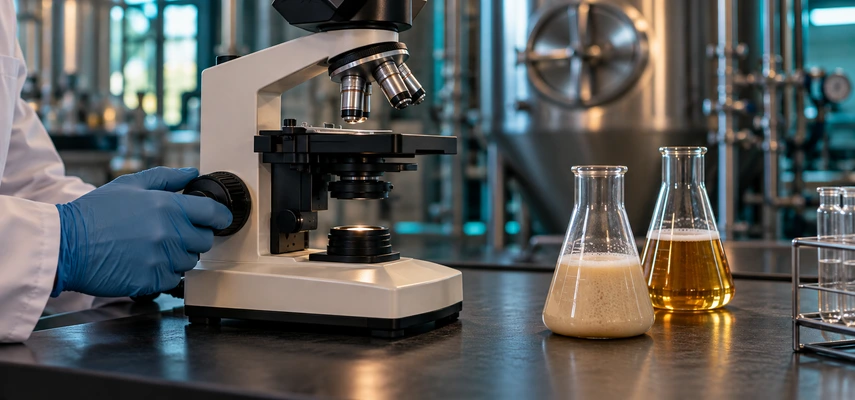

Split one batch of wort between two fermentation vessels and the finished beers can seem like different recipes. One may stay restrained enough to foreground grain and hops; another may develop fruit and spice that nobody added as ingredients. Beer yeast is doing far more than making the alcohol.
Microorganisms turn the brewer’s prepared material into a changing chemical environment. Different strains use sugars differently and create different aromatic compounds. Bacteria can add another set of transformations, especially in deliberately acidic beers. The Level 2 task is to connect each prescribed group to its likely contribution while remembering that conditions influence the result.
Fermentation is a transformation, not just a disappearing sugar
In alcoholic fermentation, yeast converts fermentable sugars into alcohol and carbon dioxide, releasing heat and producing many other compounds. Some are perceptible at low concentrations. The flavor of the finished beer therefore includes products of yeast metabolism as well as substances extracted from malt and hops.
Not every carbohydrate in wort is equally usable by every strain. A yeast’s ability to consume available sugars influences attenuation, the extent to which fermentation reduces the wort’s extract or gravity. Greater attenuation often means a drier result relative to the starting wort, but final perception also depends on the rest of the recipe.
The BJCP fermentation overview provides context for strain selection and process control. The useful study habit is to keep the organism, its food and its environment in view together. None of the three tells the whole story alone.
Esters and phenols: useful aroma families
Esters can contribute fruity impressions such as pear, banana or other fruit, depending on the compounds and their concentrations. They are not pieces of fruit manufactured inside the tank. They are molecules your sensory system recognizes through familiar comparisons, which is why the same word can describe aromas from quite different sources.
Some fermentation-derived phenols create spicy impressions, such as clove or pepper. Other phenolic aromas can seem medicinal or smoky. Whether a characteristic is welcome depends on the beer and its intensity. Clove can be central to a well-made weissbier while seeming misplaced in a restrained lager.
The AHA’s ester and phenol explanation helps distinguish these families. Do not use fruity to mean ester with complete certainty, or spicy to mean the brewer must have added spices. Observe first; use recipe and fermentation evidence to support the causal explanation.
Ale yeast: one broad group, many personalities
Conventional ale brewing commonly uses strains of Saccharomyces cerevisiae. Within that broad group, brewers select strains for sugar use, flavor expression, settling behavior and suitable process conditions. The familiar top-fermenting description refers to traditional behavior, not a rule that all activity occurs exclusively at the surface.
The official syllabus names six ale strain groups to learn individually. Regional names are practical brewing categories rather than promises that each group is a single genetically uniform organism. A Belgian-style strain and a British strain are not interchangeable merely because both make ale.
Abbey ale yeast can provide fruity esters and spicy phenolic character appropriate to beers such as dubbel and tripel. Lallemand’s Abbaye example illustrates how temperature can shift the expression of a particular strain. It is evidence of possibility, not a specification for every abbey-associated yeast.
Saison yeast is associated with dry, highly attenuated beer and a distinctive fruity, peppery or spicy expression. Individual strains differ in performance and sugar use. Do not convert a common tendency into the claim that every saison uses one strain or that merely fermenting any ale warm turns it into saison.
Witbier yeast contributes a Belgian wheat-beer fermentation profile that can include gentle fruit and spice. Actual witbier character also reflects grain and often added coriander or citrus peel. Separating those contributions explains why witbier and German wheat beer are not simply identical yeast character in different packaging.
Weizen yeast is associated with the banana-and-clove pattern familiar in weissbier. The balance depends on strain, wort and process. Lallemand’s Munich Classic information supplies one practical producer example. Wheat alone does not create this signature, and not every wheat-containing beer uses weizen yeast.
British ale yeast often supplies fruity expression that can integrate with malt and traditional hopping. Some strains leave more residual extract or settle differently from others, affecting the brewer’s choice. British is a useful family description, not a requirement for one fixed level of sweetness, haze or pear aroma.
American ale yeast is often selected for comparatively restrained fermentation character so malt and hop expression remain clear. That does not mean it produces no flavor or that every American strain is neutral. Modern strains used in hazy beers can express fruit and interact with hop aroma differently from a more restrained classic ale culture.
Lager yeast: more than a temperature label
Conventional lager brewing commonly uses Saccharomyces pastorianus strains, often with cooler fermentation and maturation practices than typical ale production. Lager yeast can support restrained fruity expression and a clean presentation of grain and hops. Clean here describes a sensory result; it does not mean chemically empty.
Lager fermentation can produce sulfur-related compounds and other intermediates that change during maturation. Managing fermentation and conditioning helps obtain the intended final profile. A young beer’s aroma is therefore not necessarily a fair prediction of the mature beer that will reach the customer.
The top-versus-bottom shorthand can help with brewing history, but it is a poor substitute for understanding strain and process. Neither pale color nor cold service proves lager fermentation. Dark lagers and pale ales are ordinary counterexamples. Ask about the culture and production choices rather than treating appearance as a laboratory test.
Brettanomyces: yeast, not a bacterium
Brettanomyces, often shortened to Brett, is a yeast genus. Different strains and environments can yield fruit, earthy, leathery, hay-like or other complex aromas. It may work alongside conventional brewing yeast or serve a different fermentation role, depending on the process.
Brett is not another name for sourness. A beer can show Brett-derived character without prominent acidity, while a lactic-acid-driven sour beer can be made without Brett. This distinction is particularly useful when comparing lambic-related beers with quicker souring approaches.
The AHA’s microbial overview distinguishes its role from bacterial acid production. Oxygen and substrate can change its activity, so do not make never-produces-acid the replacement misconception. The main lesson is that aromatic complexity and acidification are different microbial jobs.
Lactic acid bacteria: purposeful sourness
Lactic acid bacteria include organisms commonly discussed under Lactobacillus and Pediococcus in brewing. They can convert available substrates into lactic acid, increasing acidity and changing the beer’s flavor. The result depends on species or strain, temperature, available material and other organisms present.
Lactic acidity is often described as comparatively clean or yogurt-like rather than strongly vinegary. That comparison concerns sensory character, not identical food chemistry. Some bacteria also produce other compounds that influence texture or aroma, so an intentional culture still needs management.
In a deliberately sour beer, their activity can be part of the design. In a beer meant to remain free of that character, unwanted bacterial growth can be a fault. Organism names alone cannot tell you which situation applies; intention, actual sensory result and process evidence matter.
Acetic acid bacteria: oxygen changes the equation
Acetic acid bacteria can oxidize ethanol into acetic acid when oxygen is available. Acetobacter is a useful brewing reference. The familiar vinegar-like impression differs from the softer associations commonly used for lactic acidity, although a mixed beer may contain both.
White Labs’ Acetobacter description makes that oxygen relationship explicit. Controlled contribution can be relevant in some mixed-fermentation traditions. Excessive acetic character, especially where unintended, can overwhelm a beer. More complexity is not a useful excuse for uncontrolled deterioration.
This also explains why oxygen management does different jobs at different stages. Yeast may need appropriate oxygen during culture growth or early fermentation management, while uncontrolled later oxygen exposure can encourage unwanted changes. Do not turn a process-specific oxygen requirement into advice that finished beer should simply be exposed to air.
Cultured, spontaneous and mixed describe different decisions
Cultured fermentation uses organisms selected and introduced by the brewer. A cultured organism can be yeast or bacteria, and a selected combination can still produce a mixed fermentation. Controlled does not mean a single neutral strain making a non-sour beer.
Spontaneous fermentation obtains microorganisms from the production environment rather than relying solely on a conventional pitched culture. Traditional cooling and brewery ecology can help establish the population. That is not the same as leaving any liquid uncovered and assuming a known community will appear.
Mixed fermentation involves multiple microbial contributors, whether introduced together, sequentially or through environmental exposure. These terms can overlap. Article #9 examines the production methods, while the later sour-style lessons show how the methods create distinctive finished beers.
Predict the result with three questions
First, which organisms are present? Second, what can they consume or transform? Third, what environment are they working in? Temperature, available oxygen, wort composition, pitching and time influence performance and aroma. Changing one variable can alter more than one sensory property.
For study without drinking, compare an American wheat ale description with a weissbier description. Identify the grain similarity, then explain the fermentation contrast. Next compare a Brett-associated description with a lactic sour description. This tests whether you can distinguish the source of an aroma from the source of acidity.
One-page revision summary
Yeast creates alcohol, carbon dioxide, heat and aroma compounds while using fermentable material. Learn abbey, saison, witbier, weizen, British and American ale yeast individually, then contrast those families with lager yeast. Esters and phenols provide useful sensory reference groups, not automatic recipe proof.
Brettanomyces is yeast and does not make sourness inevitable. Lactic acid bacteria and acetic acid bacteria have different principal acid contributions, with oxygen especially relevant to acetic production. Explain cultured, spontaneous and mixed fermentation through how the organisms arrive and work, then connect that process to the character actually found in the beer.
Continue your beer studies
Explore the related lessons on evaluate beer alongside beer fermentation to extend the ingredient, process or sensory reasoning in this article.
Knowledge check: 10 original practice questions
Independent TFE questions, not official WSET examination items. Choose one answer per question; explanations follow separately.
1. What is Brettanomyces?
- A hop resin
- A yeast genus
- A malt category
- A serving fault by definition
2. Which group is especially associated with banana and clove in weissbier?
- Neutral lager yeast only
- Acetic acid bacteria
- Weizen yeast
- Only wheat starch without fermentation
3. What is a typical sensory association of acetic acid?
- Vinegar-like character
- Only fresh bread
- Only pine
- No perceptible taste or aroma at any level
4. What is most important when judging whether bacterial acidity is a fault?
- All bacterial activity is always a fault
- Only the country on the label
- Only whether the beer is dark
- The intended character, actual result and context
5. Which ale yeast family is associated with dry, peppery saison character?
- Saison yeast
- Every American strain without exception
- Acetobacter
- All lager strains
6. Why can two vessels of the same wort produce different flavors?
- Wort contains no flavor precursors
- Different strains or fermentation conditions can change the products formed
- Only bottle color affects aroma
- Malt enzymes produce all fermentation alcohol
7. Which organisms are especially associated with lactic acid production?
- All hop cones
- Only roasted barley
- Lactic acid bacteria
- Only the brewing-water sulfate
8. A beer has prominent Brett character. Which conclusion follows?
- It must be intensely sour
- It must contain acetic acid bacteria
- It cannot contain conventional brewing yeast
- Its aroma alone does not establish prominent acidity
9. Which statement about cultured mixed fermentation is accurate?
- A brewer can deliberately introduce multiple selected organisms
- Cultured always means one strain only
- Mixed always means accidental contamination
- Cultured bacteria cannot contribute acidity
10. Why should British and American ale yeast be learned as broad families rather than fixed flavor recipes?
- Neither family influences flavor
- Individual strains and conditions vary within each family
- Every strain ferments the same sugars equally
- Their names specify identical final sweetness
Answers and explanations
1. B — A yeast genus. Brettanomyces is yeast, not bacteria. Its contribution may be intentional or unwanted depending on the beer and production context. Mapping: LO1 AC4.
2. C — Weizen yeast. Weizen yeast can create fruity ester and spicy phenolic expression. Wheat grain by itself does not create that fermentation signature. Mapping: LO1 AC4.
3. A — Vinegar-like character. Acetic acid is associated with vinegar-like acidity. Its production by acetic acid bacteria is linked to oxygen-dependent ethanol oxidation. Mapping: LO1 AC4.
4. D — The intended character, actual result and context. Bacterial activity can be intentional in some styles and unwanted in others. The beer’s intended profile and sensory result guide the judgment. Mapping: LO1 AC4/LO4 AC3.
5. A — Saison yeast. Saison yeast provides a useful strain-family link to dry, fruity and spicy expression, while actual performance varies among strains and conditions. Mapping: LO1 AC4.
6. B — Different strains or fermentation conditions can change the products formed. Microbial metabolism depends on the organism and environment. The same starting wort can yield different aroma and attenuation profiles. Mapping: LO1 AC4.
7. C — Lactic acid bacteria. Brewing lactic acid bacteria can acidify through lactic acid production. That role is distinct from hop compounds or mineral composition. Mapping: LO1 AC4.
8. D — Its aroma alone does not establish prominent acidity. Brett-related aroma and bacterial acidification are different contributions. A Brett-associated beer can have little prominent sourness. Mapping: LO1 AC4.
9. A — A brewer can deliberately introduce multiple selected organisms. Cultured describes selected introduced organisms, while mixed describes multiple contributors. These concepts can coexist in one controlled process. Mapping: LO1 AC4/LO2 AC3.
10. B — Individual strains and conditions vary within each family. Regional family names summarize tendencies. Sugar use, flavor expression and settling can differ among strains and with process conditions. Mapping: LO1 AC4.












