










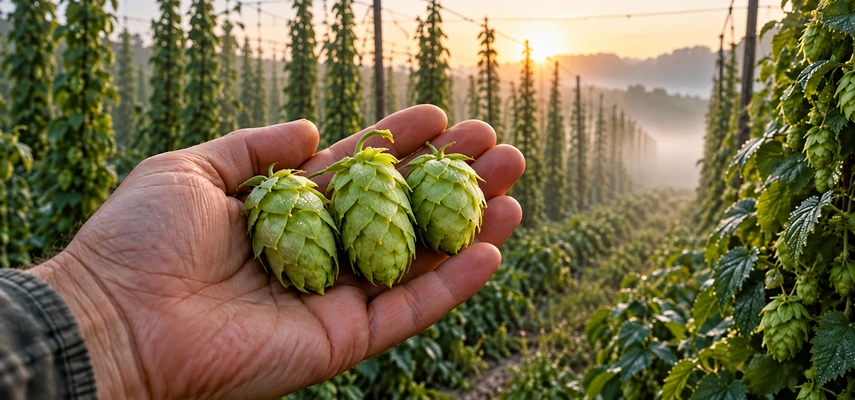

A beer can smell like grapefruit without a grapefruit ever entering the brewery. With hops explained properly, that is less a trick than an invitation to look inside a small green cone. The plant supplies aromatic possibilities; the grower, processor and brewer influence which ones survive into the glass.
For WSET Level 2, learn the named varieties as individuals, then connect them to growing regions, product forms and brewing use. Regional families help organize memory, but they cannot replace the prescribed names. Nor can the word hoppy tell you whether someone means bitterness, citrus aroma, herbal character or a mixture of all three.
Cone anatomy: find the useful material
The hop cone has a central supporting axis, the strig, surrounded by overlapping papery bracts. Among those structures are lupulin glands containing resins and oils important to brewing. The yellow material is not pollen sprinkled in from somewhere else; it is part of the cone’s own useful chemistry.
Resins include alpha acids, important precursors of kettle-derived bitterness. Aromatic oils and other compounds contribute a wide range of sensory effects. That division helps you understand purpose, but actual brewing chemistry is more complicated than one compartment for bitterness and another for smell.
The whole cone includes structural plant material as well as the concentrated substances the brewer wants. Product design partly concerns separating, preserving or concentrating those useful fractions. Two hop products with the same variety name therefore need not be interchangeable by weight or behave identically in the brewery.
Growing conditions: a variety is not a fixed recording
Hops are climbing plants commonly trained on trellises. Day length, seasonal temperature, water availability, soil conditions and plant health influence growth and cone development. Commercial growing regions combine suitable conditions with agricultural knowledge and processing infrastructure. A map explains some of the story, not every aroma in a finished crop.
Genetics matter, but so do site, harvest timing and crop year. A familiar variety can express itself differently between lots. Growers and merchants assess those lots, and brewers may select particular expressions for their recipes. Think of the variety as a range of possibilities rather than an identical bottle of perfume reproduced annually.
The official syllabus groups traditional German and Czech, traditional British, American, and New Zealand and Australian varieties. These are useful study groups. They do not mean a variety can never be grown outside the country with which it is associated.
Harvesting and storage protect potential
Harvest maturity affects what growers collect. Pick too early or too late and the aromatic result may change. After picking, most hops are dried and processed for storage. They need protection from heat and oxygen, which can degrade desirable compounds and alter character.
Oregon State’s harvesting and storage guidance reinforces drying, sealed packaging and cold storage. Good handling does not make hops immortal; it slows unwanted change. Opening a package and leaving it warm is different from retaining a cold, oxygen-protected supply.
Fresh, or wet, hops are a special case: undried cones used soon after harvest. They contain much more water than dried products and demand prompt handling. Oregon State’s grower guidance illustrates that time sensitivity. Fresh describes processing status here, not a claim that every fresh-hop beer is superior.
Bitterness and aroma: use changes the result
During a hot wort boil, alpha acids can isomerize into more soluble bitter compounds. Contact time, temperature, product and wort conditions influence the result. Early additions commonly emphasize bitterness because they have substantial hot contact, while prolonged boiling also removes or changes volatile aromatic compounds.
Later additions can retain more aroma, but they can still contribute bitterness under hot conditions. Likewise, an early addition is not chemically forbidden from influencing aroma. The useful principle is a shift of emphasis, not an absolute switch that flips from bitterness to aroma at a precise minute.
Dry hopping adds hops to cooled wort or beer, often during or after fermentation, emphasizing aroma through a different process environment. It can also change perceived bitterness and other properties. Article #7 examines addition methods in detail. Here, remember that the hop variety and the way it is used answer different questions.
Traditional German and Czech hops, individually
Hallertauer Mittelfrüh is a traditional German aroma variety associated with delicate herbal, floral and gently spicy expression. Tettnanger is another traditional German variety, often contributing fine herbal and spicy impressions. Their restrained character can suit beers where heavy tropical fruit would pull attention in a different direction.
Spalt, also called Spalter in some contexts, belongs to that traditional German aroma territory, with fine herbal, floral or spicy possibilities. Saaz, associated with the Czech Žatec region, is a key reference for delicate herbal, spicy and earthy hop expression in Czech pilsner. Do not silently replace any of these prescribed names with a newer variety that sounds similar.
These descriptions are tendencies, not identification guarantees. A balanced lager can integrate hop character with grain and fermentation so well that naming a specific cultivar from aroma alone would be overconfident. Murphy’s supplier comparison provides useful traditional-variety context without making sensory descriptors exclusive.
Traditional British hops, individually
East Kent Golding or Goldings is associated with spicy, honey-like and earthy notes. It provides a useful reference for traditional British hop expression rather than the obvious tropical profile of some modern varieties. The regional wording matters; do not treat every unrelated hop carrying Golding in its name as identical.
Challenger can offer spice, cedar and tea-like impressions and can be used for both bittering and aroma purposes. Fuggle commonly suggests earthy, floral and minty character. Compare the overlapping families while remembering what distinguishes each entry. These are three ingredients to learn, not one generic English-hop answer.
The British Hop Association’s variety records support these individual reference points. A traditional bitter may use a combination of varieties and additions. Finding an earthy note does not let you reconstruct the entire hopping schedule.
American hops, individually
Cascade is a familiar citrus-and-floral reference, frequently associated with grapefruit-like character. Chinook can combine pine or resin with citrus and fruit. Simcoe can bring pine, earthy and fruity possibilities; its contribution changes with lot and brewing use rather than fitting one immutable descriptor.
Citra is strongly associated with citrus and tropical-fruit expression. Amarillo often suggests orange or tangerine alongside floral character. Mosaic offers a broad range that can include tropical fruit, berry, citrus and resin. These overlaps are useful for blending, but they make one-aroma identification unreliable.
Crosby’s grower variety guide gives primary commercial context for this family. Learn the six prescribed names and characteristic directions. Do not substitute a fashionable newer cultivar for Cascade, Chinook, Simcoe, Citra, Amarillo or Mosaic simply because it also smells fruity.
New Zealand and Australian hops, individually
Nelson Sauvin is a New Zealand variety associated with gooseberry and white-wine-like fruit character. That comparison explains its name and sensory appeal; it does not mean wine was added or that every beer using it tastes the same.
Motueka, also from New Zealand, is associated with fresh lime and citrus, with possible tropical background notes. It can give a modern direction to a lager as well as contribute to ales. Hop origin does not dictate fermentation category.
Galaxy is Australian, with passionfruit, peach and citrus among its characteristic associations. Compare it with Motueka’s lime emphasis and Nelson Sauvin’s wine-like reference. These three memorable contrasts help organize the group while leaving room for real agricultural and brewing variation.
Whole hops, pellets, extracts and other products
Whole hops retain the dried cone’s structure. They require storage space and appropriate handling of bulky plant material. Pellets are processed, compressed hop material that is more compact and disperses differently. Pellet manufacture does not turn hops into an unrelated artificial flavoring.
Extracts concentrate selected hop components, and different extracts serve different purposes. Some focus on bittering potential; others on aromatic fractions or specific process applications. Other hop products include concentrated lupulin-rich materials and formulated aromatic preparations. Read the product’s intended use instead of assuming all concentrates do the same job.
Storage and freshness matter across forms, although stability differs by product and packaging. A concentrated product can change dosing, solids load and process efficiency. None of those advantages removes the need to consider the beer’s intended flavor and the manufacturer’s technical instructions.
Other flavorings are a separate possibility
Fruit can supply aroma, sugar, acidity or color. Spices and herbs can add distinctive aromatic material, while honey can combine fermentable sugar with potential aroma. Their contribution depends on ingredient, amount, timing and fermentation. A coriander-like impression in a witbier raises different questions from citrus character in a hop-driven ale.
When reviewing a tasting description, separate observation from cause. Citrus could be hop-derived, fruit-derived or part of another aromatic pattern. Use recipe information and style context to support a proposed explanation. The most convincing beer education is specific about possibilities and careful about proof.
One-page revision summary
Learn strig, bracts and lupulin glands, then connect resin and aromatic material to brewing use. Growing conditions, harvest, drying and storage affect what the brewer receives. Whole cones, pellets, extracts and other products preserve or concentrate that material in different ways.
Learn all 16 prescribed varieties individually within their four regional groups. Use characteristic aromas as reference points, not fingerprints. Finally, connect the variety to addition timing and product form: a hop name is the start of a production explanation, not its conclusion.
Continue your beer studies
Explore the related lessons on evaluate beer alongside beer yeast to extend the ingredient, process or sensory reasoning in this article.
Knowledge check: 10 original practice questions
Independent TFE questions, not official WSET examination items. Choose one answer per question; explanations follow separately.
1. Which cone structures contain much of the useful hop resins and oils?
- Only the strig
- Lupulin glands
- Only the outer packaging
- The trellis wires
2. Which is the best description of a hop variety’s expected aroma?
- A fixed aroma independent of growing conditions
- A guarantee of identical beer flavor
- A range influenced by genetics, lot and brewing use
- Proof of an added fruit
3. Which group contains only the prescribed traditional German and Czech varieties?
- Hallertauer Mittelfrüh, Tettnanger, Spalt and Saaz
- Cascade, Citra, Mosaic and Chinook
- Fuggle, Motueka, Galaxy and Amarillo
- Saaz, Galaxy, Challenger and Simcoe
4. Which variety is associated with New Zealand gooseberry and white-wine-like character?
- Challenger
- East Kent Goldings
- Spalt
- Nelson Sauvin
5. Which comparison matches the prescribed varieties and useful aroma references?
- Motueka—lime; Galaxy—passionfruit and peach
- Fuggle—only tropical mango; Saaz—only coconut
- Challenger—only banana; Citra—only smoke
- Spalt—vinegar; Mosaic—only butter
6. Which statement about late hot-side hopping is accurate?
- It can never contribute bitterness
- It may retain aroma while still contributing bitterness
- It removes all malt character
- It converts hops into fermentable sugar
7. Why do stored hops generally need protection from heat and oxygen?
- To stop them becoming malt
- To eliminate all aroma
- To slow changes that degrade desirable quality
- To remove their original region
8. Which set contains only the six prescribed American varieties?
- Cascade, Chinook, Simcoe, Citra, Amarillo and Mosaic
- Cascade, Fuggle, Saaz, Citra, Galaxy and Spalt
- Chinook, Motueka, Mosaic, Challenger, Saaz and Citra
- Amarillo, Goldings, Fuggle, Saaz, Simcoe and Galaxy
9. Which statement about hop extracts is most useful?
- All extracts are identical by weight
- Every extract has the same aroma
- All extracts are only for bitterness
- Different products concentrate different components for different uses
10. A beer has a citrus aroma. What additional evidence best helps establish whether fruit was added?
- The glass shape alone
- Verified recipe or producer information
- The color of the bottle cap
- The assumption that every citrus aroma requires fruit
Answers and explanations
1. B — Lupulin glands. Lupulin glands hold important resin and aromatic material. The strig supports the cone and bracts are the surrounding papery structures. Mapping: LO1 AC3.
2. C — A range influenced by genetics, lot and brewing use. Genetics establish possibilities, while site, harvest, storage and brewing choices influence the expression reaching the finished beer. Mapping: LO1 AC3.
3. A — Hallertauer Mittelfrüh, Tettnanger, Spalt and Saaz. The specification names those four in the traditional German/Czech group. The other combinations mix different regional study groups. Mapping: LO1 AC3.
4. D — Nelson Sauvin. NZ Hops describes Nelson Sauvin with gooseberry and white-wine-like associations. This is a hop characteristic, not proof that wine is present. Mapping: LO1 AC3.
5. A — Motueka—lime; Galaxy—passionfruit and peach. Motueka and Galaxy offer these characteristic citrus and fruit reference points. The descriptions are tendencies rather than exclusive sensory guarantees. Mapping: LO1 AC3.
6. B — It may retain aroma while still contributing bitterness. Late hot additions can provide aroma and still undergo bittering reactions. Temperature and contact time matter; late does not mean zero bitterness. Mapping: LO1 AC3/LO2 AC3.
7. C — To slow changes that degrade desirable quality. Warm, oxygen-exposed conditions encourage unwanted deterioration. Cold, sealed storage preserves potential more effectively but does not guarantee indefinite freshness. Mapping: LO1 AC3.
8. A — Cascade, Chinook, Simcoe, Citra, Amarillo and Mosaic. All six in the first set are required American-group entries. Other sets replace some with varieties assigned to other regional groups. Mapping: LO1 AC3.
9. D — Different products concentrate different components for different uses. Extracts can focus on bittering or aromatic components and differ in process application. The product specification matters more than the broad label. Mapping: LO1 AC3.
10. B — Verified recipe or producer information. Hops and other sources can create citrus-like impressions. Recipe evidence helps distinguish an actual addition from an aroma comparison. Mapping: LO1 AC3.












