










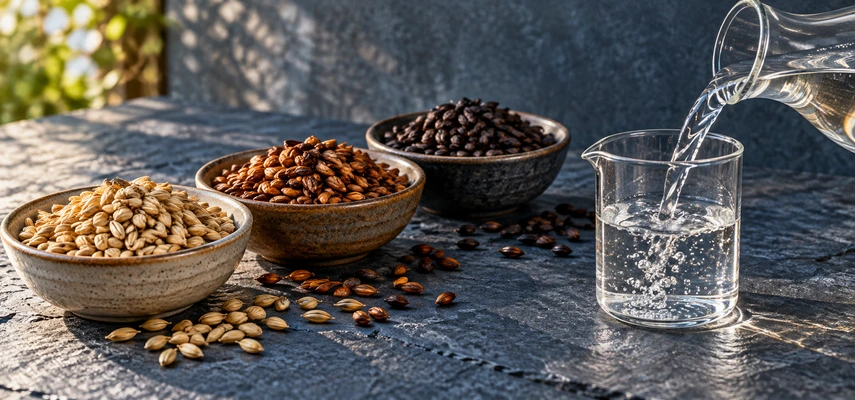

A handful of pale grain and a handful of dark grain can look like variations on a modest breakfast. In a brewery, their differences can change a beer from delicate and bread-like to deep brown and suggestive of toast or coffee. Malt and water help explain why the same broad brewing process produces such different drinks.
This chapter treats them as ingredients. The detailed stages of malting and mashing come later. Here the useful question is what each material brings to the recipe, and why a brewer might choose one combination over another.
Malt and water begin the recipe
Grains store starch as an energy reserve. Brewers need fermentable sugars rather than an unaltered sack of starch, so the grain must be prepared and processed. Malt means malted grains: grain encouraged to begin germinating, then dried under controlled conditions. Barley is especially important in brewing, although wheat and other grains also have roles.
Malting prepares the grain for subsequent brewing. During mashing, enzymes help convert its starch into sugars that yeast can use. Malt therefore contributes to alcohol production indirectly: it supplies the material from which fermentable sugars are obtained. Yeast performs the later conversion into alcohol. Mixing up those two jobs makes the whole process harder to understand.
The American Homebrewers Association ingredient guide explains malt as a principal source of fermentable sugar and distinguishes base and specialty malts. That distinction is useful well beyond homebrewing. It separates the recipe’s main foundation from ingredients selected for a more concentrated sensory effect.
Base malts carry much of the load
Base malts commonly make up most of a beer’s grain bill. They provide much of the starch and, depending on the malt, useful enzymes for mashing. Their flavors are often relatively gentle: grain, bread, cracker or biscuit are familiar comparisons. Gentle doesn’t mean absent. A pale beer can be distinctly malty without resembling caramel pudding.
The word base describes a function in the recipe, not one legally fixed color. Pale base malts are common, but brewers also use more deeply kilned base malts with richer bread-like character. It is safer to remember what a base malt contributes than to insist that every base malt must look or taste identical.
Imagine a recipe dominated by a pale malt with a delicate cereal character. That creates one starting point. Change to a malt with more pronounced bread-crust character and the beer’s foundation changes before hops or yeast enter the story. Neither choice is automatically better; each serves a different intended result.
Specialty malts change the emphasis
Specialty malts are chosen particularly for color, aroma, flavor or texture. Depending on their processing, they can suggest caramel, toast, nuts, chocolate or coffee. These are sensory comparisons, not proof that a brewer added those foods. A chocolate-like impression can come from grain treatment alone.
They are often used in smaller proportions than base malts because their character can be concentrated. Adding a little dark roasted material can substantially change color and flavor. Think of adjusting a seasoning rather than doubling the size of the meal. The comparison is about the strength of the effect, not a claim that grain behaves exactly like salt.
However, specialty is a broad practical term. Different products contribute different amounts of fermentable material and enzyme activity. At Level 1, avoid treating all dark grains as one interchangeable ingredient. The important distinction is that malt choice changes more than the appearance of the finished drink.
Color gives a clue, not a complete answer
Heating during malt production develops color and flavor. More intensive treatment can create darker, more roasted character. This helps explain why a dark beer can recall coffee while a pale one recalls bread. It doesn’t make every brown beer taste the same, nor does it tell us the alcohol content from sight.
Alcohol depends substantially on how much fermentable material is present and how fermentation proceeds. A dark beer may be comparatively modest in strength; a pale beer may be strong. Similarly, roasted flavor isn’t the same thing as sweetness. A dark, coffee-like beer can finish dry rather than sugary.
When describing malt character, separate the observations. Record color, then aroma and flavor, then sweetness and body. “Dark brown, toasty, little sweetness, medium body” communicates much more than “heavy.” The word heavy can conceal four different assumptions in one small package.
Other grains offer other possibilities
Barley is not the only brewing grain. Wheat, oats, rye, rice and maize can also appear in brewing, in malted or unmalted forms depending on the recipe. Their effects depend on processing and proportion as well as the grain itself. An ingredient name doesn’t provide a complete prediction of the glass.
Wheat can be important to wheat-beer recipes, but it doesn’t by itself create every banana-like or clove-like impression associated with some wheat beers. Fermentation character matters too. Oats can contribute to a fuller, smoother impression in suitable recipes, but their presence doesn’t guarantee that every oat-containing beer will feel thick.
The useful habit is to ask two questions: what material has been included, and what has the brewer done with it? That protects against statements such as “all wheat beers taste alike” or “rice means no flavor.” A brewer is assembling a result from several interacting choices.
The grain bill is a recipe, not a verdict
The grain bill lists the grains and their proportions. A hypothetical bill could consist mainly of pale base malt with a smaller addition of a darker specialty malt. The base supplies the foundation; the smaller addition adjusts the sensory profile. Those percentages are meaningful because ingredients do not all have equal intensity.
Compare two imagined bills containing the same total mass of grain. One uses only pale base malt; the other replaces a small share with roasted malt. They might produce noticeably different colors without the second necessarily becoming stronger. Changing the mixture and changing the amount of fermentable material are related decisions, but they aren’t the same decision.
A grain bill also needs context. Mash conditions influence the sugars obtained, and yeast influences what happens to those sugars. Reading a recipe is therefore a little like reading a list of instruments: it tells you what can contribute, but the performance still matters.
Other sources of sugar can join the grain
Brewers can use other sources of sugar, including brewing sugars, syrups or honey. These contribute fermentable material without necessarily bringing the same mix of color, flavor and grain-derived components as malt. Malt extract, made from concentrated wort, offers another way to supply material derived from grain.
Adding fermentable sugar doesn’t automatically mean making the final beer sweeter. If yeast consumes it, the sugar contributes to fermentation instead of remaining as sweetness. The result depends on the whole recipe and process. This is one reason a relatively pale, strong beer can be drier than a reader might expect.
The Cicerone brewing introduction connects ingredients to fermentation and helps keep this causal chain clear. Ask what yeast can consume before assuming what the finished drink will taste like. “Sugar was used” and “the beer tastes sweet” are different claims requiring different evidence.
Water is an ingredient with consequences
Water provides the main liquid environment for brewing and carries the finished beer’s dissolved substances. Its dissolved minerals and other characteristics can affect brewing performance and flavor balance. It isn’t simply an invisible container around the interesting ingredients.
Historically, local water helped influence brewing traditions. Modern brewers can treat water and adjust its composition, so a location’s water is not an unbreakable stylistic destiny. The beginner’s lesson is to recognize influence without turning it into a myth that only one town can produce a particular kind of beer.
No advanced water chemistry is required here. Remember that water must suit the intended brewing process and beer. A brewer making a delicate pale beer and one making a roasted dark beer may make different water decisions. Those decisions work alongside the grain bill; they don’t replace it.
Read the ingredients without overreading them
An ingredient list can suggest useful questions, but tasting remains a separate observation. It may identify barley, wheat or added sugar without telling you the exact aroma, bitterness or final sweetness. Allergens and specific ingredient claims should be checked against current producer information rather than inferred from a flavor resemblance.
For an optional alcohol-free exercise, compare dry examples of pale and darker brewing malt by sight and aroma if available. Note grain color and familiar smell associations without attempting a miniature brewing experiment. Alternatively, compare two hypothetical grain bills on paper and predict which sensory differences are plausible, then identify which facts remain unknown.
One-page revision summary
Malt is prepared grain, not yeast and not finished beer. Base malts commonly provide most of the recipe’s grain foundation; specialty malts can shift color and flavor strongly in smaller amounts. A grain bill describes the blend and proportions. Other grains and sugar sources broaden the options, while water affects both process and result.
For examination preparation, connect ingredients to purposes rather than ranking them as good or bad. Grain starch becomes sugars during mashing; yeast later ferments suitable sugars. Dark color doesn’t establish strength, and adding sugar doesn’t prove final sweetness. The official specification sets this ingredient knowledge within LO1; later chapters explain the processing in greater detail.
Knowledge check: 10 original practice questions
Independent TFE questions, not official WSET examination items. Choose one answer per question; explanations follow separately.
1. What does malt mean?
- Dried yeast ready for fermentation
- Grain that has begun germinating and then been dried
- Finished beer before packaging
- Hop cones dried after harvest
2. What commonly forms most of the grain foundation in a recipe?
- Base malts
- Hop oils
- Specialty roasted malt alone in every recipe
- Carbon dioxide
3. What does the grain bill describe?
- The total sales value of the beer
- The fermentation temperature only
- The order in which bottles are filled
- The grains and their proportions
4. A beer smells chocolate-like. Which conclusion is justified?
- Chocolate must appear in the ingredients
- The beer must be sweet
- Its aroma resembles chocolate
- Its alcohol must be high
5. Why can adding fermentable sugar fail to make beer sweeter?
- Sugar cannot dissolve in wort
- Yeast may consume that sugar during fermentation
- Water removes all sugar before fermentation
- Hops convert every sugar into starch
6. Which statement about water is sound?
- Its composition can influence brewing and flavor
- It contributes only color
- Its local composition can never be adjusted
- It replaces yeast in fermentation
7. Which observation establishes alcohol strength?
- Dark color alone
- A thick-looking foam head
- The presence of roasted malt alone
- A reliable alcohol statement or measurement
8. Which grain can be used in brewing alongside barley?
- Only barley is ever permitted
- Only grains already containing alcohol
- Wheat
- Grain cannot be used with malt
9. What is one common reason to select a specialty malt?
- To perform alcoholic fermentation
- To adjust color and flavor
- To replace all water
- To seal a bottle
10. Which distinction correctly separates two brewing jobs?
- Mashing obtains sugars; yeast ferments suitable sugars
- Malt performs fermentation; yeast supplies grain starch
- Water creates alcohol before sugar is present
- Specialty malt measures carbonation
Answers and explanations
1. B — Grain that has begun germinating and then been dried. Malting changes grain so it can be used effectively in brewing; malt is not the fermenting microorganism. Mapping: LO1.
2. A — Base malts. Base malts commonly supply much of the grain material used in mashing, with other ingredients adjusting the result. Mapping: LO1.
3. D — The grains and their proportions. The grain bill specifies the grain mixture; it is not a complete description of fermentation or packaging. Mapping: LO1.
4. C — Its aroma resembles chocolate. Specialty malt can create chocolate-like impressions without chocolate being added; resemblance is not recipe evidence. Mapping: LO1.
5. B — Yeast may consume that sugar during fermentation. Fermentable sugar can become alcohol and carbon dioxide rather than remaining as sweetness in the finished beer. Mapping: LO1.
6. A — Its composition can influence brewing and flavor. Water is a process environment and ingredient; modern brewers can treat it to suit intended results. Mapping: LO1.
7. D — A reliable alcohol statement or measurement. Color does not measure alcohol. Fermentable material and fermentation influence strength; a verified ABV provides the relevant information. Mapping: LO1.
8. C — Wheat. Wheat and other grains can play brewing roles; their treatment and proportions influence the outcome. Mapping: LO1.
9. B — To adjust color and flavor. Specialty malts offer particular sensory effects; yeast, water and packaging components perform different jobs. Mapping: LO1.
10. A — Mashing obtains sugars; yeast ferments suitable sugars. Starch conversion and alcoholic fermentation are separate processes, making different materials available at different stages. Mapping: LO1.












