










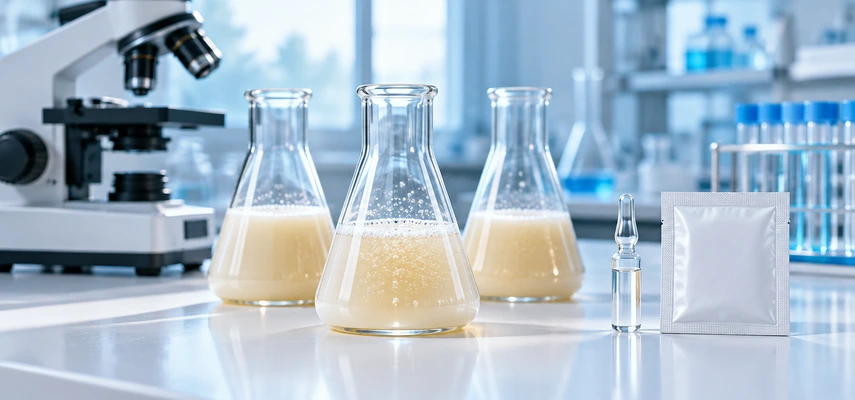

Why does a sake label sometimes mention a yeast number? Sake yeast influences fermentation behavior, acidity and aroma, so strain selection is a practical brewing decision. But the number doesn’t guarantee a particular fruit smell, and it doesn’t work independently of rice, kōji, nutrition or temperature. A useful explanation treats yeast as a living participant in a managed environment.
The WSET Level 3 specification names seven Brewing Society strains individually: #6, #7, #9, #10, #11, #14 and #1801. Learn a relevant distinction for each, then understand the conditions that allow those properties to matter. A list of seven numbers without mechanisms is not much of a fermentation plan.
Sake yeast needs sugar and produces more than alcohol
Yeast ferments available sugars into ethanol and carbon dioxide. In sake, much of that sugar becomes available through kōji enzyme action on prepared rice starch. Yeast therefore depends on a conversion process occurring alongside alcoholic fermentation in the main mash. It cannot simply consume an intact rice grain as though the starch were free glucose.
Fermentation also produces compounds that influence aroma and acidity. Esters contribute to many fruity impressions associated with aromatic sake, while organic acids contribute to palate balance. The precise result depends on strain and conditions. Smelling banana or apple doesn’t mean the brewer put that fruit into the tank, nor does it identify a unique numbered yeast by itself.
The NRIB and JSS guide connects yeast choice with production and sensory outcomes. For causal reasoning, distinguish what the organism can do from what it actually does under a particular regime. Biological potential becomes a finished result only through the full process.
Nutrition includes nitrogen compounds, vitamins and minerals
Sugar is an energy source and fermentable substrate, but it isn’t a complete nutritional environment. Amino acids, peptides and vitamins form part of the broader medium. Magnesium, potassium and phosphorus are also relevant mineral nutrients. Rice, kōji and water contribute to the overall supply, so no single ingredient can be assessed as though nothing else enters the mash.
Appropriate nutrition supports yeast growth and metabolism. However, more of every component does not necessarily improve the intended sake. The brewer is balancing fermentation performance with stylistic goals. Changes in the medium can influence aroma metabolism and the fermentation course, so an answer should not reduce yeast management to adding the largest possible dose of nutrients.
For example, highly polished rice and a chosen kōji approach create one nutritional context; less extensively polished rice and different kōji may create another. The same yeast need not behave identically in both. This is a clear reason why a strain number cannot function as a permanent flavor guarantee.
Brewing Society strains provide shared biological resources
The Brewing Society of Japan cultures and distributes selected strains under the Kyōkai yeast name. Selection and distribution allow breweries to work with known biological material rather than treating every fermentation as an unidentified microbial mixture. Known identity improves the basis for managing a process; it does not remove variation in how the material is used.
The catalogue also evolves. The specification’s required strains are the examination study set, not an assertion that only those seven exist or that their historical supply format describes every current product. Keep syllabus knowledge separate from a claim about present commercial availability. Suppliers provide the latter information.
Strains #6 and #7: useful reference points
#6 is associated with Aramasa in Akita. The Akita brewers association’s strain table describes a comparatively restrained aromatic tendency and a rounded expression. Treat that as a useful reference, not a statement that every #6 sake must smell faint or taste identical. The brewery can manage its expression through the rest of production.
#7 is associated with Masumi in Nagano and is a versatile reference strain used across different sake styles. Its importance is not limited to a single prestigious category. Reliable fermentation behavior and adaptable applications are valuable in their own right. A brewer choosing it may prioritize a process course and balance that fit the intended product.
Compare them by asking what the brewer wants from fermentation and how the surrounding conditions support that objective. Avoid ranking #7 above #6 because the number is larger. The sequence of identification numbers is not a quality scale, an alcohol percentage or a polishing-ratio instruction.
Strains #9 and #10: aromatic goals need different management
#9, associated with Kumamoto’s brewing tradition, is an important aromatic ginjō reference. It helps explain why yeast selection belongs in an account of fragrant sake production. Yet its use doesn’t guarantee that every example reaches the same aroma intensity or fermentation duration. Rice, kōji and temperature still supply the working context.
#10 is associated with low-temperature, longer fermentation approaches, comparatively low acid production and aromatic potential. That combination gives the brewer another tool for balancing aroma and palate. Low-acid tendency doesn’t mean the finished sake contains no acid, and long fermentation isn’t a universal requirement for every batch using the strain.
Therefore, don’t collapse all “ginjō yeast” into one biological personality. Different strains and fermentation courses offer different possibilities. A strong answer identifies the chosen trait and explains how it fits the intended process, while a weak one merely says the yeast is premium.
Strains #11 and #14: fermentation resilience and acid balance
#11 is especially relevant for its alcohol tolerance and ability to continue fermentation under challenging later-stage conditions. The association table also notes comparatively low amino-acid results. The most useful distinction is resilience in the fermentation environment, not a promise that every finished sake must be extremely strong or bone dry.
Alcohol tolerance means the organism can remain useful as ethanol concentration rises under appropriate conditions. It doesn’t mean fermentation becomes limitless or that other constraints disappear. Sugar availability, temperature and the yeast’s condition still affect what happens. Production decisions determine when the process ends and how the sake is subsequently adjusted.
#14, often associated with the Kanazawa yeast name, is a low-acid reference suited to specified premium-style applications. Learn that association without assigning one compulsory aroma. As with #10, comparatively lower acid production describes a useful tendency within a system. The final balance must be assessed alongside sweetness, alcohol, umami and other features.
Strain #1801: a deliberately selected aromatic tool
#1801 is a selected strain associated with high ester production, low-foaming behavior and relatively low acidity. The National Tax Agency educational manual summarizes practical brewing and aroma characteristics of association yeasts, including #1801. It illustrates that yeast development involves several desired properties, not simply making one fruity compound as abundant as possible.
Its aromatic potential makes it useful in discussions of modern fragrant styles. However, fermentation performance and aroma balance still need management. The number is not proof that the bottle must be excellent, or that every characteristic found in it came from yeast alone. Raw materials, cultivation, fermentation and storage all continue to matter.
Keep the full number. #1801 isn’t a shorthand statement that the sake uses an 18% alcohol target, and it shouldn’t be replaced with an invented general strain #18. Precise identities matter when explaining a selected biological resource.
Low-foaming 01 variants change practical handling
Many low-foaming variants carry an 01 suffix, such as #701 in relation to #7 and #901 in relation to #9. Low foaming changes the way the fermenting mash behaves at the surface and can simplify aspects of tank management. It doesn’t mean the yeast stops producing carbon dioxide or ceases alcoholic fermentation.
Likewise, the suffix alone does not define a finished sake aroma. Brewers select variants for a combination of operational and sensory objectives. Learn the connection between the parent strain and its low-foaming form, then avoid turning the naming convention into an assertion that every biochemical property is unchanged in every application.
Other yeast sources, formats and blending
Proprietary brewery strains, prefectural research strains and other regional yeasts broaden the available choices. NRIB’s yeast explanation recognizes these sources alongside commercial supply. “Local” and “proprietary” describe how a resource is associated or maintained; neither word establishes superior sensory quality without evidence.
The prescribed formats include ampoules, dried yeast and brewery-cultivated yeast. Ampoules provide a protected culture format associated with traditional distribution; dried preparations and brewery propagation organize supply and preparation differently. Current products also include other culture packages. Whatever the format, the brewery needs viable, correctly identified material handled appropriately for the chosen process.
Blending yeast means combining strains as part of a fermentation strategy, rather than blending completed sakes afterward. Their behavior together need not equal a simple arithmetic average of their separate descriptions. Relative growth and changing conditions affect the outcome. A brewer therefore evaluates the combination instead of assuming two appealing catalogue entries automatically produce the best of both.
Build a same-grade yeast flight using producer-confirmed strain 6 or 7, strain 9 and strain 1801 examples. Keep glassware and starting temperature comparable, then write blind notes before the reveal. Compare aroma and structure, but record differences in rice, koji and fermentation too. The exercise tests useful strain tendencies rather than proving that yeast alone caused the result or that a fruit descriptor uniquely identifies a strain.
Yeast performance depends on the environment established in the starter and managed during main fermentation. Connect aroma potential with the wider production choices in ginjo brewing, rather than identifying a strain from fruit character alone.
One-page revision summary
Remember the seven full identities and their relevant distinctions: #6 and #7 as important reference strains, #9 and #10 for aromatic production contexts, #11 for alcohol tolerance, #14 for its Kanazawa and low-acid association, and #1801 for selected ester production and low foaming. Then add nutrition, formats and management. Yeast offers possibilities that the complete brewing process must turn into an actual sake.
Written practice: original TFE exercises
These suggested marks and indicative points are independent teaching guidance, not official WSET marking schemes.
Exercise 1: 5 suggested marks
Explain why selecting an aromatic yeast strain does not by itself guarantee the aroma and quality of the finished sake. Mapping: Unit 1 LO1 and LO2.
Indicative marking points:
- A strain has relevant metabolic potential.
- Nutrition from rice, kōji and water affects its environment.
- Temperature and fermentation management affect behavior.
- Other production and storage choices also influence sensory results.
- Actual observations are needed to assess final aroma balance and quality.
Model answer: An aromatic strain provides useful metabolic potential, but its behavior depends on the nutrient environment and fermentation conditions. Rice preparation, kōji and temperature management influence that context, while finishing and storage can change the final expression. The brewer must therefore assess the actual aroma and balance rather than treating a strain number as a guaranteed sensory or quality result.
Why it works: It connects strain potential to conditions and then explains why the finished result still needs evidence.
Common mistake: Claiming that one fruit aroma proves a specific yeast or that a high number means high quality.
Exercise 2: 5 suggested marks
Explain how a low-foaming yeast can alter tank management without eliminating alcoholic fermentation. Mapping: Unit 1 LO1.
Indicative marking points:
- The variant has reduced foaming behavior.
- The surface behavior differs from a foaming strain.
- This can simplify practical management of the mash or tank space.
- Yeast still consumes fermentable sugar.
- Ethanol and carbon dioxide production remain part of fermentation.
Model answer: A low-foaming variant reduces the foam behavior at the mash surface, which can simplify tank handling and related operational decisions. That does not remove the yeast’s fermentation role. The organism still consumes fermentable sugar and produces ethanol and carbon dioxide; less foam is not the same as no gas production or no fermentation.
Why it works: The answer separates a visible operational trait from the underlying biochemical transformation.
Common mistake: Interpreting an 01 suffix as evidence that the mash produces no carbon dioxide.
Knowledge check: 10 original practice questions
Independent TFE questions, not official WSET examination items. Choose one answer per question; explanations follow separately.
1. What does a low-foaming variant change without eliminating fermentation?
2. Which strain is a prescribed aromatic reference associated with Kumamoto?
3. Which pair correctly links fermentation input and principal output?
4. Which statement about #6 is a useful study reference?
5. Which group includes relevant non-sugar nutritional considerations?
6. Which description best fits the role of #7 in this comparison?
7. Which strain is associated with the Kanazawa name?
8. What is the main caution when blending yeast strains?
9. Which combination is particularly relevant to #1801?
10. Which trait is especially useful to remember for #11?
Answers and explanations
1. B — Mash surface behavior while ethanol and carbon dioxide production continue.. Low foam is an operational and biological characteristic, not a claim that gas production stops. Mapping: Unit 1 LO1 Range 1; LO2 Range 4.
2. B — #9.. #9 is an important Kumamoto-associated ginjō reference, though its expression depends on conditions. Mapping: Unit 1 LO1 Range 1; LO2 Range 4.
3. C — Fermentable sugar consumed; ethanol and carbon dioxide produced.. Yeast uses available fermentable sugar; kōji enzymes help release it from starch. Mapping: Unit 1 LO1 Range 1; LO2 Range 4.
4. A — It is associated with Aramasa in Akita and a comparatively restrained aromatic tendency.. The regional and stylistic association is useful when treated as a tendency rather than a guaranteed result. Mapping: Unit 1 LO1 Range 1; LO2 Range 4.
5. C — Amino acids, peptides, vitamins, magnesium, potassium and phosphorus.. Sugar is not a complete nutritional medium; other materials support the yeast environment. Mapping: Unit 1 LO1 Range 1; LO2 Range 4.
6. D — A versatile reference strain associated with Masumi in Nagano.. Its importance includes practical fermentation use across styles rather than a numerical quality rank. Mapping: Unit 1 LO1 Range 1; LO2 Range 4.
7. A — #14.. #14 is associated with Kanazawa and a comparatively low-acid tendency in appropriate production contexts. Mapping: Unit 1 LO1 Range 1; LO2 Range 4.
8. A — Combined behavior need not be the arithmetic average of separate strain descriptions.. Relative growth and changing conditions affect the combination, requiring actual evaluation rather than catalogue arithmetic. Mapping: Unit 1 LO1 Range 1; LO2 Range 4.
9. D — Selected ester production, low foaming and relatively low acidity.. The selected strain combines several useful traits; none alone guarantees the finished sake quality. Mapping: Unit 1 LO1 Range 1; LO2 Range 4.
10. C — Alcohol tolerance in fermentation.. Alcohol tolerance distinguishes its practical relevance without promising an unlimited fermentation endpoint. Mapping: Unit 1 LO1 Range 1; LO2 Range 4.












