










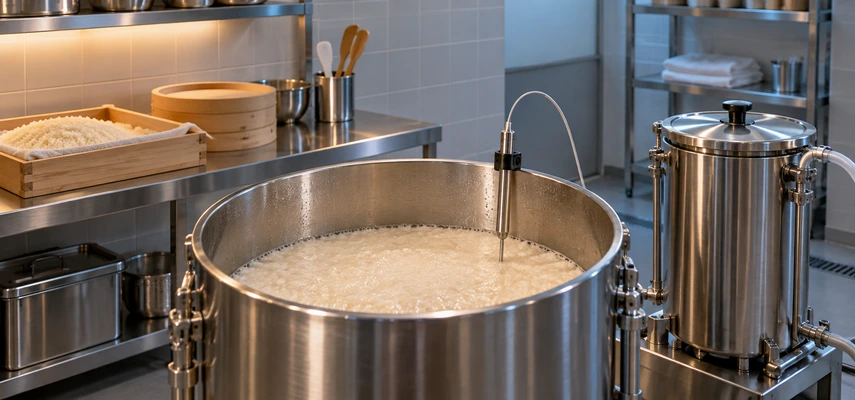

Why not put a small quantity of yeast straight into the largest tank and hope it catches up? Sake fermentation starters solve a scale and competition problem. Before the main mash expands, the brewer establishes a useful yeast population under managed conditions. Rice, kōji and water provide the medium; acid and temperature management help make that medium suitable for the selected fermentation.
The starter is called shubo or moto. In the WSET Level 3 specification, the added-acid approaches include sokujō-moto and kō-on tōka-moto. They share an important principle but organize the preparation differently. Understanding that difference requires separating sugar production, acidification and yeast growth.
Sake fermentation starters establish a working population
The main purpose of a starter is to provide sufficient healthy yeast for subsequent fermentation. A small initial culture must multiply in a useful environment before the brewery relies on it in a much larger mash. The starter therefore manages a biological population, not merely a flavoring liquid that is poured in for tradition’s sake.
The NRIB account of shubo emphasizes the acid environment used to help protect against unwanted microorganisms while supporting the chosen yeast. It does not mean every possible contaminant disappears instantly. Hygiene, ingredients and process management remain necessary. Acidification is one control within a broader system.
Here is the basic chain: appropriate starter conditions → selected yeast develops successfully → a useful population enters the main fermentation. If the middle step is missing, the explanation becomes a vague claim that starters somehow make sake better. Name the biological purpose and the conditions that help achieve it.
Four ingredients have different functions
Steamed rice supplies prepared starch and other rice components. Kōji brings enzymes that release glucose and smaller nitrogen-containing compounds from the material. Water provides the medium and contributes to the chemical environment. Yeast consumes available fermentable sugars and develops the population needed for the next stage.
Consequently, a starter isn’t simply yeast dissolved in water. Nor is it a container of finished sake added to another container. Starch conversion, yeast growth and fermentation can change its composition over time. The brewer needs to manage those changes toward a ready starter rather than assume the ingredient list alone establishes success.
The introduction to a primary study of starter development describes these relationships before comparing starter methods. For examination answers, keep the functions distinct. Kōji enables sugar availability; yeast uses the sugar. Lactic acid establishes an important condition but doesn’t replace either biological contribution.
Lactic acid changes the microbial environment
An acidic starter helps limit the growth of many unwanted microorganisms while allowing suitable sake yeast to develop. The relevant effect is selective environmental pressure, not an all-purpose guarantee that anything added afterward is safe from contamination. The selected yeast still requires suitable nutrition and temperature.
In added-acid methods, prepared lactic acid is deliberately introduced. This avoids waiting for the same acidification to arise through the development of lactic acid bacteria. The contrast is about how acidity is established, rather than whether acid exists at all. Kimoto and yamahai, discussed in the next lesson, also involve lactic acidity.
Avoid describing prepared lactic acid as necessarily artificial in the sense of fake or inferior. The production decision concerns its controlled addition. What matters here is the resulting environment and process reliability, not an unsupported hierarchy in which every older method is automatically superior. Different methods solve the starter problem in different ways.
Sokujō-moto supplies acid directly
Sokujō is the familiar added-lactic-acid starter approach. The prepared medium and selected yeast develop under controlled conditions without the brewer depending on a prolonged bacterial acidification sequence. Its name is often translated in terms of rapid development, reflecting a practical contrast with traditional acid-producing microbial development.
The useful mechanism is direct acid addition → an appropriately acidic environment from an early stage → selected yeast can be propagated without waiting for bacterial acid production. That can simplify and shorten starter preparation. However, “rapid” does not mean careless, instantaneous or independent of observation.
Temperature and handling still need to suit the yeast and the medium. The brewery monitors development and prepares the starter for its next use. A clock can help organize work, but it cannot prove that every starter has reached the same biological condition. The desired endpoint is useful yeast performance and a suitable medium, not simply elapsed time.
Direct acid does not eliminate the need for enzymes
Lactic acid isn’t a replacement for saccharification. The rice still needs to supply fermentable sugar through the enzyme system. Nor is acidity the same as yeast concentration: a correctly acidified mixture may still need the selected population to grow. Treating those measurements as interchangeable hides the very problem the starter is meant to solve.
For example, suppose a medium has the intended acidity but poor sugar availability or an unsuitable temperature. The yeast may fail to develop as planned. More acid would not necessarily correct the limiting factor. A causal explanation should identify the relevant condition rather than assume one useful ingredient can solve every process failure.
Similarly, acidification doesn’t make all yeast strains behave identically. Their fermentation and aroma properties remain relevant. Selecting #7 or an aromatic strain gives the brewery different biological material to manage within an acidic system. Starter method and yeast choice are connected decisions, not alternative names for the same thing.
Kō-on tōka-moto separates a warm preparation phase
Kō-on tōka-moto is a high-temperature saccharification starter method. Its defining idea is to use an initial warm stage to promote enzyme action on the rice before establishing the selected yeast fermentation. The warm treatment also reduces competing microbial populations. The process must then move to conditions suitable for adding and developing yeast.
That sequence is the essential distinction: warm saccharification and microbial reduction → adjustment and cooling with appropriate acidification → selected yeast propagation. It would be incorrect to say that sake yeast performs the main alcoholic fermentation at the high saccharification temperature. Heating and yeast development serve different jobs at different stages.
The producer Nakao Brewery describes its high-temperature approach in connection with controlling competing organisms and helping a chosen yeast establish itself. Its particular heating schedule is a producer example, not a compulsory universal formula for every brewery. Learn the purpose and sequence before memorizing a temperature from one account.
Temperature must suit the stage, not the method name alone
Enzyme activity and microbial growth have different temperature responses. A warm stage useful for saccharification is not automatically suitable for living yeast propagation. Likewise, heating more aggressively does not guarantee a better result: enzyme stability and the intended process must be preserved. Control concerns both what the brewer wants to encourage and what must be limited.
Cooling therefore has a biological purpose. It brings the prepared medium toward conditions in which the selected yeast can be introduced and develop. This is not merely a comfort measure for the worker or a way to make the final sake taste cooler. It connects the end of one process phase to the beginning of another.
The NRIB brewing glossary also distinguishes stages within starter temperature management. Use that vocabulary to support the explanation, while avoiding a claim that one temperature reading describes the entire preparation. A starter’s history matters as well as its state at the moment you inspect it.
Compare the methods through the problems they solve
Both sokujō-moto and kō-on tōka-moto fall within the specification’s added-lactic-acid approaches. Both aim to provide a suitable population of yeast for the main fermentation. The important contrast is how the medium is prepared and how the high-temperature method uses a distinct initial saccharification and microbial-control stage.
Neither method by itself establishes the complete sensory style of the sake. The starter can influence the process, but rice, kōji, yeast, main fermentation and finishing continue to matter. A delicate result is not proof of one method, and a full result isn’t proof that added acid was absent. Avoid reverse-engineering an entire production history from a single aroma.
Imagine a brewer wants to give a chosen yeast a strong chance of establishing itself without unwanted competitors. One route uses direct acidification in a conventional sokujō plan. Another adds a controlled high-temperature preparation phase before selected-yeast development. The comparison becomes meaningful when each action is connected to microbial conditions and sugar availability.
Before transfer, consider the dilution that comes with expanding the mash. A starter must bring enough useful yeast to remain effective after additional rice, kōji and water enter the system. That explains why the brewery develops a population beforehand and then expands the main fermentation in managed stages. A successful small starter is valuable because of what it enables next, not because the small vessel itself has special sensory powers.
Compare this acidification route with kimoto and yamahai, then follow the prepared population into the main mash. The yeast lesson explains why nutrients and strain choice still matter alongside starter technique.
One-page revision summary
Define shubo or moto through its purpose: establishing useful yeast for later fermentation. Give steamed rice, kōji, water and yeast separate functions. Explain direct lactic-acid addition in sokujō, then identify the warm saccharification phase and subsequent cooling in kō-on tōka-moto. Finally, distinguish a well-managed starter environment from a guarantee about the finished sake’s flavor or quality.
Written practice: original TFE exercises
These suggested marks and indicative points are independent teaching guidance, not official WSET marking schemes.
Exercise 1: 5 suggested marks
Explain how direct lactic-acid addition supports yeast development in sokujō-moto. Mapping: Unit 1 LO1.
Indicative marking points:
- Prepared lactic acid is added.
- The addition creates an appropriately acidic starter environment.
- This limits many unwanted microorganisms.
- The brewer need not wait for the same acidification through bacterial development.
- Selected yeast can be propagated under suitable nutritional and temperature conditions.
Model answer: Sokujō uses added prepared lactic acid to establish an appropriately acidic medium early in starter preparation. That environment limits many unwanted microorganisms and avoids waiting for a bacterial acidification sequence. With suitable nutrition and temperature, the selected yeast can then develop into the population needed for the main mash.
Why it works: The response links the addition to a change in environment, then explains the benefit for controlled yeast propagation.
Common mistake: Saying lactic acid produces all the alcohol or eliminates the need for hygiene and suitable temperature.
Exercise 2: 5 suggested marks
Explain why kō-on tōka-moto requires a change from its initial warm stage before selected yeast propagation. Mapping: Unit 1 LO1.
Indicative marking points:
- The initial stage is high-temperature saccharification.
- Warm conditions support the intended enzyme action.
- The treatment also reduces competing microorganisms.
- Those warm conditions are not the selected yeast’s propagation stage.
- Cooling and appropriate acidification establish conditions for adding and developing the selected yeast.
Model answer: The initial warm stage is designed for saccharification and reduction of competing organisms. It is not a claim that sake yeast ferments successfully at that high temperature. The medium must be brought to suitable conditions through cooling and appropriate acidification before the selected yeast is introduced and propagated for subsequent brewing.
Why it works: It explains the different objectives and biological requirements of the two phases instead of treating the entire starter as one temperature regime.
Common mistake: Writing that the high-temperature method means the main alcoholic fermentation is conducted at the saccharification temperature.
Knowledge check: 10 original practice questions
Independent TFE questions, not official WSET examination items. Choose one answer per question; explanations follow separately.
1. What defines kō-on tōka-moto’s initial phase?
2. Which inference from finished flavor is justified?
3. What is a main purpose of shubo or moto?
4. Which comparison between the two prescribed methods is accurate?
5. Why is cooling important after high-temperature saccharification?
6. What should determine readiness beyond elapsed time?
7. What chiefly distinguishes the added-acid principle of sokujō?
8. Which group gives the core starter ingredients?
9. Which statement best describes lactic acid’s role?
10. Why does an acidic starter help?
Answers and explanations
1. A — A warm saccharification stage before selected yeast propagation.. The initial warm phase serves enzyme action and microbial reduction; yeast development follows under suitable conditions. Mapping: Unit 1 LO1 Range 4; LO2 Range 4.
2. C — Starter methods can contribute to style, but flavor alone rarely proves the complete process.. Several production decisions can lead to overlapping sensory results, so attribution requires evidence. Mapping: Unit 1 LO1 Range 4; LO2 Range 4.
3. A — To provide a useful yeast population for later fermentation.. The starter establishes selected yeast under suitable conditions before the mash expands. Mapping: Unit 1 LO1 Range 4; LO2 Range 4.
4. D — Both are added-acid approaches; one has a distinct high-temperature preparation phase.. Their shared acid principle coexists with a meaningful difference in preparing the starter medium. Mapping: Unit 1 LO1 Range 4; LO2 Range 4.
5. C — It establishes conditions suitable for the selected yeast.. Different stages require different conditions; useful saccharification heat is not automatically suitable for yeast growth. Mapping: Unit 1 LO1 Range 4; LO2 Range 4.
6. A — Actual starter development and suitability for the next stage.. A planned schedule needs observation of the living material and process condition. Mapping: Unit 1 LO1 Range 4; LO2 Range 4.
7. B — Prepared lactic acid is deliberately added.. The method establishes acidity without depending on the same bacterial acid-production sequence. Mapping: Unit 1 LO1 Range 4; LO2 Range 4.
8. C — Steamed rice, kōji, water and yeast.. The four components provide prepared substrate, enzyme contribution, medium and fermenting organism. Mapping: Unit 1 LO1 Range 4; LO2 Range 4.
9. B — It helps establish the microbial environment rather than replacing saccharification.. Acidity, sugar availability and yeast population are separate aspects of starter development. Mapping: Unit 1 LO1 Range 4; LO2 Range 4.
10. D — It limits many unwanted microorganisms while suitable yeast develops.. Acidification supports selective control but does not replace hygiene, nutrition or temperature management. Mapping: Unit 1 LO1 Range 4; LO2 Range 4.











