










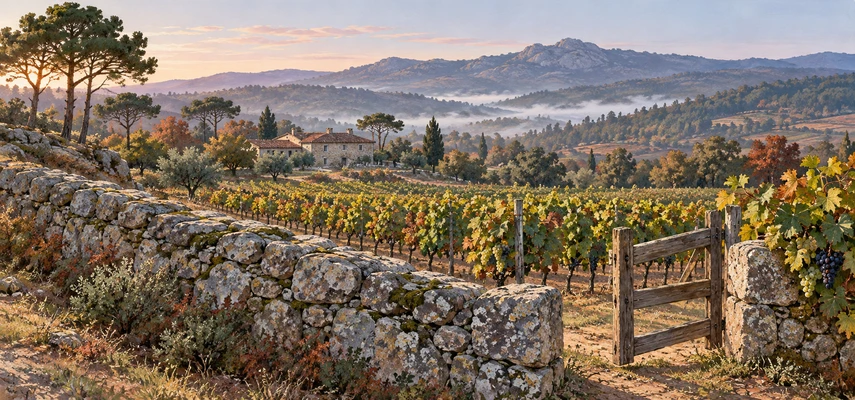

Dão and Bairrada make a useful comparison because proximity doesn’t produce identical growing conditions. Mountain shelter and elevated inland parcels shape much of the Dão discussion. Stronger Atlantic influence, clay-limestone settings and Baga bring a different set of questions in Bairrada. Both regions also have white wines worth putting beside their reds.
For Diploma study, connect those conditions with actual decisions. Explain how fruit reaches suitable maturity, how extraction handles its structure, and how the resulting wine finds a customer. Neither granite nor clay can finish that argument on the producer’s behalf.
Locate Dão within its sheltered inland landscape
Dão lies inland in central-northern Portugal, with vineyards around Viseu and surrounding areas. The regional commission’s terroir account describes surrounding mountain barriers, varied relief and predominantly granitic soils with schist outcrops. The shelter reduces some external influences; it doesn’t remove weather or create a completely uniform growing environment.
Elevation, aspect, soil depth and exposure change conditions between parcels. Winters can be cold and wet, while summers can become hot and dry. Freely draining, relatively low-fertility soils can help control vigour but make rooting and water supply particularly important. A green landscape isn’t evidence that every vine has enough usable water throughout ripening.
The national institute’s regional account also distinguishes Dão PDO from broader Terras do Dão PGI and the separate Lafões origin. Those names don’t all describe the same legal entitlement. When comparing bottles, identify the actual designation before attaching regional expectations to it.
Explain Dão’s red and white material
Touriga Nacional offers an important red reference, alongside Alfrocheiro, Jaen and Tinta Roriz among other grapes. The commission’s variety account connects these names with local material. Jaen is associated with Mencía, while Tinta Roriz is Tempranillo; shared identity doesn’t mean the resulting wines must copy Spanish regional styles.
Touriga Nacional can contribute fruit, colour, aroma and structure to a suitable blend. Alfrocheiro and other varieties offer additional material rather than merely making up a legal percentage. Crop level, site and harvest affect what each contributes. A blend can be deliberate and expressive without every bottle sharing one compulsory recipe.
Encruzado gives the whites a distinctive starting point. The IVV’s varietal account provides a technical reference for its growing requirements. Fermentation and lees choices can shape texture and development, while acidity and retained fruit remain central to balance. Other white grapes, including Malvasia Fina and Bical, broaden the picture. Don’t use a red-dominated regional reputation to leave whites out of the answer.
Connect Dão vineyard management with the intended wine
Temperature affects growth, ripening and acid retention. Sunlight supports photosynthesis, with aspect and exposure changing fruit conditions. Water availability depends on rainfall, soil depth, drainage and rooting. Nutrient availability influences vigour and crop balance. A shallow, freely draining parcel and a deeper one can need different responses even when both are described as granitic.
Weather creates frost, hail, heat, drought and harvest-rain risks. Downy and powdery mildew and bunch rot remain possible. Vineyard establishment considers exposure, drainage, access and training. Planting materials should match variety, soil and water conditions. An elevated site may preserve freshness while increasing frost exposure or making ripening less reliable in a difficult season.
Nutrient and water management follows observation and analysis within applicable rules. Canopy management balances productive leaf area, airflow and fruit protection. Harvest timing balances flavour, sugar, acidity, phenolic maturity and health. Hazard management includes erosion control and appropriate frost precautions. Pest and disease management combines monitoring, canopy work and proportionate intervention. Separate fruit decisions for a fresh white from those for a structured red instead of using one picking date as a symbol of regional authenticity.
Give Bairrada its own Atlantic argument
Bairrada lies further west, between the Atlantic and the inland mountain barriers. The national institute’s account locates the region between the Vouga and Mondego references and describes strong maritime influence. Winters bring substantial rain, and summer temperatures receive moderation from the ocean. An Atlantic description still needs actual site, season and soil information.
Clay-limestone and sandy settings create different rooting and water relationships. Clay can retain useful water while making drainage and access more demanding after rain. Sand can offer freer drainage and a different root environment. Neither soil type guarantees a fixed flavour or removes the need for careful cultivation.
Baga is central to red Bairrada, with other permitted grapes offering further possibilities. The IVV’s Baga account identifies late ripening and sensitivity to rot, particularly when fertile conditions and rain complicate maturation. Healthy, suitably ripe material can provide substantial tannin and acidity. That potential explains why harvest judgement matters; it doesn’t make harshness a compulsory badge of quality.
For Bairrada vineyards, temperature and sunlight influence ripening within the maritime setting. Water availability and nutrient availability depend on rainfall, soil, drainage and rooting. Weather can bring frost, hail, heat, drought and harvest rain; downy mildew, powdery mildew and bunch rot require monitoring. Vineyard establishment considers exposure, drainage, access and training, with planting materials matched to conditions. Nutrient and water management, canopy management, harvest timing, hazard management and pest and disease management need to preserve fruit health while allowing suitable maturity. For Baga, waiting for more sugar can lose value if the fruit deteriorates first.
Understand Baga without a compulsory heavy style
Traditional firm, structured reds form part of Bairrada’s identity, but they don’t define every possible Baga. Picking, crop, whole-bunch use, extraction and maturation can create different balances. More tannin or darker colour doesn’t establish greater quality, and a lighter-looking wine can still have meaningful structure and development potential.
Luís Pato’s variety account illustrates a producer thinking about Baga across different soils and using several white varieties. Treat its evaluations as that producer’s perspective rather than universal laws. An assertion that all Baga can age for decades needs bottle evidence, just as a preferred soil doesn’t make every other site incapable of producing worthwhile wine.
Bical, Maria Gomes, Arinto and other white material deserve their own production discussion. Maria Gomes is the local name associated with Fernão Pires. The Caves Primavera regional account places these whites alongside Baga and the region’s sparkling tradition. Still whites can range through different fermentation and maturation choices. Sparkling production is relevant context, with its detailed methods reserved for the later unit.
Compare cellar decisions across the two regions
Winemaking approaches begin with the target style. Careful grape transportation limits crushing, oxidation and unwanted fermentation. Reception should separate origins, varieties, health and ripeness. Processing and pressing affect yield and phenolic pickup. Dão red blends and Bairrada Baga need extraction appropriate to their actual material, while Encruzado, Bical and aromatic white lots require suitable juice handling.
Pre-fermentation clarification adjusts white-juice solids for the intended fermentation. Must adjustments require analysis and legal permission. Alcoholic fermentation decisions include yeast, temperature, vessel and nutrient management. Extraction and pressing should suit skin and seed maturity in reds. Malolactic conversion and subsequent maturation should fit acidity, texture and microbial stability. A wine with naturally firm structure doesn’t automatically benefit from stronger cap management.
Lees maturation can build texture in suitable whites, with oxygen and microbiological condition monitored. Barrel fermentation or maturation adds choices about vessel size, age and time. A producer can aim for a fuller Encruzado or Bical without making obvious wood the main attraction. For reds, maturation needs sufficient fruit to integrate with tannin and any oak contribution.
Blending eligible lots can improve balance while preserving origin and category entitlement. Finishing adjustments, sulfur dioxide and filtration depend on analysis and stability needs. Post-fermentation clarification removes unwanted material; stabilisation considers protein and tartrate risks. Microbiological safeguards should fit analysis, retained sugar and distribution. Packaging and closures should protect the intended drinking period. Wine transportation requires suitable temperature management, whether the wine is sold young or after substantial storage.
Relate protected names to costs and customers
International and EU protection frameworks, national Portuguese law and local appellation specifications interact. Industry associations and regional bodies communicate origin, while authorised controls establish compliance. A geographical indication links place with prescribed conditions. Dão and Bairrada operate within the PDO framework; PGI wines such as Terras do Dão and Beira Atlântico have separate requirements, and wines without GI cannot borrow protected names. DOC, Reserva and other label expressions need their actual conditions rather than an automatic sensory rank.
The official Dão specification and Bairrada specification provide the relevant starting points for detailed entitlement questions. A producer profile isn’t a substitute for checking permitted categories, varieties or release conditions. Equally, satisfying those conditions doesn’t determine whether an actual bottle tastes good, very good or outstanding.
Supply depends on healthy fruit, weather losses, permitted yields and stocks held for maturation. Demand differs between accessible blends, varietal whites and more structured specialist reds. Costs include vineyard labour, drainage, crop selection, sorting, vessels, storage and finance. Legislation affects sourcing and release choices; currency exchange changes export returns. A late Baga harvest and a longer maturation programme can create different risks from an early-release white.
A grower may supply fruit, while an estate can coordinate vineyard and cellar decisions. A broker connects parties; a merchant sources wine or grapes; a winery provides production capacity. A virtual winery contracts production, and a custom crush facility supplies agreed services. A cooperative can share equipment and market access; a conglomerate may coordinate businesses. These are possible functions, not a claim of equal prevalence in both regions. Contracts should connect quality requirements with delivery, traceability and payment terms.
Importing adds freight, compliance and currency exposure. Retail needs clear style, grape and origin information; HoReCa buyers require service training. Direct-to-consumer sales can retain revenue but add hospitality and fulfilment work. Mature and emerging markets contain varied customers. Someone seeking an immediately approachable red may need a different recommendation from a buyer willing to cellar a firm Baga, while a selected white can require its own explanation of value.
Wine brands can lead with producer, place or grape. Marketing concepts begin with a target customer; marketing options include comparative flights, technical notes and vineyard visits. The five Ps connect product, price, people, place and promotion. Regional identity is useful when it helps explain the particular bottle and drinking occasion, rather than excusing imbalance or making every wine sound alike.
Compare the evidence here with southern and central Portugal as a regional case, then apply the regional comparison framework to the comparison. Compare growing conditions, production decisions, style, quality and the commercial reasons for price. Establish the differences rather than assuming that one familiar name must be better.
Original Diploma practice
These original exercises practise explanation and evaluation. They aren’t official examination questions, marking schemes or accounts of actual bottles tasted.
Question 1: compare two regional harvest decisions
Compare vineyard and harvest decisions for an inland Dão parcel and a Bairrada Baga parcel facing a wet late season.
Reasoned outline: Establish the actual varieties, soils, exposure, water supply and crop health. Explain canopy work, disease monitoring, flavour and phenolic maturity, picking and sorting. Connect the resulting material with extraction, maturation and costs. Waiting longer has value only if the fruit remains suitable for the intended wine.
Question 2: assess a white-wine proposal
A buyer wants to reject all Dão and Bairrada whites because the regions are known for reds. Evaluate the proposal using Encruzado and Bical or Maria Gomes as examples.
Reasoned outline: Explain grape and site differences, harvest, pressing, fermentation, lees and optional wood choices. Compare freshness, texture, balance and intended customers. Separate potential ageing from obvious oak or reputation. A red-wine reputation doesn’t limit a region to one colour or one level of ambition.
Question 3: evaluate a Baga ageing claim
A merchant argues that high tannin, acidity and old vines guarantee outstanding Baga and decades of further improvement. Evaluate the claim.
Reasoned outline: Establish fruit health and ripeness, crop, extraction, maturation and actual bottle condition. Assess balance and retained fruit alongside structure, then consider price and customer patience. Strong structure needs enough sound material to develop with it. Harshness alone isn’t evidence of a promising future.
Analytical tasting preparation: compare inland and Atlantic styles
The official recommended-sample programme, printed page 23, lists Dão and Bairrada at very good or outstanding quality as optional Portuguese selections. They aren’t additional compulsory regional rows. A suitable white using local and/or international varieties at good or very good quality can support the broader essential Portuguese white selection; choose the actual bottle accordingly. An Encruzado, Bical or Maria Gomes comparison can also be additional study without pretending every variety has its own official required sample.
Write full systematic descriptions blind. Justify quality through balance, length, intensity and complexity using actual fruit, structure and development evidence. Assess bottle-ageing suitability separately, considering retained fruit and likely integration rather than acidity, tannin or wood alone. These are proposed selections and methods, not actual tasting results or predetermined official bottle grades.












