










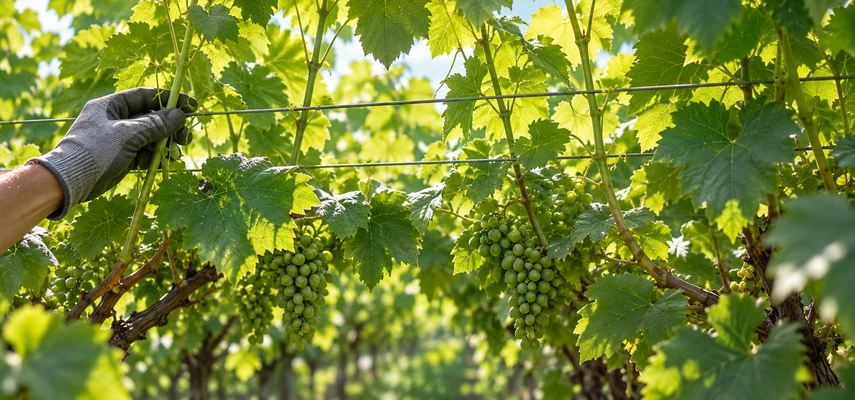

A vineyard can have plenty of leaves and still struggle to ripen its grapes. The problem may be where those leaves sit. A dense outer layer intercepts the light, leaving the interior shaded, the fruit difficult to reach and the next season’s buds developing in poor conditions. Canopy management is partly the art of making useful space.
That does not mean stripping every bunch into full sunshine. Fruit that has grown under cover can be damaged when suddenly exposed during hot weather. Nor does it mean trimming every row into an identical green rectangle. The useful canopy fits the vine’s growth, the local weather, the crop and the intended wine.
In the official D1 specification, canopy aims and techniques belong within vineyard management and its consequences for production. A good explanation connects the intervention to leaf function, fruit conditions, maturity and cost. Saying that leaf removal improves quality skips most of the interesting part.
Canopy management begins with useful leaf area
Leaves supply carbohydrates through photosynthesis. Their usefulness depends on health, exposure and environmental conditions as well as their combined area. Doubling the amount of foliage does not necessarily double the vine’s carbohydrate production when much of the added foliage sits behind existing leaves.
Think about a crowded bookshelf in front of a window. Adding another shelf behind it creates more shelf space but does not create more daylight. In a vine, the parallel is self-shading: the arrangement of foliage can limit what an apparently large canopy achieves. The analogy explains access to light, rather than making leaves interchangeable with furniture.
Canopy microclimate means the conditions within this small environment, including light, temperature, humidity and air movement. Conditions around leaves and bunches can differ from the weather station’s reading. Inspecting the canopy therefore provides information that a regional climate description cannot supply.
An appropriate canopy has enough functioning foliage to support the crop and the vine’s continuing needs. It also permits workable fruit conditions and vineyard operations. The target is neither the smallest possible canopy nor the largest. A weak vine and a vigorous vine can both need intervention, for different reasons.
Start with diagnosis before removing growth
Look inside the canopy as well as along its outer surface. Are shoots crowded or tangled? Are bunches pressed together? Does the interior remain damp after surrounding foliage dries? Are gaps exposing fruit to intense afternoon heat? These observations identify different problems, even when the rows look similarly neat from a distance.
Record shoot population, crop estimates, growth and maturity across representative parts of the block. Variation matters: a wet hollow and a shallow upper slope may not justify the same treatment. Returning to the same marked areas helps distinguish a persistent pattern from a single striking vine.
Consider the underlying growth supply. Water availability, nutrition, root environment, planting density and the training framework all influence the foliage that develops. Removing growth changes the present canopy, but vigorous vines may replace it with new laterals. Oregon State’s discussion of vine balance distinguishes direct canopy operations from management of these underlying conditions.
That distinction has a practical consequence. Repeated trimming can be necessary this season while a longer-term investigation addresses why the block repeatedly produces more growth than its available space accommodates. A successful immediate operation does not prove the underlying cause has disappeared.
Shoot thinning changes the population
Shoot thinning removes selected shoots after growth begins. It can reduce crowding, improve distribution and alter crop potential when fruitful shoots are removed. This is different from removing leaves from shoots that remain. The two operations change different parts of the canopy and need separate justification.
Selection should consider fruitfulness and future renewal positions. A shoot without bunches may still be useful for renewing an awkward or damaged part of the vine. Automatically removing every unfruitful shoot could solve a current crowding problem while creating a structural problem for the following winter.
Timing involves a compromise between identifying useful shoots and completing the work efficiently before growth becomes more tangled and woody. Frost risk and available labour can complicate that window. The University of Georgia shoot-thinning guide illustrates these choices in humid southeastern vineyards; its local shoot-density targets are not global prescriptions.
Thinning can reduce yield potential, but it need not reduce final yield in direct proportion to shoot numbers. The fruitfulness of the removed shoots, later development and losses all matter. Evaluate the resulting distribution of productive shoots rather than assuming every removed shoot represents an identical amount of lost crop.
Shoot positioning arranges the growth that remains
Positioning directs shoots through the space provided by the training system. In an upright canopy, foliage wires help organise upward growth. Other systems separate shoots into different directions or curtains. The purpose is an effective arrangement, rather than merely keeping tendrils away from the tractor driver.
Separating tangled growth can improve access to light and make the fruit zone easier to inspect and treat. However, positioning must fit shoot condition and the system. Aggressive handling can damage shoots, and a nominally divided canopy achieves little if the two zones grow back into one another.
The British Columbia canopy guide describes positioning alongside shoot and cluster thinning. Its examples show why the framework and summer work must agree: installing wires does not position the shoots by itself. Labour and timely follow-up belong in the evaluation of a training system.
Leaf removal changes fruit exposure
Removing selected leaves near bunches can improve airflow and access for crop protection. Faster drying and better access may help manage disease pressure in a congested fruit zone. It remains one part of protection, alongside monitoring, weather assessment and other suitable measures; an open canopy is not immunity from infection.
The same operation increases exposure to radiation and heat. Its consequences depend on intensity, timing, weather, variety and which side of the row is treated. A beneficial practice in a cool, humid block may be excessive in a warm site with already sparse foliage. The University of Georgia canopy resources place fruit-zone work within this wider set of management choices.
Leaves also help shade bunches during extreme heat. AWRI’s hot-weather guidance discusses keeping protective cover and reconsidering work that increases exposure ahead of heat. A plan should respond to the forecast rather than follow a fixed seasonal checklist regardless of conditions.
Suppose two sides of a row receive different afternoon exposure. Removing an equal number of leaves from both sides produces a symmetrical operation, but may not produce equally suitable fruit conditions. The sensible target is the intended microclimate. A mechanically tidy treatment is useful only when its effects fit that target.
Trimming and crop thinning solve different problems
Trimming or hedging shortens excessive shoot growth. It can maintain access and reduce overhanging foliage that shades neighbouring rows. It also removes leaf area and can stimulate lateral growth. The balance between useful clearance, lost function and renewed congestion must be assessed in the actual block.
An operator should therefore ask why another pass is needed. Has growth continued because water and nutrients remain plentiful? Is the canopy space too narrow? Is an earlier cut contributing to renewed lateral growth? Different causes can produce the same visible need for trimming, and their longer-term solutions differ.
Crop thinning removes bunches or parts of the crop. It changes demand relative to available leaf function, rather than directly adding photosynthetic capacity. A vine carrying more fruit than it can mature for the intended wine may benefit, while a well-supported crop may offer little reason for removal.
Timing affects what the intervention can achieve. Removing damaged fruit near harvest can improve what reaches the winery, but it cannot recreate the growing season already experienced by the remaining bunches. Earlier changes interact with subsequent growth and development. There is no fixed percentage reduction that guarantees a corresponding quality improvement.
Relate yield, composition and wine purpose
Distinguish yield per vine from yield per unit area. A treatment that reduces kilograms per vine may have a different commercial significance at different planting densities. Compare final marketable crop per hectare as well as the retained crop’s condition, composition and intended use.
Vine and grape health are necessary parts of that comparison. A larger sound crop may be more useful than a smaller crop with heat-damaged berries. Equally, retaining every bunch is unhelpful if disease or insufficient maturity makes part of the harvest unsuitable. The relevant quantity is usable fruit for the proposed product.
Grape component balance includes sugar and acidity alongside other constituents. Aroma and flavour ripeness may develop differently from sugar concentration, especially when heat, shade or stress changes the relationship. A higher sugar reading after an intervention does not by itself establish improved flavour, colour or suitability.
For red wine styles, canopy decisions may affect the conditions for colour and tannin development. White wine styles can require a different balance of aroma, freshness and exposure. Rosé wine styles still need healthy grapes at suitable maturity, even where the intended extraction and final colour differ from a red wine made from the same variety.
Residual sugar styles add further objectives, such as obtaining suitable maturity for a sweet wine rather than simply maximising sugar at any cost. No- and low-alcohol styles also require flavour and structure: limiting sugar without considering other components can produce an unsuitable raw material. Canopy work should follow the intended product, not an isolated laboratory target.
Quality levels from poor through acceptable, good and very good to outstanding concern the resulting wine. Price bands from inexpensive and mid-priced to premium and super-premium describe a commercial context. Neither scale is determined by the number of canopy passes. Extra work needs a benefit that matters to the crop buyer or wine producer.
Compare the full season’s result
Hand work can be selective but expensive and difficult to complete quickly over a large area. Machinery offers capacity and repeatability, provided access, canopy shape and settings are suitable. Costs include follow-up work and unintended crop damage as well as the initial pass.
Compare treated and untreated areas where a practical trial is possible, keeping other important differences in view. Record work time, fruit health, maturity and marketable yield. Several seasons are more informative than a single successful demonstration because the balance between shade, moisture and heat changes with weather.
A defensible canopy recommendation identifies the problem, explains the physical change and predicts its consequences with limits. It also states what evidence would change the decision. That is more useful than declaring that exposed fruit is good, low yields are good or a neat vineyard must make good wine.
Connect this explanation with irrigation and vine nutrition and vine training and pruning as linked parts of the same explanation. Trace the relevant growing or cellar decision through to its consequences, and identify the condition that could change the result rather than treating the relationship as automatic.
Original Diploma practice
These original exercises support explanation and evaluation. They are not official WSET questions and have no official mark allocations.
Question 1: compare two leaf-removal proposals
A humid, shaded block and a hot, sparsely foliated block are offered the same intensive leaf-removal programme. Evaluate the proposal.
Indicative answer points: diagnose starting conditions; explain airflow and crop-protection access; consider productive leaf area; assess heat and sudden exposure; adapt intensity, timing and row side; compare costs and evidence.
Outline answer: The same operation will start from different canopy conditions. In the shaded block, targeted removal may improve fruit-zone access and drying, provided adequate useful foliage remains. In the sparse block, more removal may offer little access benefit while increasing heat exposure. Review forecast conditions and the fruit’s existing exposure before acting. Trial an appropriate treatment rather than treating a shared operation as proof of shared benefit. Assess sound yield, maturity and labour against the intended wine.
Question 2: diagnose repeated trimming
A vigorous block requires repeated hedging and soon becomes dense again. Explain why trimming alone may not resolve the problem and evaluate further investigation.
Indicative answer points: separate present dimensions from underlying vigour; explain replacement lateral growth; review water, nutrients and soil variability; assess available canopy space; retain enough functioning leaves; compare seasonal costs.
Outline answer: Hedging controls dimensions but does not necessarily remove the conditions supporting strong growth. Laterals can refill the available space. Investigate resource supply, root environment and whether the training system can accommodate the growth. Avoid assuming that imposing water stress or stopping nutrients is automatically appropriate; assess vine needs and local conditions first. Maintain practical access this season while testing an underlying management change and recording its effects over time.
Question 3: evaluate a lower-yield claim
A producer removes bunches from a healthy block and advertises the resulting wine as better because yield was lower. What evidence would support or weaken that conclusion?
Indicative answer points: compare crop demand with functioning canopy; assess initial maturity constraints; distinguish healthy crop from removed losses; compare final composition and wine; consider timing and weather; include cost per usable tonne.
Outline answer: Lower yield alone does not establish a better result. A benefit is plausible if the initial crop exceeded what the vine could mature for the intended wine. Compare a suitable untreated area, harvest composition, fruit condition and resulting wines while considering other differences. Late removal of damaged bunches may improve winery intake without proving that the remaining grapes ripened better. Include lost usable volume and extra work in the commercial evaluation, and avoid extending one season’s observation into a universal rule.












