










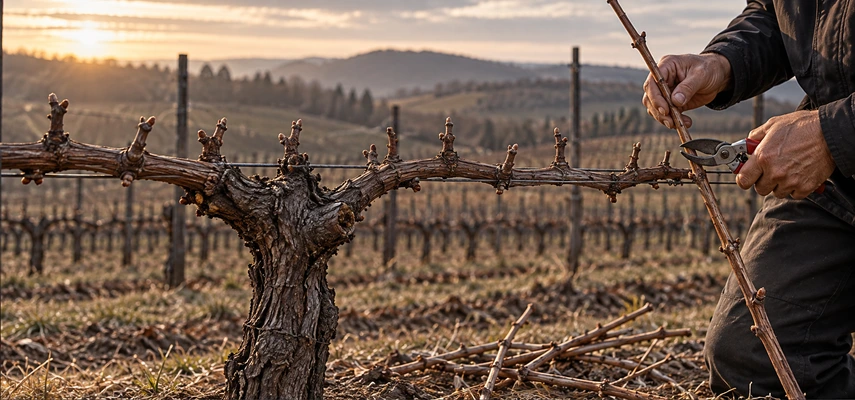

A dormant vineyard looks like a collection of sticks until someone starts choosing which sticks stay. Those choices establish where next season’s shoots will grow, how much potential crop the vine carries and how easily people and machines can work around it. Vine training and pruning are therefore decisions about the coming harvest and the vineyard’s longer working life.
The tempting shortcut is to rank systems: cane pruning for quality, spur pruning for volume, bush vines for authenticity. None survives much contact with an actual vineyard. A suitable system depends on growth habit, bud fruitfulness, vigour, climate, labour and the intended wine. The useful question is what the arrangement allows this particular vine to do.
The official Diploma specification connects vineyard management with grape composition, yield, wine style, quality and price. Training and pruning make a good exercise in that chain because a visible cut can have consequences several months later.
Vine training and pruning: framework versus renewal
Training establishes and maintains the vine’s shape. It determines the height and arrangement of its trunk, head and any permanent arms, known as cordons. Trellising supplies support through posts and wires; some head-trained bush vines grow without a continuous wire framework. Pruning selects and shortens wood, renewing productive positions and regulating the number of retained buds.
A green shoot becomes a woody cane as it matures. Next season, buds on that one-year-old wood can produce shoots bearing bunches. The trunk and older arms provide a lasting framework, but their age does not make every shoot arising directly from them fruitful. Keeping old wood and keeping fruitful buds are different decisions.
The North Carolina winegrape guide explains this relationship between vine structure, annual growth and pruning. It is the biological reason pruning must provide renewal as well as remove unwanted growth. A grower cannot keep cutting away last season’s shoots without considering where the next crop will originate.
Distinguish dormant pruning from summer canopy work. Winter decisions set the initial bud positions and potential shoot population. Shoot thinning, positioning, trimming and leaf removal subsequently modify the living canopy. Good winter planning can reduce later difficulties, although weather and uneven growth still require decisions during the season.
Cane pruning: renew the longer fruiting wood
Cane pruning retains selected lengths of one-year-old wood with several buds, commonly secured along a support wire. Other growth is removed. Short renewal spurs may be retained near the head to provide conveniently placed shoots from which future fruiting canes can be selected.
The fruiting cane is not a permanent cordon. It carries the buds that generate the coming season’s shoots and is normally replaced during the next pruning cycle. Keeping the renewal area reasonably close to the desired framework helps avoid a vine whose productive wood gradually wanders away from its allotted space.
Selection involves more than choosing the longest cane. Position, health, maturity and the distribution of usable buds matter. A poorly placed cane can create crowded shoots or awkward bends even when its bud count looks satisfactory on a worksheet. Skilled selection and tying take time, which affects labour requirements and the practicality of mechanisation.
Cane pruning can be useful where basal buds are insufficiently fruitful for a short-spur approach. Longer retained wood includes buds farther along the cane, potentially giving access to more fruitful positions. That is a conditional advantage, not a rule that every cool site or every particular grape ancestry requires cane pruning.
Spur pruning: retain short sections at renewal positions
Spur pruning retains short pieces of one-year-old wood at established positions. A spur often has two retained buds, but the appropriate length varies with the material, system and production objective. On a cordon-trained vine, these short units sit along older permanent arms; a head-trained vine can also be spur-pruned without long horizontal cordons.
The new fruiting shoots still arise from buds on retained one-year-old wood. The distinction from cane pruning is principally how that wood is selected and arranged, rather than a different rule about where grapes grow. Oregon State’s illustrated pruning guide shows both approaches and their renewal structures.
A regular cordon with accessible spur positions can suit mechanical pre-pruning and efficient follow-up work. However, unsuitable cuts, dead positions and crowded growth still need attention. A machine-compatible framework does not automatically produce evenly distributed fruitful shoots or eliminate skilled labour.
Basal bud fruitfulness is central to suitability. If the retained short spurs repeatedly produce few bunches despite healthy shoots, simply adding fertiliser may address the wrong problem. Examine variety, bud position, previous canopy conditions and pruning practice before changing the crop target. More growth is not necessarily more fruit.
Trellising and training systems organise space
Vertical shoot positioning, usually shortened to VSP, arranges growing shoots in a relatively narrow upright canopy with foliage wires. The vines supplying those shoots may be cane-pruned or spur-pruned. VSP describes the spatial arrangement of growth; it does not specify a single winter pruning method.
This can be practical where vine growth fits the available canopy space. Posts and wires organise access, while positioned shoots can make vineyard operations more predictable. Excessive vigour, however, can turn the narrow wall into a thick layer of shade. A tidy external outline can conceal a congested interior.
Divided systems distribute foliage into separate zones. Depending on design, shoots may be separated horizontally or directed both upward and downward. Their purpose includes accommodating growth with better light distribution. Additional structures and positioning work cost money, and a weak vine may not produce enough foliage to use the extra space effectively.
The British Columbia trellis guide compares these arrangements and stresses matching structure to vine growth. Its local dimensions and recommendations should not become universal specifications. An exposed site, a winter-cold region and a sheltered vigorous block may need different practical solutions.
Bush training can provide a compact framework with relatively little trellis material. Its suitability depends on local conditions and operations. Low fruit positions, restricted access or an irregular canopy can complicate some machinery, while hand work may remain commercially viable for a particular vineyard. The silhouette alone cannot establish wine quality.
Bud numbers are potential crop, not a harvest guarantee
Retained buds influence possible shoot and bunch numbers. Actual yield also depends on bud survival, bud fruitfulness, budbreak, fruit set, berry size and later losses. Two vines pruned to the same number of buds can therefore deliver different crops. A counting exercise is useful only when connected to the condition of those buds and the season ahead.
Retaining too much potential crop for a vine’s effective leaf area and growing conditions can delay the required maturity. Conversely, severe pruning can leave too few shoots and little crop, with vigorous growth concentrated into the remaining positions. The objective is a workable balance, assessed through growth, fruitfulness, crop and maturity records rather than a universal bud number.
Vine density changes the scale of the calculation. In a hypothetical example, 3,000 vines per hectare producing 3 kg each and 6,000 vines producing 1.5 kg each both yield 9,000 kg per hectare. The yield per vine differs; the yield per unit area does not. Neither calculation establishes equal canopy exposure, establishment cost or grape quality.
Closely planted vines have less space available to each plant. Wider spacing may require each vine to occupy more canopy length. Decisions about bud load must therefore fit the row layout and the growth the site supports. Transferring a successful buds-per-vine target between different planting densities can create a very different shoot population per hectare.
Connect the cuts to wine style, quality and cost
Vine and grape health underpin the outcome. A framework that permits effective access and manageable growth can support monitoring and crop protection. Appropriate foliage distribution helps expose functional leaves while avoiding unnecessary crowding. Greater fruit exposure is not endlessly beneficial: hot conditions can make excessive exposure damaging.
Grape component balance and aroma and flavour ripeness depend on the interaction of crop, leaf function and environment. Training and pruning influence those conditions indirectly. They cannot manufacture missing seasonal warmth, guarantee retained acidity or rescue fruit that the site cannot reliably mature for its intended purpose.
For red wine styles, the target may include suitable tannin and colour development alongside sugar and acidity. White wine styles may prioritise a different balance of freshness and flavour. Rosé wine styles likewise require sound fruit with the intended maturity; a pale colour does not make poor vineyard management irrelevant. The appropriate crop is the one the site can support for the intended product.
Residual sugar styles are also diverse: grapes intended for a sweet wine may require particular maturity or concentration, rather than merely a larger crop. No- and low-alcohol styles need suitable flavour, acidity and healthy fruit too. Choosing a crop solely to keep sugar low can leave other components unsuitable; training is one part of the production plan.
Quality levels from poor through acceptable, good and very good to outstanding describe the resulting wine, not the prestige of its pruning system. Price bands from inexpensive and mid-priced to premium and super-premium reflect commercial positioning as well as costs and demand. More hand labour raises costs without guaranteeing a proportionate improvement in either quality or achievable price.
Health, timing and a defensible decision
Pruning wounds can provide entry points for wood-infecting pathogens. UC IPM’s Eutypa guidance explains the connection between rain-released spores and susceptible cuts, and discusses preventive pruning strategies under California conditions. This supports considering local disease pressure and timing, rather than exporting a particular calendar date to every region.
Cold injury adds another consideration. A damaged bud population may justify assessing survival before finalising the retained load. Operational capacity matters too: a large vineyard cannot necessarily complete every cut within the ideal short window. An evaluated recommendation should acknowledge those competing demands.
Start with evidence of the problem: low fruitfulness, shaded growth, expensive hand work or damaged renewal positions. Explain how a proposed change affects shoot distribution and crop potential, then test its implications for maturity, health and cost. The best answer may retain the existing system while improving its execution. New wires are not automatically a better argument.
Connect this explanation with canopy management and vineyard establishment as linked parts of the same explanation. Trace the relevant growing or cellar decision through to its consequences, and identify the condition that could change the result rather than treating the relationship as automatic.
Original Diploma practice
These original exercises develop causal and evaluative writing. They are not official WSET questions and carry no official mark allocations.
Question 1: investigate an unfruitful block
A healthy, spur-pruned block produces vigorous shoots but few bunches. The manager proposes heavier fertilisation. Explain what should be investigated and evaluate a trial of cane pruning.
Indicative answer points: distinguish vegetative growth from fruitfulness; examine basal versus more distant bud positions; consider shading during bud development; check bud survival and records; evaluate additional selection and tying labour; compare crop maturity rather than yield alone.
Outline answer: Vigorous shoots do not establish that the retained basal buds contain enough inflorescences. Extra nutrients may increase unwanted growth. Examine fruitfulness by bud position, the previous canopy and relevant variety experience before attributing the result to pruning method. A replicated comparison retaining appropriate longer wood could test whether more distant positions improve cropping. Record shoot numbers, bunches, harvest composition and work time. Cane pruning is justified if useful production gains and suitable maturity outweigh its costs; the initial observation alone does not prove it will succeed.
Question 2: evaluate a divided canopy
A high-vigour VSP block repeatedly develops a shaded interior. Compare converting to a divided system with improving management of the present arrangement.
Indicative answer points: identify available space and growth; explain distributing foliage; assess extra structures and positioning; consider row and machine access; examine existing crowding causes; relate benefits to crop and wine objectives.
Outline answer: Dividing growth may improve the use of light by spreading foliage into separate zones. It requires suitable geometry, sufficient growth and additional establishment or management expenditure. First assess whether excessive shoot density, poor positioning or another correctable practice explains the present congestion. Conversion will not deliver its intended effect if the separated zones become tangled again. Compare practical canopy exposure, fruit health, maturity and whole-season labour under the alternatives, including whether any improvement is valuable for the proposed wine.
Question 3: compare equal bud counts
Two blocks retain the same buds per vine. One has twice as many vines per hectare and recently suffered winter injury. Explain why equal harvest yields and costs cannot be assumed.
Indicative answer points: distinguish vine and area measures; calculate the density effect on retained buds per hectare; assess viable buds and fruitfulness; include fruit set and berry size; compare framework, labour and mechanisation costs.
Outline answer: Equal buds per vine do not mean equal buds per hectare when planting density differs. Nor do retained buds equal viable fruitful buds: winter injury can change the proportion producing usable shoots and bunches. Later reproductive development and losses add uncertainty. More vines and different row geometry can also change pruning work, material requirements and equipment access. Compare actual viable bud populations, canopy space, crop records and harvest composition alongside costs. A recommendation based only on a matching winter count omits the biological and commercial questions that matter.












