











Two Austrian whites can begin with Grüner Veltliner and arrive at quite different destinations. One is brisk, peppery and ready for an uncomplicated lunch. Another has ripe fruit, considerable texture and enough concentration to develop in bottle. The grape provides possibilities; site, crop, harvest and cellar decisions determine which ones reach the glass.
Austrian wines make more sense when you follow those decisions through the country’s eastern vineyards. Add red grapes, noble-rot sweet wines and regional origin rules, and the picture becomes far richer than “Austria makes dry white wine.” It does, but that’s only the opening sentence.
This is article 20 of The TFE Guide to WSET Level 3 Wine, following the Austrian regions, grapes and law concepts in the official specification. Questions and marking guidance are original study material, not official WSET examination content.
Austrian wines begin with contrasting air masses
Most Austrian vineyards lie in the east, where continental influences bring warm summers and cold winters. Warm Pannonian air from the east meets cooler influences from higher ground. Local exposure, elevation and proximity to water modify that broad pattern. Neither “continental” nor “near a river” tells you the whole temperature story.
Warmth helps grapes accumulate sugar and develop ripe flavours. Cooler nights can help retain acidity, but the result still depends on variety, site and harvest date. In a hot, dry season, sufficient water becomes essential: severe stress can restrict photosynthesis and interrupt ripening. Spring frost, hail and harvest rain remain possible hazards.
Niederösterreich, or Lower Austria, is the large northeastern wine-growing state around Vienna and along the Danube. It includes Wachau and Weinviertel as distinct, more specific regions. The regional organisation’s climate and terroir guide describes this mixture of Danube, Pannonian and cooler influences. Keep the broad state name separate from the individual DAC origins within it.
Grüner Veltliner: Pepper is a clue, not the whole explanation
Grüner Veltliner commonly gives dry wines with refreshing acidity, citrus or apple fruit and a peppery note. Riper examples can show stone fruit and greater weight. It isn’t related to Riesling simply because both make important Austrian whites. The Weinviertel growers’ grape account describes the broad stylistic range, including fuller wines.
Crop management matters because a productive vine must have sufficient resources to ripen its fruit. Excessive crop can dilute flavour or delay development. Appropriate pruning, shoot management and yield decisions can support the intended concentration. Cutting the crop indiscriminately isn’t a quality guarantee; the aim is balance between vine capacity and fruit.
Loess soils can provide useful water storage, helping the vine through dry periods. Freely draining, shallower soils create a different balance of vigour and drought risk. In an explanation, connect soil properties to water and vine growth instead of claiming a pepper flavour was extracted directly from a rock. The regional soil overview places those differences in context.
Riesling and Welschriesling aren’t interchangeable
Riesling can retain high acidity while developing citrus, peach and apricot flavours. Austrian examples are often dry, with concentration and body varying by ripeness and site. Well-exposed slopes can help it ripen; cooler air and suitable harvest timing help maintain balance. A warm site can be an advantage until sugar accumulation outruns the freshness or flavour the producer wants.
Welschriesling is a separate grape, not another name for Riesling. It can make fresh, relatively straightforward dry whites and concentrated sweet wines. A dry producer example shows how fruit and lively acidity can shape an early-drinking style. The variety’s role in botrytised sweet wines is especially important around Lake Neusiedl in Burgenland.
The comparison is useful in tasting: identify acidity, fruit, sweetness and body before relying on a familiar name. “Riesling” appearing within a longer grape name doesn’t establish a family relationship, a production method or a guaranteed flavour profile.
Wachau: A Danube landscape built with stone and labour
Wachau lies along the Danube between Melk and Krems. Warm influences from the east interact with cooler air arriving from surrounding higher ground. Aspect and position along the valley change ripening opportunities. The growers’ Wachau overview describes these contrasts and the region’s stony terraces.
Riesling and Grüner Veltliner are the defining white-grape references. Weathered rocky soils on slopes and pockets of deeper material offer different water supplies and growing conditions. Don’t turn a useful tendency into a rule that one variety can grow only on one soil. A suitable site must provide enough heat and water for the intended wine.
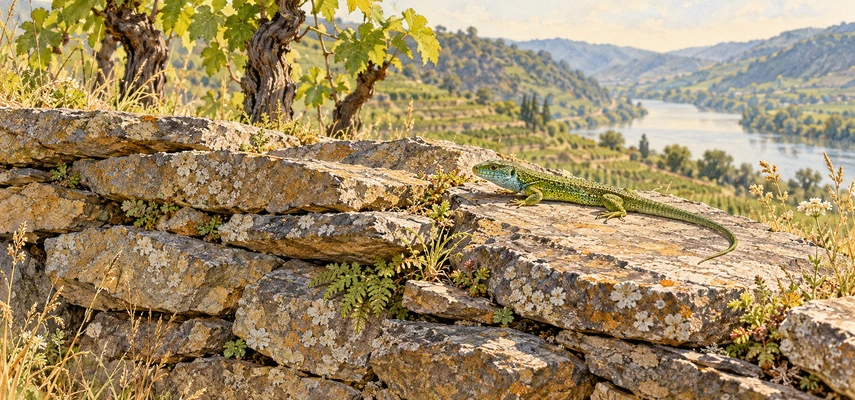
Dry-stone terrace walls create usable vineyard ground, help retain soil and require maintenance. Access can restrict ordinary machinery and increase hand work. The association’s terrace-wall explanation also describes their role as habitat, including for green lizards. Their beauty is visible from the river; the repair bill is less photogenic.
Those physical demands can raise grape costs. A concentrated wine may also involve selective harvests, separate small lots and longer cellar holding. None proves excellence by itself. The finished wine must still balance ripe fruit, acidity, alcohol and texture.
Wachau DAC and the familiar style terms
Wachau DAC is an origin framework with regional, village and single-vineyard levels. Hand harvesting is a key requirement. The permitted grape palette narrows as origin becomes more specific; single-vineyard wines focus on Grüner Veltliner and Riesling. The current growers’ DAC guide explains this structure. The term Ried identifies a named vineyard on Austrian labels.
Alongside that framework, Vinea Wachau members use the registered style terms Steinfeder, Federspiel and Smaragd. In broad terms they indicate lighter, medium-weight and more powerful styles. The association’s own explanation distinguishes these dry styles and their conditions. Smaragd isn’t an Austrian synonym for a sweet wine or for every producer’s highest-priced bottle.
Read the two systems together: DAC supplies geographical and production context, while an association style term adds a different message. Don’t transfer those private terms to every Austrian region, or assume every Wachau producer is required to use them.
Weinviertel: A clear regional Grüner identity
Weinviertel occupies a broad area north and northeast of Vienna towards the Czech and Slovak borders. Loess is widespread, but soil and local climate vary. Grüner Veltliner is central to its identity. The regional overview distinguishes its classic, fresh style from more powerful Reserve wines.
Weinviertel DAC identifies the region’s typical dry Grüner Veltliner style, often with peppery spice and fresh fruit. Other varieties grown locally don’t automatically qualify for that designation; wines outside its profile may use a broader permitted origin such as Niederösterreich. Origin and variety must be read together.
Reserve can bring more concentration, body and length, with subtle wood influence permitted under its conditions. The DAC Reserve description makes that distinction explicit. More body doesn’t require aggressive oak, and a lighter wine isn’t faulty because it aims for an earlier drinking window. Each needs balance within its intended style.
Burgenland: Warmth supports reds and something sweeter
Burgenland lies along Austria’s eastern border with Hungary. Warm Pannonian conditions help red grapes achieve ripeness, while sites vary in exposure, soils and influence from Lake Neusiedl. The broader state contains several more specific origins; it isn’t one DAC with one grape recipe.
Blaufränkisch can produce wines with dark fruit, spice, firm tannin and refreshing acidity. Its ripening needs make site and season important. The Austrian ministry’s grape account places it particularly in Burgenland. Adequate fruit concentration matters when extraction or maturation creates a structured wine.
Zweigelt, a crossing of Blaufränkisch and Saint Laurent, commonly offers cherry fruit and a rounded texture. It can make approachable young wines or more ambitious examples. A producer’s technical description illustrates different sites and maturation choices. Saint Laurent, also written St. Laurent, can contribute fragrant cherry fruit and fine texture; a producer example shows why it deserves its own identity rather than being treated as a blending footnote.
Sweet wines need the right sequence of conditions
Around Lake Neusiedl, humidity and mist can encourage noble rot when followed by suitable drying conditions. Botrytis affects berry skins, promotes dehydration and changes aroma. Concentrated grapes can then produce richly sweet wines with honeyed and dried-fruit character. Welschriesling is important, alongside other white varieties; the Burgenland wine guide explains that diversity.
Persistent wet weather can instead produce damaging rot. Repeated selective picking requires labour, while dehydration and rejection reduce usable juice. High acidity helps balance the resulting sweetness. These are mechanisms behind style and cost; “near the lake” alone doesn’t explain a successful sweet wine.
Vineyard and cellar choices should match the goal
For a fresh dry white, timely picking, gentle pressing, protected handling and controlled fermentation can preserve fruit and acidity. Steel or large old wood can avoid pronounced new-oak flavour. For a fuller white, lees contact and different vessel choices may add texture, provided they support the fruit. Malolactic conversion is a decision about acidity and style, not a compulsory national recipe.
For reds, ripeness and measured skin extraction establish the balance of fruit and tannin. Maturation can integrate texture, with new oak adding flavour when used. A dark colour isn’t evidence that more extraction is always desirable. For sweet wines, concentration and fermentation endpoint shape sugar, alcohol and body; appropriate stability is needed to prevent renewed fermentation in bottle.
Qualitätswein, Prädikat and DAC: Three separate ideas
Qualitätswein identifies wine meeting protected-origin and quality requirements, including official testing. Prädikat categories add grape-ripeness and harvest-method requirements. Austrian Prädikatswein cannot be enriched or sweetened with added sweet reserve. The ministry’s wine-law explanation sets out that distinction. Don’t simply import every German category into Austria’s framework.
Spätlese and Auslese concern ripe or selected grapes; Beerenauslese and Trockenbeerenauslese involve increasingly concentrated selected fruit with noble rot important. Eiswein relies on natural freezing and pressing frozen grapes. Strohwein or Schilfwein involves drying grapes after harvest. These mechanisms differ even when the finished wines are sweet.
DAC, short for Districtus Austriae Controllatus, identifies a regionally typical wine under its specific rules. The national wine guide explains that origin focus. A dry Weinviertel Grüner and a Burgenland sweet wine therefore need different explanations, even though both are Austrian quality wines. Neither DAC nor Prädikat automatically supplies a tasting score.
Explain quality and price with different evidence
Assess quality through balance, intensity, complexity and length. A concentrated Grüner needs freshness; a firm Blaufränkisch needs enough fruit; a sweet wine needs acidity to prevent heaviness. A simpler wine can be well made without aiming for long maturation.
For price, connect slopes, wall maintenance, hand work and crop losses to grape costs. Sorting, barrels, refrigeration, small-lot handling and stock holding affect production expense. Transport, storage, applicable taxes and trade margins contribute to retail prices. Market demand for a scarce producer or site can add a premium. These influences help explain price without making it a substitute for assessing the wine.
Knowledge check: 10 original multiple-choice questions
Choose one correct answer per question. These are independent practice questions.
1. Which statement correctly relates Niederösterreich and Wachau?
2. What can Grüner Veltliner produce?
3. Why can loess be useful in a dry season?
4. Which statement about Welschriesling is accurate?
5. What do Wachau terrace walls help explain?
6. How should Smaragd be interpreted?
7. What is the central grape identity of Weinviertel DAC?
8. Which is a useful Burgenland red-grape reference?
9. Which conditions can support noble-rot concentration?
10. What does DAC primarily communicate?
Answers and explanations
1. B — Broad and specific origins. Niederösterreich is the larger wine-growing state, with Wachau among its more specific regions. Keep that geographical relationship separate from grape variety and style terms. A broad state label doesn’t itself establish one DAC profile.
2. D — A range of possible styles. Grüner Veltliner can be fresh and relatively light or more concentrated and full-bodied. Site, crop, ripeness and cellar choices help explain the difference. A peppery note is a useful reference, but isn’t the whole quality assessment.
3. A — Water availability. Useful water storage can help vines maintain growth and photosynthesis through dry conditions. The outcome depends on soil depth, roots and the season. This mechanism is more defensible than claiming a particular flavour transfers directly from soil into wine.
4. C — A separate grape. Welschriesling isn’t a synonym for Riesling. It can produce fresh dry wines and is important in concentrated sweet styles around Lake Neusiedl. Grape identity alone doesn’t establish sweetness; fruit condition and winemaking remain essential.
5. B — Physical access and expense. Terrace walls create usable ground on steep slopes and help retain soil, while maintenance requires materials and labour. They also provide habitat. Those functions help explain production costs without proving that every terraced wine has superior quality.
6. A — An association style term. Smaragd belongs to Vinea Wachau’s registered style framework and describes a more powerful dry style meeting its conditions. Wachau DAC provides a separate origin framework. The terms coexist, and neither can be transferred to every Austrian producer or region.
7. D — Grüner Veltliner. Weinviertel DAC is associated with the regionally typical dry Grüner profile. Other locally grown varieties don’t automatically qualify for that designation. Reserve provides another set of conditions for a more concentrated expression rather than a new grape identity.
8. C — Blaufränkisch. Its dark fruit, acidity and tannin make it an important Burgenland reference. Warmth helps ripening, while crop, extraction and maturation choices affect balance. Zweigelt and Saint Laurent provide other red-wine possibilities rather than identical copies.
9. B — Moisture and drying. Appropriate humidity can encourage botrytis, followed by drying that promotes concentration. Continuous wetness can undermine fruit health. Selection and timing matter, and natural freezing represents a different concentration method rather than a requirement for noble rot.
10. A — Regional identity. DAC connects an origin with the relevant grape and production conditions for a typical regional wine. Rules differ between DACs. It isn’t an exact residual-sugar figure or a guarantee that sensory quality is identical across producers and vintages.
Written exercise 1: Explain a fuller dry white in five marks
Question: Explain five links that can support a concentrated but balanced dry Grüner Veltliner from a suitable Austrian site. Give five distinct points. This is an original five-mark practice exercise.
Model answer: A sufficiently warm, exposed site supports flavour and sugar ripening. Adequate soil water enables the vine to continue photosynthesis through dry conditions. Matching crop size to vine resources helps obtain flavour concentration. Harvest timing balances that ripeness against retaining acidity and avoiding excessive potential alcohol. Fermentation to dryness produces alcohol and body while the retained acidity supports freshness in the finished wine.
Why it earns credit: Award one practice mark each for heat/exposure, water and vine function, crop balance, harvest timing and fermentation with final balance. Simply repeating “good soil” doesn’t explain a mechanism. These are independent study points rather than an official WSET marking scheme.
Written exercise 2: Explain selection costs in five marks
Question: Explain five production factors that can increase the cost per bottle of a small Burgenland noble-rot sweet-wine lot compared with a straightforward early-release dry white. Keep the answer about production.
Model answer: Waiting for suitable fruit increases exposure to weather and deterioration risks, which can reduce the usable crop. Repeated hand-picking passes require additional labour. Dehydrated berries give less juice, spreading costs over fewer bottles. Sorting rejects unsuitable fruit and adds cellar labour. Holding the finished wine before sale uses storage and delays income, increasing stock-related costs.
Why it earns credit: Award one practice mark each for crop-loss risk, repeated picking, dehydration-related volume, separate sorting and stock holding. A famous name may increase market price, but it doesn’t itself explain physical production expense. This original five-point model isn’t an official examination answer.
One-page revision summary
| Region or idea | Connection to retain |
|---|---|
| Niederösterreich | Broad Lower Austria origin encompassing several specific regions. Danube, Pannonian and cooler influences create local contrasts. |
| Grüner Veltliner | Acidity, fruit and peppery spice can appear in light or concentrated styles. Crop, water and ripeness affect balance. |
| Riesling | Dry examples often combine high acidity with citrus and stone fruit. A suitable site must provide enough heat and water. |
| Wachau | Danube slopes and terraces create varied sites and labour demands. Wall maintenance affects cost as well as landscape. |
| Wachau DAC | Regional, village and vineyard levels have their own conditions. Ried identifies a named vineyard. |
| Vinea Wachau styles | Steinfeder, Federspiel and Smaragd broadly progress from lighter to more powerful dry styles. They coexist with DAC. |
| Weinviertel | Peppery dry Grüner is the DAC identity. Reserve adds conditions for a more concentrated style. |
| Burgenland | Pannonian warmth supports reds, while Lake Neusiedl conditions can support noble-rot sweet production. |
| Red grapes | Blaufränkisch brings fruit and structure; Zweigelt and Saint Laurent offer different cherry-fruited expressions. |
| Welschriesling | A distinct grape from Riesling, with both fresh dry and concentrated sweet uses. |
| Qualitätswein and Prädikat | Quality/origin requirements and ripeness/harvest-method requirements answer different questions. Austrian Prädikatswein cannot be enriched. |
| DAC | An origin-and-typicity framework whose specific rules vary. It isn’t a universal sensory score. |
| Quality and price | Assess balance, intensity, complexity and length. Explain vineyard, cellar and commercial costs separately. |
A practical comparison
Taste a fresh Grüner Veltliner alongside a fuller dry example using modest pours. Record acidity, alcohol, body, flavour intensity and finish before reading any Reserve or Smaragd wording. Ask whether greater body comes with enough freshness. If adding Blaufränkisch, assess tannin texture separately from fruit intensity. Don’t award extra quality simply because a wine is heavier or its label sounds more imposing.
Sources and course context
Primary sources include the WSET specification, Austrian government wine guidance, the Lower Austria regional organisation, Weinviertel DAC and Vinea Wachau. Producer technical descriptions illustrate grape and cellar choices rather than universal regional recipes. National Austrian Wine material supports the Prädikat and Burgenland context. Exact numeric legal thresholds and changing national appellation counts aren’t reproduced.
Continue your studies: Articles 2, 4, 5, 6, 7 and 8 explain site, vineyard work, winemaking and maturation. Article 19 provides a German classification comparison, article 21 moves to Tokaj, and article 49 compares wine laws.












