










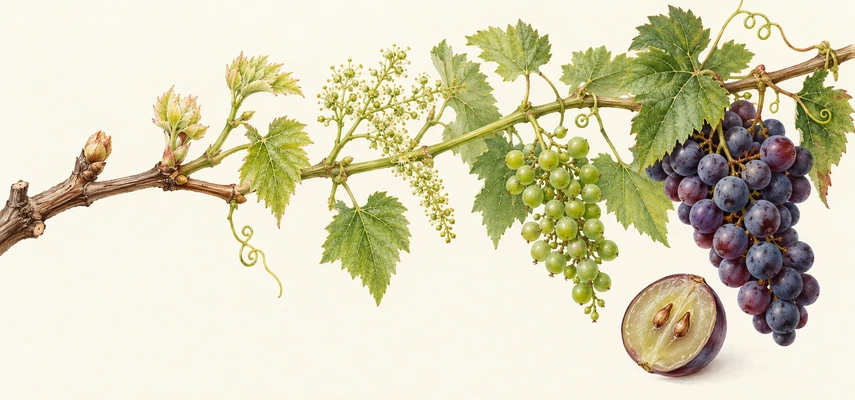

A grapevine has to finance a new growing season before it has a working canopy of leaves. It draws on reserves, builds shoots, produces flowers and then divides its resources between fruit and survival. Understanding how grapevines grow makes vineyard decisions easier to explain: the timing of an event often matters as much as the event itself.
Article #3 · Part I: Wine Science, Viticulture, and Winemaking. This independent lesson follows Unit 1 LO1, criterion 1, in the 2022 Issue 2 WSET Level 3 specification. Learn to distinguish species, varieties and clones; follow the annual cycle; and connect grape composition with potential wine style. The explanations and practice questions are original TFE material, without WSET affiliation or endorsement.
Species, varieties, clones and hybrids
Vitis is the grapevine genus. Vitis vinifera is the species to which familiar varieties such as Chardonnay, Cabernet Sauvignon and Riesling belong. A variety is a particular cultivated type with characteristic genetic and growing traits. Those traits influence ripening behaviour, grape composition and the styles that can be produced, though they do not dictate the finished wine alone.
A clone is vegetatively propagated material descended from a single selected vine. Clones within a variety may differ in features such as bunch size, yield, ripening or disease sensitivity. The OIV clonal-selection guidance explains selection within a variety. Choosing a clone is not the same as creating an entirely new variety through sexual reproduction.
In wine study, a crossing generally means offspring of two varieties within the same species. A hybrid combines ancestry from different vine species. Both involve genetic parentage; neither is simply a vine grafted onto a rootstock. Grafting joins plant parts, while the scion still produces its own variety’s fruit. The rootstock can influence performance without turning Chardonnay grapes into a new hybrid variety.
Hybrid breeding can combine useful characteristics, including cold hardiness. The University of Minnesota describes multi-species grapes suited to cold regions. That is a practical reminder that the grape chosen must fit the site. Vinifera’s prominence in the syllabus does not mean every other species or hybrid is incapable of making wine.
Read the vine’s structure
The roots absorb water and mineral nutrients and store reserves. The trunk and permanent arms form a lasting woody framework. One-year-old wood grew during the previous season and has matured into a cane. Buds on retained wood produce the new shoots on which the season’s leaves and fruit develop. Pruning changes how much of this potential growth remains.
The green parts include shoots, leaves, tendrils and developing bunches. Leaves provide much of the photosynthetic capacity. Tendrils help the climbing vine attach to supports. New shoots eventually become woody; selected parts may be retained for the following season. The British Columbia vine-development guide follows these relationships between this year’s growth and next year’s framework.
This time distinction prevents a common error. The current grape crop grows on current-season shoots, typically arising from buds on one-year-old wood. The old trunk supports and supplies the system; it does not carry grapes in the same way as a new fruitful shoot. The distinction explains why pruning decisions can change crop potential before any grapes are visible.
The vine needs resources, not just sunshine
Photosynthesis uses light energy to convert carbon dioxide and water into carbohydrates. Leaves exchange gases through pores called stomata. Water also supports cell expansion and helps manage temperature through transpiration. Roots supply mineral nutrients, needed in suitable amounts for growth and healthy function. None of these resources works independently of the others.
Temperature affects the speed of biological processes. Too little warmth delays development; excessive heat can impair function. Severe water shortage may cause stomata to close, reducing carbon dioxide uptake and photosynthesis. Thus a bright vineyard does not necessarily produce sugar efficiently during drought. A short explanatory answer should connect the missing resource to the process it restricts.
The BC basic-physiology guide explains photosynthesis, respiration and resource allocation. Respiration uses carbohydrates to support living processes; the vine does not stop using energy at night. Its need to grow fruit while maintaining roots, shoots and reserves explains why a vineyard is managed as a whole plant rather than a collection of hanging bunches.
Dormancy and budburst
During dormancy, visible growth pauses and leaves have fallen. Stored carbohydrates in perennial tissues help support the next season. The vine is alive, not switched off, and winter injury can damage buds or wood. Dormant pruning determines which buds and wood will remain, influencing the structure of the next canopy and its potential crop.
As suitable spring conditions arrive, buds open at budburst and new shoots emerge. Early growth initially relies substantially on reserves before expanding leaves contribute enough photosynthesis. Tender green tissues are vulnerable to frost. A warm early spring can advance development, exposing them to a later cold event; an early start is not automatically an advantage.
Avoid memorising one worldwide calendar. Northern and Southern Hemisphere seasons are offset, while latitude, elevation, variety and the particular year’s weather change timing. Learn the sequence first. Dates can help locate that sequence in a named region, but should never replace an explanation of why a developmental stage is early, late or vulnerable.
Flowering and fruit set establish the crop
Flower clusters develop on the growing shoots. At flowering, the small flowers open and the reproductive process takes place. Most familiar cultivated vinifera varieties have flowers capable of self-pollination. Vines do not depend on bees in the same way as crops that require insect transfer between separate compatible plants. That distinction is useful when interpreting a weather-related flowering problem.
Fruit set is the transition from flowers to developing berries. Not every flower becomes a grape. Conditions that disrupt flowering and fertilisation can reduce set or make it uneven. The eventual crop depends on the number of fruitful shoots, bunches, berries and berry size, so one good-looking bunch cannot tell the story of an entire vineyard.
Poor set can reduce yield, leaving fewer grapes over which fixed vineyard costs are spread. It does not guarantee that the remaining fruit will make better wine. A smaller crop still needs adequate ripening, healthy foliage and suitable management. Here, the factor–mechanism–consequence chain ends in a possible cost effect rather than an automatic quality improvement.
Véraison starts the visible ripening transition
Before véraison, berries are firm, relatively low in sugar and high in acidity. Véraison marks the onset of ripening: berries soften, sugar accumulation accelerates and colour changes become visible. Black varieties develop red-purple pigmentation, while white grapes become more translucent and may change towards yellow or gold. Berries within one bunch do not all change at once.
After véraison, sugar generally rises and acidity declines. Water movement and berry growth also affect concentrations. Malic acid can be consumed in respiration, especially under warmer conditions, while tartaric acid behaves differently. The Texas A&M ripening guide shows why sugar and acidity are useful measurements without treating either as a complete maturity test.
Colour is a clue, not permission to harvest. Dark skins do not prove that flavours and tannins suit the intended wine. Equally, measuring sugar alone cannot reveal every aspect of flavour development. The grower needs representative samples and a judgment about the target style, rather than relying on the most attractive berries at the edge of a row.
What is inside a grape?
| Component | Where it matters | Potential wine consequence |
|---|---|---|
| Water | Most of the berry’s mass | Influences concentration and juice volume |
| Sugar | Mainly in the pulp juice | Supplies fermentable material and potential alcohol |
| Acids | In the juice, especially tartaric and malic | Contribute acidity, balance and conditions for stability |
| Colour compounds | Mainly skins in most black wine grapes | Extraction contributes red and rosé colour |
| Tannin | Skins and seeds; stems can also contribute during production | Adds astringency and structure when extracted |
| Flavours and precursors | Distributed through berry tissues | Help shape aromas and flavours after production |
The table separates grape potential from winery outcome. Red skins do not require red wine: pressing without much extraction can yield pale juice from many black varieties. Higher grape sugar does not require sweet wine: yeast may ferment it to dryness. The subsequent decisions about extraction and fermentation determine which parts of the berry become prominent in the glass.
Sugar, acid and phenolic maturity need not agree
Phenolic maturity concerns compounds including skin and seed tannins and colour compounds. In practice, growers assess flavour development, skin texture, seeds and analytical results alongside sugar and acidity. These changes do not always proceed at the same speed. A hot season can produce high sugars while desirable flavours or tannin character still require attention.
Waiting may improve some characteristics, but can also raise sugar, reduce acidity, increase disease exposure or cause dehydration. A dehydrating berry can show higher sugar concentration partly because it has lost water, not because the vine has added an equivalent amount of new sugar. The BC fruit-maturity guide discusses this sampling and interpretation problem.
Regional examples help keep the decision concrete. A grower seeking fresh Riesling needs a different balance from one seeking ripe Malbec for a fuller dry red. Champagne base-wine production values a particular balance of acidity and potential alcohol; late-harvest sweet-wine fruit has another target. These examples illustrate different goals, not a single sugar level that defines ripeness worldwide.
After harvest, the cycle continues
Healthy leaves may continue photosynthesising after the grapes are picked, helping replenish reserves before leaf fall. The length and conditions of this period vary by region. Damage that removes functional foliage too early can affect the vine beyond the current crop. Next year’s performance partly depends on resources and buds developed during the previous season.
For an examination explanation, name the stage and the process affected. A frost after budburst can kill fruitful green shoots; poor flowering can reduce set; severe drought during ripening can restrict sugar production. Each is a different route to a crop or style consequence. The annual cycle gives those facts their order, and gives vineyard management its reasons.
Knowledge check: 10 original practice questions
1. What best describes a clone in grape growing?
2. Which statement distinguishes a hybrid from grafting?
3. Where does the current crop typically develop?
4. Why are stored reserves important around budburst?
5. What is fruit set?
6. Which change is associated with véraison?
7. Why can severe water shortage restrict sugar production?
8. Why does high sugar concentration alone not prove complete maturity?
9. Where is much of the colour found in most black wine grapes?
10. Why can healthy leaves matter after harvest?
Answers and explanations
1. B — Vegetative descent. Clonal material descends from a selected vine through vegetative propagation. It belongs within a variety rather than representing every vine in a country.
2. C — Different mechanisms. Hybrid parentage concerns genetic ancestry across species. Joining a scion to a rootstock does not itself create a new sexually produced variety.
3. A — New shoots. Fruit generally develops on this season’s shoots, often from buds on one-year-old wood. Permanent wood provides the framework and transport connections.
4. D — Early growth support. The new canopy is not immediately large enough to supply all carbohydrate needs. Reserves help bridge that stage but do not confer frost immunity.
5. B — Berries form. Fruit set follows flowering and establishes developing berries. It is distinct from véraison, harvest or winter leaf fall.
6. C — Ripening transition. Softening and other ripening changes begin, with different colour changes in white and black varieties. The whole bunch need not change simultaneously.
7. A — Restricted photosynthesis. Stomatal closure can reduce carbon dioxide entry. That explains why more severe stress is not simply a reliable route to better fruit.
8. D — Several maturity dimensions. Sugar, flavours and phenolics need assessment together. Water loss can increase concentration without equivalent new sugar accumulation.
9. B — Skin colour. Extraction from skins accounts for much red and rosé colour. The qualifier matters because red-fleshed grape exceptions exist.
10. C — Reserve replenishment. Functional leaves can continue producing carbohydrates before leaf fall. They do not alter grapes already picked or prevent the next dormant period.
Written exercise 1: frost after budburst
Question: A vineyard suffers frost after budburst. Explain how this can reduce the crop and why the effect is different from an equally cold event while the vine’s tissues are still fully dormant. Suggested marks: 4. Learning outcome: Unit 1 LO1, criterion 1.
Indicative marking points: One point each for identifying tender new green shoots; explaining that freezing can damage or kill them; connecting loss of fruitful shoots to fewer potential bunches; and explaining that dormant tissues generally tolerate lower temperatures than actively growing green tissues. This is a relative comparison, not a claim of unlimited winter hardiness.
Model answer: After budburst, tender green shoots have emerged and can be damaged or killed by frost. If fruitful shoots are lost, the vine has fewer potential bunches for the season. Fully dormant tissues generally tolerate lower temperatures than active green growth, so the same cold event need not cause the same damage at both stages. Severe winter cold can still injure dormant vines.
Why it earns credit: Stage, vulnerable tissue, damage and crop consequence are connected, with the dormancy comparison qualified. Common mistake: saying that all vines survive any winter temperature or that frost improves the remaining wine’s quality automatically.
Written exercise 2: choose a harvest on several measures
Question: A grower records rising sugar concentration while berries begin to shrivel. Explain why that reading alone is insufficient to choose the harvest date for a dry red wine. Identify two other maturity characteristics to assess. Suggested marks: 5. Learning outcome: Unit 1 LO1, criterion 1.
Indicative marking points: One point each for recognising water loss; explaining that water loss can concentrate existing sugar; separating concentration from proof of all-round ripeness; identifying flavour development; and identifying skin/seed tannin maturity or an appropriate acidity assessment. Equivalent accurate responses can earn credit without exceeding five points.
Model answer: Shrivelling suggests water loss, which can concentrate sugar already in the berry. A rising concentration therefore does not prove that the vine has added sugar at the same rate or that all maturity characteristics are suitable. The grower should assess flavour development and skin or seed tannin maturity alongside the measurements. Acidity and fruit health also help determine whether further waiting suits the intended wine.
Why it earns credit: The answer explains the measurement’s limitation before naming distinct additional checks. Common mistake: treating the highest sugar reading as the universal definition of the best harvest date.
One-page revision summary
Follow the sequence: dormancy, budburst, flowering, fruit set, véraison and ripening. Distinguish permanent wood, one-year-old wood and current green shoots. Photosynthesis needs light, carbon dioxide and water; healthy function also needs suitable warmth and nutrients. Sugar, acid, colour, flavours and tannins change on related but imperfectly synchronised paths. Explain what happens at the particular stage, then connect it to the crop or the potential wine.












