










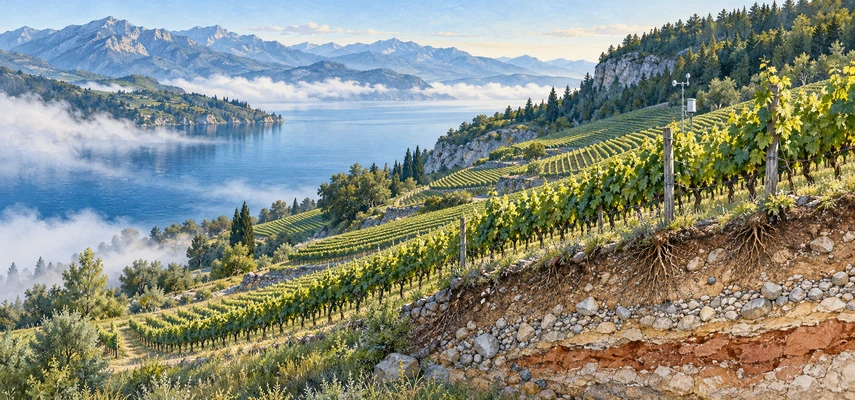

Two vineyards can sit a short walk apart and deliver surprisingly different grapes. One catches the morning sun; the other waits behind a ridge. One drains after rain; the other holds water. Climate, soil and vineyard location shape wine because vines respond to the conditions around them, not to the neat boundaries on a regional map.
Article #2 · Part I: Wine Science, Viticulture, and Winemaking. Use the factor–mechanism–consequence framework from the first lesson. The task here is to explain natural vineyard factors and connect them to ripening, style, quality and price. This independent resource follows the 2022 Issue 2 WSET Level 3 specification, Unit 1 LO1, criterion 1. It has no WSET affiliation or endorsement.
Climate and weather describe different scales
Climate describes a place’s usual weather patterns over a long period. Weather describes what happens during a particular day, week or season. A region can have a generally dry summer climate and still suffer rain at a critical harvest. The climate establishes expectations; the vintage records what actually happened.
That distinction explains vintage variation. A spring frost can reduce a crop before summer has begun. Wet flowering can interfere with fruit set. Rain near harvest can increase disease pressure or complicate picking. None of these events is captured adequately by saying that the region is “warm.” Timing belongs inside the explanation.
Warmth and sunlight also do different jobs. Leaves use light in photosynthesis to build sugars, while temperature influences growth and the rate of development. A bright but cool vineyard is not equivalent to a hot, heavily shaded one. Exposure of the fruit itself adds another layer: berry temperature can differ from the surrounding air.
Temperature changes the ripening possibilities
The specification distinguishes cool, moderate, warm and hot conditions. These categories describe a growing environment, not an automatic quality ranking. Within a workable temperature range, warmer conditions generally help grapes accumulate sugar and lose acidity more rapidly. If those sugars ferment completely, they provide the potential for higher alcohol.
Cooler conditions can preserve acidity and favour fresher fruit profiles, but only when grapes achieve suitable ripeness. Excess heat can disrupt vine function and damage berries; inadequate warmth can leave fruit unripe. WSET’s geography explanation links growing conditions with these broad stylistic tendencies. Treat them as starting points, then check variety, water supply and harvest timing.
An early-ripening variety may succeed where a later-ripening one struggles. Conversely, the early variety may reach high sugar levels before its flavours suit the intended style in a very warm site. “Warm enough for what?” is a better question than “Is this a warm place?” The grape and the target wine supply the missing context.
Continentality is annual; diurnal range is daily
Continentality concerns the difference between the coldest and warmest parts of the year. Inland locations often have a larger seasonal temperature contrast because land heats and cools relatively quickly. Ocean influence tends to moderate that contrast. A continental location may combine cold winters with warm summers and a relatively abrupt end to the growing season.
Diurnal range means the difference between daytime and night-time temperatures. It is not another name for continentality. A site can have hot summer days and cool summer nights without that single fact describing its annual winter-to-summer pattern. In an answer, identify which time scale is being discussed before explaining the consequences.
Cool nights can reduce the respiratory loss of malic acid in ripening berries. Provided sufficient ripeness develops, that can help retain acidity alongside developed fruit flavours. Mendoza’s high sites offer a useful example, described in the Catena Institute’s altitude research overview. Do not turn the example into a rule that every large diurnal range guarantees better wine.
Maritime, Mediterranean and continental patterns
A maritime climate has a strong ocean influence, with moderated seasonal temperatures and rainfall that can occur through the year. Bordeaux is a familiar study context. Rain can supply water, but wet conditions at flowering or harvest create challenges. The influence is not simply “the sea makes everything cooler”: water can also moderate cold.
A Mediterranean climate typically has relatively dry summers and wetter winters. Much of coastal California provides useful examples. Dry growing seasons may reduce some rain-related disease pressure, while increasing reliance on stored soil water or irrigation. Mediterranean does not mean uniformly hot: cold coastal air and fog can produce cool vineyard conditions.
A continental climate generally has a larger annual temperature range and weaker ocean moderation. Inland regions can face winter cold and a shorter reliable growing window. These labels simplify complex places, and transitional climates are common. Chablis is often described in wine study as semi-continental, while its regional wine board describes a modified oceanic climate with continental influences. Explain the actual conditions rather than arguing over a label.
Latitude and altitude work together
Latitude measures distance north or south of the equator. Broadly, moving towards the poles reduces the sun’s angle and makes sufficient warmth harder to obtain. Growing-season day length changes too. Many wine regions lie between approximately 30° and 50° latitude in either hemisphere, but altitude and maritime effects allow important exceptions.
Altitude generally lowers air temperature within a region. It can make grape growing possible in a latitude that would otherwise be too hot, or make an already cool location too cold for a chosen variety. Mendoza illustrates altitude’s cooling potential. Yet exposed ridges, sheltered slopes and temperature inversions mean that a fixed height difference does not guarantee a fixed vineyard temperature difference.
Always connect the site to ripening. “Higher” is a position; “cooler” is a condition; “slower acid loss” is a mechanism. From there, explain a potential style effect, such as retained freshness. Avoid skipping straight from altitude to prestige. An expensive hillside can still grow unsuitable fruit if the variety and conditions are poorly matched.
Aspect and slope change exposure and risk
Aspect is the direction a slope faces. In the Northern Hemisphere, a slope facing towards the equator generally receives more solar energy than one facing away. Reverse the compass direction in the Southern Hemisphere. In cool areas, extra exposure can improve ripening; in hot areas, less intense exposure may help protect freshness and avoid heat damage.
Slope angle changes how sunlight reaches the ground. It also influences drainage and the movement of cold air. During suitable radiation-frost conditions, dense cold air can move downhill and collect in low pockets. A midslope site may escape some of that accumulation, provided air has an unobstructed route away. This does not protect it from every type of frost.
Steep land can make machinery difficult or impractical, increasing labour requirements. Thus the same feature may help ripening and raise production costs. The British Columbia vineyard site guide discusses exposure and cold-air drainage. It demonstrates why topography has to be assessed as a system rather than reduced to “hillsides are best.”
Oceans, lakes, wind and fog
Large bodies of water warm and cool more slowly than land. Depending on season, currents and air movement, they can cool nearby vineyards or soften cold conditions. Their influence weakens with distance and barriers. A vineyard behind a mountain range may receive far less maritime moderation than a coastal distance on a map suggests.
Fog reduces incoming sunlight and can suppress daytime warming. Its timing and duration matter: a morning fog that clears differs from persistent cover that restricts ripening. Onshore breezes can carry cooling air inland. The Russian River Valley winegrowers describe the combined cooling influence of Pacific proximity, fog and breezes, illustrating why Mediterranean regions can contain cool sites.
Wind can help dry wet foliage, but strong winds increase water loss and can damage shoots. Lakes may moderate nearby temperature extremes, yet also influence humidity. A useful answer names the particular benefit or hazard instead of assuming that every water influence is beneficial. Cooling is valuable only in relation to the vine’s needs and intended style.
Soil shapes the root environment
Soil matters through drainage, water storage, nutrients, rooting conditions and temperature. Coarse material often drains readily, while fine-textured soils may hold more water. Actual behaviour depends on structure, depth and underlying layers, not just the material visible between the vines. Roots respond to the whole profile, which may differ sharply across a single block.
Insufficient water can restrict photosynthesis and ripening. Excess water can limit root aeration or encourage vigorous growth that shades fruit. Adequate nutrients support healthy leaves; excessive nitrogen can encourage unwanted vigour. Dark, dry soils can warm readily, while wet soils often warm more slowly. These effects interact rather than acting as isolated switches.
The British Columbia soils guide explains why subsurface variation matters for vineyard and irrigation planning. That is a stronger mechanism than claiming a rock deposits its literal flavour in wine. “Chalky” or “stony” may describe a tasting impression; neither word demonstrates direct transfer of geological flavour from soil to glass.
Put the factors together before judging the wine
| Factor | Useful mechanism | Possible consequence or tradeoff |
|---|---|---|
| Cool nights during ripening | Slower respiratory loss of malic acid | Greater potential acid retention, assuming suitable ripeness |
| Equator-facing slope in a cool setting | Increased solar exposure | Better ripening, with result dependent on season and variety |
| Freely draining shallow soil | Limited stored water after rain drains away | Less waterlogging risk, but greater drought risk |
| Persistent coastal fog | Reduced radiation and daytime warming | Slower ripening; unsuitable where warmth is already insufficient |
| Steep vineyard | Restricted machinery access | More manual labour and higher potential cost per bottle |
For examination practice, build a chain using the conditions actually given. State what changes in the vine or grape, then connect it to style, quality or price. Avoid treating a climate name as a finished explanation. Different routes can produce similar wines, and a grower’s response can alter the outcome. That is why the natural factors come first, but never finish the story alone.
Knowledge check: 10 original practice questions
1. Which statement describes weather rather than climate?
2. What does continentality describe?
3. What is diurnal range?
4. In a cool Northern Hemisphere site, why might a south-facing slope help ripening?
5. Which claim about soil is most defensible?
6. What best describes a Mediterranean growing pattern?
7. Why can a large lake moderate temperatures nearby?
8. Which condition can make a low-lying vineyard vulnerable to radiation frost?
9. Why is “higher altitude means higher quality” an inadequate conclusion?
10. Why can a steep slope increase cost?
Answers and explanations
1. B — A particular event. A specific harvest rainstorm describes weather in one vintage. The other choices describe usual patterns over longer periods.
2. C — Seasonal contrast. Continentality concerns the annual temperature pattern. Daily variation is diurnal range, so those terms should not be exchanged.
3. A — Day and night. The difference between day and night is the relevant scale. It does not tell the entire winter-to-summer temperature pattern.
4. D — Exposure. Greater solar exposure can assist ripening in a cool setting. It does not abolish frost or guarantee a particular vintage outcome.
5. B — Root environment. These are physical and nutritional mechanisms. A rock name alone cannot establish a literal flavour-transfer mechanism or guarantee quality.
6. C — Seasonal rainfall pattern. Relatively dry summers and wetter winters describe the broad pattern. Fog, cool breezes and occasional growing-season rain can still occur.
7. A — Heat storage. Water’s slower temperature changes can moderate nearby conditions. The result depends on season and location; it is not universal cooling or frost immunity.
8. D — Cold-air accumulation. Dense cold air can collect in low areas under suitable radiation-frost conditions. Grape colour or label prestige does not cause that process.
9. B — Several requirements. Cooling can help or hinder ripening. A quality conclusion requires evidence about the resulting wine, not the elevation alone.
10. C — Labour requirement. Difficult machinery access can make vineyard work more labour-intensive. That raises potential costs without guaranteeing a higher market price.
Written exercise 1: compare two slopes
Question: Two hypothetical Northern Hemisphere vineyards have the same grape, soil and management in a cool region. One faces south and the other north. Explain why the south-facing site may ripen grapes more reliably, and why it is not automatically superior in every year. Suggested marks: 4. Learning outcome: Unit 1 LO1, criterion 1.
Indicative marking points: One point each for identifying greater solar exposure on the south-facing slope; connecting that exposure to greater warming; connecting the improved warmth to more reliable ripening where warmth is limited; and explaining that a hot season or excessive exposure could make this advantage less useful or harmful. Credit accurate equivalents. These are original TFE practice allocations.
Model answer: The south-facing slope generally receives more solar energy, increasing warming relative to the north-facing slope. Where warmth limits development, that can help the grapes reach suitable ripeness more reliably. In an unusually hot season, additional exposure may increase heat or sunburn risk, so the slope cannot be assumed to produce the better wine every year.
Why it earns credit: Direction is connected to exposure, temperature and ripening, followed by an explicit limit. Common mistake: claiming that a south-facing site eliminates frost or always produces a higher quality wine.
Written exercise 2: explain soil and water
Question: A vineyard in a dry growing season has a shallow, freely draining soil and little water stored below it. Explain why severe water shortage can hinder ripening, and identify a human response with one commercial implication. Assume irrigation is permitted and suitable water is available. Suggested marks: 5. Learning outcome: Unit 1 LO1, criteria 1–2; introductory LO2 commerce.
Indicative marking points: One point each for limited soil water storage; severe shortage leading to stomatal closure or restricted photosynthesis; reduced sugar production restricting ripening; appropriately managed irrigation supplying needed water; and installation, water, energy or monitoring adding a specified cost. Allow equivalent accurate chains, with a five-point cap.
Model answer: The shallow soil stores little water, so freely draining water may leave insufficient reserves for the dry period. Severe shortage can close stomata and reduce photosynthesis, restricting the supply of sugar needed for ripening. Appropriately managed irrigation can replace some missing water, but installing and operating that system adds production costs. It is not a guarantee of higher quality.
Why it earns credit: The response links soil to available water and then vine function, before explaining a feasible response and a separate cost. Common mistake: assuming all water stress improves concentration, regardless of severity or timing.
One-page revision summary
Climate is the usual pattern; weather creates the particular vintage. Continentality is annual, and diurnal range is daily. Temperature, sunlight, altitude, latitude, water, aspect and slope interact with the grape variety. Soil matters through the root environment, not a guaranteed rock flavour. For each factor, explain the mechanism, the possible style consequence and the conditions that could change the answer.












