










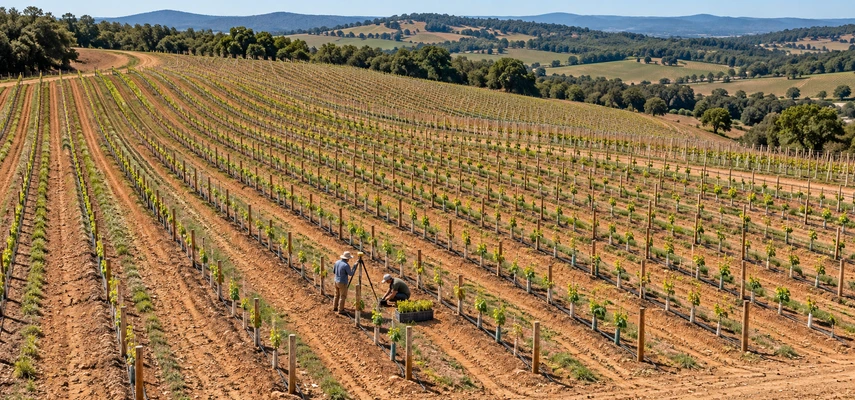

The most expensive vineyard mistake may happen before the first vine reaches the ground. A grower chooses a fashionable variety, orders the plants and only later discovers that the site cannot reliably ripen the crop buyers want. How to establish a vineyard is therefore a question about matching several decisions, not simply choosing a promising hillside.
Climate, soil, water, plant material, layout and the intended product interact. A rootstock can address particular soil constraints but cannot make an unsuitable season disappear. A desirable clone may perform differently in a new location. A vineyard that grows sound grapes can still fail commercially if the crop has no viable route to market.
The official D1 specification connects establishment with site selection, soil preparation, planting material and future management. It also includes propagation, selection, new varieties, head grafting and vine age. The common thread is making the biological and operational system fit its purpose.
How to establish a vineyard: begin with the intended wine
Describe the proposed crop before choosing the plants. Fresh white wine, structured red wine, pale rosé, concentrated sweet wine and fruit destined for no- or low-alcohol products can require different balances of composition, maturity and cost. A variety’s reputation cannot answer those questions on its own.
Specify a realistic quality and price objective. The Diploma quality scale ranges from poor through acceptable, good and very good to outstanding, while price bands distinguish inexpensive, mid-priced, premium and super-premium. These are analytical categories, not a promise that an expensive planting will produce outstanding wine.
Consider who will use or buy the fruit, the required specification and what happens if a difficult season produces a different crop. Oregon State’s establishment guide places viticulture and business planning together. A vineyard is a long-lived investment with establishment work before normal production and uncertainty afterwards.
Investigate the site below and above ground
Climate assessment needs growing-season warmth, season length, winter minima, spring and autumn frost exposure, rainfall and extremes. Compare the variety’s developmental needs with actual site conditions. Regional averages help screen options but cannot reveal every cold-air pocket or sheltered slope.
Soil investigation should establish effective rooting depth, texture and structure, drainage, restrictive layers, chemistry and relevant biological risks. A surface sample does not describe an entire profile. The British Columbia soil guide explains why subsurface variability can justify different management zones.
Water assessment includes supply, timing, quality and access, together with the root zone’s storage and atmospheric demand. A plan dependent on irrigation must establish whether a suitable supply is available and usable under current local arrangements. A pipe on a drawing is not evidence of secure water.
Access and terrain also influence viability. Slopes can improve particular growing conditions while making work more difficult. Equipment access, erosion, drainage and protection infrastructure should be considered before rows fix the layout. The best position for a cellar door need not be the best place to grow the crop.
Prepare for the problem actually found
Pre-plant preparation may include correcting drainage, addressing an identified restrictive layer, managing weeds, improving relevant soil conditions and dealing with pests or disease risks. Test the problem first. Deep cultivation that addresses compaction in one setting can be unnecessary or damaging in another.
Soil chemistry amendments also require a diagnosis. Nutrient presence, availability and future vine uptake are different measurements. Correcting an issue before planting may be easier than reaching it after roots and trellises occupy the site, but that does not justify applying a standard package everywhere.
Oregon State’s site-planning account emphasises properties such as soil depth, water capacity and restrictions. Its useful lesson is functional suitability, rather than a ranking of soil names. Preparation should reduce an identified constraint on healthy establishment and future crop development.
Variety, clone and rootstock are separate choices
The variety supplies major characteristics of development and fruit potential. Consider budburst and ripening timing, susceptibility to relevant stresses, growth habit and the proposed wine. A late-ripening variety may suit a sufficiently long season but create recurring maturity risks in a shorter one.
A clone is vegetatively propagated material tracing back to a selected source vine within a variety. Differences can involve traits such as yield components, growth or fruit characteristics. Those possibilities need evidence under relevant conditions, not the assumption that a clone favoured elsewhere must be best locally.
Rootstock selection addresses the root environment and interaction with the scion. Relevant considerations include phylloxera or nematode resistance, drought, soil chemistry, waterlogging, vigour, compatibility and establishment performance. The regional rootstock guide illustrates why a choice must answer the site’s particular concerns.
Grafting joins scion and rootstock; it does not merge their identities into a new grape variety. The rootstock can influence scion performance through resource supply and growth, but the berries retain the scion variety’s identity. No single resistance trait establishes that the combination will perform well under every condition.
Check identity, health and evidence of performance
Those three checks answer different questions. Identity concerns what material is supplied. Health concerns the pathogens tested and the current condition of the stock. Performance concerns what it does in the vineyard and winery. Passing one check does not automatically pass the others.
Foundation Plant Services explains its selection numbering and distinguishes its source selections from formally evaluated clones. A number is not a quality score. Its health protocols concern specified tests and standards; they should not be interpreted as a guarantee that a vine will never encounter disease after planting.
Plan procurement early enough to obtain suitable material rather than replacing a considered choice with whatever remains available. Traceable plants and careful records support later investigation if a block develops unevenly. A bargain in planting material can become expensive if it introduces persistent infection or the wrong identity.
Clonal selection and mass selection
Clonal selection starts from an individual source vine whose material is propagated and evaluated. It can support reproducibility of selected traits, although environment and management continue to influence the result. Planting a mixture of selected clones is also possible; using clones does not require choosing only one.
Mass selection collects propagation material from multiple selected vines. It can retain a broader set of vine differences from a source vineyard, but selection and health testing still matter. An admired old vineyard may owe its performance partly to its site and management, rather than superior transferable genetics.
The AWRI discussion of mass selection challenges automatic superiority claims. The sound comparison asks what was selected, how material was assessed and whether the results apply to the proposed site. Neither a single-source clone nor a traditional mass selection deserves an unqualified quality guarantee.
Propagation preserves material in different ways
Cuttings use vegetative material to produce new plants. Hardwood cuttings are commonly taken from matured dormant growth. They can be rooted to create own-rooted plants, or suitable scion and rootstock material can be combined through grafting. Oregon State’s propagation guidance distinguishes this from growing seedlings, which do not reproduce the parent variety identically.
Layering encourages roots to form on a cane while it remains attached to the parent. After establishment, the connection can be severed. It can fill a gap under suitable circumstances, but the resulting own-rooted vine does not gain the separate resistance of a grafted rootstock. The health and identity of the parent remain relevant.
University of California’s propagation account describes cuttings, grafting and layering in commercial context. The choice affects multiplication, establishment and pest exposure. A convenient propagation method is not necessarily appropriate for an infested site.
New varieties involve reproduction, not just copying
Sexual crossing combines parental material and creates genetically distinct seedlings. Breeding programmes can select among them for useful traits and evaluate the resulting material. This is different from multiplying an existing selection by cuttings.
In wine-study terminology, a crossing commonly refers to parent varieties within a species, while an interspecific hybrid combines ancestry from different species. Scientific usage of “hybrid” can be broader, so make the context clear. Neither category automatically establishes high quality, resistance to every disease or suitability for every market.
Wine Australia’s planting-material overview describes breeding work addressing performance and resistance. Potential advantages still need trials, compatible production goals and acceptance by buyers. Confirm current local variety and planting rules for any proposed vineyard rather than assuming that a promising new plant is authorised everywhere.
Plan the mature vineyard while planting young vines
Spacing, row orientation, trellis design, irrigation, drainage and access all shape later work. A layout suited to mechanisation may lower recurring labour requirements but needs compatible terrain and production choices. Protection infrastructure may be difficult to retrofit around an established system.
Distinguish yield per vine from yield per unit area. In a hypothetical hectare, 4,000 vines carrying 2 kg each and 2,000 vines carrying 4 kg each both yield 8,000 kg. That arithmetic does not establish equal fruit composition, vine balance or cost. Density changes the distribution of crop and resources; the system still has to mature it.
Establishment should develop a healthy root system and framework rather than demand a full crop immediately. Vine and grape health, grape component balance, and aroma and flavour ripeness remain the objectives as productive capacity develops. Future management must fit the chosen red, white, rosé, residual-sugar or reduced-alcohol style rather than treat every market as the same maturity target.
Head grafting and vine age: changing an existing system
Head grafting, or topworking, changes the scion on an established vine. It may allow a producer to change variety while retaining a suitable root system and framework. However, graft success, disease status, compatibility, labour and the interruption to production all matter. It cannot correct every underlying soil or root problem.
Vine age is another factor to evaluate rather than a quality verdict. Older vines may have established roots and a history of productive balance, but can also carry disease, missing neighbours or structural problems. Young vines need establishment; old vines need their actual condition assessed. Age alone does not measure the quality of the fruit.
The decision to retain, topwork or replant should compare realistic future performance and costs. A successful vineyard combines suitable biology with a workable system and a viable product. Establishment is the moment to test that combination while changing it is still comparatively possible.
Connect this explanation with vine training and pruning and vineyard pests and diseases as linked parts of the same explanation. Trace the relevant growing or cellar decision through to its consequences, and identify the condition that could change the result rather than treating the relationship as automatic.
Original Diploma practice and outline answers
These hypothetical TFE exercises provide indicative points and model outlines, not official WSET questions or marks.
Question 1: evaluate a familiar rootstock
A grower chooses a rootstock because it works well in a neighbouring region. Explain why that information is useful but insufficient.
Indicative points: Evidence from elsewhere; actual soil and water; relevant pests; scion compatibility; local trials and growth; no universal resistance guarantee.
Outline answer: Neighbouring experience can identify a candidate and possible traits, but the proposed site may differ in drainage, chemistry, water and pest pressure. The scion and production system also influence performance. Compare relevant conditions and evidence before choosing the combination. Success nearby is a reason to investigate, not proof of suitability.
Question 2: compare selection methods
A producer calls material taken from several admired source vines “one superior clone.” Explain the terminology problem and the evidence needed to judge the planting material.
Indicative points: Multiple sources versus single-source clone; mass selection; health testing; identity; source vineyard environment; local performance.
Outline answer: Material from multiple selected vines is a mass selection rather than a single clone. The source vineyard’s reputation does not prove that its performance is entirely genetic or transferable. Check identity, plant health and evaluated traits, then consider evidence under the new site’s conditions. Neither selection method eliminates the need for those checks.
Question 3: evaluate topworking
A vineyard’s current variety sells poorly, but its root system and framework appear suitable. Compare head grafting with complete replanting and identify a condition that could change the decision.
Indicative points: Retained infrastructure and roots; graft labour and success; production interruption; disease and compatibility; replant opportunity to change layout/rootstock; long-term return.
Outline answer: Topworking may change the product while retaining useful established structures, potentially avoiding some establishment work. It still requires suitable clean material, successful grafts and a period of reduced production. Replanting offers an opportunity to change rootstock or layout at greater establishment cost. If persistent disease or unsuitable roots are found, retaining the old system may become the weaker choice.
Make each planting decision answer a question
Ask what the site can support, what the market needs and which plant combination can connect the two. Then test the future management system against that choice. Establishment succeeds through compatible decisions, rather than a collection of individually impressive ingredients.












