










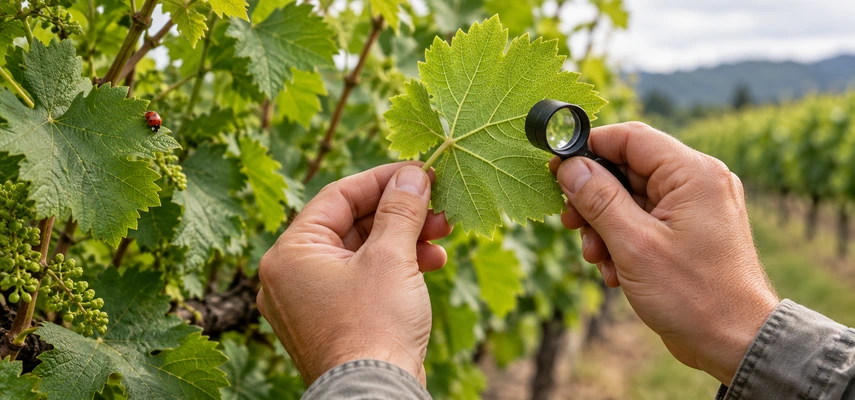

A grapevine with red leaves might be carrying a virus. It might also have a nutritional problem or another source of stress. Vineyard pests and diseases become manageable only when the grower identifies the cause accurately enough to choose a useful response. A symptom is evidence to investigate, not a diagnosis printed on the leaf.
For Diploma study, follow the damage through the plant. A root-feeding pest can restrict the canopy’s supply. A leaf disease can reduce its ability to supply the crop. Damaged berries may lose value directly and become vulnerable to further deterioration. The result involves yield, composition, quality potential and cost, often across more than one season.
The official D1 specification requires phylloxera, nematodes, grape moths, spider mites, birds, mammals, fungal diseases, viruses and bacteria, together with management options. These groups do different damage and need different strategies. There is no single vineyard treatment that replaces understanding them.
Vineyard pests and diseases: identify the process first
A pest may consume tissues, remove fruit or interfere with a root’s function. A pathogen causes disease through infection. Some pests also act as vectors, carrying a pathogen between plants. Killing a vector and curing an infected vine are therefore different achievements.
The practical sequence is prevention, monitoring, identification, intervention and reassessment. Integrated pest management combines appropriate measures rather than using a fixed treatment calendar irrespective of conditions. It considers the organism, susceptible stage, weather, natural enemies and likely economic consequence.
Scouting records are useful because a pattern can reveal the mechanism. A problem concentrated at an edge, around a wet patch or within particular planting material suggests different investigations. Record the affected organs and developmental stage as well as the visible severity. A vineyard map can turn isolated observations into a useful question.
Phylloxera: protect the root system
Phylloxera is a small aphid-like insect whose root-feeding forms can severely damage susceptible grapevines. Feeding wounds and associated deterioration impair the root system, reducing growth and production and potentially killing the vine. Healthy-looking fruit early in an infestation does not establish a healthy long-term root system.
UC IPM’s phylloxera guidance explains why resistant rootstocks are central to management in affected vineyards. The fruiting variety can be grafted onto a suitable resistant root system. Selection still has to account for soil and other conditions: resistance to one pest does not make a rootstock universally suitable.
Prevention also concerns movement of planting material, soil and equipment. A treatment that reduces an insect population is not necessarily an eradication method or a repair for existing root damage. The economic comparison can include lost production, repeated management and eventual replanting, rather than only the cost of a single intervention.
Nematodes: microscopic organisms, different effects
Plant-parasitic nematodes are roundworms that feed on roots. Different types damage tissues in different ways; some disrupt water and nutrient uptake, while some can transmit particular viruses. Not every nematode in soil is a pest, and not every plant-parasitic species is the vector of the same disease.
UC IPM’s nematode account distinguishes direct root injury from virus transmission. Root-knot nematodes can produce galls and disrupt function. The dagger nematode Xiphinema index is important as a vector of grapevine fanleaf virus. A general statement that “nematodes cause viruses” loses that specificity.
Management begins with identifying the problem in soil and planting material, using suitable healthy stock and selecting rootstocks with relevant resistance. Measures appropriate before planting may be difficult to apply in an established vineyard. A soil test, root assessment and knowledge of the organism’s hosts provide a better basis than assuming every declining patch has the same cause.
Grape moths and mites attack different parts
The damaging stage of many grape moth pests is the larva. Feeding can damage flowers or berries, depending on species and generation. Wounded berries may also become more susceptible to rot. The adults observed in a trap provide monitoring information, but the adult count is not itself a measure of every damaged berry.
The University of Kentucky’s grape berry moth guidance describes larval damage and management approaches, including mating disruption. Pheromones can interfere with adults locating mates, reducing successful reproduction under suitable conditions. They do not remove larvae already protected inside berries. Species identification, timing and the scale of the treated area matter.
Spider mites feed on leaf tissues and can reduce the functional canopy when populations become damaging. Hot, dusty or stressed conditions may favour problems, while predatory mites and other natural enemies can help suppress them. UC IPM’s mite guidance treats pest and predator monitoring together.
That creates an evaluative tradeoff: a broad intervention against another pest can disrupt beneficial organisms and worsen mite pressure. Appropriate monitoring and selective management can preserve useful biological control. The mere presence of a mite is not a reason to ignore population, damage or natural enemies.
Birds and mammals: loss, wounds and barriers
Birds may remove whole berries or peck at fruit. Direct losses can be accompanied by juice leakage and secondary deterioration. UC IPM’s bird guidance describes exclusion netting as effective but costly, with monitoring needed to assess species, timing and pressure.
Netting requires purchase, installation, maintenance and access arrangements. Scaring methods can be less dependable as birds become accustomed to them. Suitability depends on the crop’s value and the extent of pressure, rather than on whether a device looks convincing to a person walking past.
Mammals create several different problems. Browsing animals can remove shoots; fruit-eating animals can damage the crop; burrowing or root-feeding mammals can harm underground tissues. UC IPM’s gopher account provides one example of the latter. Fencing or individual-vine protection may suit some threats but cannot exclude every organism by the same design.
Choose measures for the actual species, route of access and local conditions. Wildlife protection rules and permitted interventions differ by location, so a regional control recommendation is not a universal permission. The educational point is to match prevention and cost to the damage mechanism.
Mildews and bunch rot require different conditions
Powdery mildew, caused by Erysiphe necator, can damage green tissues and berries. Its disease cycle differs from that of downy mildew; it cannot be dismissed simply because a growing season is relatively dry. UC IPM’s powdery mildew guidance links management with susceptible stages, monitoring and disease-favouring conditions.
Downy mildew, caused by Plasmopara viticola, is technically an oomycete disease rather than a true fungal disease, although vineyard discussions commonly group it with fungal problems. Cornell’s downy mildew factsheet identifies the organism. Wet conditions help its infection and spread; damage can affect leaves, young clusters and the canopy’s ability to ripen the crop.
Botrytis cinerea can cause destructive bunch rot, particularly where moisture, susceptible fruit and canopy conditions favour infection. Berry wounds can increase the problem. UC IPM’s Botrytis account connects canopy design and management with reduced disease-favouring conditions, while warning against excessive exposure that increases sunburn risk.
Prevention can combine suitable plant material, sanitation, canopy management, monitoring and appropriately timed protective treatments. Fungicides differ in activity and target; choosing a product against one pathogen does not establish effectiveness against another. Current local labels and resistance-management advice determine practical use, not a generic examination summary.
Botrytis also illustrates why the intended style matters. Under particular conditions, noble rot can provide material for valued sweet wines. Uncontrolled bunch rot is not automatically noble rot, and a grower making healthy dry wine need not welcome the same infection. The condition of the fruit and the weather sequence determine whether the process is useful or destructive.
Viruses: planting material and vectors both matter
Viral diseases can reduce yield, delay ripening and change fruit composition, with symptoms depending on the virus, variety and environment. Some infections may not be obvious visually. UC IPM’s virus guidance explains why absence of symptoms does not prove that propagation material is free of infection.
Leafroll-associated viruses provide an important example. Particular viruses can spread through infected material and relevant insect vectors, including mealybugs or scale insects. Clean, tested planting material reduces initial risk; monitoring, diagnosis and vector management address spread in the vineyard.
Infected vines may need removal and replacement within a wider strategy. Managing the insects does not turn an already infected vine into a clean source of propagation wood. Laboratory testing and appropriate sampling help distinguish infection from visually similar problems. Replacement also brings establishment costs and an interval before normal productive capacity returns.
Bacteria: water transport and persistent damage
Pierce’s disease is caused by Xylella fastidiosa, a bacterium associated with the water-conducting xylem. Insect vectors that feed on xylem fluid can spread it between hosts. Affected vines can show declining growth, leaf injury and poor fruit development, with severity shaped by host and conditions.
UC IPM’s Pierce’s disease guidance connects the organism, vascular dysfunction and vector pathways. Management therefore involves plant health, exposure and relevant vectors, rather than treating the condition as a fungal leaf spot. Similar-looking scorch still needs diagnosis.
Other bacterial problems, including crown gall, have different pathways and management concerns. Wounds, planting material and environmental injury may be important depending on the disease. It is more useful to know why prevention and healthy material matter than to memorise one supposed bacterial cure for every region.
Follow the cost beyond the treatment
Pests and diseases can reduce yield per vine and impair vine and grape health. Lost leaf function or damaged roots can disrupt sugar accumulation and aroma and flavour ripeness. Fruit infection can change grape component balance and increase selection or processing requirements. Those consequences depend on timing and severity, not merely the name of the organism.
Costs include monitoring, testing, protection, labour, rejected fruit and renewal of vines. A cheaper immediate intervention may leave a more expensive persistent problem. Conversely, treating every observed organism irrespective of damage or risk can waste resources and disturb useful biological control.
The final wine’s quality and price remain separate judgments. Removing damaged berries may preserve quality while reducing volume and raising cost per saleable unit. A buyer may still refuse a higher price. Evaluate the intervention against avoided losses, future production and the intended market, rather than assuming expenditure creates a premium wine.
Connect this explanation with vineyard establishment and vineyard weather hazards as linked parts of the same explanation. Trace the relevant growing or cellar decision through to its consequences, and identify the condition that could change the result rather than treating the relationship as automatic.
Original Diploma practice and outline answers
These are original TFE exercises. The indicative points and model outlines are not official WSET questions or marking schemes.
Question 1: separate a vector from an infection
A grower eliminates visible mealybugs and concludes that vines previously diagnosed with a leafroll-associated virus are now suitable for propagation. Evaluate the conclusion.
Indicative points: Vector control versus established infection; infected propagation material; appropriate testing; clean stock; continuing vineyard monitoring.
Outline answer: Removing vectors can reduce a route of further spread, but does not establish that infected vines have lost the virus. Propagating from those vines can carry infection into new material. Use appropriate diagnostic and clean-stock procedures rather than interpreting the absence of insects as proof of clean plant health. Monitoring must address both the vector and the disease.
Question 2: evaluate a canopy decision
A producer proposes removing all cluster-zone leaves to reduce Botrytis pressure during a hot season. Explain the possible benefit and the weakness of the proposal.
Indicative points: Air movement and drying; spray access; site and timing; sunburn and excessive berry heating; balance rather than maximum removal.
Outline answer: Reducing an overly dense canopy can make conditions less favourable to bunch rot and improve access for protection. However, removing every protective leaf can expose fruit to damaging radiation and heat, especially abruptly in a hot season. Evaluate the initial canopy, timing and exposure, and choose an appropriate degree of change. Disease prevention does not justify ignoring a new hazard created by the intervention.
Question 3: compare prevention with renewal
A hypothetical vineyard is being replanted after decline associated with a root-feeding pest. Explain why choosing the familiar fruiting variety alone is an incomplete plan.
Indicative points: Identify pest; rootstock resistance is organism-specific; soil and water suitability; healthy material; reinfestation pathways; establishment costs and production delay.
Outline answer: The fruiting variety does not by itself solve the root-zone problem. Identify the organism and choose suitable plant material and a rootstock that addresses relevant resistance and site conditions. Soil assessment and hygiene help reduce avoidable exposure. Compare the cost and delayed return from replanting with the risk of repeating the same decline; a familiar varietal name is not a biosecurity strategy.
Make the diagnosis earn the intervention
For each organism, identify where it acts, how it spreads and what damage it can cause. Then explain what the proposed response changes and what remains unresolved. That pattern connects prevention with wine quality and commercial survival, while keeping a vineyard’s living system more complicated than a list of things to spray.












