











A German wine label can tell you where grapes grew, how ripe they were, whether the wine is dry and which producer association classified the site. The difficulty is that those answers don’t all come from the same word. Spätlese isn’t simply a sweetness setting, and a famous vineyard doesn’t make every bottle taste alike.
German wines become much easier to understand when you separate those questions, then reconnect them through climate, grape variety and production. Riesling provides an excellent starting point: one grape can make a light, delicately sweet wine, a concentrated dry white or a richly sweet rarity.
This is article 19 of The TFE Guide to WSET Level 3 Wine, following the regional and classification requirements in the official specification. The practice material is original and independent of WSET. Current labelling developments are distinguished from the course’s traditional framework.
German wines begin with a ripening question
Germany’s principal wine regions lie at relatively northerly latitudes, many around the Rhine and its tributaries. Ripening opportunities vary considerably between exposed uplands, sheltered river valleys and warmer southern areas. A long growing season can allow flavour development while retaining acidity, provided the weather and site allow fruit to remain healthy.
Favourable south-facing slopes intercept more useful sunshine. Sheltered valleys reduce exposure, while rivers can moderate nearby temperatures. Slope also affects cold-air drainage, although it doesn’t eliminate frost. Dark, stony soils can absorb and release heat; soil depth and water storage influence vine performance during dry periods. No soil name guarantees one exact aroma.
Warm recent vintages have made excessive sugar, falling acidity, drought and sunburn increasingly relevant alongside the traditional challenge of insufficient ripeness. Canopy management must balance exposed leaves with protection for fruit. Harvest timing then matches the intended style. The German Wine Institute’s Riesling guide describes a slowly ripening variety whose acidity and site sensitivity make these connections particularly important.
Riesling is central, but Germany isn’t only Riesling
Riesling typically retains high acidity, with apple, citrus and stone-fruit flavours changing with ripeness. Dry wines can have substantial body; sweeter wines may retain freshness through acidity. Bottle age can add honeyed or petrol-like notes. Neither a petrol aroma nor sweetness is required for a good example.
Müller-Thurgau ripens earlier and commonly produces softer, gently fruity or floral whites. Earlier ripening can help where achieving full maturity is harder, although excessive cropping may dilute flavour. Silvaner, especially associated with Franken, often has a more restrained fruit profile and can produce dry wines with useful texture. The institute’s Müller-Thurgau and Silvaner accounts describe these alternatives.
For reds, Spätburgunder is Pinot Noir: thin skins and a delicate aromatic profile make healthy fruit and measured extraction important. Styles range from fresh red-fruited wines to more structured, oak-matured examples. Dornfelder can produce darker-coloured, fruit-led reds, particularly in Rheinhessen and Pfalz, with some wines receiving wood maturation. The primary Pinot Noir and Dornfelder profiles explain the different starting points. Darker colour isn’t a quality score.
Mosel: Steep slopes and several possible balances
The Mosel region includes the Saar and Ruwer. Steep valley vineyards and Riesling are defining reference points, though flatter sites and other grapes also exist. Bernkastel, Wehlen and Piesport are important Middle Mosel place names. Their individual sites differ in aspect, exposure and soil; a village name isn’t a complete tasting description.
The regional overview describes slate slopes and wines ranging from dry to sweet. Favourable exposure can help late-ripening Riesling develop flavour while retaining high acidity. If fermentation leaves sugar, sweetness can balance that acidity with relatively modest alcohol. Fermenting similar juice further changes the alcohol-sugar balance.
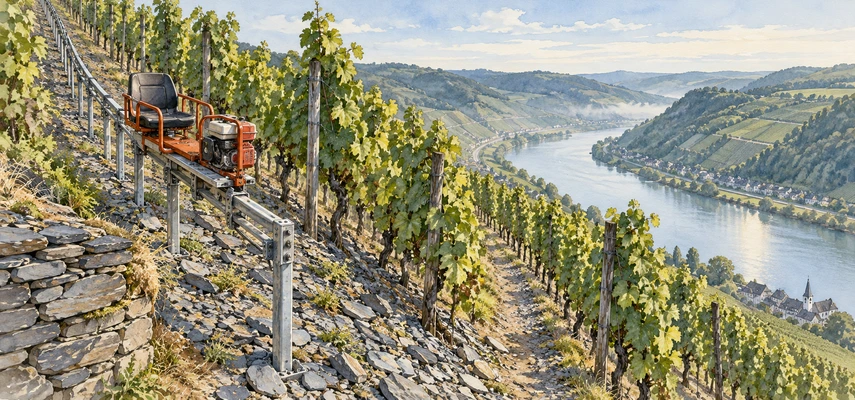
Steep parcels limit conventional machinery and increase the work of canopy management and harvesting. Specialist equipment can assist access, but doesn’t turn every slope into an inexpensive vineyard. Selective picking and small volumes can add further costs. Ripeness, extraction and maturation still determine whether the resulting wine is balanced.
Nahe and Rheingau: Different river-valley settings
The Nahe, west of the Rhine, has varied exposures and geology, including volcanic rocks, slate and loess. Riesling is important, with other whites and reds also grown. Schlossböckelheim is a key place name: its Kupfergrube site illustrates steep, favourably exposed vineyards with freely draining volcanic soils. The Nahe overview and VDP site description show why local conditions matter. Drainage can help in wet conditions while increasing drought risk in dry summers.
The Rheingau occupies vineyards along the Rhine’s westward-flowing stretch and beyond. Many slopes face favourably towards the river, with shelter from hills to the north. Rüdesheim and Johannisberg are important names within this Riesling-focused region. The Rheingau guide describes its hillside setting and Pinot Noir presence too.
Rieslings here can combine ripe fruit, firm acidity and more body than a light Mosel reference style, but that comparison isn’t universal. Dry and sweeter styles exist in both regions. Explain the individual wine through fruit ripeness and fermentation rather than assigning one compulsory sweetness level to a river.
Rheinhessen and Pfalz: Scale doesn’t remove site identity
Rheinhessen occupies rolling country within the Rhine’s great bend, with a wide range of wines. Riesling, Müller-Thurgau, Silvaner and Dornfelder are useful reference grapes. Larger-scale production coexists with ambitious estate wines. Nierstein, beside the Rhine, is associated with the Roter Hang, where favourable river-facing slopes make a different proposition from straightforward production on easier ground. The regional profile describes these contrasting settings.
Pfalz lies further south, sheltered by the Haardt and Pfälzerwald. Comparatively warm, sunny conditions support ripe whites and reds. Forst and Deidesheim are important Riesling villages near the Haardt edge. Their wines can have ripe fruit, body and freshness, with site and harvest choices influencing the balance. The Pfalz overview also identifies Dornfelder and Spätburgunder.
On suitable, accessible land, mechanisation and larger lots can reduce unit costs. Selected hillside parcels, hand work and extended maturation create a different cost structure. Neither region should be reduced to its least expensive wines, and an estate label doesn’t eliminate the need to assess quality.
Baden and Franken: Two useful alternatives
Baden extends through southwestern Germany and includes warm districts as well as cooler locations. Spätburgunder is especially important, alongside white Pinot varieties. The German Wine Institute’s Baden account emphasises that regional diversity. Adequate warmth helps Pinot Noir ripen; avoiding excessive extraction can preserve its red fruit and finer texture. Oak may add complexity when the fruit can support it.
Franken, further east along the Main and its tributaries, has a stronger continental influence, with warm summers and cold winters. Silvaner and Müller-Thurgau are important. Dry Silvaner can offer restrained fruit and a firm, textured palate, with quality depending on balance and length rather than perfume alone. The Franken profile describes its Main-valley setting and grape identity. The distinctive Bocksbeutel bottle is a useful clue, but isn’t a quality guarantee or a substitute for reading the label.
Cellar choices explain dry, light and sweet styles
For many Rieslings, pressing and controlled fermentation in steel or large old wood preserve fruit without pronounced new-oak flavour. Retaining malic acidity may be desirable, so malolactic conversion is often avoided. Lees and vessel choices can modify texture without creating a mandatory regional recipe.
Fermentation converts sugar to alcohol. Stopping it with sugar remaining can produce a sweeter wine with less alcohol than if the same juice fermented further. A producer must stabilise that wine appropriately, potentially using filtration, to prevent renewed fermentation. Concentration through noble rot or natural freezing provides a different starting juice, rather than simply a different fermentation endpoint.
Qualitätswein and Prädikatswein answer different questions
Qualitätswein must meet the applicable protected-origin and quality-testing requirements. Limited enrichment to raise potential alcohol can be allowed; it doesn’t mean a wine must finish sweet. Prädikatswein cannot be enriched and must meet the relevant minimum grape must weight and harvest requirements. Must weight measures density and indicates grape sugar concentration, not the finished wine’s residual sugar.
The institute’s Prädikat explanation distinguishes the six categories. Specific thresholds vary by grape and region. Learn the mechanisms before attempting to memorise numbers:
| Prädikat | Meaning and style connection |
|---|---|
| Kabinett | Ripe grapes meeting its minimum must weight. Delicate examples can have low alcohol, but the term doesn’t itself mean sweet. |
| Spätlese | A higher ripeness requirement, traditionally associated with later harvesting. Dry and sweeter versions exist. |
| Auslese | Selected fully ripe bunches with unsuitable berries removed. Some botrytis may occur; sweetness isn’t fixed by the word alone. |
| Beerenauslese | Selected overripe berries, usually affected by noble rot. The resulting wines are richly sweet and concentrated. |
| Trockenbeerenauslese | Selected shrivelled, noble-rot-affected berries give intensely concentrated sweet wines. “Trocken” within this compound doesn’t mean a dry palate. |
| Eiswein | Grapes freeze naturally on the vine and are pressed while frozen. Ice stays in the press, concentrating the extracted juice; noble rot isn’t the defining mechanism. |
Trocken means dry when used as a sweetness designation. Halbtrocken indicates a less dry category with defined conditions; feinherb is a less precisely defined stylistic expression, so check the producer’s information. A Spätlese trocken and a sweet Spätlese can therefore share a Prädikat while differing markedly on the palate.
VDP and the current origin framework
The VDP is a growers’ association with its own classification: estate wines, village wines, VDP.ERSTE LAGE and VDP.GROSSE LAGE. In that system, VDP.Grosses Gewächs (GG) identifies a dry wine from a VDP.GROSSE LAGE site meeting its conditions. A top-classified site can also produce sweeter Prädikat wines. The association’s classification explains the distinction between vineyard and dry-wine designation.
National law has also moved towards a more explicit origin hierarchy. Rules mandatory from the 2026 vintage distinguish growing-region, broader “Region”, village and single-vineyard origins within protected-origin wines. Prädikat categories remain. National provisions also regulate Großes Gewächs and Erstes Gewächs, so it is no longer accurate to describe those words without a VDP prefix as exclusively private association terminology. The institute’s current law guide explains the change. Check vintage and exact wording; narrower origin is a regulated promise, not proof that every bottle tastes better.
Quality and price need their own explanations
Assess balance, intensity, complexity and length. High acidity needs enough fruit; sweetness needs freshness; a dry wine shouldn’t be rewarded merely for being dry. Prädikat ripeness and site classification provide context rather than replacing that assessment.
Steep-site labour, selective harvesting and crop losses affect grape costs. Sorting, concentration, barrels, cellar space and stock holding affect production expense. Transport, storage, applicable taxes and trade margins contribute to retail price. Market demand and scarce supply can add premiums for famous producers or sites. Those mechanisms explain why price and quality may relate without being interchangeable.
Knowledge check: 10 original multiple-choice questions
Choose one correct answer per question. These are independent practice questions.
1. Why can a favourably exposed slope help Riesling ripen?
2. Which places belong with the Mosel reference map?
3. Which pairing is correct?
4. Which grape-region connection is especially useful?
5. What does Spätlese establish on its own?
6. Which enrichment statement is correct?
7. What is central to Eiswein concentration?
8. What does VDP.Grosses Gewächs identify?
9. Which statement reflects the national origin reforms?
10. Why can a small steep-site wine cost more to produce?
Answers and explanations
1. D — Sunshine and exposure. A favourable slope can improve useful solar exposure and help ripening. Its effect interacts with elevation, weather and water supply. Neither slate nor a famous name automatically creates ripe, balanced fruit without suitable conditions and management.
2. B — Middle Mosel names. Bernkastel, Wehlen and Piesport belong on the Mosel map. Their individual sites can differ, and the village name doesn’t fix sweetness. Forst and Deidesheim belong in Pfalz, while Nierstein belongs in Rheinhessen.
3. A — Nahe context. Schlossböckelheim is an important Nahe name, with sites illustrating the region’s exposed slopes and varied geology. Johannisberg belongs in Rheingau, Piesport in Mosel and Forst in Pfalz. Correct location comes before a plausible style explanation.
4. C — Silvaner in Franken. Dry Silvaner is an important Franconian reference, often with restrained fruit and useful texture. This doesn’t mean every wine there is Silvaner. Baden’s Pinot Noir and the Mosel’s Riesling provide other useful regional anchors.
5. D — Grape ripeness. Spätlese belongs to the Prädikat framework, which concerns grape must weight and harvest conditions. Fermentation and retained sugar determine the finished balance. The additional sweetness designation trocken therefore carries information that Spätlese alone doesn’t provide.
6. A — Different legal conditions. Qualitätswein may be enriched within the applicable limits, while Prädikatswein cannot. Enrichment raises potential alcohol before fermentation; it doesn’t automatically leave the finished wine sweet and isn’t the same process as fortification with spirit.
7. B — Frozen pressing. Naturally frozen grapes are pressed while frozen, leaving much of the water as ice and extracting concentrated juice. This differs from noble-rot concentration. Keeping fruit on the vine while awaiting suitable freezing also exposes it to losses and weather risk.
8. C — A dry wine within the VDP system. VDP.GROSSE LAGE classifies the site, while VDP.GROSSES GEWÄCHS identifies its dry wine under association conditions. Sweeter wines can also come from that site. Read the VDP prefix separately from national legal terminology.
9. D — Stronger origin distinctions. National rules mandatory from the 2026 vintage strengthen the framework for more precise origins. They don’t abolish Prädikat categories. Older vintages and association classifications require attention to their own context rather than one timeless label shortcut.
10. A — Labour and access. Difficult access can limit ordinary mechanisation, while hand work and selection take time. Small saleable volumes then spread those costs over fewer bottles. Scarcity and reputation can affect price too, through market mechanisms rather than physical vineyard inputs.
Written exercise 1: Explain a Mosel balance in five marks
Question: Explain five links that can produce a balanced, relatively low-alcohol Riesling with noticeable sweetness from a favourable Mosel slope. Give five distinct points. This is an original five-mark practice exercise.
Model answer: Favourable exposure helps the grapes receive sufficient sunshine for ripening. A long suitable season can develop flavour without losing all the grape’s acidity. Managing the crop in relation to the vine’s resources supports adequate flavour concentration. Ending fermentation with grape sugar remaining produces sweetness and less alcohol than if that same juice fermented further. Retained Riesling acidity balances the sweetness and keeps the palate fresh.
Why it earns credit: Award one practice mark each for exposure, seasonal flavour development, crop-resource balance, fermentation endpoint and the role of acidity in the finished wine. Don’t award an extra mark for merely repeating “slate” or “good site.” These original marking points aren’t an official WSET scheme.
Written exercise 2: Separate three label messages in five marks
Question: A label includes a specific German origin, Spätlese and trocken. Explain what can be concluded from those messages and what still needs assessment. Give five distinct points.
Model answer: The named origin identifies the geographical claim under the relevant framework. Spätlese indicates that the grapes met its applicable Prädikat ripeness and harvest requirements. As Prädikatswein, the wine cannot have been enriched. Trocken supplies the separate message that the finished wine is dry. Those terms don’t prove outstanding quality, which still requires assessment of balance, intensity, complexity and length.
Why it earns credit: Award one practice mark for each separate point: origin, Prädikat ripeness, no enrichment, finished dryness and the need for sensory quality evidence. Saying Spätlese always means sweet contradicts the separate trocken message. This is general practice outside any association-specific labelling convention, not an official examination answer.
One-page revision summary
| Region or term | Explanation to retain |
|---|---|
| Mosel | Riesling on varied valley sites, including steep slate slopes. Bernkastel, Wehlen and Piesport are important names. |
| Nahe | Varied geology and exposures. Schlossböckelheim illustrates favourable slopes and the drainage-water trade-off. |
| Rheingau | Riesling-focused Rhine slopes, including Rüdesheim and Johannisberg. Dry and sweeter styles both exist. |
| Rheinhessen | Broad rolling region with varied grapes and production scales. Nierstein’s Rhine-facing sites add a specific context. |
| Pfalz | Shelter and warmth support ripe whites and reds. Forst and Deidesheim are useful Riesling anchors. |
| Baden | Diverse southwestern districts with important Spätburgunder. Ripeness and measured extraction support red-wine balance. |
| Franken | Main-valley continental conditions, Silvaner and Müller-Thurgau. A bottle shape doesn’t establish quality. |
| Qualitätswein | Protected origin and quality requirements, with limited enrichment potentially allowed. Sweetness is a separate question. |
| Kabinett, Spätlese, Auslese | Increasing ripeness/selection contexts. None is an exact finished-sugar measurement. |
| BA and TBA | Concentrated sweet wines from selected overripe or shrivelled berries, with noble rot important. |
| Eiswein | Natural freezing and frozen pressing concentrate juice. It isn’t defined by botrytis. |
| VDP.GG | Dry wine from a VDP.GROSSE LAGE site under association rules. National terminology has its own framework. |
| Current origin law | The 2026-vintage rules strengthen geographical distinctions while retaining Prädikat categories. |
| Price | Connect site labour, selection, small volume, cellar holding, transport, margins and demand. |
A practical tasting comparison
Compare a dry German Riesling with a sweeter example using small pours. Assess sweetness, acidity, alcohol and body separately before reading the Prädikat. Ask whether the sweetness is balanced and whether the dry wine has enough fruit to support its acidity. If comparing regions, avoid guessing an exact village from one aroma. Site, vintage and producer choices create variation within each regional reference.
Sources and course context
Primary references include the official WSET specification, the German Wine Institute’s regional and grape accounts, its current national-law guidance and the VDP’s own classification. Traditional Prädikat concepts are retained while current origin-law changes are identified. Exact must-weight and residual-sugar thresholds aren’t reproduced; association terms aren’t treated as universal German law.
Continue your studies: Articles 2, 5, 7 and 8 explain site, white winemaking, sweet-wine concentration and maturation. Article 16 offers an Alsace Riesling comparison, article 20 introduces Austria, and article 49 compares classification systems.












