










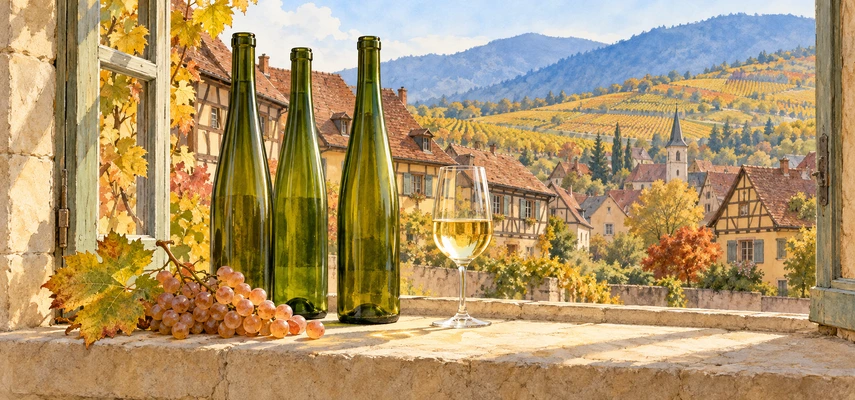

Three Alsace wines can arrive in nearly identical tall bottles and behave quite differently. One delivers a sharp line of lemon and acidity. Another fills the glass with rose and lychee. A third feels broad and textured, with ripe pear and a hint of spice. The bottle shape gives you a regional clue; it doesn’t tell you how the wine will taste.
Alsace wines become easier to understand when you connect their sheltered growing conditions with grape variety, harvest decisions and fermentation. For WSET Level 3, the useful question is how those choices produce a particular balance of fruit, acidity, alcohol, texture and sweetness.
This is article 16 of The TFE Guide to WSET Level 3 Wine. It follows the regional requirements in the official specification, with original practice material rather than official examination questions.
Alsace wines begin in the shelter of the Vosges
Alsace lies in northeastern France, beside the Rhine plain and close to Germany. Its vineyards run along the eastern foothills of the Vosges. The mountains intercept rain arriving with prevailing westerly winds, leaving the vineyards in a relatively dry rain shadow. The regional wine body’s vineyard brochure explains that shelter and the sunny growing conditions it creates.
Continental influences bring cold winters and warm summers. In favourable years, a relatively dry, sunny autumn allows grapes to remain on the vine and develop further ripeness. This is why a northern location doesn’t automatically mean thin, unripe wines. Shelter, sunshine and time can produce substantial sugar accumulation and wines with considerable body.
That opportunity comes with risks. Spring frost can damage young shoots and reduce the crop. Rain near harvest can undermine fruit health. In hot, dry conditions, restricted water supply may slow ripening rather than improve it. A rain shadow reduces average rainfall; it doesn’t cancel the weather forecast.
Slopes, soils and vineyard decisions
Many important sites occupy foothill slopes. A favourable south-facing or southeast-facing aspect increases exposure to sunshine, helping ripening. Elevation and air movement modify temperature, while cold air may drain away from sloping ground. Those advantages vary with the site: a steep, exposed parcel also brings difficult access and more costly work. The regional terroir overview places the vineyards within this hillside setting.
Alsace has varied geology, including granite, limestone, sandstone and marl. For an explanation, move beyond a list of rocks. Soil depth and drainage influence the water available to roots. Water availability affects vine growth and the ability to ripen fruit through dry periods. A tasting note mentioning stone isn’t proof that a particular rock flavour travelled directly into the grape.
Growers manage crop size, canopy and harvest timing around the intended wine. Adequate exposed leaf area supports photosynthesis; an excessively dense canopy shades fruit and restricts air circulation. Opening it can improve fruit exposure and drying, but excessive removal increases sunburn risk. Leaving grapes longer may increase sugar and flavour ripeness while acidity falls. The decision is a trade-off, especially for a naturally lower-acid grape.
Riesling: acidity gives ripeness a framework
Riesling commonly brings high acidity, citrus and apple flavours, with stone fruit becoming more prominent at greater ripeness. The regional Riesling profile also describes its capacity to develop with bottle age. Mature examples may acquire honeyed or petrol-like complexity, although neither age nor a famous site guarantees improvement.
Many Alsace Rieslings are dry, but the grape also makes sweeter wines. A warmer, well-exposed site can produce riper fruit and more potential alcohol; retained sugar changes the finished balance. High acidity can keep a concentrated wine fresh, yet acidity alone doesn’t establish quality. Fruit concentration, integration and length still matter.
In an answer, connect the steps: favourable exposure supports ripening; ripe grapes provide sufficient flavour and sugar; fermentation determines how much becomes alcohol and how much remains as sweetness. Don’t jump straight from “sunny hillside” to “excellent wine.”
Gewurztraminer and Pinot Gris: two forms of richness
Gewurztraminer is highly aromatic, often suggesting rose, lychee and sweet spice. Its pink-skinned grapes can produce white wines with substantial body and alcohol. Acidity is typically lower than Riesling’s, making harvest timing important. Too much sugar accumulation with insufficient freshness can produce a heavy result. The regional Gewurztraminer profile describes its expansive aromas and relatively discreet acidity.
Its perfume can suggest sweetness before the wine reaches your mouth. Assess actual sweetness on the palate instead. A dry Gewurztraminer may smell like ripe exotic fruit without containing enough residual sugar to taste sweet. Conversely, some examples retain noticeable sugar. Variety identifies an aromatic tendency, not a guaranteed sweetness category.
Pinot Gris generally offers more weight than the light, straightforward style often associated with Pinot Grigio elsewhere. Expect pear, stone fruit and sometimes smoky or spicy notes, with a broad texture. Dry and sweeter versions exist. The regional Pinot Gris account emphasises body and aromatic complexity. Assess the individual wine rather than assuming every bottle is sweet or richly concentrated.
Muscat and Pinot Blanc deserve their own space
Muscat is useful precisely because it challenges an easy shortcut. Many ordinary Alsace examples are dry, despite intensely grapey, floral aromas. Muscat à petits grains and Muscat Ottonel are used in the region. The official Muscat profile explains their role. Preserving primary aromas is central to this fresh style; obvious new-oak flavour would change its character.
Pinot Blanc commonly produces a gentler, less intensely aromatic wine, with apple, peach and floral notes. It can be lighter in body and suited to earlier drinking. The regional Pinot Blanc profile explains that Auxerrois is often blended with it, contributing roundness. A Pinot Blanc label therefore shouldn’t be treated as conclusive evidence of a pure single-variety wine.
These are stylistic reference points, not a league table. An accurate, balanced Pinot Blanc can succeed on its own terms. More perfume or greater body doesn’t automatically mean higher quality.
Cellar choices preserve or reshape the fruit
For many regional white wines, the aim is to preserve grape aromas. Gentle pressing, clarification and controlled fermentation help achieve that. Stainless steel and large, old wooden vessels can both support a style without pronounced new-oak flavour. The regional white-winemaking guide describes pressing and these fermentation vessels.
Old wood isn’t chemically identical to steel, but it contributes far less overt oak flavour than a new small barrel. Lees contact may add texture, depending on its duration and handling. Malolactic conversion reduces sharp malic acidity and may be avoided when retaining freshness is a priority. These are producer decisions, not universal rules for every Alsace white.
Yeast converts fermentable sugar into alcohol. Allowing fermentation to finish produces a drier wine; retaining grape sugar produces sweetness. Highly concentrated must can make fermentation demanding. Sweet wines also need suitable microbial stability, potentially including filtration, so that fermentation doesn’t restart in bottle. “Rich fruit” and “residual sugar” describe different things.
Alsace, Alsace Grand Cru and the label
Alsace AOC covers a broad range of regional wines, often labelled by grape variety. More precise geographical designations also exist. Its breadth allows relatively simple, fresh wines alongside ambitious examples. The appellation overview describes village and locality names within the framework.
Alsace Grand Cru identifies named, delimited sites with more restrictive production conditions. The traditional core grapes are Riesling, Muscat, Pinot Gris and Gewurztraminer. Avoid turning that revision shorthand into an absolute: site-specific exceptions exist, and Pinot Noir has gained recognition at selected grands crus. The regional brochure’s appellation section acknowledges exceptions and the more recent red-wine development.
For the white wines here, the useful reasoning is that a delimited favourable site and stricter production conditions can support concentrated, distinctive wines. The name doesn’t guarantee a particular sweetness level or outstanding quality in every vintage. Crémant d’Alsace is the region’s separate sparkling appellation; its production is covered later in the series.
Vendanges Tardives and Sélection de Grains Nobles
Vendanges Tardives, meaning late harvest, is a regulated mention rather than a casual description. Eligible grapes are Riesling, Muscat, Pinot Gris and Gewurztraminer. Fruit is harvested at advanced ripeness with high required sugar concentration. The mention may accompany Alsace or Alsace Grand Cru. The regional explanation sets out that relationship.
Sélection de Grains Nobles, often shortened to SGN, involves hand-selection of berries affected by noble rot. Under suitable conditions, Botrytis cinerea promotes water loss and concentrates the berry’s contents, while also changing the aromatic profile. These are highly concentrated sweet wines. The official SGN description identifies noble-rot selection as central to the style.
SGN is therefore more specific than simply picking the whole vineyard late. Waiting exposes fruit to weather and crop-loss risks; selective picking requires labour and may involve repeated passes. Dehydration and rejection reduce the juice available. Neither late harvest nor noble rot is suitable for every site and year. Check the wine’s sweetness information rather than using the words “late harvest” as an exact residual-sugar measurement.
Explain quality and price separately
Judge quality through balance, flavour intensity, complexity and length. A rich Pinot Gris needs enough freshness to remain satisfying; a high-acid Riesling needs sufficient fruit. A long finish carries more useful evidence than an expensive-looking flute bottle. Nor does SGN automatically outperform a well-made dry wine: they have different aims.
For price, identify production costs first. Difficult slopes increase labour; selective harvests and small yields spread costs over fewer bottles. Sorting, cellar space, maturation and delayed sales add expense. Larger-scale production and earlier release can reduce some unit costs. Transport, storage, applicable taxes and trade margins contribute to the retail price. Strong demand for a limited supply from a respected site or producer may add a premium. Price and quality can relate, but they aren’t interchangeable.
Knowledge check: 10 original multiple-choice questions
Choose one answer per question. These are independent practice questions, not official WSET material.
1. Why are many Alsace vineyards relatively dry?
2. Which explanation best connects site and ripeness?
3. Which grape typically brings high acidity to Alsace white wines?
4. What does a rose-and-lychee aroma establish about sweetness?
5. Which is a useful general reference for Alsace Pinot Gris?
6. Which statement about ordinary Alsace Muscat is accurate?
7. Why might Auxerrois appear in a Pinot Blanc-labelled wine?
8. Which choice most directly limits overt new-oak flavour?
9. What distinguishes SGN from a general late harvest?
10. Why can selective noble-rot production increase unit costs?
Answers and explanations
1. B — Mountain shelter. Rain-bearing westerly air loses moisture on the Vosges, leaving the eastern foothills relatively dry. That rain-shadow effect helps explain the region’s ripening opportunities, but doesn’t mean that harvest rain or other weather risks disappear.
2. D — Aspect changes exposure. A favourably oriented slope receives useful sunshine and may support ripening. Its effects depend on elevation, weather and water availability. Neither the soil name nor a geographical designation alone establishes the finished wine’s ripeness or quality.
3. A — Riesling. High acidity is an important reference point for Riesling. In Alsace it can balance ripe fruit and support concentrated dry or sweeter styles. Quality still depends on sufficient fruit, integration and length rather than acidity in isolation.
4. C — Aroma isn’t residual sugar. Gewurztraminer’s floral and exotic-fruit aromas can suggest sweetness, but a dry example can display those same aromatic families. Determine sweetness on the palate and use the producer’s information rather than inferring it from fragrance alone.
5. B — Weight and texture. Alsace Pinot Gris often has a broad palate and ripe fruit, sometimes with smoky or spicy complexity. That reference doesn’t mean every example is equally concentrated or sweet; assess the wine rather than treating a variety as a fixed recipe.
6. A — Aromatic and dry. Many ordinary Alsace Muscats are dry and strongly grapey. Muscat à petits grains and Muscat Ottonel are regional varieties. Perfume doesn’t require residual sugar, and this dry still-wine style doesn’t require fortification.
7. D — A regional blending practice. Auxerrois can contribute a rounder character to blends labelled Pinot Blanc or Pinot. The label is therefore insufficient evidence that the wine contains only Pinot Blanc. Blending doesn’t automatically grant a more prestigious geographical classification.
8. C — Neutral vessels. Steel and large old wood can preserve fruit without the prominent vanilla or toast associated with new oak. Other decisions still affect flavour and texture, so choosing a neutral vessel doesn’t make every wine taste identical.
9. B — Noble-rot selection. SGN requires selective harvesting of noble-rot-affected berries, not merely a later date on the harvest calendar. The combination of dehydration and botrytis changes creates concentrated sweet wines when the fruit and conditions are suitable.
10. A — Labour and limited volume. Selecting berries takes time, while dehydration and rejection reduce the quantity of juice available. Spreading those costs over fewer bottles can raise unit costs. Reputation and demand may also affect price, through a different mechanism.
Written exercise 1: Explain a regional style in five marks
Question: Explain five links between a well-exposed Alsace site, vineyard decisions and the balanced, ripe style of a dry Riesling. Give five distinct points. This is an original five-mark practice exercise.
Model answer: The Vosges rain shadow provides relatively dry conditions that can help grapes remain healthy during ripening. A favourable sunny aspect increases exposure and supports sugar and flavour development. Suitable canopy management maintains effective leaf area for photosynthesis without excessive bunch shading. Harvest timing balances developed flavours and sugar against the need to retain acidity. Fermentation to dryness converts most fermentable sugar to alcohol, producing body while Riesling’s retained acidity supports freshness.
Why it earns credit: Award one practice mark for each separate connection: regional shelter and fruit health; aspect and ripening; canopy and photosynthesis/exposure; harvest timing and balance; fermentation and the finished dry structure. Simply naming the Vosges or writing “good terroir” doesn’t explain a mechanism. These are practice marking points, not an official WSET scheme.
Written exercise 2: Explain the cost of selection in five marks
Question: An Alsace producer makes a small SGN lot. Explain five production factors that can raise its cost per bottle relative to a straightforward early-release white wine. Keep the answer about production, not reputation.
Model answer: Waiting for suitable fruit exposes the crop to additional weather and deterioration risks, potentially reducing the usable harvest. Hand-selecting affected berries uses skilled picking time. Dehydrated berries provide less juice for a given original crop. Sorting out unsuitable fruit requires further cellar labour. Holding the resulting wine before sale uses storage capacity and delays income, adding stock-related costs.
Why it earns credit: Award one practice mark each for crop-loss risk, selective picking labour, reduced juice volume through dehydration, separate sorting labour and stock-holding costs. Picking and cellar sorting are distinct operations here. Claiming that all noble rot improves fruit, or that a prestigious label itself costs more to produce, earns no additional credit. This original rubric isn’t an official examination answer.
One-page revision summary: Match the clue to its explanation
| Clue | Explanation to practise |
|---|---|
| Eastern Vosges foothills | Mountain shelter reduces rain from prevailing westerly weather. Site and vintage still affect water availability. |
| Sunny slopes | Aspect can support ripening. Slope access and vineyard work can increase costs. |
| Riesling | High acidity can balance ripe fruit in dry and sweeter styles. Intensity and length still matter. |
| Gewurztraminer | Floral, lychee and spice aromas often accompany body and relatively lower acidity. Perfume doesn’t prove sweetness. |
| Pinot Gris | Broad texture and ripe fruit are useful reference points. Check the individual wine’s sweetness. |
| Muscat | Grapey, floral aromas can appear in dry wines. Ottonel and petits grains are regional varieties. |
| Pinot Blanc | Generally gentler and less aromatic. Auxerrois may contribute roundness in a blend. |
| Neutral vessels | Steel or large old wood can preserve fruit without prominent new-oak flavour. |
| Alsace Grand Cru | Named delimited sites and stricter conditions matter. Grape exceptions prevent an absolute four-variety rule. |
| Vendanges Tardives | A regulated advanced-ripeness mention for four eligible grape groups. It isn’t an exact finished-sugar figure. |
| Sélection de Grains Nobles | Hand-selected noble-rot berries create concentrated sweet wines, with additional harvest risks and costs. |
| Quality and price | Assess balance, intensity, complexity and length. Explain costs, supply and demand separately. |
A practical tasting comparison
Compare a dry Alsace Riesling with a dry Gewurztraminer using modest pours. Record aroma families, sweetness, acidity, alcohol, body and finish before naming the grapes. Ask whether the more perfumed wine is actually sweeter, and whether the higher-acid wine has enough fruit to balance it. If you add Pinot Gris, compare texture as a separate observation. Avoid inventing a site, vintage or classification from one familiar aroma.
Sources and course context
The linked primary sources comprise the official WSET specification and the Conseil Interprofessionnel des Vins d’Alsace’s regional, grape, appellation and production material. Grape profiles describe reference styles; they aren’t guarantees about every bottle. Site-specific legal exceptions and modern developments are distinguished from the traditional white-grape revision framework. Numerical legal thresholds and annual derogations aren’t reproduced here.
Continue your studies: Revisit vineyard climate, canopy management, white winemaking and sweet-wine concentration in articles 2, 4, 5 and 7. Article 19 returns to Riesling in Germany; article 44 develops analytical tasting.












