










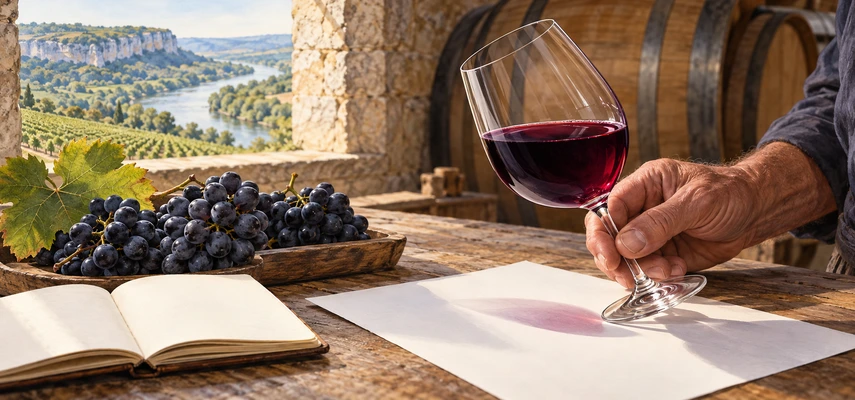

South West France doesn’t have a single house style. A fresh Gascony white, a firm Madiran red and a sweet Jurançon can share a broad regional identity while having remarkably little else in common. Trying to memorise them as one wine is rather like describing every cheese in the fridge as “dairy.” Technically helpful, briefly.
The region makes more sense as a set of connections: Atlantic weather, inland valleys, Pyrenean foothills, local grapes and different ways of handling ripeness. For WSET Level 3, those connections explain the styles more effectively than a list of unfamiliar names.
This is article 17 of The TFE Guide to WSET Level 3 Wine, covering the Dordogne and South West France requirements in the official specification. The questions and marking guidance are original study material, not official WSET examination content.
South West France is a collection of growing environments
Begin east of Bordeaux around Bergerac and Monbazillac in the Dordogne. Move inland to Cahors on the Lot, then southwest towards Gascony, Madiran and Jurançon near the Pyrenees. Their different positions affect heat, rain, exposure and harvest opportunities. “South West” identifies a broad wine region, not a uniform climate or one appellation.
Atlantic influences bring rainfall and moderate temperatures, particularly towards the west. Further inland, summer heat and greater seasonal variation become more significant. Near the Pyrenees, elevation, slope and warm drying winds can alter conditions. A sheltered slope may ripen differently from a damp valley floor only a short distance away.
The vineyard consequences are practical. Drainage matters where rainfall is substantial. An airy canopy can help bunches dry and reduce disease pressure, although growers must retain enough leaf area for ripening. In drier conditions, soil water reserves become valuable. Warm weather helps late-ripening grapes, but excessive heat and water stress can interrupt their progress. No regional climate label replaces a site assessment.
Bergerac: familiar grapes, a separate identity
Bergerac lies along the Dordogne east of Bordeaux. Its reds commonly draw on Merlot, Cabernet Sauvignon, Cabernet Franc and Malbec. Merlot can contribute ripe plum fruit and a rounded palate; the Cabernets bring different combinations of structure, black or red fruit and sometimes leafy notes. Harvesting adequately ripe fruit is important: extracting more tannin from insufficiently ripe grapes doesn’t solve a ripeness problem.
Dry whites commonly combine Sauvignon Blanc, Sémillon and Muscadelle. Sauvignon brings acidity and citrus or herbaceous fruit; Sémillon contributes weight; Muscadelle can add floral perfume. The regional Bergerac and Côtes de Bergerac guide also identifies rosé and sweeter white styles. Learn the specific appellation and wine colour rather than assuming every Bergerac bottle is red.
For a fruit-led red, moderate extraction and maturation in neutral vessels can preserve freshness and allow earlier release. More concentrated fruit may support greater extraction and oak maturation, adding structure and potentially spice or toast. Those choices increase costs and need enough fruit to remain balanced. A prestigious neighbour doesn’t turn Bergerac into Bordeaux AOC; origin rules remain separate.
Monbazillac: useful moisture, followed by drying
Monbazillac occupies hills south of the Dordogne near Bergerac and makes sweet white wines from Sémillon, Sauvignon and Muscadelle. Morning mist followed by drying sunshine can support noble rot. Under suitable conditions, Botrytis cinerea affects berry skins and encourages water loss, concentrating the contents while changing the aromatic profile.
The regional Monbazillac profile describes successive hand-picking passes and the resulting honeyed, candied-fruit styles. Pickers select suitable berries as they develop rather than assuming every bunch is ready together. Persistent wet weather can instead produce destructive rot. “Botrytis” is therefore the start of an explanation, not automatic evidence of excellent fruit.
Dehydration reduces juice volume; selection and repeated picking increase labour. Concentrated must produces a rich wine when fermentation leaves residual sugar. Acidity must balance that sweetness. Suitable barrel maturation can add another layer, but excessive oak can overwhelm the fruit. These factors help explain both the style and its production costs without assuming that every sweet wine is fortified.
Cahors: Malbec on the Lot
Cahors is a red-wine appellation in the Lot valley, inland from Bordeaux. Malbec, also called Côt, is its defining grape; Merlot and Tannat may appear alongside it. The regional Cahors account describes both river terraces and the higher limestone causses. Those settings differ in elevation, soil depth, drainage and available water.
Malbec can produce deeply coloured wines with black-fruit flavours, substantial tannin and refreshing acidity. Don’t turn that reference into “all Cahors needs decades.” Fruit selection, extraction and maturation allow styles ranging from approachable young reds to more concentrated wines intended for development.
Compare two plausible sites. A deeper soil may store useful water, while a shallower, freely draining plateau soil may restrict vigour but increase drought risk. The result depends on the season and management; “higher terrace equals better wine” is too simple. Careful cap management extracts useful colour and structure. More forceful extraction may increase bitterness and astringency without adding desirable complexity.
Madiran: Tannat makes texture a central decision
Madiran lies northeast of Pau in the Pyrenean foothills. Its red wines are based on Tannat, with Cabernet Franc and Cabernet Sauvignon among the supporting grapes. Tannat’s potential for deep colour, firm tannin and acidity makes ripeness and texture central concerns. The regional Madiran description explains its oceanic influence and foothill setting.
Warm, exposed sites and favourable autumn conditions can help fruit ripen. Canopy and crop management must support that aim without leaving bunches unnecessarily vulnerable to rot or sun damage. In the winery, the producer chooses how much material to extract and how to mature it. Ripe tannin and enough fruit matter more than sheer quantity of tannin.
Micro-oxygenation introduces small, controlled amounts of oxygen and may help manage tannin texture. It is an option, not a compulsory Madiran recipe. The appellation’s Domaine Sergent technical description provides a producer example. Controlled exposure differs from leaving wine open to air; excessive oxygen can cause damage. Barrel maturation may also develop texture and add oak flavours, with a cost in barrels, space and time.
Jurançon: acidity supports concentration
Jurançon lies near Pau, south of Madiran, among the Pyrenean foothills. Both dry and sweet white wines are important. Petit Manseng has small, thick-skinned berries and can accumulate considerable sugar while retaining high acidity. Gros Manseng is also important, particularly in dry wines, though the grapes don’t belong to exclusive dry-versus-sweet boxes. The regional white-grape guide explains these roles.
For sweet wines, passerillage concentrates grapes through dehydration on the vine. Warm, drying autumn conditions can help, while extended hanging time exposes fruit to weather and crop losses. This mechanism doesn’t require noble rot. The growers’ Clos Lapeyre La Magendia account describes this on-vine concentration in Petit Manseng.
The finished sweet style can combine tropical or dried-fruit flavours, richness and high acidity. Dry Jurançon instead offers a different balance of aromatic intensity, freshness and body. A dry Gros Manseng example illustrates that contrast. Harvest timing and fermentation decisions matter alongside the grape: a ripe aroma doesn’t establish residual sugar.
Côtes de Gascogne: freshness is an active choice
Côtes de Gascogne IGP, centred on Gers and surrounding areas, is strongly associated with fresh, aromatic white wines. Colombard contributes lively acidity and pronounced fruit; Ugni Blanc can provide acidity and a lighter aromatic contribution. Sauvignon Blanc and the Manseng grapes also appear. The growers’ harvest overview describes these varieties and rapid transport of harvested fruit.
For an early-drinking style, prompt processing, protection from unwanted oxidation and controlled fermentation help preserve primary fruit. Neutral vessels avoid covering that fruit with strong new-oak character. Efficient handling and earlier release can reduce unit costs. Some wines are richer or sweeter, so “Gascogne” doesn’t guarantee one exact palate. Its current IGP specification sets the geographical and production framework.
An IGP allows a different framework from these AOCs, but it isn’t an exemption from origin rules or a verdict of inferior quality. Evaluate whether the wine fulfils its intended fresh style with balance and sufficient fruit, rather than penalising it for lacking the weight of Madiran.
Keep the grape map and the legal map separate
Across the wider South West, Cabernet Sauvignon, Cabernet Franc, Merlot, Sauvignon Blanc, Sémillon and Muscadelle coexist with local varieties. Petit Verdot also occurs in the wider permitted regional palette: the official IGP Ariège profile lists it. As a late-ripening grape, it needs appropriate warmth and exposure to supply ripe colour and structure.
That broader presence does not make Petit Verdot a standard Cahors or Madiran blending grape. Nor can a grower transfer the rules of one appellation to another because both lie in the South West. In an examination answer, name the relevant origin and apply its own grape and production framework. Exact legal percentages are less helpful than a correct regional distinction if you can’t explain their context.
Quality, production costs and the retail price
Assess quality through balance, intensity, complexity and length. Firm tannin needs sufficient fruit; sweetness needs enough freshness; aromatic simplicity can be appropriate in an accurate early-drinking wine. Neither a dark colour nor a difficult harvest proves superior quality by itself.
Production costs follow identifiable mechanisms. Disease losses reduce the usable crop. Slopes and selective picking increase labour. Dehydration yields less juice; sorting, barrels and extended maturation add expense. Transport, storage, applicable taxes and trade margins contribute to retail price. Market demand, reputation and limited supply can change the price further. Explain those commercial influences separately from the sensory evidence in the glass.
Knowledge check: 10 original multiple-choice questions
Select one correct answer per question. These are independent practice questions.
1. Which statement best describes South West France?
2. Which white-grape combination is associated with Bergerac?
3. What makes alternating mist and drying sunshine useful in Monbazillac?
4. Which grape defines Cahors red wines?
5. Why must Cahors site differences be interpreted carefully?
6. Which is the defining grape of Madiran?
7. What is micro-oxygenation intended to provide?
8. Which mechanism is particularly important for sweet Jurançon?
9. Which choice suits a fresh, early-drinking Côtes de Gascogne white?
10. Which statement correctly treats regional grape rules?
Answers and explanations
1. C — A diverse regional collection. Atlantic influences, inland valleys and Pyrenean foothills create different growing environments. Match the relevant grapes and decisions to each origin rather than assuming that a broad regional name predicts a single climate or style.
2. A — Familiar white varieties. Sauvignon Blanc, Sémillon and Muscadelle are important Bergerac white grapes. Their different contributions to acidity, fruit, weight and perfume help explain blends, but the actual proportions and cellar decisions determine each finished wine.
3. D — Suitable noble-rot conditions. Moisture can support botrytis, while subsequent drying promotes concentration. Persistent wetness can instead encourage damaging rot. The sequence and the condition of the fruit matter; the presence of a fungus isn’t a quality guarantee.
4. B — Malbec. Also called Côt, Malbec is the defining Cahors grape. Merlot and Tannat may support it. Wine style still varies with site, fruit ripeness, extraction and maturation, so the grape doesn’t require every bottle to be equally powerful or long-lived.
5. C — Interacting site factors. A deeper soil’s water storage may be valuable in a dry season, whereas drainage may help in a wet one. Altitude and exposure also matter. Ranking all terraces or plateaux without those conditions leaves out the explanation.
6. D — Tannat. Madiran is based on Tannat, whose colour, tannin and acidity make ripeness and extraction important. Supporting varieties and maturation choices can change the balance, but they don’t remove the need for sufficiently ripe, healthy fruit.
7. A — Controlled oxygen exposure. Micro-oxygenation may help a producer manage texture through measured oxygen additions. It isn’t unrestricted aeration, doesn’t repair fundamentally unsuitable fruit and isn’t compulsory for every Madiran producer or cuvée.
8. B — Passerillage. Dehydration on the vine can concentrate Petit Manseng in favourable conditions. This is distinct from relying on noble rot. High acidity helps balance the richness of the resulting sweet wine, while extended hanging time increases harvest risks.
9. C — Protect primary fruit. Prompt handling and controlled fermentation support a clean, aromatic early-drinking style. Neutral vessels can avoid strong new-oak flavours. These choices don’t guarantee quality, but they fit the wine’s intended character and release schedule.
10. D — Rules belong to the origin. A grape permitted in one South West IGP isn’t automatically permitted in Cahors or Madiran. Keep regional knowledge separate from each legal specification, and don’t turn the presence of Petit Verdot somewhere into a universal blending rule.
Written exercise 1: Compare two concentration methods in five marks
Question: Explain how suitable fruit can become concentrated for Monbazillac and sweet Jurançon. Give five distinct linked points comparing the mechanisms. This is an original five-mark practice exercise.
Model answer: In Monbazillac, suitable moisture supports noble rot on ripe berries. Subsequent drying encourages water loss through affected skins, concentrating the contents and changing the flavour profile. In sweet Jurançon, passerillage concentrates berries through on-vine dehydration without requiring noble rot. Warm, drying autumn conditions can help that process. Petit Manseng’s retained high acidity helps balance the sweetness and concentration of the resulting wine.
Why it earns credit: Award one practice mark each for botrytis-supporting moisture, drying and botrytis-related concentration, the distinct non-botrytis requirement of passerillage, suitable drying weather and the balancing role of Petit Manseng acidity. Writing “both grapes get sweeter” doesn’t explain the mechanisms. This is independent marking guidance, not an official WSET scheme.
Written exercise 2: Manage a structured red in five marks
Question: Explain five decisions that can help a Madiran producer make a balanced, structured Tannat-based red. Connect each decision with its purpose rather than prescribing maximum extraction.
Model answer: Choosing a suitably warm, exposed site helps Tannat achieve adequate ripeness. Managing canopy density balances effective leaf area with bunch exposure and air movement. Harvesting according to fruit and tannin ripeness helps avoid extracting excessive unripe character. Measured cap management controls how much colour and tannin enter the wine. Suitable maturation, potentially including controlled oxygen exposure, can help integrate texture while retaining enough fruit.
Why it earns credit: Award one practice mark each for site, canopy, harvest timing, extraction and maturation, provided the relevant mechanism is explained. Counting micro-oxygenation as a sixth compulsory operation earns no extra mark; it is one possible maturation choice. “More tannin means better wine” doesn’t earn credit. The five-point rubric is original practice material.
One-page revision summary
| Origin or clue | Style and explanation |
|---|---|
| Bergerac | Reds commonly use Merlot, Cabernets and Malbec. Dry whites use Sauvignon Blanc, Sémillon and Muscadelle. Apply its own origin rules. |
| Monbazillac | Sweet whites from selected fruit. Suitable moisture and drying can support noble rot, concentration and honeyed flavours. |
| Cahors | Malbec-based reds on Lot terraces and limestone causses. Site water supply, ripeness and extraction explain stylistic differences. |
| Madiran | Tannat-based reds with colour, tannin and acidity. Ripe fruit, controlled extraction and suitable maturation support balance. |
| Micro-oxygenation | Measured oxygen additions may manage texture. The process isn’t compulsory or equivalent to uncontrolled oxidation. |
| Jurançon | Dry and sweet whites near Pau. Manseng grapes retain useful acidity; passerillage is central to many sweet styles. |
| Petit Manseng | Small, thick-skinned berries can concentrate through on-vine dehydration while retaining acidity. |
| Côtes de Gascogne IGP | Fresh aromatic whites are important. Colombard and Ugni Blanc contribute differently; efficient protected handling supports early release. |
| Petit Verdot | Present in the wider regional palette, with late ripening requiring suitable conditions. Permissions aren’t transferable between origins. |
| Quality and price | Assess balance, intensity, complexity and length. Explain crop, labour, cellar and commercial costs through separate mechanisms. |
Practice the comparison in the glass
Compare a fruit-led Cahors with a structured Madiran using small pours. Record tannin quantity and texture separately from acidity, body and fruit intensity. Ask whether each wine has enough fruit to support its structure. If comparing Monbazillac with sweet Jurançon, note sweetness, acidity, fruit and any honeyed or dried-fruit character, then propose a production explanation. Similar sweetness doesn’t prove the same concentration method.
Sources and course context
Primary sources linked throughout include the official WSET specification, the South West interprofession, the Bergerac-Duras interprofession, the Côtes de Gascogne growers and local producer technical descriptions. Producer examples illustrate choices rather than universal recipes. Historical origin legends, marketing superlatives and exact legal percentages aren’t used as explanatory evidence.
Continue your studies: Articles 6 and 7 explain red-wine extraction and sweet-wine concentration. Articles 9 and 10 provide Bordeaux comparisons. Article 18 moves to southern France, while article 44 develops systematic tasting.











