











Wine selection, storage and service share one practical aim: give the guest a wine that suits the situation and reaches the glass in good condition. A brilliant description of an unsuitable bottle isn’t much help. Nor is an expensive red served so warm that alcohol overwhelms the fruit you were hoping to show.
For WSET Level 3, connect the recommendation with the customer’s needs and explain the procedures that protect the wine. The assigned specification covers preferences, sensitivities, price, occasion, storage and service. This guide follows those decisions from the first conversation to the final pour; #48 develops faults, pairing and responsible advice.
Ask what the guest actually wants
Start with individual preferences: colour, sweetness, body, acidity, tannin, oak and familiar styles. Ask for an example they enjoyed and what they liked about it. “Something smooth” might mean low tannin, gentle acidity or a rounded texture. Clarifying that phrase is more useful than assuming it means your favourite full-bodied red.
Next establish price and occasion discreetly. A casual glass before dinner, a gift and a multi-course celebration can call for different choices. Confirm whether the budget is per glass or bottle and explain the actual price. WSET’s selection advice encourages understanding the drinker rather than treating the highest price as the automatic answer.
Consider wine style and wine quality separately. A very good, highly tannic red may be unsuitable for someone seeking a delicate, low-grip wine. An approachable fresh white could meet their needs more closely. Explain the relevant features and offer a limited, meaningful choice: for example, a crisp dry option and a softer, more aromatic alternative within budget.
Sensitivities require checked information
Ask about individual sensitivities or dietary requirements when relevant, then check the actual product information. Don’t promise that organic wine is sulphite-free, that a particular colour is safe for every allergy, or that an unfamiliar fining process must be vegan. Ingredients, allergen declarations and producer confirmation answer different questions from a tasting note.
The Food Standards Agency’s wine-allergen guidance identifies sulphites and relevant milk- or egg-derived materials within its labelling framework. Requirements depend on the jurisdiction and product. If reliable information is missing, explain that limitation and find an appropriately verified alternative. A service professional shouldn’t improvise medical reassurance from a grape name.
Meanwhile, respect a decision to choose an alcohol-free drink or no drink at all. The recommendation should solve the guest’s problem, not create pressure to order wine. Confirm the intended quantity and service pace, particularly with groups sharing bottles. Good commercial service includes trust, accurate information and avoiding an unsuitable sale.
Before the first pour, confirm who ordered the wine and offer the appropriate condition check under the establishment’s service procedure. Explain a suspected problem calmly, replace an unsuitable bottle through the proper process and keep the guest informed rather than disputing their sensory experience.
Storage protects condition before service
For longer storage, aim for a cool, stable temperature, darkness and freedom from unnecessary disturbance. Keep bottles away from radiators, direct sun and places that repeatedly heat up. Natural-cork wines are conventionally stored horizontally to maintain contact with wine; screwcaps don’t need that same cork-moisture arrangement. Closure type alone doesn’t determine quality or ageworthiness.
Poor storage can accelerate development, flatten fresh fruit or produce damaged aromas and flavours. A pushed cork or leakage may prompt investigation, but its absence doesn’t prove perfect handling. The AWRI transport-and-storage guidance documents the effect of conditions on the wine that eventually reaches the customer. A valuable label doesn’t make heat harmless.
Separate long-term storage from short-term chilling for service. A household refrigerator can prepare a bottle for dinner without being the ideal cellar for years. Keep stock organised, track opened bottles and rotate appropriate wines so freshness doesn’t depend on chance. Later, inspect the bottle and assess its condition before assuming a storage plan has worked.
Serving temperatures are style-dependent
Temperature changes expression. Excessive cold can suppress aromas and make some reds seem hard; excessive warmth can emphasise alcohol and reduce freshness. Room temperature in wine service isn’t whatever temperature a heated dining room happens to reach. WSET’s temperature guide places fuller reds around 15–18°C and fuller whites around 10–13°C.
Use the following broad style sequence: sparkling and sweet wines well chilled; lighter whites and rosés chilled; fuller whites lightly chilled; lighter reds lightly chilled or at a cool room temperature; fuller reds at cool room temperature. These are starting points, not an instruction to conceal every aromatic wine beneath ice or serve every red warm.
For Champagne specifically, the Comité Champagne service guidance recommends 8–10°C. Adjust thoughtfully for the wine’s expression and conditions. An ice-and-water bucket makes contact around the bottle and chills more effectively than ordinary ice cubes alone, with air gaps between them. Avoid rapid heating beside a radiator; allow a cold wine to warm gradually.
Sequence of service follows sensory weight and context
As a useful starting sequence, serve lighter before fuller wines, less aromatic or intense before more powerful ones, and dry before sweet. A delicate dry wine can seem diminished after a rich sweet one. Younger before older wines can work in some tastings, but age alone isn’t a reliable measure of intensity or an absolute service rule.
By contrast, a meal’s courses and the guests’ preferences may justify a different order. A sparkling aperitif can precede still wines, but sparkling wine isn’t restricted to that role. Explain the reason for the sequence rather than reciting “white before red” as a law. A rich white can have greater sensory weight than a light red.
Opening still wine: control the bottle and closure
Confirm the bottle, vintage and agreed price before opening. For a cork-sealed still wine, remove the capsule below the lip, wipe the neck, centre the corkscrew and extract steadily without driving fragments into the wine. Keep the bottle stable and finish gently. Afterwards, check the neck and wine’s condition; cork fragments aren’t the same thing as cork taint.
For screwcaps, hold the bottle securely and turn the closure as designed. Fragile older corks may need an appropriate specialist opener and trained handling. WSET’s guide to wine tools explains why one corkscrew isn’t ideal for every closure. Don’t use elaborate equipment as a substitute for identifying the actual practical problem.
Opening sparkling wine: retain control of pressure
Chill the bottle and avoid shaking it. Point it away from people and breakable objects. Keep a hand controlling the cork while removing foil and loosening the cage; never leave the cork unrestrained. Hold the bottle at roughly 30–45 degrees, grip the cork firmly and rotate the bottle slowly so pressure is released under control.
The Comité Champagne’s illustrated service reference supports controlled release while retaining the cork. The desired result is a quiet opening, not a projectile. Pour gently in stages as needed to manage foam. Ordinary corkscrews and dramatic sabrage aren’t the routine procedure for a pressurised bottle.
Decanting has a purpose, not a universal timetable
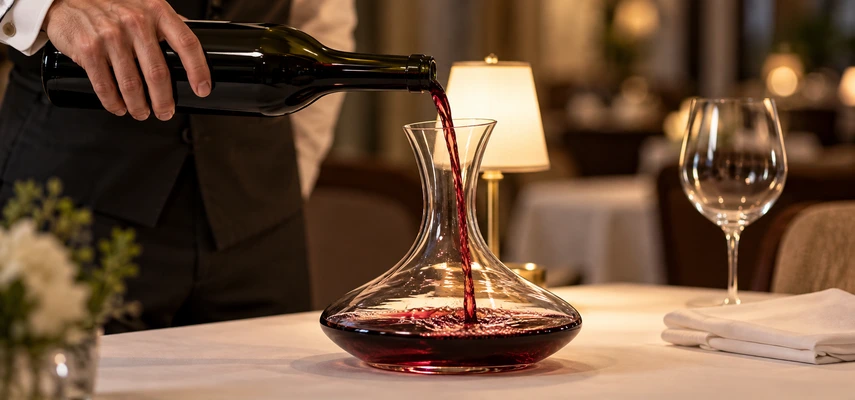
Decanting can separate clear wine from deposit. Let sediment settle where appropriate, move the bottle carefully, open gently and pour in a steady movement while watching the neck against a light. Stop when deposit approaches it. Avoid disturbing the bottle repeatedly between settling and pouring, which defeats the separation you are trying to achieve.
Decanting for aeration is a separate decision. Some young wines may become more expressive, while fragile mature wines may lose character with prolonged exposure. There is no universal number of hours that improves every red. WSET’s decanting discussion distinguishes deposit removal from the debated benefits of aeration. Assess the actual wine and purpose rather than automatically decanting every costly bottle.
Glassware and equipment should help the wine
Choose clean, odour-free, unchipped glasses with space above the pour. A suitable bowl and narrower opening can help concentrate aromas, while the stem permits handling without constantly warming the bowl. Glasses needn’t be huge or expensive to work well. Detergent residue, cupboard odours or a damaged rim can cause more trouble than the absence of a fashionable shape.
For sparkling wines, a tulip-shaped glass can balance aroma expression with the experience of bubbles. WSET’s glassware research discussion shows why shape and preference both matter. Equipment includes a reliable opener, clean cloth, bucket, thermometer where useful, decanter, light and appropriate stoppers. Check cleanliness and function before service begins.
Preserve opened wine and check it again
After service, reclose still wine and refrigerate it to slow deterioration, including reds that can later return toward serving temperature. Suitable vacuum or inert-gas systems can extend useful life, but they don’t restore lost fruit or guarantee an identical result for every wine. Track opening dates and assess condition again before pouring for another guest.
For sparkling wine, use a proper pressure-compatible sparkling stopper and keep it chilled; don’t apply an ordinary vacuum pump that removes dissolved gas. WSET’s preservation guide also rejects the teaspoon-in-the-neck trick. Finally, explain a recommendation through the guest’s brief, the wine’s relevant features and the practical service plan. That turns wine knowledge into useful advice.
Knowledge check: Selection and service
1. What should lead a wine recommendation?
2. How should uncertain allergen information be handled?
3. Which storage conditions are generally appropriate for longer keeping?
4. What does room temperature mean for fuller red-wine service here?
5. What is a useful starting service sequence?
6. What is essential when opening sparkling wine?
7. Which statement about decanting is correct?
8. What should happen as deposit approaches the neck during decanting?
9. What matters most in everyday glassware?
10. How should opened sparkling wine be preserved?
Answers and explanations
1. C — Fit the actual brief. Style, budget and occasion determine suitability. Expensive or personally preferred wine can still be the wrong recommendation.
2. B — Verify rather than reassure by guessing. Product information and producer confirmation support an answer. Colour and organic status aren’t universal allergen guarantees.
3. D — Protect condition. Stable cool temperatures and darkness help limit damaging exposure. Heat and repeated disturbance undermine storage aims.
4. A — A cool wine-service meaning. The range is cooler than many heated rooms. Excess warmth can emphasise alcohol and blur freshness.
5. C — Explain and adapt. Sensory weight and sweetness offer useful starting principles. Courses and preferences may justify exceptions to a fixed colour order.
6. B — Control the cork. Pressure can propel an unrestrained closure. Chilling, safe direction and gentle release are central to the procedure.
7. D — Identify the purpose. Sediment removal is distinct from aeration. A fragile mature wine may be harmed by unnecessary extended exposure.
8. A — Keep the deposit behind. Stopping before sediment enters the decanter separates clear wine from deposit. Shaking or faster pouring works against that aim.
9. C — Practical condition comes first. Clean suitable glasses let the wine express itself. A prestigious shape cannot compensate for odours or damage.
10. B — Retain pressure appropriately. A suitable stopper and chilling help retain freshness and bubbles. Vacuum pumps and teaspoons aren’t appropriate substitutes.
Written exercise 1: Recommend within a guest’s brief (5 marks)
A guest wants a dry, refreshing white without obvious oak for a casual meal, within a stated budget. They mention a sensitivity requiring product verification. Give five steps supporting a useful recommendation.
Model answer: Confirm that refreshing means noticeable acidity and a lighter style, using a familiar liked wine if helpful. Select a dry white whose verified production and tasting profile avoid dominant oak. Check that its actual listed price fits the budget. Explain why its fresh, approachable style suits the casual occasion rather than selecting by prestige alone. Verify the relevant sensitivity information for the actual product, disclose uncertainty and offer a checked alternative if needed.
Why it earns credit: Award one mark each for (1) preference clarification, (2) style match, (3) budget, (4) occasion and explained suitability, and (5) verified sensitivity handling. No particular grape is compulsory when several wines could meet the brief.
Written exercise 2: Serve a mature red with deposit (5 marks)
Explain five practical steps or decisions for serving a sound mature red with sediment, covering condition, temperature and decanting.
Model answer: Confirm the intended bottle and assess its condition rather than assuming maturity guarantees soundness. Bring it gently toward an appropriate cool red-wine serving temperature. Allow deposit to settle and handle the bottle carefully to avoid resuspending it. Pour steadily into a clean decanter while watching the neck against a light, stopping before sediment transfers. Serve without an automatic prolonged aeration period, because a fragile mature wine can lose expression through unnecessary oxygen exposure.
Why it earns credit: Award one mark each for (1) identity and condition check, (2) appropriate gentle temperature adjustment, (3) settling and handling, (4) controlled sediment separation and (5) avoiding unjustified prolonged aeration. A costly label doesn’t establish the bottle’s needs.
One-page revision summary
| Decision | Useful action | Reason |
|---|---|---|
| Preferences | Clarify sweetness, body, acidity, tannin and oak | Familiar words can mean different things to different guests |
| Budget and occasion | Confirm actual price and intended use | Suitability includes practical constraints |
| Sensitivities | Check actual product information | Organic, colour and grape aren’t safety guarantees |
| Storage | Cool, stable, dark; appropriate bottle position | Protect condition and avoid heat/light damage |
| Temperature | Match style; fuller red around 15–18°C, fuller white 10–13°C | Avoid excessive warmth or suppressed expression |
| Sequence | Lighter before fuller, dry before sweet as starting principles | Adapt to sensory weight, courses and preferences |
| Still opening | Stable bottle, correct tool, careful closure extraction | Avoid fragments and unnecessary disturbance |
| Sparkling opening | Chill, safe direction, cork controlled, rotate bottle gently | Release pressure without launching the closure |
| Decanting | Define sediment-removal or aeration purpose | No universal benefit from a fixed exposure time |
| Glasses and tools | Clean, odour-free, sound and suitable | Equipment should support expression and safe service |
| Preservation | Reclose, chill, suitable system; proper sparkling stopper | Slow deterioration and retain bubbles where relevant |
| Next service | Track opening and reassess condition | Preservation doesn’t guarantee indefinite freshness |
Practise a recommendation in three sentences: the guest’s brief, the wine features that meet it, and the service plan that will preserve those features in the glass.












