










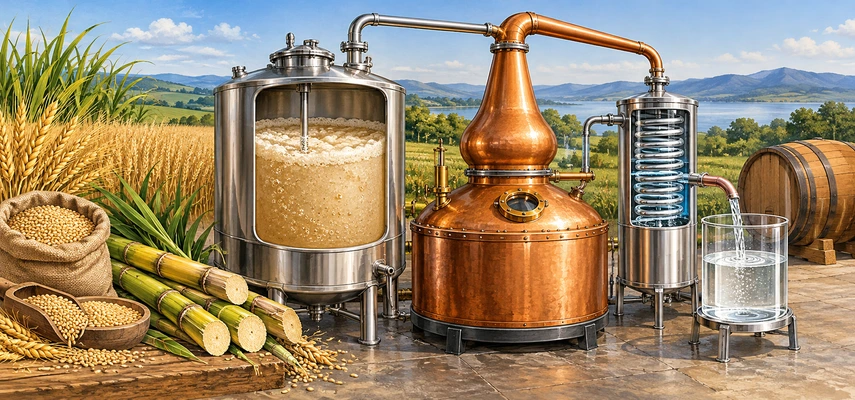

A bottle of rum begins long before anyone opens a valve on a still. Someone grows sugarcane, someone makes decisions about its juice or molasses, and microorganisms perform a transformation that no amount of polished copper can replace. The still enters a story already in progress.
That sequence is the most useful way to understand spirits production. Start with an agricultural material, prepare its carbohydrates, ferment them into alcohol, separate components through distillation, then decide what the new spirit needs before bottling. The route is shared broadly; the choices along it are not.
This is a tour of a production chain rather than instructions for operating equipment. The aim is to understand why a distillery has so many different rooms and why changing an apparently small decision early on can change the bottle at the end.
Begin with a product goal
A producer making an aromatic fruit spirit has a different assignment from one creating a neutral vodka base. A gin distiller may purchase neutral alcohol and focus on botanicals rather than fermenting crops on site. Neither arrangement can be understood simply by counting stills.
The goal affects ingredient selection, fermentation management, separation and finishing. For a characterful spirit, reducing every trace of agricultural or fermentation aroma would defeat the purpose. For a neutral base, that reduction may be central to the specification.
The WSET production syllabus distinguishes raw-material processing, fermentation, distillation and post-distillation operations. Thinking in those stages makes it easier to locate a particular producer’s work without assuming every distillery performs the entire chain.
Prepare something yeast can use
Yeast needs fermentable sugars. Grapes supply accessible sugars in their juice, so crushing and pressing can help create a suitable fermentation medium. Grain and potatoes present a different challenge because much of their carbohydrate is starch.
Starch is a large structure built from sugar units. Enzymatic processing breaks it into smaller carbohydrates, including sugars yeast can ferment. In familiar grain production, milling, water and controlled processing help make that conversion possible. The details vary with the raw material and intended spirit.
Sugarcane juice and molasses require their own preparation and handling. Agave is different again: its carbohydrates and the ways they are made available for fermentation shouldn’t be treated as identical to cereal starch. One agricultural ingredient isn’t a universal replacement for another merely because both can eventually produce alcohol.
The ingredient has jobs beyond supplying sugar
Raw materials can also contribute nutrients, acids and aroma precursors. Freshness, handling and storage therefore matter before fermentation begins. A producer choosing fruit isn’t buying nothing but a sugar delivery service.
That distinction helps explain why a neutral spirit and a fruit-forward spirit may make different purchasing decisions. When the goal is to preserve agricultural character, the crop’s sensory potential matters directly. When extensive rectification is intended, other specifications can take greater priority.
Let fermentation do the biological work
Yeast converts suitable sugars into ethanol and carbon dioxide. It also generates other compounds that can contribute to aroma. The liquid emerging from fermentation therefore contains much more than water, ethanol and a completed checklist.
The spiritsEUROPE process overview identifies fermentation as the stage that creates alcohol. Distillation later concentrates and separates; it doesn’t persuade an unfermented potato to turn directly into vodka.
Producers manage fermentation conditions in pursuit of a particular result. Yeast selection, temperature, time and the condition of the prepared material influence what happens. Some traditions also involve microbial activity beyond a simple single-yeast picture. Those details deserve category-specific treatment rather than one universal distillery recipe.
Fermentation is consequently both an alcohol-production stage and a flavor-development stage. If the desired aromas never develop here, the still can’t reliably recover them from nowhere. Copper is versatile, but it isn’t a substitute for a missing earlier process.
Bring the fermented liquid to distillation
The fermented material may be called wash, wine, beer or another tradition-specific term. Such words can describe its role in production rather than a beverage intended for retail sale. A distiller’s wine, for example, is chosen for the spirit it can become.
Heating the liquid creates vapor with a different composition from the liquid remaining below. In ordinary spirit-production conditions, that vapor can be richer in ethanol. Cooling and condensing it produces a collected liquid with a higher alcohol concentration.
The WSET distillation explanation describes this enrichment. Water and other volatile compounds also move through the system. A still doesn’t separate a real fermentation into perfectly pure ingredients that wait in a neat queue.
Equipment changes the possibilities
Pot stills commonly process batches; columns allow repeated contact between rising vapor and descending liquid and can support continuous production. Hybrid arrangements combine features. What matters is the actual separation achieved, not whether the equipment looks traditional in a photograph.
A producer can seek a highly neutral output or retain more aromatic character, within the rules for the intended spirit. Equipment design, operating decisions and the selected portions all contribute. Detailed comparisons belong to a closer look at stills, but the production-chain point is straightforward: distillation is an active selection stage.
Decide what to keep
In batch distillation, the composition of the collected output changes over time. Producers make decisions about different fractions, often described as heads, hearts and tails. The heart is the portion selected for the intended product; the boundaries aren’t identical for every spirit or apparatus.
This isn’t a simple story in which one named fraction contains every desirable molecule and another contains every undesirable one. Compounds overlap and behave as mixtures. Distillers use appropriate process controls, measurements and trained assessment rather than relying on a nursery rhyme about boiling points.
Regulation can also constrain what may be produced under a particular name. The U.S. standards of identity connect spirit categories with defined ingredients and production requirements. A technically drinkable distillate isn’t automatically entitled to any label the producer likes.
Choose the spirit’s next chapter
Some new spirits are intended to retain a fresh, unaged identity. Others enter wooden containers for maturation. Wood can contribute color and aromatic compounds while the spirit develops through several interacting processes. Time is part of that environment, not an independent flavor ingredient you can simply sprinkle in.
Cognac provides a concrete example of a tightly connected chain. The Cognac interprofessional organization describes vineyard work, winemaking, distillation, aging and blending as parts of its production system. The result depends on the relationship among them.
Other spirits take a botanical route. Gin may receive its characteristic flavors through redistillation with juniper and other ingredients, or through other permitted methods. Liqueurs may involve flavor extraction and sweetening. These are production decisions after an alcoholic base already exists.
Blend, adjust and check
Blending can combine batches or components to create an intended style and level of consistency. It doesn’t automatically mean disguising poor material. Even well-made components may differ, and selecting how they work together is a separate task.
Water is commonly added to reach the chosen bottling strength. The water, spirit and any permitted additions must suit the product’s specification. The strength leaving a still is therefore not necessarily the strength printed on the finished bottle.
Filtration can remove material or affect appearance, depending on the method and product. Producers also check factors such as alcohol content, clarity and consistency before packaging. The TTB’s alcohol-content labeling guidance shows why the declared concentration is a measured product detail, not an approximate tasting impression.
Packaging introduces practical questions too: closure integrity, bottle condition, traceability and the accuracy of the label. A good liquid still needs a reliable container and a truthful description. Those tasks are less photogenic than a copper still but matter just as much to the person opening the bottle.
Traceability links the finished package to production records. If a batch develops an unexpected problem, identifying its inputs and processing history allows the producer to investigate a specific cause. That is another reason the production chain needs documentation as well as sensory judgment. A memorable recipe can’t replace knowing which material went into which tank and which bottles came from it.
Read a bottle as a sequence of decisions
Take an imaginary grape spirit. Its fruit supplied sugars and other material; fermentation created alcohol and aromas; distillation changed their proportions; maturation may have added wood influence; blending and dilution helped determine the final style. Each stage has its own purpose.
Now imagine a botanical gin made from purchased neutral alcohol. Its distiller’s distinctive contribution may begin much later in the chain, with the selection and treatment of juniper, citrus and roots. That doesn’t make the earlier stages disappear; it means another producer carried them out.
When a label emphasizes one attractive fact, ask where it sits in the sequence. A special crop, a long fermentation, an unusual still or an old cask can be meaningful. None tells the whole production story by itself.
The most revealing question isn’t simply how many times a spirit was distilled. It’s what each stage was intended to accomplish, and whether the finished product reflects those choices coherently. Follow that chain and the distillery stops being a room full of impressive metal. It becomes a series of linked problems, solved in different ways.











