










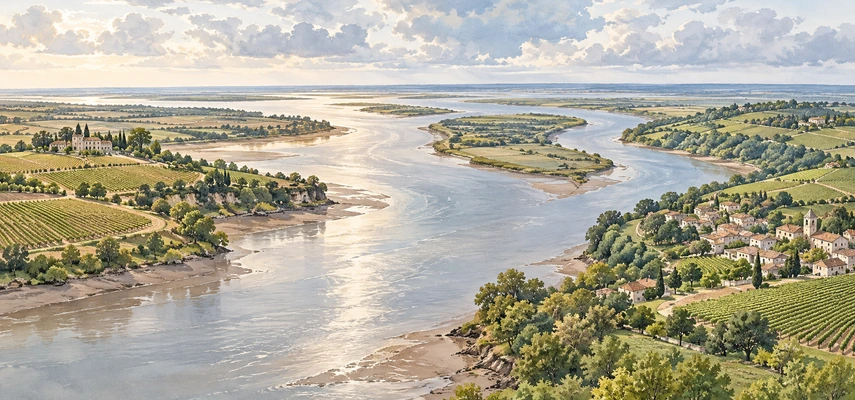

Bordeaux red wines make more sense when you stop treating the river as a line between two recipes. The Left Bank favours Cabernet Sauvignon; the Right Bank favours Merlot. That’s useful shorthand. The interesting part is why growers made those choices, and how a wet September can change the blend without moving a single vineyard.
This lesson connects Bordeaux’s geography with ripening, winemaking, quality and price. It covers the red-wine appellations in the WSET Level 3 specification, with original practice questions and worked written answers. It’s an independent study guide, not official WSET examination material.
Put Bordeaux red wines on the map
Bordeaux lies in south-west France near the Atlantic. The Garonne and Dordogne meet to form the Gironde estuary. Think downstream when identifying banks: the Médoc occupies the Gironde’s left side, north of Bordeaux city. Graves and Pessac-Léognan lie farther south along the Garonne’s left bank. Saint-Émilion and Pomerol belong to the Libournais on the Dordogne’s right-bank side.
The broad Bordeaux and Bordeaux Supérieur appellations aren’t confined to either bank. They cover qualifying sites across the region, including land between the rivers. The regional wine council’s overview makes that geographical breadth clear. A Bordeaux label therefore supplies less precise location information than a communal name such as Pauillac.
Maritime influence moderates temperatures, giving Bordeaux a moderate maritime climate. But a climate average doesn’t pick the grapes. Rain during flowering can reduce fruit set; humid weather encourages fungal disease. Wet harvest conditions can increase rot pressure and force a choice between waiting for ripeness and bringing fruit in earlier. Spring frost, hail, heat and drought remain possible. Nearness to water doesn’t make a vineyard hazard-proof.
Why the grape and the ground work together
Cabernet Sauvignon ripens relatively late. Small, thick-skinned berries can supply deep colour, substantial tannin and blackcurrant fruit, with enough acidity for structure. Insufficient ripeness can leave pronounced leafy or herbaceous character and hard tannins. The Bordeaux wine council’s grape profile links it particularly with warm gravel sites. Drainage reduces waterlogging; a warmer site helps a late variety complete ripening. Neither effect means gravel automatically makes great wine.
Merlot generally ripens earlier, making it useful where Cabernet Sauvignon might struggle to finish. It often contributes plum fruit, body and a rounder impression, though serious Merlot can be very tannic. Clay can hold water for dry periods, and clay-limestone sites are important on the Right Bank. Water availability depends on depth, structure and rooting, not the word “clay” alone. Merlot’s earlier growth also leaves it exposed to spring frost; earlier ripening isn’t an all-purpose insurance policy.
Cabernet Franc can contribute red fruit, floral or leafy aromas, freshness and tannin. It’s particularly important in Saint-Émilion blends, although proportions vary widely. Petit Verdot supplies colour, acidity and tannin in small quantities when adequately ripe. Its late ripening can be a disadvantage in difficult seasons. The Médoc council’s variety guide describes these complementary roles. Don’t convert them into mandatory blend percentages.
A warmer season may help Cabernet reach ripeness, yet hot, dry conditions can push Merlot towards high sugar and alcohol while drought restricts vine function. Soil water reserves become especially useful then. Climate change doesn’t simply turn every year into an easier version of the last one.
The Left Bank: learn the sequence, then the differences
The Médoc peninsula sits between the Atlantic and the Gironde. The subregional names Médoc and Haut-Médoc differ from the more specific communal appellations. Médoc production is concentrated farther north; Haut-Médoc extends southwards around the communal zones. Neither name tells you a fixed Cabernet percentage or guarantees a particular quality level.
Moving broadly north to south through four key communes gives Saint-Estèphe, Pauillac, Saint-Julien and Margaux. Their gravel terraces vary in depth and underlying clay. The Médoc appellation council identifies the regional and communal names separately. Use the following tendencies as orientation, not a blind-tasting answer key.
| Appellation | Useful site and style connection |
|---|---|
| Médoc | Northern sites include varied gravel and clay soils. Merlot can be important alongside Cabernet, producing everything from accessible fruit-led reds to structured wines. |
| Haut-Médoc | Gravel ridges favour Cabernet Sauvignon where warmth and drainage support ripening. Blends commonly show black fruit, acidity and firm tannins, with considerable producer variation. |
| Saint-Estèphe | Gravel overlies clay in important sites. Water retention can help in dry years, while cooler, wetter conditions make drainage valuable. Many wines are notably firm and structured. |
| Pauillac | Prominent gravel sites suit Cabernet Sauvignon. Concentrated cassis fruit and substantial tannin are common reference points for ambitious wines intended to develop. |
| Saint-Julien | Gravel sites support Cabernet-led blends. Wines often combine dark fruit, structure and balance, though neither texture nor quality is uniform across estates. |
| Margaux | Gravel soils vary across a relatively extensive communal area. Cabernet-led wines may show fragrant fruit and fine tannins; a delicate reputation doesn’t imply weak structure. |
The Médoc’s regional guide provides a useful geographical companion. In an explanation, connect the gravel to drainage and ripening, then to grape choice and structure. “Pauillac tastes powerful because it is Pauillac” merely sends the question back where it started.
The Right Bank and the wider Bordeaux family
Saint-Émilion includes limestone plateau, slopes and lower sandy or gravelly areas. Merlot is central, with Cabernet Franc important on suitable sites. Clay and limestone can support water supply and ripening balance, but the area isn’t one continuous slab of identical soil. Blends range from approachable plum-fruited reds to concentrated, structured wines with expensive maturation and long development potential.
Saint-Émilion Grand Cru is an appellation with additional production requirements, not automatic membership of an estate classification. A producer may use that appellation without being a Grand Cru Classé. The Saint-Émilion wine council explains the separate, periodically revised classification. Read the complete wording; “Classé” changes the information being supplied.
Pomerol lies beside Saint-Émilion near Libourne. Its plateau and terraces include clay, gravel and sand. Merlot dominates, with Cabernet Franc among the supporting grapes. Rich plum or dark fruit and a full texture are useful expectations, but both tannin and longevity can be considerable. INAO’s Pomerol profile confirms red-only production and the absence of an official cru classification. A famous unclassified Pomerol can cost far more than many classified wines elsewhere.
Bordeaux reds often aim for accessible fruit and moderate production costs, although ambitious examples exist. Bordeaux Supérieur has its own stricter requirements; it isn’t a classified growth or a promise that every bottle outperforms Bordeaux. The appellation syndicate’s overview distinguishes the designations. Côtes de Bordeaux brings together separate hillside areas, commonly with Merlot-led reds. Slope, exposure and drainage can support ripening, while less famous addresses can offer value. It isn’t another name for Médoc, and Côtes de Bourg is a separate appellation.
From a wet vineyard to a balanced blend
Growers commonly train vines along wires and manage shoots and leaves to balance light, airflow and fruit protection. An open fruit zone can help drying and spray coverage in humid weather. Excessive leaf removal can expose berries to sunburn in a hot season. Pruning and crop management must match yield to the vine’s ripening capacity; a lower crop isn’t automatically a better one.
At harvest, separate parcels and varieties can be picked when ready. Sorting removes damaged or unripe fruit, at the cost of labour and reduced saleable volume. Fermentation with skins extracts colour and tannin. Pumping over, temperature and maceration duration should suit the fruit: aggressive extraction cannot manufacture ripe tannin from underripe skins. Malolactic conversion normally follows or accompanies alcoholic fermentation in these reds, reducing sharp malic acidity.
Blending then adjusts proportions of separately assessed lots. Cabernet may supply structure; Merlot may add body and fruit; Cabernet Franc may lift aroma. A press-wine lot might strengthen a blend, or make it too astringent. Trial blends test the result. Keeping varieties with different ripening times also spreads exposure to difficult harvest weather, without eliminating risk. WSET’s comparison of Bordeaux and Napa Cabernet shows how vintage conditions affect Bordeaux blend choices.
Premium wines often mature in oak barrels. New oak can add toast or spice, while oxygen exposure and time influence texture and development. The proportion of new barrels must fit fruit concentration. An everyday red may use tanks, older oak or a shorter maturation to preserve fruit and control costs. More expensive wood is not a substitute for balance.
Labels, classifications and the price on the shelf
An AOC defines an origin and production rules; AOP is the corresponding EU protected-origin term. IGP, traditionally Vin de Pays, is a different geographical category. Vin de France identifies French provenance without an appellation or IGP. These aren’t interchangeable quality scores. The French consumer authority’s labelling guidance explains the distinctions.
Cru classé indicates a classified growth within a particular system. The 1855 classification ranks red estates in five tiers, from first to fifth growth. Its red wines come from the Médoc except Haut-Brion in Graves, now within Pessac-Léognan. It does not rank every Bordeaux estate, and its separate sweet-wine classification uses different tiers. Saint-Émilion has its own revised system. The Cru bourgeois classification is another Médoc system, currently revised every five years with three levels. It isn’t a sixth 1855 tier.
Grape costs reflect land, vineyard work and harvest volume. Sorting, barrels, cellar labour and holding stock add production costs. Transport, storage, import charges where applicable, and distributor and retailer margins affect the shelf price. Reputation and demand can push scarce bottles beyond those costs. Classification may influence demand and investment, but price alone doesn’t demonstrate balance, complexity or length.
In a tasting, describe the evidence before naming a bank: fruit, acidity, alcohol, tannin, body, oak and development. Then explain quality from balance, intensity, complexity and finish. A structured young wine may develop tobacco or cedar-like complexity, but tannin alone doesn’t guarantee improvement. There must be enough fruit and balance to accompany it.
Knowledge check: 10 original questions
Choose one answer for each question. These are independent practice questions, not official WSET questions.
1. Why can well-drained, warmer gravel sites suit Cabernet Sauvignon in Bordeaux?
2. Which statement about Merlot is most accurate?
3. Which geographical sequence moves broadly north to south?
4. What does Saint-Émilion Grand Cru alone establish?
5. Why might a grower avoid extreme leaf removal in a hot season?
6. What is the strongest reason to keep parcel wines separate before blending?
7. Which statement correctly describes Pomerol?
8. How should a student interpret Bordeaux Supérieur?
9. Which choice best explains a premium wine’s high price without confusing price with quality?
10. What is the correct relationship between Cru bourgeois and the 1855 red classification?
Answers and explanations
1. C — Site and ripening. Warmth can assist late ripening, while drainage matters in a region exposed to rain. Neither guarantees quality or removes frost risk. The useful answer connects a site characteristic with a vine requirement.
2. A — Timing and risk. Merlot’s earlier ripening can be helpful before late-season rain arrives. It still faces hazards, including frost and rot, and can produce concentrated, tannic wines. A relative timing advantage isn’t universal protection.
3. D — Médoc geography. Saint-Estèphe lies north of Pauillac, followed southwards by Saint-Julien and then Margaux. Learning this sequence helps locate the communes without treating their boundaries as fixed changes in grape or wine style.
4. B — Appellation versus classification. Saint-Émilion Grand Cru is an appellation. Grand Cru Classé supplies additional classification information. The 1855 red classification has a different geographical scope and doesn’t confer Saint-Émilion status.
5. C — Canopy trade-off. Airflow and fruit-zone access can help disease management. Exposing too much fruit in intense heat can cause sunburn, so the appropriate canopy decision depends on conditions rather than a rule to remove more leaves.
6. D — Selection before assembly. Separate vinification lets the winemaker assess ripeness, structure and aroma from individual lots. Trial blends can then test their interaction. Separation preserves options; it doesn’t abolish vintage variation or fermentation management.
7. A — Pomerol identity. Pomerol is a Right Bank red-wine appellation with no official cru classification. Its reputation and pricing demonstrate that a wine need not appear in a classification to command demand or show ageing potential.
8. B — Reading Supérieur. Additional appellation requirements don’t constitute an estate classification. Nor do they guarantee that every bottle tastes better than wines carrying the broader Bordeaux designation. Origin rules and individual quality judgments answer different questions.
9. D — Costs and market forces. Vineyard and cellar expenditure affect costs, while transport and margins affect distribution prices. Demand and scarcity can add a further premium. None of those mechanisms replaces assessing the wine itself.
10. C — Separate systems. Cru bourgeois is a distinct Médoc classification with periodic revision. The 1855 red classification ranks its own estates in five tiers. Combining them into one ladder misreads both systems.
Written exercise 1: explain a vineyard decision
Question — 5 marks: A Bordeaux estate has a warmer, well-drained gravel parcel and a cooler clay-rich parcel. Explain why it might favour Cabernet Sauvignon on the first and Merlot on the second. Include one limitation of this reasoning.
Indicative marking points: Award one mark each for Cabernet Sauvignon’s later ripening; warmth helping ripening; drainage reducing waterlogging; Merlot’s earlier ripening suiting a cooler site; and a relevant limitation such as drought, rooting depth, vintage variation or other site factors.
Model answer: Cabernet Sauvignon ripens later than Merlot, so the warmer parcel can help it reach suitable ripeness. Gravel drainage can reduce waterlogging after rain. Merlot’s earlier ripening makes the cooler parcel a more plausible choice than late Cabernet. However, gravel can become drought-prone, and actual performance also depends on soil depth and water reserves. The estate must assess the whole site rather than plant by soil name alone.
Why it earns credit: Five separate points connect variety, site and outcome, with a specific limitation. Merely assigning one grape to each soil would identify a pattern without explaining it.
Written exercise 2: explain price without assuming quality
Question — 5 marks: Explain five reasons why a carefully selected, barrel-matured Bordeaux red might sell for more than a high-volume, tank-matured Bordeaux red.
Indicative marking points: Award one mark each for selection reducing saleable volume; additional sorting labour; barrel purchase and handling costs; capital/storage costs during maturation; and reputation or demand permitting a market premium.
Model answer: Rejecting unsuitable fruit reduces the volume available for sale, spreading vineyard costs over fewer bottles. Sorting also requires labour or equipment. Barrels add purchase and handling costs compared with a simple tank programme. Longer maturation ties up stock and requires cellar space before income arrives. Finally, a sought-after estate may command a reputation premium when buyers compete for limited supply. These explain a price difference without proving that the wine is better balanced.
Why it earns credit: Each reason supplies a distinct cost or market mechanism. Repeating “more expensive production” five ways would not demonstrate five separate explanations. These are educational marking suggestions, not an official WSET mark scheme.
One-page revision summary
| Remember | Explain it this way |
|---|---|
| Location | The Left Bank includes Médoc and Graves; Saint-Émilion and Pomerol belong to the Right Bank Libournais. |
| Climate | Maritime moderation coexists with rain, fungal disease, frost and vintage variation. Heat and drought can also challenge ripening balance. |
| Grapes | Late Cabernet Sauvignon benefits from suitable warm sites. Earlier Merlot suits many cooler clay-rich sites; Cabernet Franc and Petit Verdot add other blending options. |
| Médoc sequence | From north to south, remember Saint-Estèphe, Pauillac, Saint-Julien and Margaux. Treat style descriptions as tendencies. |
| Broader origins | Bordeaux, Bordeaux Supérieur and Côtes de Bordeaux cover varied sites and price levels; they aren’t classification tiers. |
| Winery | Separate lots preserve blending choices. Extraction and oak must suit fruit concentration and tannin ripeness. |
| Labels | AOC/AOP, IGP/Vin de Pays and Vin de France describe different origin categories. Saint-Émilion Grand Cru doesn’t automatically mean Grand Cru Classé. |
| Classification | 1855, Saint-Émilion and Cru bourgeois are separate systems. Pomerol has no official cru classification. |
| Quality and price | Judge balance, intensity, complexity and length. Explain price through costs, distribution and demand rather than using reputation as tasting evidence. |












