










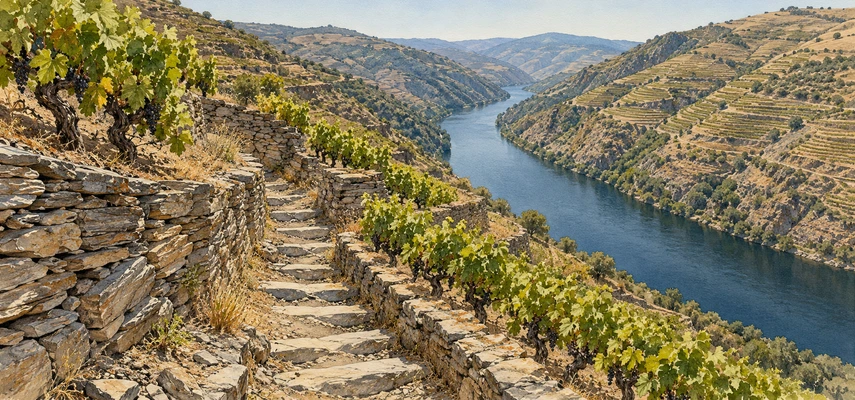

Portuguese wines reward a little attention to geography before the grape names arrive. Cross the mountains inland from the damp Atlantic north-west and the growing problem changes dramatically: drying fruit is no longer always the priority; finding enough water may be. Head south and you meet generous reds, then discover higher sites making a rather fresher argument. Portugal is compact, but its vineyards haven’t agreed on one climate.
For WSET Level 3, connect those conditions with varieties, vineyard decisions and cellar choices. This guide covers the Portuguese still-wine origins and grapes assigned in the WSET specification. The practice questions are independent educational material. Port has its own lesson later; not every red from the Douro is fortified.
Start with ocean, mountains and distance inland
Portugal lies along the Atlantic edge of the Iberian Peninsula, west of Spain. Maritime influence is strongest in exposed coastal areas, moderating temperatures and bringing rain. Mountains can shelter inland vineyards, while distance from the ocean increases seasonal temperature contrasts. Elevation and aspect create further variation within individual regions.
Cooler, wetter sites can preserve acidity but create disease pressure and make ripening difficult in an unfavourable season. Warmer, drier sites can develop ripe fruit and sugar but face water shortages and acid loss. Canopy management therefore has different priorities: sufficient airflow in humidity, enough protection from excessive sun in heat. Neither “Atlantic” nor “Mediterranean” is a complete production plan.
Soil depth, drainage and available water affect vine function. Schist occurs in the Douro, granite is important in Dão, and other regions contain varied materials. Explain rooting and water supply rather than assuming that a rock passes its flavour directly into grapes. Suitable sites need appropriate farming; a celebrated soil name doesn’t remove the need for healthy, ripe fruit.
Vinho Verde: a region, not a promise of green grapes
Vinho Verde lies in the north-west, between the Spanish border and the area south of Porto. The regional overview describes strong Atlantic influence, abundant rain and many small holdings. Its name doesn’t mean that the grapes must be picked unripe. Nor does the appellation make only white wine, although fresh whites are its best-known international introduction.
Alvarinho, Loureiro and Arinto are useful starting points. Alvarinho is the same variety as Spain’s Albariño. It can produce aromatic citrus and stone-fruit whites with fresh acidity and appreciable body. Its famous northern heartland is Monção e Melgaço, a relatively sheltered setting. The Alvarinho profile describes its fuller style compared with many lighter regional wines.
Loureiro can contribute floral fragrance and citrus or orchard fruit, with refreshing acidity. Arinto, locally called Pedernã, is especially useful for retaining freshness and can add lemon or green-apple character. The Loureiro account and Arinto profile help distinguish aroma from structural contribution. These grapes can appear in blends or varietal wines rather than one mandatory regional formula.
Vigorous growth needs managing so bunches receive sufficient light and airflow. Traditional raised systems coexist with modern trellises; neither description applies to every parcel. Small or awkward holdings can increase hand work and grape costs. Healthy fruit, gentle pressing and temperature-controlled fermentation in neutral vessels preserve clean aromas. Lees contact or wood can add texture in selected wines.
Many accessible examples are light, refreshing and intended for early drinking; some have slight sweetness or a gentle spritz. Those features aren’t compulsory for every Vinho Verde. More concentrated Alvarinho and other ambitious wines can be dry, still, fuller and capable of development. Don’t turn a familiar commercial style into a legal definition of the entire region.
Douro: still wine from a demanding landscape
The Douro follows the river inland from the Atlantic towards Spain. Mountain shelter reduces maritime influence, and the region becomes generally hotter and drier eastwards. The Douro regional account describes steep slopes and extensive terraces. Cooler elevations and differing aspects qualify the broad pattern: not every vineyard has the same heat or water supply.
Terraces make farming possible but can restrict machinery and require expensive maintenance. Narrow plots and steep access add labour, while erosion and water management need attention. Where slopes permit, different layouts can improve efficiency. Deep roots accessing available moisture can help through summer, but severe drought still limits vine function. Dry terrain isn’t automatically a mechanism for improving quality.
Touriga Nacional can contribute intense dark fruit, floral notes, colour and tannin. Tinta Roriz, also called Aragonez elsewhere in Portugal, is Tempranillo. Touriga Franca and other local varieties are important partners. The Douro institute’s wine descriptions explain the prevalence of blends. Different grapes can supply complementary aroma, structure and ripening responses, while separate lots give the producer options.
Typical dry Douro reds can have deep colour, concentrated dark fruit, firm tannins and substantial body. Extraction and maturation need matching to fruit ripeness: more skin contact isn’t automatically better. Oak and bottle development can add complexity when fruit is sufficiently concentrated. White wines also exist, often benefiting from cooler sites and careful handling. Douro DOC still wine must be distinguished from Port’s fortified production framework; the shared landscape doesn’t make the finished wines identical.
Dão: a sheltered inland comparison
Dão lies south of the Douro in north-central Portugal, with vineyards around Viseu and the surrounding hill country. Mountains shelter it from direct maritime and continental extremes. Granite-derived soils and varied elevations are important, as the Dão regional account explains. Warm growing conditions and cooler nights can support ripe fruit with freshness when the site and crop are balanced.
Touriga Nacional is important here too. Its variety profile describes the combination of floral and fruit intensity with colour and tannic structure. Alfrocheiro can contribute colour, berry fruit and useful acidity. Jaen can provide fragrance and a softer, earlier-drinking expression. Tinta Roriz adds another blending option. Don’t assume that Dão is simply a smaller Douro with an identical blend.
Crop and canopy decisions help achieve flavour maturity without excessive shading. Smaller hillside parcels can add labour costs. Careful extraction preserves fruit while obtaining the intended tannic framework; neutral vessels or appropriate oak shape different expressions. Typical reds can be fragrant, fresh and structured, with some developing savoury complexity over time. Encruzado is an important additional white grape, so a red-wine emphasis shouldn’t become a claim that Dão only makes reds.
Bairrada: Baga needs a cooperative autumn
Bairrada lies closer to the Atlantic, south of Porto around the Aveiro–Coimbra area. The regional profile describes maritime influence, relatively mild temperatures, rainfall and clay-limestone as well as sandy soils. Wet weather near harvest can create real pressure for growers.
Baga is the key black grape to understand. It ripens late and can produce high acidity and tannin, with dark berry or plum fruit and considerable ageing potential when properly ripe. The Baga variety account highlights the risks of inadequate ripening and rot in cooler, wetter years. Suitable exposure, crop balance and canopy airflow can help; a famous grape cannot negotiate autumn rain away.
Selective harvesting may improve fruit quality but reduces saleable volume and adds labour. Extraction should respect the tannin ripeness, while maturation can soften the structural impression and develop complexity in suitable wines. More accessible interpretations and blends also exist. Bairrada additionally makes whites and sparkling wines, so Baga’s important role doesn’t define every bottle’s colour or production method.
Alentejo and Alentejano: related geography, different frameworks
Alentejo lies in south-central Portugal, east and south of Lisbon. Much of the landscape is rolling plain with hot, dry conditions and considerable continental influence. Higher Portalegre sites around the Serra de São Mamede provide an important cooler contrast. The Alentejo regional profile describes that diversity. Water availability, canopy protection and harvest timing matter when heat can push sugar ahead of balance.
Aragonez, the name commonly used here for Tinta Roriz/Tempranillo, can provide ripe berry fruit and structure. Trincadeira can add fruit, acidity and herbal or spicy character when ripe, but its vigorous growth and rot susceptibility require care. The Trincadeira profile explains why warm, dry conditions can suit it better than persistently wet settings.
Alicante Bouschet is also important, contributing deeply coloured, structured wines and supporting powerful blends. Mouchão’s vineyard account illustrates its major place at one established Alentejo producer, alongside Aragonez and Trincadeira. It isn’t interchangeable with Garnacha merely because similar Alicante names occur elsewhere. Blending should be explained through actual varieties rather than guessed from a nickname.
Typical reds can show ripe dark fruit, substantial body and rounded or firm tannins depending on the grapes and extraction. Neutral-vessel, earlier-release wines can foreground fruit; concentrated selections may support oak and longer maturation. Arinto can help preserve acidity in regional whites. Picking sufficiently early for freshness, without sacrificing ripe flavour, is one way to avoid treating every warm site as a competition for maximum alcohol.
Alentejo DOC/DOP and Vinho Regional Alentejano IGP are distinct frameworks. The Portuguese wine institute’s Alentejo account explains the broader regional indication and its greater flexibility. A producer may use Alentejano for permitted fruit or a blend outside narrower DOC requirements. That choice doesn’t automatically establish inferior quality, and DOC isn’t a universal guarantee of superior balance.
Lisboa: coastal influence with sheltered exceptions
Lisboa extends through hills north of Lisbon along the Atlantic side. Exposed sites can experience strong maritime moderation, while more sheltered inland vineyards can ripen under warmer conditions. The Lisboa regional profile describes a varied landscape containing more specific protected origins as well as broader regional production.
Arinto is particularly useful in fresh whites and is strongly associated with the more specific Bucelas origin. Reds can involve Touriga Nacional, Aragonez, Trincadeira and other permitted varieties. Site selection and crop management help achieve the intended ripeness; protective white winemaking or measured red extraction then preserves an appropriate balance. Lees, oak and further maturation can shape more ambitious styles.
Broader Lisboa regional wines can offer blending flexibility and efficient volumes, while particular parcels or smaller origins may face different labour and land costs. Don’t mistake Lisboa IGP for the city’s restaurant address or treat every coastal wine as identical. A refreshing affordable blend and a concentrated site-focused wine answer different commercial and stylistic aims.
Make the grape names work for you
Tinta Roriz and Aragonez are Portuguese names for Tempranillo, with spelling variants encountered in study material. Alvarinho is Albariño. Touriga Nacional is not the same grape as Touriga Franca. Alfrocheiro and Jaen are separate varieties, not interchangeable descriptions of a light red. The national variety guide is a useful starting point for checking names before comparing styles.
Portuguese DOC sits within the DOP protected-origin framework. IGP wines may be labelled Vinho Regional, as the certification guide explains. These terms regulate entitlement and production, not a nationwide tasting score or one compulsory barrel schedule. Check the particular origin and wine rather than transferring a rule from another country.
Explain quality and price with different evidence
Assess balance, intensity, length and complexity in the wine. Then explain price through five separate categories. Grape costs reflect land, vineyard labour, yield and demand for fruit. Winery production costs include equipment, staffing, barrels and maturation stockholding. Transport adds freight and distribution expenditure. Distributor and retailer margins pay for their services and risks. Market forces connect limited or abundant supply with consumer demand, sometimes creating a premium beyond direct production costs.
Steep Douro work and selective Baga harvesting can increase grape costs through different mechanisms. Extended maturation increases later cellar costs. Efficient, earlier-release regional blends may cost less without being defective. For revision, revisit environment in #2, vineyard choices in #4, white and red winemaking in #5 and #6, and maturation in #8. Compare Spain in #27 and #28; Port follows in #42 and law returns in #49.
Knowledge check: 10 original practice questions
Choose one correct answer per question.
1. Which grape pairing identifies the same variety across Portugal and Spain?
2. Which statement about Vinho Verde is sound?
3. Which grape is particularly useful for preserving acidity in Portuguese whites?
4. Which statement distinguishes Douro still wines from Port?
5. Which names identify Tempranillo in Portuguese contexts?
6. Which varieties are particularly relevant to Dão reds?
7. Why can Baga be challenging in Bairrada?
8. What is the relationship between Alentejo DOC and Alentejano IGP?
9. Which factor can directly raise grape costs on steep Douro terraces?
10. Which statement about Lisboa is most useful?
Answers and explanations
1. C — Alvarinho and Albariño. These names identify the same variety in different national contexts. They don’t require all resulting wines to share identical body, alcohol or maturation choices.
2. B — A broad regional identity. Light refreshing whites are familiar, but fuller wines, different colours and other styles exist. The name does not require underripe fruit or one universal spritz level.
3. D — Arinto. Its acidity makes it valuable in blends as well as varietal wines. Aroma intensity and acidity are different attributes, so freshness needn’t depend on an especially floral grape.
4. A — Shared landscape, distinct wine. Still Douro wines can ferment without Port’s fortification process. Region, variety and finished production method must be kept separate.
5. C — Two Portuguese identities. Tinta Roriz and Aragonez refer to Tempranillo. Touriga Nacional and Touriga Franca, by contrast, are separate grapes rather than local synonyms.
6. B — A useful Dão set. These varieties can provide complementary fruit, fragrance, colour and structure. Individual blends vary; Dão additionally has important white wines.
7. D — Late-season exposure. Baga needs sufficient ripeness, while autumn rain can increase rot and picking risks. Suitable sites, canopy work and selection help but cannot remove the weather.
8. A — Related geography, separate rules. Alentejano offers a broader regional framework rather than simply duplicating Alentejo DOC. Individual quality must still be assessed in the wine.
9. C — Growing labour. Difficult access can increase working time and cost per unit of fruit. Tanks and later cellar operations belong to a different production stage.
10. B — Coastal and inland variation. Exposure and shelter alter the strength of Atlantic influence. The region’s name alone doesn’t fix one grape blend or sensory profile.
Written exercise 1: compare Atlantic and inland challenges
Give five linked observations comparing vineyard priorities in wet Vinho Verde and dry inland Douro settings. Cover water, disease, canopy, access and ripening. Five marks.
Model answer: Douro growers need sufficient available water to sustain vine function through dry summers, whereas wet Vinho Verde sites may require effective drainage. Humidity can increase fungal disease pressure in Vinho Verde, making crop protection and drying important. Canopy work must balance airflow in damp conditions against avoiding excessive fruit exposure and sunburn in hot sites. Steep Douro terraces can restrict machinery and increase manual labour. Site and crop selection must provide enough ripening warmth in cooler Atlantic vineyards while avoiding excessive sugar or acid loss in warmer inland ones.
Why it earns credit: One mark each for water management, disease, canopy trade-off, access/labour and ripening balance. These are separate mechanisms. The question compares described settings rather than claiming every parcel in either region experiences identical conditions.
Written exercise 2: distinguish five commercial costs
Explain a possible price premium for a scarce, carefully selected red held for maturation. Address grapes, winery production, transport, margins and market forces separately. Five marks.
Model answer: Selective harvesting can increase labour and reduce saleable fruit, raising grape costs. Barrels and extended storage add winery production expenditure and tie up capital. Small shipments to distant markets can increase freight cost per bottle. Distributor and retailer margins pay for handling, selling and risk. Demand exceeding a limited supply can support a market premium beyond those direct extra costs.
Why it earns credit: Each point covers one named commercial category with its own mechanism. Harvest labour and rejected fruit both concern grape costs; they don’t replace the separate winery production point. A higher price does not by itself demonstrate better balance or complexity.
One-page revision summary
| Topic | Remember | Explain the consequence |
|---|---|---|
| Vinho Verde | Wet Atlantic north-west; Alvarinho, Loureiro, Arinto | Canopy/disease work and protective white winemaking support freshness |
| Alvarinho | Albariño identity; Monção e Melgaço important | Fuller aromatic wines exist alongside lighter regional styles |
| Loureiro and Arinto | Floral fragrance versus especially useful acidity | Distinct contributions to blends and varietal wines |
| Douro | Sheltered inland river slopes and terraces | Heat, water supply and difficult access influence style and cost |
| Touriga Nacional | Floral/dark fruit, colour and tannin | Can support concentrated structured blends and development |
| Tinta Roriz/Aragonez | Tempranillo | Shared grape identity doesn’t mean identical regional expression |
| Dão | Sheltered hills; Touriga, Alfrocheiro, Jaen, Tinta Roriz | Fragrance, freshness and structure shaped by site and extraction |
| Bairrada | Atlantic conditions; Baga important | Late ripening, rain and tannin maturity require careful decisions |
| Alentejo | Hot dry south-central region with cooler exceptions | Water, harvest timing and canopy protection matter |
| Alentejo red grapes | Aragonez, Trincadeira, Alicante Bouschet | Complementary fruit, acidity, colour and structure |
| Alentejano | Broader IGP framework than Alentejo DOC | Flexibility isn’t an automatic quality penalty |
| Lisboa | Atlantic hills north of Lisbon, sheltered inland variation | Arinto whites and varied reds; not one uniform coastal style |
| Commerce | Grapes, production, transport, margins, market forces | Separate price mechanisms from sensory quality evidence |
For practice, explain why a fresh Loureiro, a firm Baga and a concentrated Douro blend can all make sense within the same country. Start with the growing problem, then follow the producer’s choices into the glass.












