










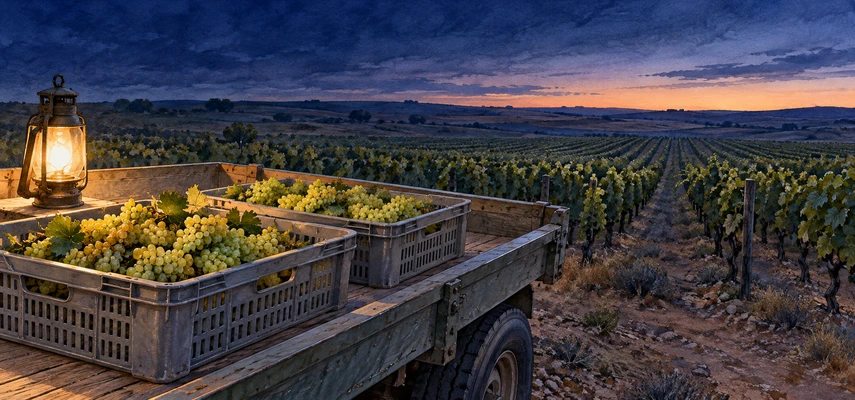

Spanish wine regions become easier to remember when you give each one a job. Priorat shows how steep, dry terrain can shape a concentrated red and its price. Rueda explains why an inland plateau can produce fresh, aromatic whites. Jumilla puts a demanding late-ripening grape into a setting where it can ripen properly. The names stop being a list once they start explaining something.
This guide covers the remaining Spanish still-wine origins assigned in the WSET Level 3 specification. Follow the route from Navarra and Aragón through Catalunya, across Castilla y León, down the eastern side and into the central plateau. The questions are original practice, not official WSET examination material.
Keep three growing factors in view
Much of inland Spain has hot, dry summers, cold winters and limited rainfall. Mediterranean coastal influence can moderate temperatures, while mountains and elevation create cooler sites within otherwise warm regions. A grape ripening on a high slope may experience a different season from one growing on a nearby plain. Regional descriptions are starting points, not guarantees for every parcel.
Water availability is a recurring concern. Deep rooting, appropriate rootstocks, suitable ground management and permitted irrigation can help, but severe stress can restrict photosynthesis and obstruct ripening. Sparse bush-vine planting can fit dry conditions; trellises can improve access and mechanisation where the site permits. An open canopy needs balancing against sunburn risk. Neither very old vines nor very low yields automatically establish quality.
In the cellar, neutral vessels and earlier release can preserve fruit and control costs. More concentrated wines may support greater extraction, oak maturation and bottle development. Those choices need ripe fruit and balance. A dark red isn’t necessarily better than a pale one, and an expensive barrel isn’t a repair kit for a poor harvest.
Navarra: rosé is the introduction, not the whole story
Navarra lies north-east of Rioja, towards the Pyrenees. Atlantic, continental and Mediterranean influences meet across a varied territory. The Navarra specification describes how this variation supports different grapes and styles. Cooler northern settings and warmer southern land require different ripening and canopy decisions.
Garnacha is important, including for familiar fresh rosados. Limited skin contact extracts pink colour and some flavour without the tannic structure of a red fermentation. Controlled fermentation and neutral vessels can preserve strawberry or raspberry fruit. The presence of a traditional rosé identity doesn’t mean every Navarra wine is pink.
Tempranillo, Cabernet Sauvignon and Merlot also contribute reds, while Chardonnay is important among whites. The Valdizarbe profile illustrates that diversity. Cabernet can add black fruit and firm tannin, Merlot rounded plum fruit, and Chardonnay can support either fresh or broader, lees- or oak-shaped whites. Suitable site and harvest choices matter more than simply calling a grape international.
Calatayud and Cariñena: Garnacha in Aragón
Calatayud lies in Aragón, south-west of Zaragoza, with vineyards extending onto elevated slopes. Its municipal vineyard account highlights Garnacha and the substantial range of elevations. Warm days help ripening while higher sites can preserve freshness. Older bush vines and awkward slopes can require manual work and produce limited quantities, raising grape costs when saleable yields are low.
Garnacha can give ripe red fruit, body and substantial alcohol. Balanced yields and careful picking help retain enough acidity and avoid excessive overripeness. Gentle handling and neutral maturation can emphasise fruit, while concentrated examples may support oak and longer development. Old-vine wording invites questions about the particular site; it doesn’t answer them automatically.
Cariñena is another Aragón origin near Zaragoza, distinct from Calatayud. It is also a grape name, which can cause understandable confusion. A bottle from Cariñena doesn’t have to be made entirely from the Cariñena grape. The appellation’s wine descriptions emphasise Garnacha alongside other varieties and include reds, rosés and whites. Continental seasonal contrasts and dry conditions make water and crop balance relevant; extraction and maturation distinguish accessible fruit-led reds from more structured styles.
Priorat: understand what the slope costs
Priorat lies inland in southern Catalunya, near Tarragona. Garnatxa and Carinyena, the Catalan names used for Garnacha and Carignan, are central to its red identity. Llicorella is the local name for its characteristic slate. The Catalan wine institute’s Priorat profile describes the difficult terrain, varied elevation and low production associated with this setting.
Warm, dry conditions can support ripe, concentrated fruit. Fractured rock and shallow soils affect rooting, drainage and water access, but don’t pour slate flavour directly into wine. Steep costers and terraces restrict machinery and increase working time. Low saleable yields spread growing costs across fewer bottles. Those are concrete reasons for higher grape prices, independent of the region’s reputation.
Typical reds can be full-bodied, concentrated and high in alcohol, with dark fruit, substantial tannin and a fresh acidic framework when balanced. Careful extraction and oak maturation can support complexity, while excessive wood or overripeness can obscure the fruit. Priorat’s DOQ status is a regulated protected-origin category, not a promise that every wine is dry red, identically blended or automatically superior to every neighbouring bottle.
Catalunya and Penedès: broad origin versus a specific region
Catalunya DO provides a broad geographical framework across permitted parts of Catalonia. It isn’t simply a synonym for Priorat or Penedès. The Catalunya grape and wine account describes local varieties alongside Cabernet Sauvignon, Merlot, Chardonnay and other international grapes. Fruit-led reds and whites coexist with oak-matured examples, so neither one grape nor one flavour defines the entire DO.
Blending fruit from suitable permitted locations can help a producer achieve a consistent style and manage volume. That flexibility may support efficient production, but does not abolish legal origin and grape requirements. A broader appellation can contain ambitious wines as well as straightforward examples; read the actual production choices rather than assuming a fixed quality level.
Penedès lies between Barcelona and Tarragona, extending from Mediterranean-influenced land towards cooler higher sites. Its regional profile explains the variations in elevation, coast and soils. Chardonnay whites can retain freshness at suitable sites or gain body through lees and barrel work. Cabernet Sauvignon and Merlot can support ripe structured reds, with exposure and harvest timing influencing tannin maturity. Traditional local white varieties also remain important.
Penedès makes still wines as well as having a strong association with sparkling production in the wider area. Don’t label every Penedès wine Cava or treat Cava as simply another spelling of Penedès. Sparkling methods and origins receive their own treatment later in the series. Here, the useful comparison is how site and cellar choices produce different still whites and reds.
Toro: another expression of Tempranillo
Toro lies along the Duero farther west than Ribera del Duero. Tinta de Toro is the locally adapted Tempranillo identity, not a synonym for Monastrell. The Toro grape profile provides the regional context. Warm, dry summers in an elevated continental setting can produce ripe fruit and significant alcohol, with cold-season risks and water limitations still relevant.
Reds commonly show deep colour, dark fruit, firm tannin and full body. Crop balance and harvest timing help avoid excessive sugar and retain freshness. Extraction must suit tannin ripeness: pushing harder can make a wine coarse rather than impressive. Oak and bottle maturation can develop complexity in concentrated examples, while earlier-release wines can emphasise accessible fruit. The origin also permits other styles; a reputation for reds is not a legal ban on whites.
Rueda: preserve the white fruit
Rueda lies on the inland plateau around Valladolid, Segovia and Ávila. Verdejo is the key white grape, with Sauvignon Blanc also important. The Rueda Verdejo profile describes herbal and fruit character with fresh acidity. Hot days support ripeness, while elevation and cool nights help explain how freshness can survive in an inland setting.
For aromatic dry whites, harvesting in cooler hours and moving fruit promptly to the winery can limit warming and unwanted oxidation. Gentle pressing and controlled fermentation in neutral vessels retain citrus, orchard-fruit and herbal notes. Sauvignon Blanc can contribute its own aromatic profile; it isn’t another name for Verdejo. Lees contact or barrel fermentation can add texture and complexity to suitable wines.
These are familiar production choices rather than a prohibition on all other Rueda styles. Older oxidative traditions and more involved modern wines also exist. Don’t assume that a successful fresh young wine must improve with long storage, or that oak automatically makes it more complete. Assess the balance between fruit, acidity and texture.
Bierzo: Mencía in the north-west
Bierzo lies in north-western Castilla y León, towards Galicia. Its regulatory board’s production-area account describes a continental-Atlantic setting with important slopes and variation. Mencía is the principal black grape. It can give fragrant red fruit, floral notes and fresh acidity, with tannin and body varying according to site, crop and extraction.
Elevation and aspect influence ripening, while rain and canopy density can increase disease pressure in wetter conditions. Older hillside parcels may demand more hand work than a level mechanised vineyard. Moderate extraction and neutral vessels can preserve fragrance; more concentrated fruit can support wood and development. Don’t assume all Mencía is either light and soft or heavily oaked. The grape’s aromatic identity and the winemaker’s structural choices need considering together.
Castilla y León Vino de la Tierra, often abbreviated VdlT, is a broader regional geographical indication, distinct from individual DOs such as Bierzo, Toro and Rueda. The regional agricultural institute identifies its IGP framework. It can accommodate different grapes and styles within its rules. A producer may choose that framework for a wine outside a narrower origin’s requirements; the letters alone don’t prove inferior quality.
Valencia, Jumilla and Yecla: look inland as well as coastwards
Valencia DO is on Spain’s eastern side, but its production areas include inland elevations rather than only beachfront vineyards. Its regulatory council’s regional account describes a varied grape mix. Mediterranean warmth supports ripe reds from grapes including Monastrell and Tempranillo, while local white varieties and international grapes contribute other styles. Site, yield and protective handling can distinguish clean fruit-led whites from tired examples; oak and extraction shape more structured reds.
Jumilla extends through inland Murcia and neighbouring Albacete. Monastrell, also called Mourvèdre or Mataró, is central. This late-ripening black grape needs sufficient warmth and a long season for mature fruit and tannins. The Jumilla consortium’s regional guide explains its importance in a dry, sunny continental-influenced setting.
Expect potentially deeply coloured, full-bodied reds with ripe blackberry or plum fruit, substantial tannin and alcohol. Water stress, crop balance and picking dates need careful management; drought tolerance doesn’t mean drought immunity. Controlled extraction and neutral vessels can make accessible fruit-led wines, while concentrated selections may support oak and development. Sweet styles exist too, so ripe-fruit language and finished sweetness must remain separate.
Yecla is a distinct neighbouring Murcia DO, also strongly associated with Monastrell. The Yecla regulatory account identifies that leading variety. It shares dry, elevated inland challenges, but isn’t a subzone of Jumilla. Compare individual sites and production choices: a restrained, fresh example and a richer oak-matured red can both be legitimate expressions without one universal flavour or price.
La Mancha and Valdepeñas: scale and variety on the plateau
La Mancha lies on the broad central plateau in Castilla-La Mancha. Hot dry summers, cold winters and relatively workable land have supported substantial production. Airén is an important white grape, while Tempranillo, locally called Cencibel, is central to reds. The La Mancha grape list also includes Cabernet Sauvignon, Merlot, Chardonnay and Sauvignon Blanc, among others.
Airén can supply relatively restrained fruit in dry whites. Prompt, protective processing and temperature control preserve freshness in warm harvest conditions. Well-equipped cooperatives and large wineries can spread equipment costs over substantial volumes. Modern production can therefore improve consistency and offer value; scale is not itself evidence of poor quality. More selective vineyards and maturation programmes can produce a different style at a higher cost.
Valdepeñas is a separate DO farther south in the same autonomous community, rather than a subzone of La Mancha DO. The municipal wine guide identifies Cencibel/Tempranillo and Airén among its grapes. Dry continental conditions and elevation frame the growing season. Fruit-led whites and young reds coexist with oak-matured reds, whose structure and complexity depend on fruit quality, extraction and time. Don’t substitute Rioja’s origin-specific barrel rules for the requirements of every other DO.
Explain the price without making it the quality score
Separate five categories: grape costs reflect land, vineyard labour, yields and demand for fruit; winery production costs include equipment, staffing, barrels and storage; transport adds freight and distribution; margins pay distributors and retailers; market forces connect supply with demand. Manual work on steep Priorat slopes can raise grape costs, while long maturation raises later winery costs. An efficient early-release La Mancha wine can cost less without being defective.
For quality, return to balance, intensity, length and complexity in the particular wine. For revision, revisit vineyard work in #4, white/rosé and red winemaking in #5 and #6, and maturation in #8. Article #27 covers Rioja, Ribera del Duero and Rías Baixas; #40 returns to sparkling origins and #49 to classification.
Knowledge check: 10 original practice questions
Choose one correct answer per question.
1. Which statement about Navarra is accurate?
2. Which distinction avoids confusion in Aragón?
3. What most directly helps explain high grape costs on steep Priorat sites?
4. What does Catalunya DO provide?
5. Which local identity is associated with Tempranillo in Toro?
6. Which pairing suits Rueda?
7. Which grape principally identifies Bierzo reds?
8. Which statement about Jumilla and Yecla is correct?
9. Which distinction correctly describes La Mancha and Valdepeñas?
10. What does Castilla y León VdlT identify?
Answers and explanations
1. C — A varied region. Garnacha rosados provide a familiar introduction, but Navarra also produces reds and whites from local and international varieties. Its varied conditions support that range.
2. B — Place versus variety. Cariñena the DO permits different grapes and styles. The shared name doesn’t establish a compulsory single-variety wine; Garnacha is important too.
3. D — Labour and yield. Steep parcels can require more hand work, while limited yields spread costs over less fruit. Those mechanisms explain growing cost independently of prestige.
4. A — A broad framework. Catalunya covers permitted production under its own rules. It isn’t interchangeable with a narrower appellation or a sparkling-wine designation.
5. C — Tinta de Toro. This is Toro’s locally adapted Tempranillo identity. Monastrell and Mencía are different grapes associated with different important regional examples.
6. B — Two important whites. Verdejo leads Rueda’s familiar identity, while Sauvignon Blanc adds another aromatic possibility. Cool handling and protective winemaking can preserve their fruit.
7. D — Mencía. It can supply fragrant fruit and fresh acidity in Bierzo. Site, extraction and maturation affect body and tannin, so the variety doesn’t impose one uniform style.
8. A — Neighbours, not synonyms. Both have strong Monastrell associations, but their origins are legally distinct. Ripe fruit aromas don’t automatically establish finished sweetness.
9. C — Separate DOs. The wider autonomous community contains both origins. Airén contributes whites, while Cencibel is the local Tempranillo name; each DO has its own requirements.
10. B — Regional IGP framework. VdlT identifies a geographical indication with rules. A broader entitlement does not establish a fixed blend or replace individual quality assessment.
Written exercise 1: protect freshness in a white wine
Explain five separate choices that can support a fresh, aromatic dry white from a warm inland Spanish region. Five marks.
Model answer: Selecting a suitable elevated site can moderate ripening temperatures and help retain acidity. Matching crop load to the vine’s capacity supports enough flavour rather than dilution. Harvesting in cooler hours limits fruit warming before processing. Gentle pressing reduces extraction of unwanted phenolic bitterness. Temperature-controlled fermentation in a neutral vessel preserves primary fruit without prominent oak aroma.
Why it earns credit: One mark each for site, crop balance, cool harvest, pressing and fermentation, each connected to a distinct result. The answer offers available choices, not a claim that every Rueda or La Mancha wine must follow an identical method.
Written exercise 2: compare vineyard and commercial costs
Explain a possible price difference between a scarce, steep-site red held for maturation and a large-volume early-release wine. Address grapes, winery production, transport, margins and market forces separately. Five marks.
Model answer: Manual vineyard work and low saleable yields can increase the cost of grapes on steep sites. Barrels and extended cellar storage add winery costs after harvest. A small shipment to a distant destination can raise transport cost per bottle. Distributor and retailer margins pay for handling, selling and risk. Strong demand relative to scarce supply can support an additional price premium beyond those direct extra costs.
Why it earns credit: Each of the five commercial categories receives its own mechanism. Limited yield and manual picking both concern grapes, so they don’t replace a separate point about production after harvest. The model describes possible differences rather than assuming expensive wines always travel farther.
One-page revision summary
| Origin | Main association | Useful explanatory link |
|---|---|---|
| Navarra | Garnacha rosé; Tempranillo, Cabernet, Merlot, Chardonnay | Varied climate and sites support more than one wine colour |
| Calatayud | Elevated Aragón Garnacha | Warmth plus elevation; old or awkward parcels may raise labour costs |
| Cariñena | Aragón DO, Garnacha important | Shared grape/place name does not fix every blend |
| Priorat | Garnatxa, Carinyena, llicorella, DOQ | Steep dry sites, limited yields and labour can increase costs |
| Catalunya | Broad DO with local and international grapes | Flexibility within rules, no automatic sensory rank |
| Penedès | Coastal-to-higher sites; varied whites and reds | Still wines mustn’t all be called Cava |
| Toro | Tinta de Toro/Tempranillo | Ripe fruit and structure need water, crop and harvest balance |
| Rueda | Verdejo and Sauvignon Blanc | Cool handling and protective fermentation preserve fresh aromas |
| Bierzo | Mencía | Continental-Atlantic slopes, fragrance and variable structure |
| Castilla y León VdlT | Broad regional IGP | Distinct from the region’s narrower DOs |
| Valencia | Varied Mediterranean and inland production | Elevation and grape choice qualify a purely coastal picture |
| Jumilla | Monastrell in dry inland Murcia/Albacete | Long-season ripening and water management matter |
| Yecla | Distinct Murcia DO; Monastrell important | Neighbouring origin, not a Jumilla subzone |
| La Mancha | Airén, Cencibel and other grapes | Scale and equipment can improve efficiency and consistency |
| Valdepeñas | Separate DO, Cencibel/Tempranillo and Airén | Own production rules; young and matured styles coexist |
Practise explaining one wine from Rueda, Priorat and Jumilla without using price as your quality evidence. If you can connect the conditions with sensible vineyard and cellar decisions, the map is doing its job.












