











North American wines beyond California make a useful test of climate assumptions. Washington’s important vineyards aren’t generally growing in Seattle’s rain. Canada doesn’t spend its entire growing season frozen. And a lake can help a vineyard by delaying spring growth as well as keeping autumn a little warmer. Those details explain far more than a country’s reputation for weather.
For WSET Level 3, connect the environment with grape choice, production and price. This guide follows the regions assigned in the WSET specification: Oregon and Washington, New York’s Finger Lakes, Ontario and British Columbia. Original questions and worked answers follow the lesson; these aren’t official examination materials.
Compare the growing season, not the holiday forecast
Successful ripening depends on usable warmth and light between spring growth and harvest. A region with cold winters can still have warm summers, while long summer daylight can help at higher latitudes. Early autumn cold, spring frost, disease or drought can interrupt the process. The relevant question is whether a particular variety can mature reliably at a suitable site.
Large lakes heat and cool more slowly than land. Their stored warmth can moderate nearby autumn temperatures, while cold water can delay spring warming and budburst. Mountains may shelter vineyards from rain-bearing air. Neither effect eliminates risk: a severe freeze can still injure buds or trunks, and a sheltered dry site may require irrigation. Explain the benefit and its limit together.
Oregon: Willamette Valley and Pinot Noir
Oregon lies north of California. Its important Willamette Valley runs south from the Portland area between the Coast Range and the Cascades. The Oregon Wine Board’s regional account describes relatively cool conditions with wet winters and generally drier, warmer summers. Marine air entering through gaps and variations in slope, elevation and exposure produce distinct sites within the valley.
Pinot Noir is the leading association, with Chardonnay, Pinot Gris and other whites also important. Suitable warmth and a long season can develop ripe red fruit while retaining fresh acidity. Autumn rain can make picking decisions difficult; a shaded or heavily cropped site may struggle to achieve the intended maturity. Warmer years can bring a different problem, requiring attention to sunburn, water and excessive sugar.
Growers use crop and canopy management to balance ripening and healthy fruit. Hillside sites can improve drainage and cold-air movement, but machinery access and erosion require consideration. In the cellar, careful Pinot extraction can preserve fragrance without excessive tannic grip. Oak can add complexity to sufficiently concentrated fruit, while an overpowering barrel programme can hide the wine’s character. Site name and expensive equipment aren’t substitutes for balance.
Oregon also illustrates the importance of state-specific label rules. For an Oregon Pinot Noir variety claim, the state’s usual 90% varietal requirement is stricter than the federal baseline. There are exceptions for certain other varieties, so don’t apply 90% indiscriminately to every Oregon wine. The Oregon label guidance distinguishes these requirements and cross-border situations. An AVA remains an origin framework rather than a government tasting score.
Washington: east of the mountains changes everything
Washington lies north of Oregon, but the important Columbia Valley vineyards are mainly east of the Cascades. The mountains create a rain shadow, making this interior much drier than the coastal stereotype. Sunny growing conditions and long summer days can develop ripe fruit, while cool nights can help retain acidity. The Washington commission’s introductory material explains that rain-shadow setting.
Columbia Valley is a broad AVA extending into Oregon, not solely a Washington state label. Its numerous sites differ in elevation, exposure and heat accumulation. Cabernet Sauvignon and Merlot are important reds, while Riesling and Chardonnay provide white comparisons. The commission’s regional guide locates the main growing areas without making every vineyard climatically identical.
Low rainfall makes water management important. Irrigation can support vine function and controlled growth where available; severe stress can obstruct ripening rather than improve it. Exposed sites also face wind, spring frost and damaging winter cold. Cold-air drainage, suitable locations and appropriate varieties reduce particular risks but cannot make a region freeze-proof.
Riesling commonly retains high acidity and can show citrus, apple or stone fruit. Styles range from dry to sweet. Fermentation decisions determine how much sugar remains, while neutral vessels can preserve aromatic clarity. Cabernet and Merlot can give ripe fruit and substantial structure, shaped by extraction and oak maturation. Don’t transfer one region’s typical sweetness or barrel programme to every Washington wine.
Yakima Valley: a more specific Washington comparison
Yakima Valley lies within the broader Columbia Valley framework in south-central Washington. Its official AVA profile describes a varied growing area supporting Chardonnay, Riesling, Merlot and Cabernet Sauvignon. Elevation, exposure and distance along the valley create different heat and ripening conditions.
Cooler sites can suit aromatic whites and preserve acidity, while warmer locations support fuller reds. Match crop load and canopy to those conditions, then harvest for the intended balance. In the winery, protective handling and controlled white fermentation preserve fruit; measured red extraction avoids taking more tannin than the fruit can support. An individual site can be distinctive without every wine carrying the most specific available origin name.
Efficient large-scale production can spread equipment and staffing costs across more wine. Selected small parcels or extended maturation may require greater expenditure per bottle. Neither model proves quality on its own. Assess whether the wine achieves concentration, balance, length and appropriate complexity for its style.
New York: the Finger Lakes are part of the vineyard system
New York lies in the north-eastern United States. The Finger Lakes region is inland in the state’s west-central area, with deep elongated lakes and sloping vineyard land. The regional terroir account explains how lake influence and air movement help moderate a cool setting. The lake’s proximity matters, but so do slope, aspect and exposure.
Cold spring water can delay nearby warming, reducing the chance that vulnerable new shoots emerge before a frost. Autumn water retaining summer warmth can help extend ripening. Good cold-air drainage can reduce frost pockets. These are risk reductions, not a promise that every lakeside vineyard escapes winter injury or that every year ripens all varieties equally well.
Riesling is especially important. It can combine high acidity with citrus, orchard-fruit, floral or riper stone-fruit character, depending on site, season and harvest. The Finger Lakes Riesling profile describes its regional role. Dry, off-dry and sweet wines exist; the grape name alone doesn’t settle sweetness. Acidity, flavour concentration and residual sugar need assessing together.
Canopy airflow and crop protection matter in humid conditions. Selecting a suitable site and balancing yield help achieve mature flavour within the available season. Gentle pressing, oxygen management and temperature-controlled fermentation preserve clean primary aromas. Neutral vessels are familiar, but different maturation choices exist. Concentrated, balanced wines can develop complexity, while straightforward examples may be intended for earlier drinking.
Ontario: Niagara Peninsula and lake moderation
Ontario is in eastern Canada, with Niagara Peninsula vineyards between Lake Ontario and the Niagara Escarpment forming a major production area. The Ontario appellation authority’s Niagara account explains how lake influence, slopes and breezes create varied conditions. This is a cool-climate region with useful summer warmth, not a vineyard kept in permanent winter.
Riesling, Chardonnay, Pinot Noir and Cabernet Franc are important examples. Suitable sites can ripen fragrant fruit while retaining acidity. Site choice, crop balance, drainage and canopy work help manage cool-season and humidity risks. Severe winter temperatures can injure vines, and lake moderation does not protect every location equally. Additional protective work and lost crops can increase costs.
Dry and sweet wines coexist. Riesling can show bright fruit and acidity; Chardonnay can be fruit-led or shaped by malolactic conversion, lees and oak. Pinot or Cabernet Franc requires appropriately ripe fruit and careful extraction rather than simply a darker colour. Icewine is an important specialist style, but it isn’t the legal definition of every Canadian wine.
Icewine: frozen grapes, concentrated liquid
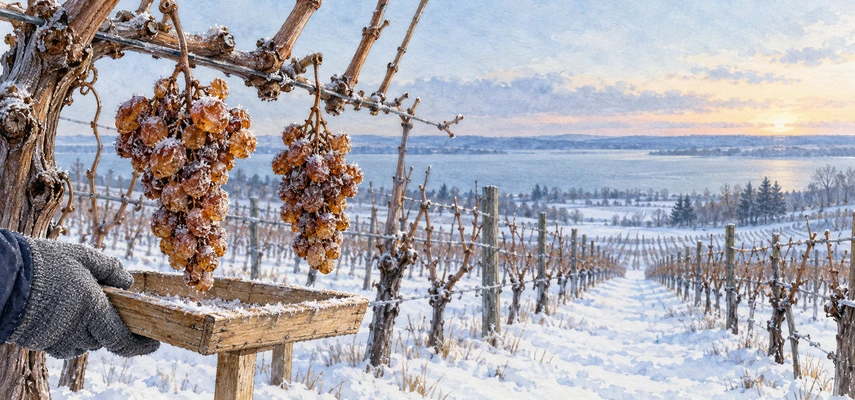
For Ontario VQA Icewine, grapes freeze naturally on the vine and are harvested and pressed in a continuous process while air temperature remains at or below minus 8°C. The Ontario Icewine guide sets out this production framework. Artificially freezing ordinary harvested grapes isn’t the equivalent required process.
Pressing while frozen leaves much of the water behind as ice and releases a small amount of concentrated juice. Sugar, acidity and flavour components become concentrated. Fermentation produces a sweet wine with intense fruit and enough acidity to balance the residual sugar when successful. It isn’t necessary to add spirit to stop fermentation: Icewine is not inherently a fortified category.
Vidal, a hybrid white variety, and Riesling are important. Vidal can retain fruit on the vine into winter and provide concentrated apricot or tropical-fruit character; Riesling can contribute particularly fresh acidity and citrus or stone fruit. Other approved varieties also occur. Ontario’s wine-category guidance distinguishes Vidal Icewine within the VQA framework rather than treating all hybrid wines identically.
The cost chain is unusually clear. Fruit left after normal harvest is exposed to rot, birds, weather and loss. Growers need suitable cold conditions and labour ready at short notice. Frozen pressing gives little juice per unit of grapes, raising cost per bottle. Concentrated must can be demanding to ferment, requiring careful monitoring. Small quantities, specialist production and demand can then support a premium. None of that means every expensive sweet bottle automatically has good balance.
British Columbia: the Okanagan interior
British Columbia is in western Canada. The Okanagan Valley lies inland, not in Vancouver’s coastal climate. Mountain shelter contributes to dry conditions; summers can be warm or hot, while winter cold remains a significant hazard. The BC Wine Authority’s Okanagan description outlines a long valley containing lakes, varied elevations, exposures and soils.
Cooler northern or exposed sites can suit Riesling, Pinot Gris, Chardonnay and Pinot Noir. Warmer southern settings can support Merlot, Cabernet Sauvignon and Syrah. These are broad tendencies with local exceptions. Lake influence can moderate nearby conditions, but north–south distance and individual site characteristics prevent one universal Okanagan profile.
Water supply, irrigation where used, canopy protection and harvest timing help achieve ripeness without excessive stress or alcohol. Winter injury can reduce future crops and require replanting, making suitable site and variety choices commercially important. Neutral fermentation preserves fresh white aromas; lees or oak can add texture. Ripe reds can support structured extraction and maturation, while unripe tannins won’t be repaired simply by more expensive barrels.
Read VQA as a production and origin framework
VQA refers to Vintners Quality Alliance systems in Ontario and British Columbia, with provincial rules and administration. BC VQA identifies wine grown and made in British Columbia under its certification requirements, as the BC VQA explanation makes clear. It must be distinguished from other wines made in the province using grapes sourced elsewhere.
Ontario VQA likewise has rules governing origin, permitted grapes, label claims and production categories. It isn’t identical to a US AVA, which principally identifies a growing area under a different legal system. Nor should VQA be read as a guarantee that every certified wine is preferable to every other wine. Sensory assessment still requires balance, intensity, length and complexity in the particular bottle.
Keep five price mechanisms separate
Grape costs reflect vineyard land, labour, yield and demand for fruit. Winery production costs include equipment, staff, pressing and fermentation demands, barrels and maturation stockholding. Transport adds freight and distribution expenditure. Distributor and retailer margins pay for their services and risks. Market forces link supply with consumer demand, potentially creating a premium beyond direct extra costs. Taxes can add further market-specific amounts.
An Icewine’s small juice yield and a hillside Pinot’s manual vineyard work increase costs for different reasons. Efficient larger-volume Riesling can offer value without being poor quality. For revision, revisit climate in #2, vineyard decisions in #4, white and sweet winemaking in #5 and #7, maturation in #8, California in #30 and law in #49. Always connect the named region to an actual growing or production mechanism.
Knowledge check: 10 original practice questions
Choose one correct answer per question.
1. Which region is especially associated with Oregon Pinot Noir?
2. Why is Columbia Valley generally drier than Washington’s coastal stereotype?
3. What is the relationship between Yakima Valley and Columbia Valley?
4. How can a deep lake reduce spring frost exposure nearby?
5. Which variety is important in Finger Lakes dry and sweet wines?
6. Which statement describes Ontario VQA Icewine production?
7. What happens when frozen Icewine grapes are pressed?
8. Which pair identifies important Icewine grapes?
9. Which Okanagan description is most defensible?
10. What does BC VQA help establish?
Answers and explanations
1. C — Willamette Valley. Its relatively cool growing conditions and varied sites underpin an important Pinot Noir identity. That association doesn’t exclude Chardonnay, Pinot Gris or other varieties.
2. B — Rain shadow. Mountains reduce the moisture reaching the interior. Summer warmth and sun can coexist with low rainfall, making water management important.
3. D — More specific within broader. Yakima provides a focused comparison inside the Columbia Valley setting. Columbia Valley itself crosses the state border into Oregon.
4. A — Delayed budburst. Water warms more slowly than nearby land, which can delay the appearance of vulnerable shoots. The effect reduces a particular risk without eliminating every frost.
5. C — Riesling. It is important in the cool Finger Lakes setting and can retain fresh acidity. Residual sugar varies with the intended production style rather than being fixed by its name.
6. B — Natural freezing and controlled harvest. Ontario VQA specifies the vineyard freezing and cold picking/pressing process. Artificial freezing isn’t interchangeable with that entitlement.
7. D — Water separation. Ice is retained while a small amount of concentrated juice is extracted. This helps explain both sweetness and low production yield without requiring fortification.
8. A — Vidal and Riesling. Vidal is a hybrid variety, while Riesling is Vitis vinifera. Both can be used for important Icewine examples under the applicable rules.
9. C — Continental variation. The inland location differs from the coast, and lakes, elevation, exposure and distance along the valley create contrasts. Winter cold remains a real hazard.
10. B — Origin and certification. BC VQA has defined production and provincial-origin requirements. It does not fix one sweetness level or replace individual sensory quality assessment.
Written exercise 1: explain lake moderation
Explain five separate site or vineyard considerations for reliable ripening in a cool lake-influenced region. Five marks.
Model answer: Cold lake water can delay spring warming and budburst, reducing exposure of young shoots to frost. Stored summer warmth can moderate autumn temperatures and extend the ripening period. A suitable sunny aspect can provide useful warmth for flavour maturity. Good cold-air drainage can reduce the formation of frost pockets. Matching crop load to vine capacity helps the fruit mature within the available season rather than remaining diluted or unripe.
Why it earns credit: One mark each for spring lake effect, autumn lake effect, aspect, air drainage and crop balance. These are distinct mechanisms. Lake proximity alone cannot guarantee frost freedom, sufficient ripeness or high quality every year.
Written exercise 2: explain Icewine costs
Give five separate production-related reasons why naturally frozen Icewine can be expensive to produce. Five marks.
Model answer: Leaving fruit beyond normal harvest increases the chance of losses to rot, birds and weather. A suitable freezing window creates uncertain timing and requires monitoring. Workers and equipment must be ready to harvest and press promptly under cold conditions. Frozen pressing extracts little juice from the grape mass, reducing saleable volume. Highly concentrated must can be difficult to ferment, requiring careful fermentation management.
Why it earns credit: One mark each for exposure losses, uncertain timing/monitoring, cold-harvest logistics, low juice yield and fermentation demands. These are five different production mechanisms. Simply saying that Icewine is famous or comes in a small bottle doesn’t explain its production cost.
One-page revision summary
| Region or concept | Remember | Explain the consequence |
|---|---|---|
| Oregon / Willamette Valley | Relatively cool valley; Pinot Noir important | Exposure, crop and autumn weather shape ripeness and freshness |
| Oregon labels | Pinot Noir usually subject to 90% varietal rule | State requirements can exceed federal baseline; other varieties have exceptions |
| Washington / Columbia Valley | Dry interior east of Cascades, crosses into Oregon | Rain shadow, sun and water management differ from coastal assumptions |
| Yakima Valley | More specific Columbia Valley setting | Varied sites support Riesling/Chardonnay and Cabernet/Merlot |
| New York / Finger Lakes | Deep lakes and sloping vineyards | Delayed spring growth and warmer autumn conditions help reduce risk |
| Riesling | High-acid aromatic variety, dry-to-sweet styles | Harvest and fermentation decisions shape balance and residual sugar |
| Ontario / Niagara Peninsula | Lake Ontario and Escarpment influence | Useful summer warmth and cool-season risks coexist |
| Icewine | Naturally frozen grapes, cold picking and pressing | Small concentrated juice yield; high sweetness needs acidity |
| Vidal | Hybrid variety important for Icewine | Not all hybrid wines have identical category entitlements |
| British Columbia / Okanagan Valley | Inland, varied, warm summers and cold winters | Site and variety choice matter; not Vancouver’s coastal climate |
| VQA | Provincial certification and origin frameworks | Distinct from AVA; not an automatic preference score |
| Price | Grapes, production, transport, margins, market forces | Explain each mechanism separately from sensory quality |
For practice, compare a dry Finger Lakes Riesling with an Ontario Vidal Icewine. The shared importance of acidity gives you a connection; harvest conditions, concentration and residual sugar give you the explanation of their differences.












