










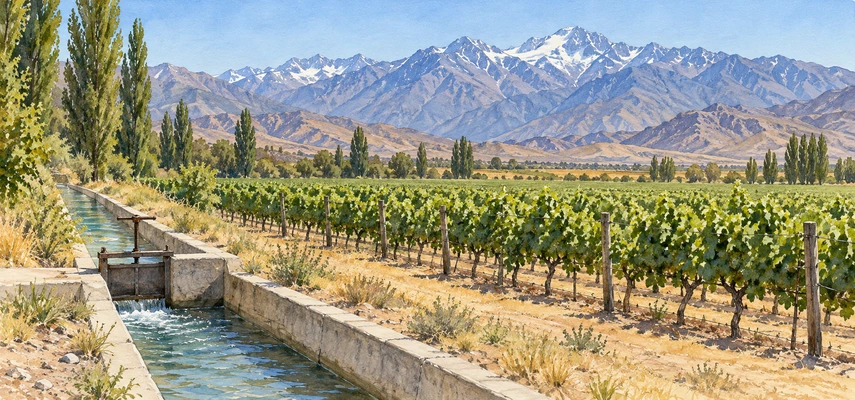

Chilean wines are easier to understand if you turn the map sideways for a moment. North to south matters, but so does the short journey from the cold Pacific across coastal hills towards the Andes. A coastal Sauvignon Blanc and an inland Cabernet can have very different growing seasons without being especially far apart. One long country contains several useful climate conversations.
For WSET Level 3, connect those conditions with grapes, vineyard work and cellar decisions. This guide covers the Chilean origins and label terms assigned in the WSET specification. The practice questions are original educational material. Start with coast versus interior, then place the named valleys within the broader wine regions.
Pacific cooling, mountain air and water supply
Chile lies on South America’s Pacific side, with the Andes to the east. In the principal central wine-growing areas, summers are generally dry and warm, with most rainfall outside the growing season. Farther north, aridity becomes a major constraint; farther south, cooler, wetter conditions become increasingly important. Local elevation, aspect and marine access qualify that broad pattern.
The cold ocean and associated coastal air can moderate exposed vineyards. Fog may delay warming, while breezes and lower temperatures help preserve acidity and extend ripening. Coastal hills can shelter inland sites from that influence, creating warmer conditions suited to later-ripening reds. Foothill vineyards can experience cool nights and air movement from the Andes. None of these effects makes every coastal site cool enough for the same grape or every foothill frost-free.
Water availability is central to vineyard decisions. Irrigation can sustain growth in dry areas where supply permits, but it isn’t an unlimited resource. Soil depth, drainage, water retention and root development affect the vine’s access to moisture. Severe drought can restrict photosynthesis and impede ripening. Canopy work balances useful exposure with protection from heat and sunburn; crop load must fit the site’s capacity to ripen fruit.
Read the regional hierarchy carefully
Chile’s DO system uses geographical regions, sub-regions and smaller units. The broad Aconcagua Region isn’t identical to the more specific Aconcagua Valley. Likewise, the Central Valley Region is a legal geographical grouping, not simply every vineyard somewhere in the middle of the country. The official DO rules establish the hierarchy.
Costa, Entre Cordilleras and Andes provide an additional east–west distinction under specified rules. Costa points towards coastal influence, Entre Cordilleras towards the intermediate land between mountain ranges, and Andes towards the Andean side. These indications don’t replace the valley hierarchy or award a quality score. Nor can a producer use them merely because the scenery feels suitably mountainous.
Origin, variety and vintage claims have requirements, and export markets can affect the applicable thresholds. The SAG certification guidance explains the role of certification. Don’t take a familiar percentage from another country and apply it automatically to every Chilean label. A geographical term also doesn’t prescribe one compulsory grape or new-oak recipe.
Coquimbo Region: Elqui and Limarí
Coquimbo lies north of the central production heartland and includes Elqui Valley and Limarí Valley. Aridity, strong light and water supply are important, but coastal influence and altitude create distinct sites. Elqui isn’t simply a hot desert with vines added. Falernia’s Elqui Syrah account illustrates vineyards at different distances inland and elevations, with substantial day/night contrasts.
Syrah can produce ripe dark fruit and spice, with freshness depending on site, crop and picking. Cooler or more maritime locations can show a different aromatic and structural profile from warmer inland ones. Cabernet Sauvignon and Sauvignon Blanc also occur. Where irrigation is needed, reliable access and careful application influence both yield and cost. High sunlight doesn’t eliminate the need for water and balanced growth.
Limarí is especially associated with Chardonnay, alongside Sauvignon Blanc, Pinot Noir and Syrah. Coastal fog and breezes can preserve acidity in suitable sites despite the northern latitude. Calcareous soils occur, but their useful explanation concerns vine conditions rather than literal chalk flavour. Tabalí’s Limarí Chardonnay information provides a producer example. Neutral fermentation can foreground fresh fruit; lees and oak can support texture and complexity when the fruit has sufficient concentration.
Aconcagua Region: distinguish valley and coast
The broad Aconcagua Region includes Aconcagua Valley, Casablanca Valley and San Antonio Valley. Their names should not be treated as interchangeable. In Aconcagua Valley itself, inland warmth supports Cabernet Sauvignon, Carmenère and Syrah, while more maritime sites suit cooler varieties. Errázuriz’s vineyard account demonstrates the journey between inland and coastal vineyards within that valley.
Cabernet can provide black fruit, firm tannin and structure when ripe. Syrah may show peppery freshness in cooler settings or richer dark fruit and body in warmer ones. Harvest timing balances mature flavour and tannin against sugar accumulation and acid loss. Extraction and oak should fit that fruit, rather than imposing identical handling on every parcel.
Casablanca Valley lies between Santiago and the Pacific and is strongly associated with Sauvignon Blanc and Chardonnay, with Pinot Noir also important. Morning fog and maritime cooling can favour fresh acidity, citrus or herbal whites and fragrant reds. Frost and insufficient ripeness can be concerns in colder sites. Exposure, air drainage and crop balance matter as much as the general cool-climate reputation.
San Antonio Valley lies near the coast farther south, with Leyda Valley an important more specific growing area. Santa Rita’s Leyda account describes maritime influence and morning fog. Sauvignon Blanc, Chardonnay and Pinot Noir are useful associations, with Syrah in appropriate sites. These are regional tendencies, not a rule that every wine is white or every vineyard has identical wind exposure.
For fresh Sauvignon Blanc, gentle pressing and temperature-controlled fermentation in neutral vessels can preserve citrus and herbal aromas. Chardonnay can remain fruit-led or gain breadth from malolactic conversion, lees and oak. Careful Pinot extraction preserves fragrance without excessive grip. More involved maturation raises winery costs but should be justified by the wine’s concentration and balance.
Central Valley Region: a broad framework with local contrasts
The Central Valley Region includes important origins such as Maipo Valley, the Rapel area containing Cachapoal Valley and Colchagua Valley, plus Curicó Valley and Maule Valley. That hierarchy prevents two common mistakes: treating every Central Valley wine as anonymous bulk production, or assuming every valley name describes the same growing conditions.
Maipo lies around and south of Santiago. Its Andean foothills are especially associated with Cabernet Sauvignon, while more sheltered and lower sites create further variation. Concha y Toro’s Maipo profile describes a range from foothill vineyards towards the south-west of Santiago. Warm days can support ripe fruit, while cooler nights and suitable harvest decisions help retain freshness.
Typical Cabernet can show blackcurrant or plum fruit, substantial tannin and development potential when concentrated and balanced. Merlot can contribute a rounder plum-fruited expression. Neutral vessels and earlier release can emphasise accessible fruit; oak and longer maturation can add spice and complexity. Famous foothill names and new barrels don’t guarantee quality without ripe fruit and integrated structure.
Cachapoal and Colchagua: give Carmenère enough season
Cachapoal forms the northern part of the Rapel setting. Carmenère, Cabernet Sauvignon and Merlot are particularly relevant, with vineyard differences between foothill and more sheltered sites. Carmenère is a distinct grape from Merlot despite their historical confusion in Chile. It ripens late and needs sufficient warmth and a long enough season to achieve mature flavours.
Ripe Carmenère can show plum or blackberry, spice and a rounded palate, sometimes with herbal nuances. Picked too early or grown with excessive shade, green flavours can become dominant. Crop balance, canopy and timing therefore matter. Concha y Toro’s Peumo Carmenère example illustrates the link between a long season and soil water availability; its particular harvest date is not a compulsory regional timetable.
Colchagua is the southern part of the Rapel area and is strongly associated with Cabernet Sauvignon, Carmenère, Merlot and Syrah. Inland warmth can support generous ripe reds, while coastal and foothill settings create cooler contrasts. Montes’s Colchagua Carmenère information provides one producer-level example. Don’t turn a red-wine reputation into a ban on whites or an assumption that every site is hot.
Extraction should obtain the intended colour and structure without making ripe fruit feel coarse. Oak and bottle maturation can develop complexity in concentrated examples, while a fruit-led wine may suit earlier release. More expensive maturation adds cellar space, capital and barrel costs; it doesn’t make an unbalanced wine automatically better.
Curicó and Maule: volume and distinctive parcels coexist
Curicó Valley lies south of Colchagua, with varied soils, elevation and coastal access. Cabernet Sauvignon, Merlot, Sauvignon Blanc and Chardonnay provide important style comparisons. The Miguel Torres Chile account locates a long-established producer in Curicó and its wider Chilean work. Suitable warmer sites support ripe reds; more moderated sites and timely picking help preserve white-wine freshness.
Larger workable vineyards and well-equipped wineries can spread costs across substantial volumes, producing consistent affordable wines. Selective parcels, reduced saleable yields and more involved maturation can support different styles at higher cost. Neither production scale nor one broad valley label establishes a fixed quality level. Explain the actual fruit and production decisions.
Maule Valley lies farther south within the Central Valley Region and contains both substantial production and distinctive older vineyards. Greater rainfall than in the arid north doesn’t mean every vineyard has the same water conditions. Dry-farmed old-vine parcels occur alongside other systems; Gillmore’s Maule account illustrates a secano, or dry-farming, focus at one producer.
Cabernet, Merlot, Sauvignon Blanc and other varieties contribute to a varied range, while older local plantings broaden the picture. Old vines may have developed substantial root systems, but age alone doesn’t guarantee either low yields or superior quality. Hand work, selection and limited fruit can raise grape costs; efficient larger volumes can provide value. Assess balance, intensity and finish in the wine rather than romanticising an old trunk.
Southern Region: cooler and wetter changes the priorities
The Southern Region in the assigned study framework includes important settings around Itata and Bío-Bío, with production extending into other cooler southern areas. Rainfall and lower temperatures become more important than in central Chile’s warmer sheltered interiors. The national regional map supplies a broad geographical reference; a specific bottle still needs its actual entitled origin checked.
Cooler suitable sites can support Sauvignon Blanc, Chardonnay and Pinot Noir with fresh acidity, although exposure and crop balance must provide sufficient ripeness. Rain and humidity can increase fungal disease pressure, making airflow and healthy fruit important. Traditional local varieties and old vines also remain part of the south’s identity. Avoid the assumption that development here means replacing every vineyard with the same international grape.
Protective white handling can preserve clean fruit, while measured red extraction avoids hard tannins from insufficiently ripe skins. Some wines emphasise freshness and early drinking; selected concentrated examples can support additional maturation. Wetter conditions don’t guarantee poor quality any more than arid sunshine guarantees excellence.
Bring style, quality and price together carefully
Cabernet and Merlot explain much of the familiar red range, Carmenère requires particular attention to a long ripe season, and Syrah links warm inland and cooler coastal expressions. Pinot Noir, Chardonnay and Sauvignon Blanc provide important comparisons wherever the conditions suit their intended styles. The same grape name does not make the climate or cellar decisions identical.
For price, separate five mechanisms. Grape costs reflect land, growing labour, irrigation where required, yield and fruit demand. Winery production includes equipment, staff, fermentation, barrels and stockholding. Transport adds freight and distribution expenditure. Margins pay distributors and retailers for their services and risks. Market forces link available supply with consumer demand; a sought-after limited wine may command a premium beyond its direct extra costs.
Quality still needs sensory evidence: balance, intensity, length and complexity. For revision, revisit environment and vineyard work in #2 and #4, white/red winemaking in #5 and #6, and maturation in #8. Compare Argentina in #33, coastal California in #30 and wine law in #49. Try explaining a coastal Sauvignon and an inland Carmenère before adding another valley name to your notes.
Knowledge check: 10 original practice questions
Choose one correct answer per question.
1. Which pair names valleys within the Coquimbo Region?
2. Which distinction is correct?
3. What does Costa principally help indicate under the relevant rules?
4. Which variety is particularly important in Limarí whites?
5. Which combination suits a fresh coastal Casablanca or Leyda white?
6. Which origin is especially associated with Cabernet Sauvignon near Santiago?
7. Why does Carmenère need careful site and harvest decisions?
8. Which statement correctly places Cachapoal and Colchagua?
9. What is a sensible qualification when describing Maule?
10. Which is a relevant change in cooler, wetter southern settings?
Answers and explanations
1. C — Elqui and Limarí. These northern valleys belong to Coquimbo. Aridity, coastal exposure and elevation interact, so neither should be reduced to one uniformly hot profile.
2. B — Different levels. The broad region includes several important valleys. Aconcagua Valley is a more specific name, not a substitute for every wine from the wider grouping.
3. D — East–west geography. Costa complements Entre Cordilleras and Andes under defined conditions. It isn’t a quality rank or permission to ignore origin certification.
4. A — Chardonnay. Appropriate coastal sites in Limarí can retain freshness. Lees and oak may shape texture, but the valley name alone doesn’t establish one compulsory cellar programme.
5. C — Protecting primary fruit. Gentle pressing limits unwanted phenolics and controlled neutral fermentation preserves fresh aromas. More involved maturation is possible but not universal.
6. B — Maipo. Its warmer and foothill settings provide important Cabernet examples. Vineyard and harvest decisions still determine whether ripe fruit, tannin and acidity are balanced.
7. D — A demanding long season. Suitable warmth and crop/canopy balance help avoid dominant unripe flavours. Historical confusion with Merlot doesn’t make them the same grape.
8. A — Rapel within Central Valley. Cachapoal is the northern and Colchagua the southern part of that broad setting. Both contain important red-wine production and local climatic variation.
9. C — A varied production landscape. Efficiency and distinctive small parcels aren’t mutually exclusive within one valley. Vine age alone cannot prove balance or complexity.
10. B — Different priorities. Humidity raises disease concerns while cooler conditions can challenge late ripening. Suitable exposure, crop load and canopy management help manage those risks.
Written exercise 1: explain a coastal white style
Give five separate links between a coastal Chilean vineyard or production decision and a fresh, aromatic dry white. Five marks.
Model answer: Marine air can moderate temperatures and help retain acidity. Suitable exposure can provide enough warmth to develop ripe fruit despite cooling influence. Matching crop load to vine capacity helps prevent diluted or unripe fruit. Gentle pressing reduces unwanted skin and seed phenolics. Temperature-controlled fermentation in a neutral vessel preserves primary aromas without prominent new-oak character.
Why it earns credit: One mark each for marine moderation, exposure, crop balance, pressing and fermentation, with a distinct result. The model does not claim that every coastal site is equally cool or that all Chilean whites must avoid wood.
Written exercise 2: explain a red wine’s retail price
Explain a possible premium for a carefully selected, long-matured Chilean red. Address grapes, winery production, transport, margins and market forces separately. Five marks.
Model answer: Selective vineyard work and a limited saleable crop can increase grape costs. New barrels and extended cellar storage add winery expenditure and tie up capital. Export freight and distribution add transport cost. Distributor and retailer margins pay for handling, selling and risk. Demand for a scarce, well-regarded wine can support a premium beyond direct extra production costs.
Why it earns credit: Each of the five commercial categories has its own mechanism. Barrels and cellar rent both belong to production, so repeating them cannot replace the separate grape, transport, margin or market-force point. A price premium is not sensory quality evidence by itself.
One-page revision summary
| Origin or term | Remember | Useful explanation |
|---|---|---|
| Chile | Pacific, coastal hills, intermediate land and Andes | East–west influence qualifies north–south latitude |
| Coquimbo Region | Elqui and Limarí | Aridity, water access, coastal cooling and elevation |
| Elqui | Syrah important, with varied other grapes | Site-specific light, heat and cool-night balance |
| Limarí | Chardonnay, also Sauvignon, Pinot and Syrah | Coastal fog/breezes can preserve freshness |
| Aconcagua Region / Valley | Broad region versus specific valley | Don’t collapse the legal hierarchy |
| Casablanca | Maritime Sauvignon, Chardonnay and Pinot | Ripeness and frost need managing alongside fresh acidity |
| San Antonio / Leyda | Coastal region and important more specific area | Fresh whites and fragrant reds, with local variation |
| Central Valley Region | Broad grouping with distinct valleys | Not a synonym for one wine style or quality level |
| Maipo | Cabernet Sauvignon near Santiago | Warm ripening plus local/Andean moderation |
| Cachapoal / Colchagua | Rapel setting; Carmenère, Cabernet, Merlot | Long-season ripeness and appropriate extraction |
| Curicó / Maule | Varied grapes, production scales and sites | Efficiency and selective parcels can coexist |
| Southern Region | Cooler/wetter settings, including Itata and Bío-Bío | Disease pressure and sufficient ripeness become priorities |
| Costa / Entre Cordilleras / Andes | Regulated supplementary geographical indications | Coastal, intermediate and Andean distinctions, not tasting grades |
| Commerce | Grapes, production, transport, margins, market forces | Explain each price mechanism separately |
Practise moving one grape between a warmer sheltered site and a cooler coastal one. If you can explain the likely changes in ripening, acidity and production decisions, the Chilean map is starting to work for you.












