











Argentine wines often arrive with a number attached: the vineyard’s altitude. It is useful information, but it isn’t a score. Higher sites can be cooler and receive intense sunlight; they can also face frost, exposure and difficult ripening conditions. The interesting question is how a grower turns that particular combination into ripe, balanced fruit. “Very high” is the beginning of an explanation, not the answer.
For WSET Level 3, connect place, variety and production choices with style, quality and price. This guide covers Argentina’s assigned origins and five key grapes in the WSET specification, with original study questions and worked answers. Follow Mendoza first, then compare San Juan, northern Salta and southern Patagonia.
On the eastern side of the Andes
Argentina’s principal wine regions follow the eastern side of the Andes in the country’s west. Mountain shelter creates dry conditions in many important areas. Continental seasons, strong sunlight and limited rainfall make altitude, water supply and exposure central to vineyard planning. The neighbouring Chilean coast has a very different relationship with Pacific air, so the two countries shouldn’t share one generic climate description.
Increasing elevation generally lowers average temperatures and can extend ripening. Cooler conditions can help retain acidity while fruit flavours develop. Sunlight can remain intense, making canopy protection important. A higher vineyard may produce fresher fruit than a lower nearby site, but aspect, soils, water and crop load also matter. Too cool a site may fail to ripen a late variety in an unhelpful year.
Irrigation is important in many dry western vineyards, using available surface water or groundwater. Snowmelt contributes to river systems and water supply, but a mountain backdrop isn’t proof of unlimited water. Application should fit vine demand and resources. Soil depth, texture and drainage influence water access; severe stress restricts growth and can interrupt ripening. Rock names don’t supply literal flavours to the finished wine.
Frost, hail and a sensible canopy
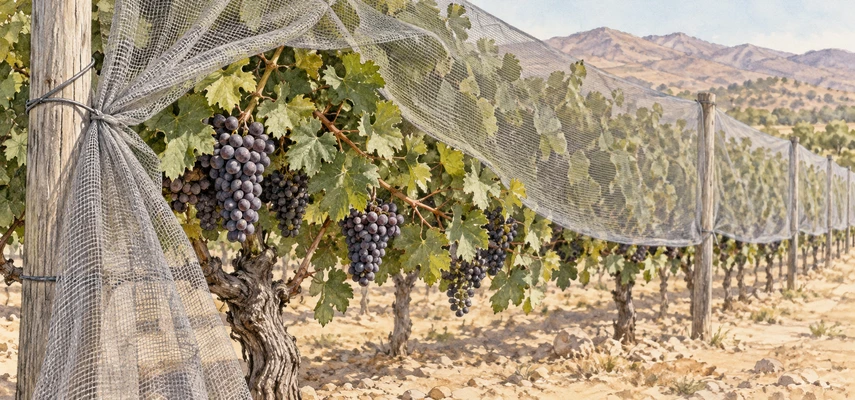
Spring frost can damage new growth, while summer hail can strip fruit and leaves quickly. Suitable site selection and cold-air drainage can reduce particular frost risks. Protective hail netting can reduce damage, but costs money and changes the working environment around vines. The national trade body’s vineyard-challenge account describes these practical threats alongside intense sunlight and water limitations.
Growers must balance light exposure with protecting fruit from sunburn. Vigorous growth can cause shading and delay maturity, while an overly open canopy can expose grapes to excessive heat. Training systems, pruning, crop load and irrigation need considering together. Parral, an overhead training approach, and vertically trained systems offer different ways to manage canopy and access; neither is automatically correct for every variety or wine style.
Selective harvesting can remove damaged or unsuitable fruit but increases labour and reduces saleable volume. Mechanisation may improve efficiency where land and training permit it. Those are real cost differences, unlike the unsupported assumption that hand-picked wine must always taste better. Assess the resulting fruit and balance rather than the romance of the equipment.
Malbec: fruit and structure can take different forms
Malbec is Argentina’s best-known red grape. Typical wines can show deep colour, plum or blackberry fruit and floral notes, with medium-to-high tannin, substantial body and varying acidity. Riper, warmer-site expressions can feel generous and rounded; cooler suitable sites can preserve a fresher, more taut profile. The Malbec-and-altitude account describes how a wider range of sites has broadened that familiar style.
Ripeness matters to tannin quality as well as sugar. Picking later can develop fruit and tannins, but may raise alcohol potential and reduce acidity. Picking earlier preserves freshness but can leave unripe flavours if the site or season hasn’t supplied enough maturity. A low yield doesn’t fix an unsuitable location, and maximum extraction doesn’t guarantee concentration in the glass.
During red fermentation, temperature, cap management and skin contact shape extraction. Gentle handling can preserve fragrance and avoid a hard finish; sufficiently concentrated fruit can support a firmer style. Oak can add toast or spice and influence structure, while neutral vessels keep primary fruit clearer. Bottle development can add savoury complexity in suitable wines. Neither new oak nor additional years can manufacture balance from poor fruit.
Mendoza: a province with several important comparisons
Mendoza lies in the central-west at the foot of the Andes, around the city of Mendoza and extending much farther across the province. Its broad production contains different elevations, soils, exposures and levels of investment. The national tourism authority’s Uco Valley account helps locate one important part of this wider setting. Don’t treat every Mendoza-labelled bottle as coming from the same high foothill parcel.
Luján de Cuyo lies around and south-west of Mendoza city, while Maipú lies farther east and south-east. Both are historic production centres with important Malbec, alongside Cabernet Sauvignon and other grapes. Their warmer settings can support ripe, rounded fruit, but different sites produce considerable variation. The First Zone discussion describes the local contrast rather than one compulsory flavour for both areas.
Cabernet Sauvignon can provide blackcurrant fruit and firm tannin when suitably ripe. Blending it with Malbec can combine complementary fruit and structure, although varietal wines are important too. Crop control and harvest timing help avoid excessive alcohol or immature tannins. Neutral fermentation and earlier release differ stylistically and commercially from selected fruit, barrels and extended maturation.
Uco Valley lies south of the city, close to the Andes, with important high-elevation vineyards. Generally cooler suitable sites can extend ripening and preserve acidity. Local variation means not every Uco wine is automatically fresher than every Luján or Maipú wine. Casa de Uco’s Malbec example demonstrates a specific Uco origin and a concrete-vessel approach rather than a requirement for all Malbec to use new barrels.
Chardonnay is another important comparison. Cool enough sites can preserve citrus or orchard fruit and acidity. Gentle pressing and neutral fermentation can make a fresh style, while malolactic conversion, lees and oak can create more breadth. A high vineyard does not dictate whether the finished wine tastes buttery; that depends substantially on cellar decisions.
Bonarda: another red with its own identity
Bonarda contributes to Argentina’s red range, including warm Mendoza and San Juan settings. It can produce deeply coloured, fruit-led reds with approachable texture, as well as more concentrated examples. Productive potential makes crop balance relevant: simply growing more fruit can dilute flavour or delay ripening if the vine cannot support it.
Argentine Bonarda is associated genetically with Douce Noir, also called Corbeau or Charbono, rather than automatically being the Italian grape suggested by a familiar name. The national variety discussion explains that identity and its fruit-led reputation. Don’t treat Bonarda as another name for Malbec or assume every grape called Bonarda internationally is identical.
Moderate extraction and neutral vessels can preserve accessible berry fruit. More concentrated fruit may support oak and development, but obvious wood isn’t compulsory. Larger volumes and relatively early release can lower unit costs; selection and longer storage add costs. As with Malbec, judge balance and finish in the individual wine rather than awarding automatic marks for the better-known grape.
San Juan: warm country with important local variation
San Juan lies north of Mendoza. Warm, dry conditions and strong sunlight make water supply and fruit protection important. Elevation and exposure create cooler exceptions within the province. The official San Juan regional profile provides a broad geographical and grape reference.
Malbec, Cabernet Sauvignon and Bonarda are relevant, alongside the province’s important Syrah tradition. Ripe reds can show generous fruit and substantial body, but choosing harvest time and managing the canopy can preserve freshness and avoid excessive sugar. Suitable cooler sites also broaden the available styles; don’t reduce a whole province to one hot valley floor.
Efficient workable vineyards can support production at scale, while selected sites and more demanding fruit work can support a different price point. Neutral vessels and earlier release emphasise fruit and reduce stockholding. Oak-matured, more concentrated reds need enough acidity and fruit to integrate that structure. Warmth is an opportunity for ripeness, not an automatic quality guarantee.
Salta and Cafayate: altitude qualifies the northern latitude
Salta lies in the north-west, with high-elevation vineyards in the Calchaquí Valleys. Cafayate is an important valley and production centre within this setting. Its national tourism profile identifies the high-altitude wine landscape. Strong sunlight and warm days can coexist with cool nights; a northern location doesn’t mean every site stays uniformly hot.
Malbec and Cabernet Sauvignon can show concentrated ripe fruit and substantial structure when grown at suitable sites. Exposure, irrigation and crop balance matter in the dry setting. Cool-night conditions can preserve freshness, but extreme exposure or a short effective season can create other difficulties. Greater elevation doesn’t remove frost or sunburn risk.
Torrontés is the essential white comparison. The term can refer to related Argentine varieties, with Torrontés Riojano particularly important for fine aromatic wine. The national Torrontés discussion describes its range. Familiar still examples have pronounced floral and grape-like aromas, often with citrus, peach or other fruit, yet finish dry. Aroma sweetness and residual sugar are different observations.
Suitable crop and canopy management help retain aroma and balance without excessive alcohol. Domingo Molina’s Cafayate account locates Torrontés in the valley’s high, sandy setting. Gentle pressing limits unwanted bitterness, while protective handling and controlled fermentation in neutral vessels preserve fragrance. Some producers explore other methods, but prominent oak isn’t required to make an expressive wine.
Don’t assume Torrontés has Riesling-like acidity in every example or that it must be sweet. Taste the actual balance of fruit, acidity, alcohol and any residual sugar. Many fresh styles are intended for earlier drinking, while more ambitious interpretations exist. The point is to explain the intended expression rather than force every bottle into one formula.
Patagonia: latitude provides another route to freshness
Patagonia lies much farther south, with important vineyard areas including Río Negro and Neuquén. Lower elevations than some northern vineyards don’t prevent cool growing conditions: latitude, exposure and local lakes or river settings matter too. Humberto Canale’s Río Negro terroir account describes dry conditions, day/night contrasts, wind and irrigation-water context at one established producer.
Wind can help dry bunches and reduce humid conditions, but can also damage shoots and increase water demand. Frost remains relevant, making site and protection decisions important. Irrigation supports vines in dry areas where water is available. Malbec, Cabernet Sauvignon and Chardonnay are among the relevant grapes, with Pinot Noir and other cool-climate varieties adding further comparisons.
Typical fresher styles depend on choosing grapes that can ripen within the season. Pinot can emphasise red fruit and fragrance, while suitable Malbec or Cabernet sites can supply a different balance of fruit and structure from warmer northern examples. Chardonnay can remain fresh or gain texture from lees and wood. Neither the Patagonia name nor a cool-climate reputation guarantees low alcohol, no oak or identical ripeness every year.
Read origin and variety claims separately
Argentina’s Instituto Nacional de Vitivinicultura oversees wine regulation, including geographical indications and label requirements. An IG identifies an entitled geographical origin; a DOC has additional defined conditions. Luján de Cuyo can appear in these contexts, but don’t assume every bottle from the area automatically qualifies for a DOC claim. Check the wine’s actual designation.
The current INV regulatory text specifies at least 85% of the stated variety for a single-variety claim. That tells you about composition, not a compulsory 100% single-grape wine. Geographical entitlement, variety and vintage are separate tests. Altitude on a label isn’t a nationwide quality ranking, and an origin name doesn’t establish one universal oak-ageing schedule.
Explain price with five commercial mechanisms
Grape costs reflect land, growing labour, irrigation, protective equipment, yield and fruit demand. Winery production costs include equipment, staffing, fermentation, barrels and maturation stockholding. Transport adds freight and distribution expenditure. Distributor and retailer margins pay for handling, selling and commercial risk. Market forces connect supply with demand; scarce fruit or a sought-after wine can command a premium beyond direct extra costs.
Hail nets and selective picking can raise grape costs, while long cellar storage raises later production costs. Efficient, earlier-release wine can offer value without being defective. For quality, assess balance, intensity, length and complexity in the wine. For revision, revisit environment in #2, vineyard work in #4, white and red winemaking in #5 and #6, maturation in #8, Chile in #32 and law in #49.
Knowledge check: 10 original practice questions
Choose one correct answer per question.
1. Which statement about altitude is most defensible?
2. Which pair identifies important historic Mendoza production areas?
3. Where is Uco Valley in relation to Mendoza city?
4. Which comparison correctly describes Malbec and Cabernet Sauvignon?
5. Which identity is associated with Argentine Bonarda?
6. Which province lies north of Mendoza and has important warm, dry vineyard settings?
7. Which statement describes Cafayate?
8. What should pronounced floral aromas in Torrontés establish about sweetness?
9. Why can Patagonia produce fresh styles at lower elevations than northern sites?
10. What does the stated 85% single-variety requirement concern?
Answers and explanations
1. C — A useful influence, not a score. Temperature moderation can help preserve acidity and extend ripening. Too much cold, exposure or water stress can still prevent balanced fruit.
2. B — Luján and Maipú. Both are historic Mendoza areas with important Malbec production and local variation. They shouldn’t be treated as one identical vineyard or compulsory DOC entitlement.
3. D — Southern Mendoza foothill setting. Uco contains important elevated vineyards south of the city. Site differences mean that not every Uco wine must taste fresher than every wine from elsewhere.
4. A — Different blending contributions. Fruit, tannin and ripening responses can complement one another. The presence of a familiar variety on the label does not require 100% of that grape.
5. C — Douce Noir identity. Argentine Bonarda mustn’t be assumed identical to every Italian grape using a similar name. It is also distinct from Malbec.
6. B — San Juan. It lies north of Mendoza and combines important warm sites with higher or otherwise cooler exceptions. Water and canopy decisions remain central.
7. D — Salta and altitude. Cafayate is an important part of the northern high-altitude landscape, particularly associated with Torrontés and structured reds from appropriate sites.
8. A — Aroma isn’t sugar. Floral and grape-like aromas can suggest sweetness without establishing residual sugar. Taste and production information are needed to identify the finished balance.
9. C — Latitude as well as elevation. A southerly location can provide cooler conditions without replicating northern vineyard heights. Wind, exposure and site also influence ripening.
10. B — Grape composition. It is a varietal labelling threshold, distinct from geographical origin, vintage and sensory quality. It isn’t a requirement to mature the wine in new oak.
Written exercise 1: evaluate a higher vineyard
Explain five separate environmental or vineyard considerations when assessing a high-elevation Argentine site for ripe, balanced fruit. Five marks.
Model answer: Cooler temperatures can preserve acidity but may delay maturity in a site too cold for the variety. Strong sunlight requires enough canopy protection to avoid sunburn. Limited rainfall makes adequate available irrigation water important for vine function. Spring frost risk makes air drainage and suitable location relevant. Crop load must fit the vine’s capacity to ripen fruit within the season rather than assuming elevation compensates for excessive yield.
Why it earns credit: One mark each for temperature/ripening, sunlight/canopy, water, frost/location and crop balance. The answer explains separate mechanisms. Claiming that higher automatically means better would not address any of the practical trade-offs.
Written exercise 2: preserve a dry Torrontés style
Give five separate vineyard or cellar decisions that can support an aromatic, balanced dry Torrontés. Five marks.
Model answer: Balanced cropping helps achieve sufficient flavour concentration. An appropriate canopy protects fruit from excessive sun while allowing ripening. Harvest timing balances ripe aromas against rising sugar and alcohol potential. Gentle pressing limits unwanted bitterness from skins and seeds. Controlled fermentation in a neutral vessel preserves primary fragrance while fermenting to the intended dry endpoint.
Why it earns credit: One mark each for crop, canopy, harvest, pressing and fermentation. These choices connect to concentration, fruit condition, balance, phenolics and aroma respectively. Floral smell does not prove the wine was left sweet, and obvious new oak is not required for aromatic intensity.
One-page revision summary
| Origin or concept | Remember | Useful explanation |
|---|---|---|
| Argentina | Eastern Andes, dry western settings | Altitude, irrigation and exposure qualify latitude |
| Mendoza | Broad province with varied sites | Not every bottle comes from one cool high parcel |
| Luján de Cuyo / Maipú | Historic Mendoza centres, Malbec important | Warm ripeness with local variation; actual DOC entitlement needs checking |
| Uco Valley | South of Mendoza city, high-elevation sites | Cooler suitable locations can preserve freshness; not automatic superiority |
| Malbec | Deep colour, plum/black fruit, floral notes | Ripeness, extraction and maturation shape tannin and complexity |
| Cabernet Sauvignon | Black fruit and firm structure | Separate grape, useful blending partner or varietal wine |
| Bonarda | Argentine Douce Noir identity | Fruit-led styles and more concentrated examples; not Malbec |
| San Juan | Warm dry sites north of Mendoza, with cooler exceptions | Water, canopy and picking affect balance |
| Salta / Cafayate | Northern high-altitude vineyards | Warm sun and cool nights can coexist; frost and exposure still matter |
| Torrontés | Floral/grape-like fragrance, commonly dry still styles | Aroma sweetness is separate from residual sugar |
| Chardonnay | Fresh fruit or broader cellar-shaped styles | Malolactic conversion, lees and wood are choices, not altitude requirements |
| Patagonia | Southerly, often lower vineyards, dry/windy settings | Latitude offers another route to freshness; water and frost remain relevant |
| Price | Grapes, production, transport, margins, market forces | Nets and vineyard work differ from later cellar storage costs |
For practice, compare a dry Cafayate Torrontés with a structured Mendoza Malbec. Explain why altitude might help both, then identify the different vineyard and cellar decisions needed for each intended wine.











