











Port explained through its colour alone quickly becomes confusing. A deep ruby wine might be a fruity blend for drinking now or a young Vintage Port built to develop for decades. A tawny-coloured wine might be a straightforward bottling or a carefully blended, long-aged example with extraordinary complexity. The important clues are how fermentation was stopped and what happened during maturation.
For WSET Level 3, connect the Douro’s environment with its grapes, rapid extraction, fortification and contrasting ageing routes. This guide follows the assigned factors and styles in the official specification. Start with the fruit and follow the wine forward; the label names then become much easier to organise.
The Douro grows the grapes; Porto gives the familiar name
Port is a protected fortified wine from Portugal’s Demarcated Douro Region, inland from the Atlantic. It isn’t simply any sweet red wine made with added spirit. The IVDP introduction connects its identity with both origin and production. The same wider region also produces unfortified Douro wines, so location alone doesn’t decide which product a grower will make.
The valley is sheltered from much Atlantic weather by mountains to the west. Summers can be hot and dry, with winter cold and marked local variation. The western Baixo Corgo has more Atlantic influence than the farther-inland Cima Corgo and Douro Superior, where dryness becomes particularly important. The IVDP regional account provides the geographical framework.
Altitude can reduce temperatures, while aspect changes the amount and timing of sun exposure. A cooler north-facing parcel and a sun-exposed slope can need different grapes or harvest decisions. Proximity to the sea matters mainly through the declining influence inland; the vineyards shouldn’t be described as all having Porto’s coastal climate.
Schist is a key soil reference. Fractures can allow roots to penetrate deeply in search of water, while the stony landscape and steep slopes create practical constraints. Terraces and carefully designed plantings make cultivation possible, but labour, erosion control and access can be costly. Rocks don’t deliver a finished “schist flavour” directly to the glass. The regional planting guide shows why slope, exposure and variety need to be considered together.
Five red grapes: complementary choices, not one mandatory formula
Touriga Nacional can supply concentrated fruit, deep colour and firm tannin. Touriga Franca, also encountered under the older name Touriga Francesa, can add floral character, fruit and structure. Tinta Roriz, the Portuguese name for Tempranillo, contributes another fruit-and-structure component. These are separate grapes, not three names for the same variety.
Tinta Barroca can provide colour, generous fruit and body, but its tendency toward high sugar makes cooler exposures useful in warm settings. Tinto Cão can contribute acidity and longevity, with low yields affecting its economics. The Taylor’s grape guide explains these different roles and site preferences.
Blending allows a producer to combine characteristics rather than require every variety to do every job. Older field-blend vineyards and newer separate blocks offer different management possibilities. Site, vintage and intended wine determine the useful combination. Avoid assuming that every Port must contain precisely those five grapes or in fixed proportions; they are the key study references, not an exhaustive recipe.
Why extraction must happen quickly
For the familiar sweet red styles, fermentation is stopped before all grape sugar becomes alcohol. The time available to extract colour, flavour and tannin from skins is therefore short. Crushing releases juice, while cap management maintains contact between skins and fermenting liquid. The aim is efficient extraction without unnecessarily harsh seed tannin.
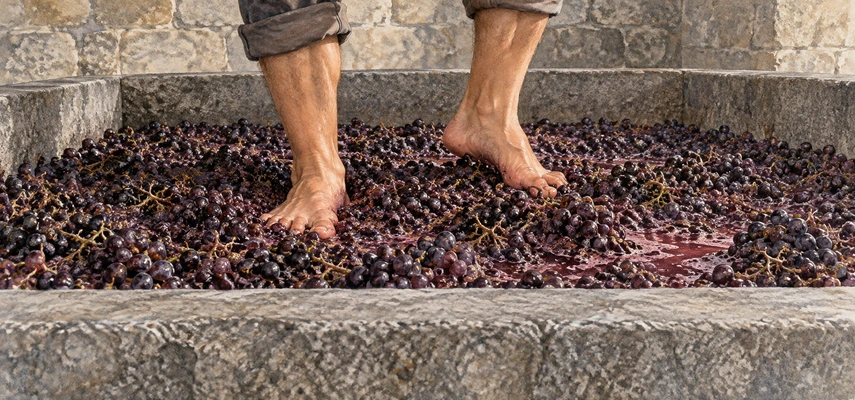
Traditional human feet extraction takes place in shallow stone lagares. Feet crush the fruit and keep skins in contact with juice while exerting relatively gentle pressure. It can be effective, but requires considerable labour. The Taylor’s production account describes this process; don’t turn the traditional method into a rule that modern equipment cannot produce fine wine.
Piston plungers offer a mechanical approach, pushing the cap into the fermenting wine according to a controlled programme. Modern systems allow producers to manage extraction for individual batches. Taylor’s Nogueira winery account gives a concrete example. The machine needs suitable settings and sound fruit; automation doesn’t independently guarantee concentration or balance.
Autovinifiers use pressure from fermentation’s own carbon dioxide to circulate juice over the skins. This reduces reliance on external power for that circulation, but the cycle depends on active gas production. Symington’s technical account explains the mechanism. It is different from a piston mechanically plunging the cap, although both seek useful skin contact in a limited period.
Fortification preserves sugar because of its timing
At the intended point, grape spirit is added to stop fermentation. The rising alcohol prevents the yeast from continuing normally, leaving unfermented grape sugar in the wine. Earlier intervention generally preserves more sugar than allowing fermentation to proceed farther, assuming comparable starting fruit. Fortification raises alcohol; timing explains the retained sweetness.
The fortifying spirit is typically around 77% abv, rather than the strength of ordinary drinking brandy. It contributes enough material to the blend that its quality and compatibility matter. The producer’s spirit explanation distinguishes it from an oak-aged beverage brandy. Finished Ports commonly sit around 19–22% abv, with category-specific exceptions; don’t transfer the spirit’s strength to the bottled wine.
Compare the classic dry Sherry route in #41: there the base can ferment fully dry before fortification. Adding spirit afterwards doesn’t bring back sugar already consumed. In Port’s sweet route, stopping fermentation while sugar remains is the crucial difference. A stronger wine isn’t automatically a sweeter one.
Two maturation aims: preserve fruit or encourage development
After fermentation and fortification, wines are assessed for their intended category, blended where appropriate and matured. Short maturation in relatively inert vessels or large, well-seasoned vats can preserve deep colour and fresh fruit. Inert maturation doesn’t mean no development at all; it means limiting the oxygen influence associated with a more oxidative style.
Long maturation in smaller seasoned wooden casks gives proportionally greater opportunity for oxygen influence and evaporation. Colour can shift toward tawny, while dried-fruit, nut, caramel and spice characters develop. The point isn’t necessarily to taste new oak. Wood size, condition, duration and cellar environment all influence the result.
Many Port houses have historic lodges in Vila Nova de Gaia, near Porto, where the coastal environment differs from the vineyard climate. Maturation can also occur in the Douro. Don’t describe river-boat transport to Gaia as a universal modern legal requirement. The producer’s maturation account provides the useful distinction between storage routes and styles.
Ruby and Reserve Ruby: keep the fruit in view
Ruby is usually a blend aimed at youthful red or black fruit, deep colour and ready enjoyment. Relatively short, protective maturation helps retain that character. It doesn’t need to be laid down for decades to become legitimate Port.
Reserve Ruby uses selected wines to give a more concentrated, structured fruit-led expression. “Reserve” isn’t simply a declaration that the bottle is old, nor does it mean every component comes from one harvest. The IVDP category guide distinguishes the richer blended ruby style from the single-harvest categories that follow.
Before bottling, clarification and filtration choices affect sediment and further development. Straightforward fruit-led bottlings are generally ready when sold. Buying them for the same cellar plan as a young Vintage Port confuses the producer’s intention rather than demonstrating patience.
LBV and Vintage: one harvest, different release paths
Late Bottled Vintage (LBV) comes from one harvest and is bottled after four to six years of maturation, conventionally in wood. The longer pre-bottling period makes many examples ready to drink on release. Filtered bottlings generally need little further development; some unfiltered examples can develop in bottle and may require decanting.
Vintage Port also comes from one harvest, but is bottled much earlier, generally two to three years after harvest, following selection and approval. Deep fruit, tannin and concentration can support long bottle development. With suitable storage, mature wines can gain complex dried-fruit, spice and savoury characters while tannins become more integrated. Not every bottle needs the same number of decades before anyone can enjoy it.
The current Portuguese category regulation governs the terms. A producer’s Vintage decision isn’t a requirement that all houses declare every good harvest together. A single-quinta Vintage identifies one estate and harvest, rather than being a lesser grape variety or a separate fortification technique.
Vintage Port normally throws sediment as it develops, so decanting separates clear wine from the deposit. The Fonseca estate example illustrates bottle development and sediment handling. LBV isn’t merely another name for Vintage, and Vintage isn’t the only Port capable of changing in bottle.
Tawny, Reserve Tawny and an indication of age
Basic Tawny is a lighter-coloured, ready-to-drink style; don’t automatically assign it the long wood-ageing history of a twenty-year-old bottling. Its colour alone doesn’t establish how many decades it spent in cask. Blending and the original wines’ characteristics also influence appearance and style.
Reserve Tawny adds a more developed wood-matured reference. Under the 2022 regulation, its minimum time in wood is six years. Older sources quote seven, so check the rule rather than repeat a familiar number. A producer can choose longer: Graham’s reserve-tawny account supplies an individual example with a different actual ageing programme.
Tawny with an Indication of Age is a blended mature style, with familiar indications such as 10, 20, 30 and 40 years. The number isn’t a single harvest date or a statement that every component has exactly the same age. These wines are generally ready to drink when bottled, having gained their intended mature character in wood.
Those four study examples aren’t the whole current range: newer official provisions include 50 years and an 80-year indication. The IVDP’s 2025 circular records the later development. Keep a blended age indication distinct from Colheita, which identifies a single-harvest wood-aged style. Neither should be confused with Vintage Port’s earlier bottling and intended bottle evolution.
Quality, price and choosing the right ageing story
Assess balance between alcohol, sugar, acidity, fruit and tannin, alongside length, intensity and complexity. A youthful Ruby succeeds through fresh fruit and sound balance; a mature Tawny needs more than a pale-brown colour. One style isn’t automatically better because its maturation route is longer or more expensive.
Steep-vineyard labour, low yields and selective harvesting can raise grape costs. Foot treading, extraction equipment and fortifying spirit add production costs. Long cask storage occupies space, ties up capital and loses volume through evaporation. Meanwhile, demand, reputation and limited mature stock affect achievable price separately. An old bottling can be expensive for several reasons; identify which ones apply.
For revision, reconnect red-wine extraction in #6, sweet fermentation in #7, maturation in #8, Portugal’s regional setting in #29 and Sherry in #41. Articles #43 and #49 add fortified Muscat and label comparisons.
Knowledge check: Port
1. What best explains the sweetness of the familiar Port route discussed here?
2. Why is efficient extraction particularly important?
3. Which mechanism describes an autovinifier?
4. Which statement best distinguishes LBV from Vintage?
5. Which pair identifies two different grapes?
6. What is the current Reserve Tawny minimum in wood under the regulation cited here?
7. What does a twenty-year Tawny indication mean most defensibly?
8. Why might a Tinta Barroca parcel benefit from a cooler exposure?
9. Which statement about Vintage Port is correct?
10. Why can a long-aged Tawny cost more to produce?
Answers and explanations
1. C — Timing preserves sugar. The addition stops fermentation before all grape sugar is consumed. This differs from fortifying an already dry base wine.
2. B — A short available window. Colour, flavour and tannin must be extracted effectively before fortification stops the ferment. Excessive harsh extraction still isn’t desirable.
3. D — Fermentation supplies the driving pressure. Autovinifiers use CO₂ to circulate liquid over skins. This differs from human treading or mechanical plunging.
4. A — Different maturation paths. LBV generally spends four to six years before bottling, whereas Vintage is normally bottled two to three years after harvest.
5. C — Separate blending components. Touriga Nacional and Touriga Franca are distinct grapes. Tinta Roriz is Tempranillo, while Touriga Francesa is an older name for Franca.
6. B — Use the cited current rule. The 2022 regulation specifies six years for Reserve Tawny. A producer’s longer programme doesn’t change that minimum.
7. D — A blended age-indicated style. The indication doesn’t identify one harvest or make every component identical in age. Mature character is developed largely in wood.
8. A — Match the variety to the site. Reduced heat or exposure can help moderate sugar accumulation. It doesn’t remove the need to manage crop, water and harvest.
9. C — Bottle development and deposit. Suitable Vintage wines can evolve substantially and throw sediment. Decanting can separate it from clear wine.
10. B — Time has economic consequences. Storage, tied-up stock and evaporation affect production costs. Demand and reputation are separate market influences.
Written exercise 1: Explain rapid Port extraction (5 marks)
Explain why rapid extraction matters in red Port and compare three ways producers can achieve it, giving five linked points overall.
Model answer: Fortification stops fermentation before it runs dry, so the available skin-contact period is short. Colour, flavour and tannin must therefore be extracted effectively within that window. Human foot treading crushes fruit and keeps skins in contact with liquid while applying relatively gentle pressure. Piston plungers mechanically submerge the cap according to a controlled cycle. Autovinifiers use pressure from fermentation CO₂ to circulate juice over skins, reducing the need for external power for that movement.
Why it earns credit: Award one mark each for (1) early stopping and short time, (2) the extraction consequence, (3) explained foot treading, (4) explained pistons and (5) explained CO₂ circulation. Naming three devices without their actions doesn’t explain extraction.
Written exercise 2: Compare Vintage Port with age-indicated Tawny (5 marks)
Explain five differences in origin claim, maturation or drinking implications between Vintage Port and Tawny with an Indication of Age.
Model answer: Vintage identifies one harvest, whereas an age-indicated Tawny is a blend across harvests. Vintage is bottled relatively early, generally two to three years after harvest. An age-indicated Tawny develops its intended mature character through prolonged wood ageing before bottling. Suitable Vintage wines can develop substantially in bottle and form sediment, making careful decanting useful. The mature Tawny is generally ready to drink when bottled, with nutty and dried-fruit development already established.
Why it earns credit: Award one mark each for (1) harvest versus blend, (2) early Vintage bottling, (3) prolonged Tawny wood development, (4) Vintage bottle evolution/sediment and (5) Tawny readiness/style implication. An age indication isn’t the harvest year, and every component needn’t have exactly the same age.
One-page revision summary
| Name or idea | Anchor | Explain the consequence |
|---|---|---|
| Douro | Inland Portugal, sheltered hot/dry settings | Distinguish vineyard climate from coastal Porto/Gaia |
| Baixo / Cima Corgo / Douro Superior | Generally declining Atlantic influence inland | Local altitude and aspect still create variation |
| Schist and slopes | Fractures, root water access, terraces | Water, erosion, labour and access matter |
| Touriga Nacional / Franca | Concentration and tannin / floral fruit and structure | Distinct grapes; Franca also called Francesa |
| Tinta Roriz / Barroca / Tinto Cão | Structure / generous colour-body / acidity-longevity | Match site and crop to their different tendencies |
| Extraction | Crush, feet, pistons or autovinifiers | Short fermentation needs effective controlled skin contact |
| Fortification | Add grape spirit before fermentation finishes | Preserve grape sugar while raising alcohol |
| Inert or large-vat maturation | Limit oxygen influence | Retain youthful colour and fruit |
| Prolonged smaller-cask maturation | Oxygen influence and evaporation | Tawny colour, nutty complexity, volume and capital costs |
| Ruby / Reserve Ruby | Youthful fruit / selected richer blend | Usually ready to drink, not a single-harvest promise |
| LBV | One harvest, four to six years before bottling | Many ready on release; unfiltered examples may develop |
| Vintage | One harvest, earlier bottling, typically two to three years | Suitable long bottle development and sediment |
| Tawny / Reserve Tawny | Ready style / wood-matured reserve, current six-year minimum | Don’t assume every pale-brown Port is decades old |
| Tawny with age indication | Mature blend, not a single harvest | Common 10–40 examples plus newer older indications |
| Quality and price | Balance, length, intensity, complexity | Costs and demand differ from a guaranteed tasting rank |
Compare a Ruby, an LBV and an age-indicated Tawny. Explain their fruit, tannin and development through the time and vessel used, then identify which bottling you would expect to benefit most from further bottle ageing—and why.












