










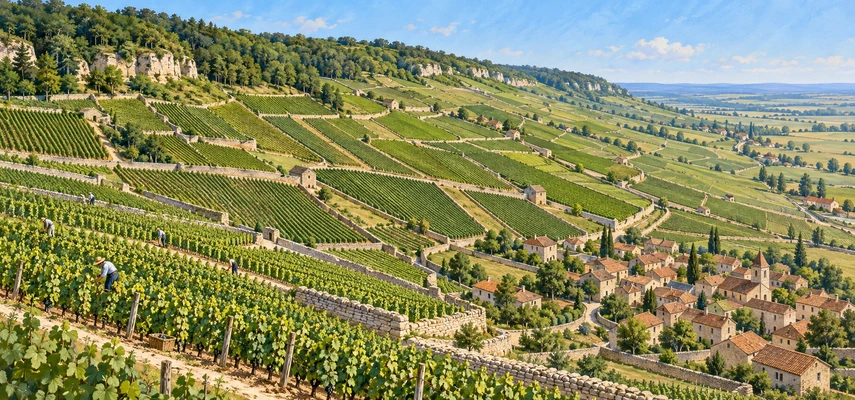

The Côte d’Or can make a short walk feel like an advanced geography examination. A village name changes, a wall marks another parcel, and the price of the wine may change more dramatically than the view. Yet the underlying questions are familiar: where does the fruit ripen well, what can the soil supply, and how does the producer handle the crop?
Pinot Noir and Chardonnay provide the common thread. This independent lesson follows their Côte d’Or regions, appellations and classifications in the WSET Level 3 specification. The questions and written exercises are original study material, not official WSET examination content.
The Côte d’Or: one escarpment, two main districts
In eastern France, south of Dijon, the Côte d’Or vineyard strip follows a limestone escarpment towards the south and south-west. The Côte de Nuits forms the northern section, famous for Pinot Noir. The Côte de Beaune continues south, producing important reds as well as celebrated Chardonnay. “Nuits equals red, Beaune equals white” is a useful first sketch with too many exceptions to serve as a rule.
Most main-slope vineyards face roughly east or south-east, while combes, bends and changes in elevation alter local conditions. Higher hills to the west contain the Hautes Côtes. The Bourgogne wine board’s northern district account places the main slope and higher country together. Don’t confuse the vineyard district with the larger administrative département of Côte-d’Or.
The climate is broadly moderate continental, with cold winters and warm summers. Spring frost, hail and wet weather can reduce yields or damage fruit. Temperature and rain around flowering, ripening and harvest make vintage consequential. Climate change can improve ripening in previously marginal sites, while heat, drought and earlier budding create fresh problems.
Why the middle of a slope often matters
A favourable slope can combine useful exposure, drainage and moderate soil depth. Upper sites may have thin soils and more wind; lower sites can have deeper deposits and greater vigour. Cold air may collect below slopes during radiation frosts. Mid-slope sites often combine advantages, but “middle is best” isn’t an explanation until you identify which factors help that parcel.
Limestone, marl and clay vary over short distances. They affect soil structure, water supply and rooting; they don’t deliver a guaranteed aroma straight from rock to glass. Shallow soil may restrict vigour but also increase drought exposure. More clay may improve water reserves while making drainage important in wet conditions. Suitability changes with season and management.
Pinot Noir buds and ripens relatively early. That helps it mature within the growing season but increases frost exposure. Its thin skins and compact bunches can be vulnerable to rot, so healthy fruit, canopy airflow and harvest timing matter. It typically gives red cherry or strawberry fruit, relatively pale colour, refreshing acidity and modest to medium tannin. Serious examples can still be structured and ageworthy.
Chardonnay also buds early and adapts to a wide range of sites. Here, apple and citrus can move towards ripe stone fruit with greater warmth or ripeness. Its comparatively restrained aroma leaves room for oak, lees and malolactic influences. Those cellar signatures aren’t proof of grape quality: flavour concentration and balance must already support the intended style.
Read Burgundy’s labels as geography
The broad ladder is regional, village, Premier Cru and Grand Cru. Premier Cru identifies classified sites within a village appellation. Grand Cru sites have their own appellations, such as Chambertin or Montrachet. These are site-based origins, unlike a Bordeaux classification ranking particular estates. The wine board’s classification explanation sets out the structure.
A climat is a named, delimited vineyard area with a historical identity. A named vineyard on a label isn’t automatically Premier Cru: read the classification wording. “Gevrey-Chambertin” is a village appellation; “Chambertin Grand Cru” identifies a separate Grand Cru. A hyphenated village name doesn’t award every vineyard in that village the famous site’s status.
| Wider designation | Location and interpretation |
|---|---|
| Bourgogne | A regional appellation with a broader sourcing area than one village. Pinot Noir reds and Chardonnay whites offer a range of fruit-led and more ambitious styles. |
| Bourgogne Côte d’Or | A geographical denomination within Bourgogne, restricted to the Côte de Nuits and Côte de Beaune area. It isn’t a new Grand Cru tier. |
| Bourgogne Hautes Côtes de Nuits | Higher country west of the Côte de Nuits. Cooler sites can retain freshness but need suitable exposure to ripen successfully. |
| Côte de Nuits-Villages | A village-level appellation covering specified sites across several communes. Mainly Pinot Noir, it doesn’t mean every village wine in the district. |
| Bourgogne Hautes Côtes de Beaune | Higher hills west of the Côte de Beaune. Pinot Noir and Chardonnay can offer fresh styles; aspect and elevation influence ripening. |
| Côte de Beaune-Villages | A defined appellation for red wines from eligible communes. It isn’t the collective name for all red and white Côte de Beaune villages. |
The Bourgogne Côte d’Or fact sheet explains its regional status. Compare the official accounts of Hautes Côtes de Nuits, Hautes Côtes de Beaune and Côte de Beaune-Villages. More precise geography can shape expectations without guaranteeing a better individual bottle.
Côte de Nuits: follow the Pinot Noir villages
The following sequence moves broadly north to south through four required names. Site differences operate within each village, and producer choices can outweigh a simple village stereotype.
| Appellation | Useful connection between location and style |
|---|---|
| Gevrey-Chambertin | Northern Côte de Nuits, with varied clay-limestone sites. Pinot Noir often offers firm structure and red or dark fruit; site and extraction influence its weight. |
| Vougeot | Between the Chambolle and Vosne sectors. Village and Premier Cru wines include Pinot Noir reds and Chardonnay whites; Vougeot isn’t synonymous with Clos de Vougeot Grand Cru. |
| Vosne-Romanée | South of Vougeot, around Vosne and neighbouring Flagey-Échezeaux. Fragrant, spicy, textured Pinot Noir is a useful reference, without assuming every wine is rich or heavily oaked. |
| Nuits-Saint-Georges | Farther south, with sites extending towards Premeaux. Mainly Pinot Noir, often firm and structured; northern and southern sectors differ, and small white production exists. |
The official profiles of Gevrey-Chambertin, Vougeot, Vosne-Romanée and Nuits-Saint-Georges show why one regional description can’t cover every colour or parcel.
Côte de Beaune: reds first, then the white-wine heartland
Continuing south brings Corton hill, Beaune, Pommard and Volnay, then the famous Chardonnay villages. The change from north to south isn’t a clean switch from one grape to another. Clay content, limestone formations, exposure and local tradition all contribute to planting choices.
| Appellation | Useful connection between location and style |
|---|---|
| Aloxe-Corton | At Corton hill in northern Côte de Beaune. Mainly structured Pinot Noir; the village name is distinct from Corton and Corton-Charlemagne Grand Cru appellations. |
| Beaune | Around the wine-trade town south of Corton. Pinot Noir dominates, ranging from fragrant to firmly structured; Chardonnay whites also exist. |
| Pommard | Between Beaune and Volnay. Red Pinot Noir often has a firm tannic framework, but site, vintage and winemaking prevent one universal “powerful” style. |
| Volnay | Just south of Pommard, on slopes with favourable exposure. Red Pinot Noir is known for fragrance and fine texture; finesse doesn’t mean an absence of concentration. |
| Meursault | South of Volnay. Mainly Chardonnay, often combining ripe fruit, texture and nutty complexity; styles vary and a little Pinot Noir is made. |
| Puligny-Montrachet | South of Meursault. Predominantly Chardonnay, with concentration and freshness as useful expectations; village Puligny isn’t Montrachet Grand Cru. |
| Chassagne-Montrachet | Beside and south of Puligny. Both Chardonnay whites and Pinot Noir reds matter, although its white wines are especially famous. |
The wine board’s Aloxe-Corton sheet and Pommard sheet qualify the structural stereotypes. Its Meursault profile also distinguishes dominant white production from rare red wine. Learn the common style without turning “mainly” into “only.”
Vineyard choices carry through to the glass
Many vineyards use close planting and trained canes or cordons. Pruning sets the potential crop; shoot positioning, leaf management and disease control then help ripen healthy fruit. In a cool, wet season, excessive vigour can shade bunches and delay ripening. During heat, removing too much leaf may increase sunburn. Crop control should fit vine capacity rather than pursue the lowest possible yield.
Harvesting parcels separately allows different ripening conditions to be respected. Sorting damaged or unripe grapes improves the usable fruit supply but adds labour and reduces volume. Hail or frost can make both decisions more expensive by shrinking the crop before it reaches the cellar.
For Pinot Noir, producers decide whether to destem or retain some whole bunches. Stems can affect aroma and tannin; suitability depends on their condition and the intended wine. Fermentation with skins, pumping over or punching down extracts colour and structure. More extraction isn’t inherently better for a thin-skinned variety. Malolactic conversion and barrel maturation commonly follow, with new-oak proportion matched to concentration.
Chardonnay is pressed and fermented as juice, often in barrel for ambitious wines. Malolactic conversion can soften acidity; lees contact and stirring can build texture. New oak adds flavour, but older barrels can provide maturation with less wood impact. BIVB’s vinification account places cellar work within the regional production chain. A buttery or toasty note isn’t an appellation test: several decisions can produce overlapping impressions.
Fragmented ownership, quality and price
A single climat may have several owners. Each can choose different farming, picking, extraction and maturation methods, so wines from the same named vineyard needn’t taste identical. A domaine may grow and make its own grapes; a négociant may buy grapes, must or wine. Some businesses do both. Purchased fruit isn’t automatically inferior, and ownership doesn’t guarantee quality.
Small parcels, expensive land, skilled labour and low saleable yields can raise grape costs. Separate small-lot handling, barrels, cellar time and stock financing add production costs. Transport, storage, applicable taxes and trade margins affect shelf prices. International demand for small volumes from sought-after sites or producers can add scarcity premiums. Prestige isn’t a production cost, though it can strongly affect what the market will pay.
Judge quality through balance, intensity, complexity and length. Pale Pinot Noir can be concentrated and long; a deeply coloured red can be unbalanced. A powerful Chardonnay needs freshness and integrated oak, not simply more weight. With suitable fruit and structure, reds may develop savoury woodland notes and whites nutty complexity. Classification indicates site and rules, while the individual wine supplies the evidence for the judgment.
Knowledge check: 10 original questions
Choose one answer per question. These are independent practice questions.
1. What is the relationship between the Côte de Nuits and Côte de Beaune?
2. Which label identifies a geographical denomination within regional Bourgogne?
3. Why might a mid-slope parcel be favourable?
4. Which statement correctly distinguishes Vougeot and Clos de Vougeot?
5. Which colour statement is most accurate?
6. Why should Pinot Noir extraction be adjusted to the fruit?
7. What does fragmented ownership imply for wines from one climat?
8. Which statement about Côte de Beaune-Villages is correct?
9. Which factor is a market premium rather than simply a cellar expense?
10. What is the soundest conclusion from pale colour in a Côte d’Or Pinot Noir?
Answers and explanations
1. C — District geography. The Côte de Nuits forms the northern main district and the Côte de Beaune the southern continuation. Their red and white reputations are useful orientation, but neither district is limited to a single colour.
2. A — Regional specificity. Bourgogne Côte d’Or adds geographical specificity within Bourgogne. It doesn’t create a Grand Cru or Premier Cru tier. Read the hierarchy separately from how famous the geographical words sound.
3. D — Several factors together. Favourable exposure, drainage and soil depth can help ripening and vine balance. Those factors explain a site’s potential; the position alone doesn’t guarantee quality or immunity from weather damage.
4. B — Village and Grand Cru distinction. Vougeot village and Premier Cru wines are distinct from Clos de Vougeot Grand Cru. The shared place name doesn’t make the labels interchangeable, and the classifications concern sites rather than Bordeaux-style estate ranks.
5. C — Red Burgundy beyond Nuits. Pommard and Volnay are important Pinot Noir appellations in the Côte de Beaune. Other villages make both colours. Famous Chardonnay origins don’t turn the whole district into a white-only production zone.
6. D — Extraction and balance. Colour and tannin extraction must suit the fruit’s ripeness and the intended wine. Aggressive treatment may add astringency without useful complexity. More extraction isn’t a substitute for sound fruit.
7. A — Same site, different decisions. Owners can vary farming, picking, fermentation and maturation. The same climat therefore supplies a shared origin, while producer choices help explain differences in texture, aroma and quality.
8. B — A defined appellation. Côte de Beaune-Villages applies to red wines from eligible communes. It isn’t shorthand for all the district’s village wines, and it doesn’t carry Grand Cru status or identify white-wine production.
9. D — Demand and scarcity. A limited supply from a sought-after producer may command a premium beyond production expenses. Barrels, energy and sorting labour are actual cost inputs; demand affects how far the selling price can move above them.
10. C — Assess the whole wine. Pinot Noir can be relatively pale while offering intense flavour, structure and length. Colour alone can’t establish dilution, ageing potential, appellation tier or quality. Taste for the relevant evidence.
Written exercise 1: explain a vineyard comparison
Question — 5 marks: Compare a well-exposed mid-slope parcel with a higher, windier site in the Hautes Côtes. Explain five possible effects on grape growing or harvest decisions.
Indicative marking points: Award one mark each for useful exposure aiding ripening; greater elevation tending to lower temperature; wind affecting vine conditions; soil-depth/water differences requiring assessment; and a resulting difference in picking date or crop/canopy management.
Model answer: A well-exposed mid-slope parcel may intercept useful sunlight and reach flavour ripeness sooner. A higher site can be cooler, slowing ripening and retaining acidity. Wind can improve drying but may also increase water loss or disrupt growth. Soil depth and water reserves need checking because slope position alone doesn’t specify either. The grower might therefore pick the parcels separately or adjust crop and canopy management to help the cooler parcel ripen. These are conditional comparisons, not guaranteed outcomes.
Why it earns credit: Five distinct mechanisms connect the sites with vine performance and decisions. “One is better” would supply neither an explanation nor a useful management response.
Written exercise 2: explain producer differences
Question — 5 marks: Two producers make Pinot Noir from the same named climat. Suggest five vineyard or winery choices that could make the wines taste different.
Indicative marking points: Award one mark each for harvest timing; crop or canopy decisions; whole-bunch versus destemming choice; extraction regime; and oak/maturation choice, each linked to a possible sensory effect.
Model answer: Picking later may increase ripeness and potential alcohol. Crop and canopy management can alter flavour development and fruit condition. Retaining whole bunches rather than fully destemming can affect aroma and tannin. Different maceration or cap-management regimes can change extraction and texture. Finally, the proportion of new oak and maturation time can alter spice, wood influence and development. Shared origin doesn’t force identical decisions or results.
Why it earns credit: Each point identifies a separate decision and its effect. The answer doesn’t assume that one producer’s approach is automatically superior. These are original educational marking suggestions, not an official WSET scheme.
One-page revision summary
| Topic | Causal connection |
|---|---|
| Main districts | Côte de Nuits lies north; Côte de Beaune continues south. Both require attention to colour exceptions. |
| Sites and climate | Continental weather, aspect, soil depth and water supply shape ripening, frost exposure and vintage variation. |
| Principal grapes | Early Pinot Noir and Chardonnay suit the growing season, while early budding and disease hazards require management. |
| Wider names | Bourgogne and its geographical denominations differ from defined village appellations such as Côte de Nuits-Villages and Côte de Beaune-Villages. |
| Northern villages | Gevrey-Chambertin, Vougeot, Vosne-Romanée and Nuits-Saint-Georges provide distinct Pinot Noir contexts. |
| Southern villages | Aloxe-Corton, Beaune, Pommard and Volnay matter for reds; Meursault, Puligny and Chassagne are especially important for Chardonnay. |
| Hierarchy | Regional, village, Premier Cru and Grand Cru identify different origins. A famous village suffix doesn’t confer Grand Cru status. |
| Cellar | Whole bunches, extraction and oak shape reds; barrel fermentation, MLC and lees can shape whites. Match choices to fruit. |
| Ownership | Several producers can own parts of one climat and make different wines. Domaine and négociant are business models, not quality scores. |
| Quality and price | Assess the wine individually. Land, labour, low yields, cellar time, transport, margins and scarcity affect price. |












