










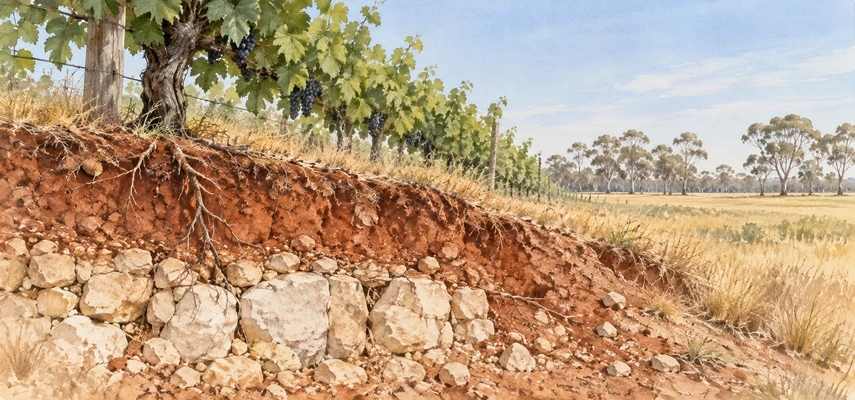

South Australian wines don’t fit neatly into “big reds from a hot country.” A rich Barossa Valley Shiraz and a taut Eden Valley Riesling can come from neighbouring regions. Elevation changes the growing conditions, the grapes respond differently, and the cellar choices follow. That contrast is much more useful than trying to give an entire state one tasting note.
For WSET Level 3, connect each place with the factors that explain style, quality and price. This guide covers South Australia and the associated high-volume Australian regions assigned in the WSET specification. Riverina and Murray-Darling belong in this comparison, but they aren’t South Australian regions. Keep the geography straight before reaching for the tasting glass.
Read the address before predicting the wine
South Australia is a state. South Eastern Australia is a much broader zone spanning several states and parts of others; the similar names don’t make them interchangeable. The broad zone allows eligible fruit from different regions to be blended, helping producers maintain volume, price and a consistent style. It doesn’t prescribe a single climate or prove poor quality.
Australian geographical indications identify origin through Zone, Region and Sub-region, alongside other recognised geographical levels. Barossa is a zone containing the separate regions Barossa Valley and Eden Valley. High Eden is a sub-region of Eden Valley. The official GI register is the place to check these relationships, rather than assuming “Valley” always means the same rank.
For a single vintage, variety or GI claim, at least 85% of the wine must meet that particular claim under the Australian blending rules. Assess each claim separately. A GI isn’t a legal promise of oak ageing, a grape’s dominance beyond the relevant labelling requirements, or an official quality score.
Heat, altitude and the available water
Across many South Australian vineyards, warm dry summers and winter-dominated rainfall make growing-season water important. Coastal air and elevation moderate suitable locations. Meanwhile, inland regions can face intense heat and very little rain when vines are actively growing. Temperature averages alone miss the effects of exposure, cool nights, weather events and water supply.
Canopy shade helps protect bunches from excessive radiation and sunburn. At the same time, sufficient water keeps leaves functioning, although irrigation must match available supply, soil and crop needs. Severe stress can interrupt ripening rather than neatly concentrating flavour. Wine Australia’s heatwave guidance connects canopy protection and water planning with practical risk management.
Climate change makes these decisions more pressing: the appropriate variety, rootstock, canopy and harvest plan must suit the intended wine and the site. Earlier picking can retain acidity, but simply picking unripe fruit isn’t a complete solution. Later harvesting can develop richer flavours while increasing sugar and potential alcohol. Explain the tradeoff rather than declaring one date inherently better.
Barossa Valley: Shiraz, Grenache and ripeness
North-east of Adelaide, Barossa Valley has warm growing conditions, with cooler positions in surrounding hills. Shiraz is the central reference: ripe blackberry or plum fruit, substantial body and tannin can support rich dry reds. Cabernet Sauvignon also matters, particularly in suitable cooler sites. The regional profile emphasises variation within the region, rather than one temperature for every parcel.
Shiraz is the same variety as Syrah. Riper fruit can deliver fuller body and higher potential alcohol; concentration still needs enough freshness for balance. Fermentation on skins supplies colour and tannin. Extraction should suit the fruit, followed by malolactic conversion and, where appropriate, maturation in oak. New barrels can add noticeable vanilla or spice, but older wood can provide maturation with less wood flavour. Neither choice is compulsory for every Barossa red.
Grenache brings a different reference: ripe red fruit, spice and potentially high alcohol, often with less deep colour than Shiraz. It can appear alone or in blends with Shiraz and Mataro, the local name for Mourvèdre. Old vines are significant in some parcels, although age alone doesn’t prove excellence. Crop balance, healthy fruit and sensitive extraction still determine whether a generous wine remains lively.
Eden and Clare: explain the Riesling contrast
Eden Valley, east of Barossa Valley, generally has cooler growing conditions, with elevation and exposure creating further differences. Riesling is a major reference, while Shiraz, Chardonnay and Cabernet Sauvignon also appear. Wine Australia’s Eden Valley profile supplies that useful comparison with its warmer neighbour.
Dry Riesling commonly combines high acidity with citrus and floral characters. Gentle pressing, protection from oxidation and fermentation in neutral vessels can preserve those aromas. Avoiding malolactic conversion generally helps retain acidity. With suitable concentration, balance and storage, bottle development can bring more complex toasty or kerosene-like notes; not every young bottle needs a long wait.
Clare Valley, farther north, has warm summer days, but elevation, cooler nights and breezes help explain its Riesling reputation. Don’t call the entire region uniformly cold. Its reds, including Shiraz and Cabernet Sauvignon, demonstrate that suitable ripening conditions vary with variety and site. The Clare Valley profile connects local variation with these different grapes.
For an exam comparison, explain how retained acidity supports a fresh dry Riesling, whereas ripe skins and tannins matter more directly to a structured red. Both need balance; they reach it through different grape characteristics and production choices.
Adelaide Hills: elevation changes the options
Adelaide Hills, east and south-east of Adelaide, uses elevation to provide cooler growing conditions, with varied slopes and valleys. Chardonnay, Sauvignon Blanc and Pinot Noir are useful anchors; Shiraz can also suit appropriate sites. Lenswood and Piccadilly Valley are recognised sub-regions, although a label needn’t name them. The regional account makes the link between topography and variety particularly clear.
Sauvignon Blanc can retain fresh acidity and citrus, herbaceous or tropical fruit, depending on ripeness and site. Protective handling and neutral fermentation support a fresh aromatic style. By contrast, Chardonnay offers producers a choice of malolactic conversion, lees work and barrels to build texture and additional flavours. Butteriness comes from a cellar influence, not directly from altitude.
Pinot Noir can deliver red-fruit flavours, relatively light colour and fine tannin. Gentle extraction helps preserve that balance. Some Chardonnay and Pinot Noir also supply sparkling wines, where freshness and an appropriate base-wine structure matter. Articles #38–40 examine sparkling methods and regions; don’t assume every Adelaide Hills wine is still or every Pinot Noir becomes sparkling.
McLaren Vale: warm sunshine with a coastal influence
South of Adelaide, McLaren Vale combines a Mediterranean pattern with cooling marine influence that varies by exposure. Shiraz, Grenache and Cabernet Sauvignon provide the main red anchors. Chardonnay also grows here. Wine Australia’s profile describes the resulting diversity rather than treating proximity to the coast as one uniform temperature.
Shiraz can combine ripe dark fruit, spice and substantial body, while Grenache can offer fragrant raspberry-like fruit and a more translucent appearance. A producer seeking freshness might protect fruit from excessive sun, monitor water stress and pick before sugar rises too far. In the cellar, measured extraction and restrained wood can preserve fruit definition. A bigger wine may justify different decisions; neither aim excuses harsh tannin or unbalanced alcohol.
Warm, dry summers don’t remove the need to manage water or occasional disease pressure. Likewise, a coastal breeze isn’t proof that every site suits the same variety. Connect exposure with the particular intended wine rather than memorising “McLaren Vale equals powerful.”
Coonawarra: Cabernet and terra rossa
In the state’s south-east, Coonawarra belongs to Limestone Coast zone. Maritime influence and cool nights can support a long ripening period, while Cabernet Sauvignon is the principal reference for structured reds. Merlot is a useful blending partner and can also appear alone; Shiraz is important too. The Coonawarra profile connects these grapes with the local environment.
The famous terra rossa is reddish soil over limestone. Discuss drainage, water supply and root conditions rather than claiming that red soil directly supplies blackcurrant or mint flavours. Not every square metre of the GI has identical soil. Site management and healthy ripeness remain essential to balance firm Cabernet tannins with fruit and acidity.
Oak and bottle maturation can allow suitable wines to develop complexity and softer-feeling tannins. However, extra years also create storage and financing costs. A longer life needs the wine’s underlying structure and concentration; Coonawarra on the label doesn’t guarantee that every bottle will improve for decades.
Inland scale: Riverland, Murray-Darling and Riverina
Riverland, in South Australia, is a warm inland region where irrigation is fundamental to commercial grape growing. Chardonnay, Shiraz and Cabernet Sauvignon are useful anchors. Large, workable vineyards, mechanisation and efficient wineries can spread costs across high volumes. The Riverland profile gives the regional context; an inexpensive price shouldn’t become a verdict before tasting.
Murray-Darling crosses north-west Victoria and western New South Wales. It isn’t a synonym for the entire Murray-Darling river basin. Hot, dry conditions and low growing-season rainfall make irrigation vital, with Chardonnay, Shiraz and Cabernet Sauvignon important. The regional profile supports this geographical distinction. Water availability and cost can constrain output, even on an otherwise efficient site.
Riverina, in New South Wales, also produces substantial volumes of Chardonnay, Shiraz and other grapes, including Merlot and Semillon. Its distinctive additional reference is sweet botrytised Semillon. Suitable humid conditions encourage noble rot, followed by drying that concentrates the fruit. Conditions must be monitored carefully: unwanted rot isn’t automatically noble. Selection, low juice yields and difficult high-sugar fermentations add cost. The Riverina profile explains why the region can’t be reduced to inexpensive dry wine alone.
Five different reasons a bottle costs more
Keep commercial categories separate. Grapes carry vineyard labour, water, yields and any scarcity premium. Winery production includes equipment, barrels, maturation space and packaging. Transport adds freight and distribution costs. Margins cover the work and profit of the businesses along the chain. Market forces, including reputation, demand, competition and currency movements, affect the price customers will pay.
As a result, a low-yield parcel and a long barrel programme can raise costs for different reasons. Large-scale sourcing and efficient production may lower them. Strong demand for a name can raise selling price separately from either. For revision, reconnect climate in #2, vineyard choices in #4, production in #5–7 and maturation in #8; #36 continues beyond South Australia and #49 compares laws.
Knowledge check: South Australian wines
1. Which statement correctly distinguishes Barossa from Barossa Valley?
2. What helps explain Eden Valley’s dry Riesling styles?
3. What is Shiraz in relation to Syrah?
4. Which statement best describes terra rossa’s relevance in Coonawarra?
5. Why is irrigation important in the inland regions discussed here?
6. Which region crosses Victoria and New South Wales?
7. Which Riverina speciality requires careful distinction between beneficial and destructive rot?
8. Which choice most directly preserves a fresh Sauvignon Blanc’s fruit-led style?
9. For a single Australian variety claim, what is the general minimum proportion of that variety?
10. Which example belongs primarily to market forces?
Answers and explanations
1. C — Different geographical levels. Barossa is the zone; Barossa Valley and Eden Valley are separate regions within it. Their names don’t imply identical climates.
2. B — Environment and method work together. Suitable cooler conditions help retain acidity, while protective handling and neutral fermentation can preserve fruit aromas.
3. D — Two names for one grape. Shiraz and Syrah refer to the same variety. Regional environment and production choices explain stylistic differences.
4. A — Explain the vine mechanism. Drainage, water and rooting conditions affect growing. Soil colour isn’t a direct flavour ingredient or a guarantee of quality.
5. C — Water sustains growth and ripening. Dry growing seasons create a supply need. Available water and appropriate scheduling remain constraints.
6. B — A region across a state boundary. Murray-Darling spans north-west Victoria and western New South Wales. It isn’t located wholly in South Australia.
7. D — Noble rot needs suitable conditions. Carefully monitored botrytis and subsequent drying can concentrate Semillon. Destructive rot doesn’t automatically make desirable dessert wine.
8. A — Preserve delicate aromas. Protection from oxidation and appropriate neutral fermentation support a fresh style; wood and texture treatments are separate choices.
9. C — The single-claim threshold. At least 85% must meet the named variety claim. Vintage and geographical claims have their own separate compositional checks.
10. B — Demand affects achievable price. Scarcity and reputation can support higher prices. Tanks, freight and irrigation belong to different cost categories.
Written exercise 1: Compare Barossa Valley Shiraz with Eden Valley Riesling (5 marks)
Explain five links between environment or production and the contrasting styles of a rich dry Barossa Valley Shiraz and a fresh dry Eden Valley Riesling.
Model answer: Warm suitable Barossa Valley sites can ripen Shiraz to rich dark-fruit flavours and substantial potential alcohol. Fermenting Shiraz on its skins extracts colour and tannin for a structured red. Cooler suitable Eden Valley sites can retain Riesling’s naturally high acidity while flavours develop. Gentle pressing and protection from oxidation help preserve Riesling’s delicate citrus and floral aromas. Neutral-vessel fermentation without malolactic conversion can retain a fresh, fruit-led Riesling style rather than adding butter or prominent oak flavour.
Why it earns credit: Award one mark each for (1) warmth linked to Shiraz ripeness, (2) skin fermentation linked to colour/tannin, (3) cooler conditions linked to acidity, (4) protective handling linked to aromas, and (5) explained Riesling fermentation choices. Regional names alone don’t supply the causal links.
Written exercise 2: Explain a Riverina sweet wine’s price (5 marks)
A selected botrytised Riverina Semillon costs more than a high-volume dry white. Give one plausible explanation in each of the five commercial categories.
Model answer: Grapes cost more when selection and concentrated fruit give less usable juice per hectare. Winery production costs can rise through slow high-sugar fermentation and any longer maturation. Transport may cost more per bottle for small shipments and additional handling. Importer or retailer margins cover their work, overheads and profit. Market forces can support a premium if demand for a distinctive limited sweet wine is strong relative to supply.
Why it earns credit: Award one mark each for a relevant explanation covering (1) grapes, (2) winery production, (3) transport, (4) margins and (5) market forces. More expensive production doesn’t itself prove higher demand, and two cellar costs don’t cover two different categories.
One-page revision summary
| Name or idea | Study anchor | Explain the consequence |
|---|---|---|
| South Australia / South Eastern Australia | State / much broader zone | Different sourcing scope; neither defines one style |
| Barossa / Barossa Valley / Eden Valley | Zone / two separate regions | Don’t confuse geographical levels or climates |
| Barossa Valley | Shiraz, Grenache, Cabernet Sauvignon | Warm ripeness, crop balance, extraction and oak choices |
| Eden Valley | Riesling; cooler suitable elevated sites | Acidity and aroma preservation; site variation remains |
| Clare Valley | Dry Riesling, Shiraz and Cabernet | Warm days plus cooling factors; not uniformly cold |
| Adelaide Hills | Chardonnay, Sauvignon Blanc, Pinot Noir | Elevation and exposure support freshness; still and sparkling uses |
| McLaren Vale | Shiraz, Grenache, Cabernet | Warm Mediterranean pattern with variable coastal cooling |
| Coonawarra | Cabernet, Merlot, Shiraz; terra rossa | Maritime influence, root conditions and tannin balance |
| Riverland | South Australia, warm inland, irrigation | Scale can lower unit costs; water isn’t unlimited |
| Murray-Darling | Victoria and New South Wales | Distinguish the GI from the whole river basin |
| Riverina | New South Wales; Semillon speciality | Noble rot, selection and low juice yields can raise costs |
| Australian labels | Zone, Region, Sub-region; single claims generally 85% | Origin isn’t a compulsory cellar method or quality rank |
| Commercial categories | Grapes, production, transport, margins, market forces | Explain separately, then relate to price |
Practise with a dry Riesling, a Shiraz and a Cabernet Sauvignon. Explain the role of acidity, fruit concentration and tannin before looking at the prices. The labels can help you form a hypothesis; the wine still has to supply the evidence.












