










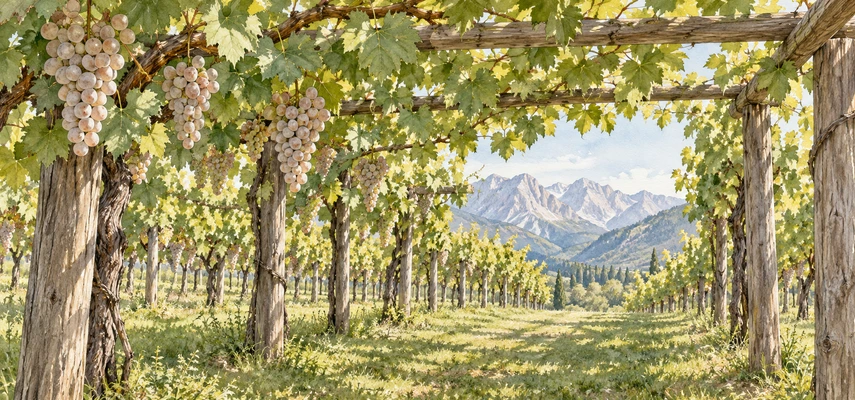

Northern Italy can turn Pinot Grigio into a fresh, straightforward white or a richer, more textured wine. Around Verona, a family of red grapes can become a light cherry-fruited red, a powerful dried-grape wine or a sweet Recioto. The names become easier when you follow the decisions behind them.
The region isn’t one continuous Alpine climate, and its classifications aren’t interchangeable decorations. Mountain slopes, Adriatic influences, broad plains and drying rooms all help explain the wines. For WSET Level 3, connect those conditions with grape composition and production rather than relying on a single regional stereotype.
This is article 23 of The TFE Guide to WSET Level 3 Wine, following the northern Italian origins, grapes and label terms in the official specification. All practice questions and marking guidance are original, independent study material.
Northern Italian wines: Mountains, plains and different ripening opportunities
Northeastern Italy includes the mountain valleys of Trentino-Alto Adige, Friuli-Venezia Giulia near Slovenia, and Veneto around Verona and towards the Adriatic. Elevation generally reduces temperature, while sheltered valleys can become warm. Mountain protection, aspect, water supply and maritime influences modify each site.
Sunny days support ripening; cooler nights can help preserve acidity. Rainfall brings useful water but can increase disease pressure. On slopes, drainage and air movement may help, while access increases labour. On flatter land, machinery and larger contiguous parcels can improve efficiency. Neither hillside nor plain automatically determines the quality of every bottle.
Canopy and crop decisions connect these conditions with style. Too much shaded fruit can struggle to ripen; excessive exposure can increase sunburn. A large crop needs enough healthy leaf area and water to mature. Harvest timing then balances fruit flavour, acidity and potential alcohol according to the intended wine.
Trentino-Alto Adige contains two important contexts
Trentino-Alto Adige is the broad northern region, with Trentino to the south and Alto Adige, also called Südtirol, further north. Valleys and slopes allow different varieties and styles. The regional names shouldn’t be treated as a single appellation with one compulsory grape.
Trentino grows Pinot Grigio and Chardonnay alongside other whites and reds, including Merlot. Traditional pergola training remains part of its vineyards, alongside other systems. A pergola supports an elevated canopy; shade, airflow, crop and access depend on its management rather than the name alone. The Trentino growers’ overview shows the range, while a regional producer account illustrates pergola and Guyot use.
Alto Adige’s sunny sheltered valleys contrast with higher, cooler sites. Choosing variety and altitude helps match ripening needs to conditions. The consortium’s climate guide explains why an Alpine location can still ripen substantial wines. Pinot Grigio can combine ripe pear or apple fruit with freshness and body; not every example is as light as a high-volume reference style.
Pinot Grigio: Grape identity doesn’t fix body
Pinot Grigio is the same grape as Pinot Gris. Its grey-pink skins can contribute a coppery hue when juice receives skin contact. Prompt separation can instead support pale wines. Ramato refers to a copper-toned expression; it isn’t proof that a wine is sweet, heavily oaked or from one particular appellation.
For a fresh, early-drinking white, protected handling, gentle pressing and controlled fermentation in neutral vessels preserve primary fruit. More concentrated grapes can support greater texture, lees contact or different vessels. Malolactic conversion may be avoided when retaining acidity matters. A richer wine still needs freshness, while a lighter wine needs enough fruit to avoid seeming dilute.
Comparing two bottles, ask how much difference comes from site and ripeness, and how much from skin contact, fermentation or maturation. The varietal name tells you the starting material, not a complete production recipe.
Friuli-Venezia Giulia: Hills beside a broad plain
Friuli-Venezia Giulia occupies Italy’s northeastern corner, with Alpine protection and Adriatic influences. White wines are important, including Pinot Grigio, Chardonnay and local varieties. Merlot and other reds also appear. Conditions vary between hill slopes, stony plains and areas nearer the coast.
Collio, near Gorizia and Slovenia, has rolling hills and marl-sandstone soils often called ponca. Colli Orientali, commonly encountered in its full DOC name Friuli Colli Orientali, covers hills in the eastern part of the Udine area. Their slope, exposure and drainage can support ripe, concentrated whites, while rain and canopy density still require attention. The Collio consortium and Colli Orientali territory guide establish the distinct origins.
Friuli Grave covers much of the stony alluvial plain around the Tagliamento. Its gravelly deposits influence drainage and water availability. More accessible ground can allow efficient vineyard operations and relatively large-scale production of fresh wines. The Grave consortium describes this setting. Efficient production doesn’t mean every wine is simple, just as a hill label doesn’t guarantee concentration.
Pinot Grigio delle Venezie is a broader DOC
Pinot Grigio delle Venezie DOC draws on a large northeastern area covering Veneto, Friuli-Venezia Giulia and the province of Trento. The last wording matters: don’t expand that claim automatically to all Alto Adige. The consortium’s introduction identifies the production territory.
The broad supply area and production scale can support consistent, accessible wines, often with a fresh, fruit-led style. It remains a regulated origin rather than permission to use grapes from anywhere. More specific origins such as Collio or Alto Adige provide different geographical information. A broader DOC doesn’t prevent good winemaking, and a smaller name doesn’t remove the need for sensory assessment.
Veneto: Local grapes alongside international varieties
Veneto extends from foothills onto the northeastern plain. Pinot Grigio, Chardonnay and Merlot are important in its wider wine picture, while Corvina defines the Valpolicella family and Garganega the Soave reference. Site, crop, production scale and cellar choices create a broad range of styles.
Chardonnay can support fresh neutral-vessel wines or richer expressions with lees and oak. Merlot can make rounded, plum-fruited reds, with structure changing through ripeness and extraction. Those possibilities don’t mean either grape is permitted in every local appellation. For the required local wines, learn the separate Corvina and Garganega frameworks.
Valpolicella and Valpolicella Classico
Valpolicella lies north of Verona, where plains and hills create different conditions. Corvina is a key grape, usually alongside other permitted local varieties such as Corvinone and Rondinella. Fresh-grape Valpolicella commonly has red-cherry fruit, refreshing acidity and a relatively approachable structure. The consortium’s wine-family guide sets out the distinct designations.
Valpolicella Classico identifies the historic western production area. Classico is a geographical term, not a promise of dried grapes, a particular oak flavour or outstanding quality. Hillside sites can change exposure, temperature and drainage, but producer decisions remain important. Moderate extraction and earlier release can preserve the fresh-fruit character of a straightforward red.
More concentrated fruit can support a fuller interpretation, yet “more” isn’t always the objective. The intended style needs enough fruit to balance acidity and tannin. An accurate fresh Valpolicella shouldn’t be judged as failed Amarone merely because it lacks Amarone’s weight.
Appassimento changes the starting grapes
Appassimento dries selected harvested grapes before fermentation. Bunches are laid in ventilated drying spaces, traditionally on racks or in suitable crates. Water loss concentrates their contents and changes the fruit’s composition and aromatic profile. The consortium’s production overview explains the drying stage.
Suitable fruit selection and airflow matter because unwanted rot can undermine the crop. Drying uses space and time, while dehydration reduces the wine available from the original harvest. More concentrated must can make fermentation demanding. These mechanisms help explain style and costs without treating every dried grape as automatically desirable.
Drying alone doesn’t determine the final sweetness. Fermentation decides how much of the available sugar becomes alcohol and how much remains. That distinction connects Amarone and Recioto while keeping their finished styles separate.
Amarone and Recioto: Related methods, different balances
Amarone della Valpolicella DOCG is made from dried grapes and fermented towards a dry style. It commonly has substantial alcohol, body and concentrated fruit, with dried-fruit, spice and developed notes depending on maturation. The consortium’s Amarone account explains the relationship between drying, fermentation and structure.
Recioto della Valpolicella DOCG also begins with dried grapes, but fermentation leaves substantial residual sugar, producing a sweet wine. Its production description distinguishes the endpoint. Both wines need balance: alcohol can overwhelm Amarone, while insufficient freshness can make Recioto heavy.
Neither style requires a fortified-wine explanation merely because the grapes are concentrated. Barrel and bottle maturation can add complexity and integrate texture, but oak strength, colour and sugar aren’t independent quality scores.
Valpolicella Ripasso: A further fermentation stage
Valpolicella Ripasso DOC begins with Valpolicella wine, which undergoes further contact and fermentation on the residual grape skins, or marc, from Amarone or Recioto production under the applicable rules. Remaining fermentable material and extraction can increase alcohol, body, tannin and flavour intensity.
The production specification describes the process. Ripasso isn’t simply a bottle of Valpolicella blended with finished Amarone, nor is it identical to fermenting a separate lot of dried grapes from the beginning. Contact and extraction need control so that added structure doesn’t overwhelm the fruit.
The useful comparison is fresh-grape Valpolicella, dried-grape Amarone or Recioto, and refermented Ripasso. Keep the production sequence clear before deciding how the wines might differ in the glass.
Soave and Soave Classico: Garganega leads
Soave, east of Verona, makes white wines led by Garganega. Trebbiano di Soave and Chardonnay can appear as supporting grapes under the rules. Trebbiano di Soave is a specific variety name, not permission to treat every grape called Trebbiano as interchangeable. The consortium’s specification establishes that framework.
Soave Classico identifies the historic hillside area. The broader origin also includes easier, flatter growing land. Exposure, drainage, crop and harvest timing can help explain the difference between a fresh, lighter wine and a more concentrated example. The regional production guide describes the geographical contrasts.
Garganega can produce citrus, pear and floral notes with a subtle almond-like finish. Neutral vessels preserve a direct style; lees contact or selected use of wood can add texture. Neither hills nor oak guarantees quality, and a simpler fresh Soave doesn’t need to imitate a heavily worked Chardonnay.
DOC, DOCG, IGT, Classico and Riserva
DOC and DOCG are Italian traditional terms within the protected designation of origin framework; IGT corresponds to protected geographical indication. Italy’s agriculture ministry explains the relationship. Each origin has its own grape, area and production conditions. DOCG doesn’t mean every bottle automatically outperforms every DOC or IGT wine.
Classico identifies a specified historic production area. Riserva adds regulated requirements, commonly including longer maturation, which depend on the particular origin. Don’t memorise one nationwide ageing duration and apply it everywhere. Nor should extra time be mistaken for a guarantee of balance: the fruit must support the wine’s development.
Quality, production costs and retail price
Judge quality through balance, intensity, complexity and length. Fresh Pinot Grigio needs clarity and sufficient fruit; textured whites need freshness; concentrated reds need enough fruit and acidity to support alcohol and tannin. Different styles can succeed at different levels of weight and ambition.
Production costs follow identifiable mechanisms. Steep access and hand work increase labour; selective harvesting and drying reduce saleable volume. Refrigeration, drying rooms, barrels and stock holding add cellar costs. Efficient mechanisation, large lots and early release can reduce unit costs. Transport, storage, applicable taxes and trade margins contribute to retail prices, while demand, reputation and limited supply can add premiums. Explain the chain rather than treating a label word as the whole reason for price.
Knowledge check: 10 original multiple-choice questions
Choose one correct answer per question. These are independent practice questions.
1. Why can an Alpine location still produce ripe wines?
2. Which statement about Pinot Grigio is correct?
3. Which geographical statement is accurate?
4. Which territory is identified for delle Venezie DOC?
5. Which grape is central to the Valpolicella family?
6. What does Classico primarily identify here?
7. What distinguishes Amarone from Recioto in the core comparison?
8. What is central to Ripasso?
9. Which grape leads Soave?
10. Which classification statement is accurate?
Answers and explanations
1. C — Local conditions matter. A mountain region includes different elevations, aspects and sheltered valleys. Sunshine and warmth can support ripe fruit even at northerly latitudes. Altitude isn’t itself a sugar source, and no broad regional label eliminates the need to assess the site.
2. B — One grape, different expressions. Pinot Grigio and Pinot Gris name the same variety. Ripeness, concentration, skin contact, vessels and lees can change the wine’s body and texture. The varietal label doesn’t require one sweetness level or one universal tasting profile.
3. D — Separate hill origins. Collio and Friuli Colli Orientali are distinct contexts within Friuli-Venezia Giulia. Friuli Grave provides the stony plain contrast. These relationships explain growing conditions more usefully than confusing a geographical region with a single uniform appellation.
4. A — The specified northeastern area. The delle Venezie framework covers Veneto, Friuli-Venezia Giulia and Trento province. Avoid automatically expanding that wording to all Alto Adige. A broad regulated territory still has boundaries rather than permission to source grapes from anywhere.
5. C — Corvina. Corvina is a central Valpolicella grape, usually alongside other permitted local varieties. Garganega leads the Soave white-wine reference. Correct grape identity provides the starting point, while fresh grapes, drying or ripasso create different production paths.
6. B — Geographical context. Classico identifies a specified historic area in examples such as Valpolicella and Soave. It doesn’t independently determine sweetness, oak treatment or drying. A geographical claim provides useful information without replacing a quality assessment of the individual wine.
7. D — The fermentation endpoint matters. Appassimento creates concentrated starting grapes for both wines. Amarone is fermented towards a dry style, while Recioto retains substantial residual sugar. Drying therefore doesn’t automatically mean a sweet result, and concentration alone doesn’t establish fortification.
8. A — A distinct further stage. Ripasso involves contact and further fermentation with marc from Amarone or Recioto production. It differs from making a separate dried-grape wine from the outset or simply blending finished wines. The process can increase body, alcohol and structure.
9. C — Garganega. Soave is led by Garganega, with permitted supporting varieties under its own rules. Trebbiano di Soave is a specific name, not a universal substitute for every Trebbiano. Site, harvest and cellar decisions help explain texture and concentration.
10. B — Italian and European terms. DOC and DOCG are traditional terms used within PDO, while IGT corresponds to PGI. Conditions depend on the origin. Neither DOCG nor Riserva automatically proves a wine is better balanced, and extra maturation requirements aren’t identical nationwide.
Written exercise 1: Explain appassimento costs in five marks
Question: Explain five production factors that can raise the cost per bottle of a dried-grape Valpolicella wine compared with a straightforward early-release fresh-grape red. Give five distinct points.
Model answer: Selecting healthy, suitable bunches requires extra harvest care. Holding grapes in drying spaces uses facilities and requires monitoring. Dehydration reduces the volume available from the original crop. Concentrated must can make fermentation more demanding and increase the need for careful management. Extended wine maturation uses cellar capacity and delays income, creating stock-holding costs.
Why it earns credit: Award one practice mark each for selection, drying facilities, reduced volume, fermentation demands and maturation/stock holding. Repeating that the wine is prestigious doesn’t explain production expense. These are original five-point study criteria, not an official WSET marking scheme.
Written exercise 2: Compare Amarone, Recioto and Ripasso in five marks
Question: Explain five distinct production connections that separate these three Valpolicella styles. Keep the processes in order and connect them with the result.
Model answer: Amarone and Recioto begin with selected grapes dried before fermentation, concentrating their contents. Amarone is fermented towards dryness, producing substantial alcohol and body. Recioto fermentation leaves substantial residual sugar, producing a sweet wine. Ripasso instead begins with a Valpolicella base wine made from fresh grapes. Further contact and fermentation on dried-grape wine marc can add alcohol, structure and flavour to that base.
Why it earns credit: Award one practice mark each for shared drying, Amarone’s endpoint, Recioto’s endpoint, Ripasso’s base and its further fermentation effect. Calling Ripasso “cheaper Amarone” doesn’t explain the process. This original rubric isn’t an official examination answer.
One-page revision summary
| Origin or term | Connection to retain |
|---|---|
| Trentino-Alto Adige | Broad northern region containing distinct Trentino and Alto Adige contexts. Altitude, shelter and exposure matter. |
| Trentino and Alto Adige | Pinot Grigio styles vary with site and production. Pergola and other training systems require appropriate management. |
| Friuli-Venezia Giulia | Alpine and Adriatic influences meet across hills and plains. White wines and several red varieties coexist. |
| Collio and Colli Orientali | Separate hill origins with varied exposures and marl-sandstone settings. Concentration still depends on crop and ripeness. |
| Friuli Grave | Stony alluvial plain with different drainage, access and production opportunities. |
| Pinot Grigio delle Venezie | Broad DOC covering Veneto, Friuli-Venezia Giulia and Trento province. It isn’t all northeastern territory without limits. |
| Veneto | Local Corvina and Garganega identities coexist with wider Pinot Grigio, Merlot and Chardonnay production. |
| Valpolicella Classico | Historic area within the Valpolicella context. Classico doesn’t itself mean dried grapes or extra oak. |
| Amarone and Recioto | Dried-grape wines with different fermentation endpoints and finished sweetness. |
| Valpolicella Ripasso | Base wine undergoes further contact and fermentation on marc from dried-grape wines. |
| Soave and Soave Classico | Garganega-led whites, with a historic hillside area distinguished from the broader origin. |
| DOC, DOCG and IGT | Protected-origin and geographical-indication frameworks with origin-specific requirements. |
| Riserva | Additional regulated conditions, commonly longer maturation. No single duration applies to every origin. |
| Quality and price | Judge balance and finish. Explain labour, drying, volume, cellar, transport, margins and demand separately. |
A practical tasting comparison
Compare fresh-grape Valpolicella and Ripasso using modest pours. Record acidity, alcohol, body, tannin texture, fruit character and finish before reading the production notes. If adding Amarone, look for the effects of concentration and alcohol without automatically ranking the most powerful wine highest. A Pinot Grigio comparison from different origins offers the same lesson: measure the differences before assuming the label predicts them all.
Sources and course context
Linked primary sources comprise the official WSET specification, regional and appellation consortia, production specifications and Italy’s agriculture ministry. Producer examples illustrate choices rather than universal recipes. Exact blend proportions, drying durations and maturation thresholds are omitted; the causal and geographical distinctions are the focus. No official examination material is reproduced.
Continue your studies: Articles 5, 6, 7 and 8 explain white, red, sweet and maturation decisions. Article 24 moves to Piedmont, article 25 to Tuscany, and article 49 compares wine classifications.












