










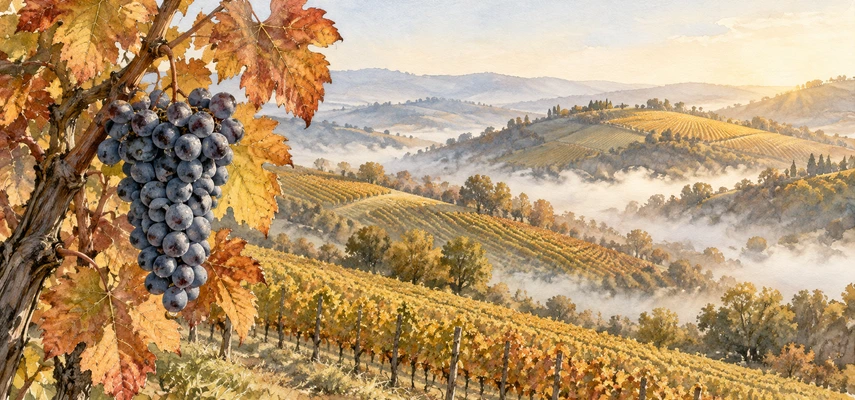

Piedmont wines make a useful corrective to the idea that a darker red must be a more powerful red. Nebbiolo can look surprisingly pale while delivering enough tannin to make your gums sit up straight. Barbera often supplies deeper colour with much less tannin. Dolcetto, despite its friendly-sounding name, is normally dry. And Gavi reminds us that this famous red-wine region also makes refreshing whites.
For WSET Level 3, the productive question is why these differences exist. Connect grape variety, ripening conditions and cellar decisions with the wine in the glass, then explain what those choices cost. This guide covers the Piedmont origins assigned in the WSET specification, with original practice questions and worked answers.
Put Piedmont on the map
Piemonte, usually called Piedmont in English, lies in north-western Italy. The Alps frame the region to the north and west, but the vineyards discussed here are principally in hills farther south. The Langhe around Alba contain Barolo and Barbaresco. Asti lies farther east, with Barbera d’Asti extending through hills in the provinces of Asti and Alessandria. Gavi occupies the south-eastern corner, towards Liguria and the Apennines.
The overall climate is continental: cold winters, warm summers and a marked seasonal change. A favourable summer doesn’t remove the risks of spring frost, hail or rain near harvest. Early-budding vines can expose tender shoots to frost. Later-ripening fruit remains on the vine longer, increasing its exposure to deteriorating autumn weather. Vintage conditions therefore affect yield, ripeness and production costs rather than merely providing another number on the label.
On a hillside, aspect changes the amount and timing of sunlight. A well-exposed slope can help a demanding variety complete ripening; a higher or less exposed site may preserve freshness but struggle in an unhelpful year. Air drainage can reduce frost risk compared with a low pocket. None of this makes every hillside automatically superior: excessive heat, drought or erosion can create different problems.
Clay and calcareous marl occur in important vineyard areas. Their practical significance includes water availability, drainage and rooting conditions. Clay can help retain water through a dry spell, while poorly drained ground can leave roots short of oxygen. Soil names aren’t flavours poured directly into grapes. The Langhe consortium’s Nebbiolo profile is a useful starting point for connecting the variety’s long season with appropriate exposure.
Four grapes, four different priorities
Nebbiolo buds early and ripens late. It needs a sufficiently long, favourable season to develop ripe fruit and tannins without losing the acidity that helps its wines age. Growers must manage crop load and canopy so the vine can ripen its fruit, rather than simply produce the largest possible harvest. Excessive shading can delay ripening; excessive leaf removal can expose berries to sunburn. The right balance depends on the site and season.
Typical Nebbiolo has pale ruby colour that develops towards garnet, high acidity and high tannin, often with substantial alcohol. Red cherry and floral notes may develop towards dried flowers, earth and savoury complexity. Pale colour doesn’t mean low concentration: pigments and tannins are different groups of compounds. A young wine can therefore look delicate while feeling decidedly firm.
Barbera offers a different combination: naturally lively acidity, usually deeper colour and relatively modest tannin. Cherry and plum fruit can support either a fresh, accessible style or a richer, oak-matured wine. Its productive potential makes yield management relevant. A large crop on an unsuitable site can dilute flavour or delay ripeness; simply lowering yield, however, doesn’t guarantee balance. The consortium’s Barbera profile describes the variety’s vigour and adaptability.
Dolcetto generally ripens earlier than Nebbiolo. That can help growers spread picking and cellar work, and allows suitable cooler sites to contribute a different wine rather than imitate Barolo. Expect dark fruit, often a floral or slightly bitter finish, lower acidity than Barbera and a potentially noticeable tannic grip. Don’t translate the grape’s name into a promise of sweetness. The regional Dolcetto profile explicitly distinguishes sweet-tasting ripe grapes from dry finished wine.
Cortese supplies the white comparison: typically high acidity, restrained citrus and orchard fruit, and a lighter profile than the region’s powerful reds. The winemaker’s challenge is to preserve clean fruit while achieving enough ripeness and texture to avoid a thin, sharp result. These are grape tendencies, not a substitute for tasting an individual bottle.
Barolo and Barbaresco: shared grape, distinct origins
Barolo DOCG and Barbaresco DOCG are dry reds made entirely from Nebbiolo. Barolo’s hills lie principally south-west of Alba; Barbaresco lies to its north-east around Barbaresco, Neive and Treiso, with a specified part of Alba also included. They are separate protected origins, not two grades of the same appellation.
Barbaresco commonly ripens somewhat earlier and can show a more approachable tannin profile when young. Barolo is often associated with particularly powerful structure. Treat those as broad tendencies: vineyard exposure, vintage, extraction and producer decisions create considerable overlap. A muscular Barbaresco and a fragrant, relatively open Barolo needn’t have got their labels mixed up.
During red fermentation, contact between juice and skins extracts colour, tannin and flavour. Temperature, cap management and contact time affect extraction. Nebbiolo requires judgement: aggressive handling can produce harsh tannins, while insufficient extraction may fail to support the intended ageing style. Ripe fruit and careful extraction matter together. Malolactic conversion softens the acid profile, although the resulting wine can still have high acidity.
Maturation provides time for structural integration and flavour development. Large, older wooden vessels usually contribute less obvious new-oak aroma than small new barrels. Smaller new oak can add toast or spice and increases the oak’s influence relative to wine volume. Actual practice varies; neither appellation demands that every producer use an identical barrel recipe.
The legal minima are more precise than the convenient phrase “several years”. The consortium’s Barolo specification and Barbaresco specification set out the following periods, counted from 1 November of the harvest year.
| Origin and type | Minimum total ageing | Minimum within that period in wood |
|---|---|---|
| Barolo | 38 months | 18 months |
| Barolo Riserva | 62 months | 18 months |
| Barbaresco | 26 months | 9 months |
| Barbaresco Riserva | 50 months | 9 months |
The wood period is included in the total, not added to it. Riserva requires additional time under the relevant rules; it doesn’t certify that you will prefer the wine. Legal release is also different from ideal drinking readiness. A compliant young bottle may benefit from further development if its fruit and structure can sustain it.
Barbera d’Asti: acidity can carry the wine
Barbera d’Asti DOCG comes from a different production area from the Alba-centred Nebbiolo appellations. Its name identifies an origin and a Barbera-led wine; don’t assume every named Italian grape appellation has the same blending rules. The Asti and Monferrato consortium describes both fruit-led versions and more concentrated, wood-matured expressions.
For an earlier-drinking style, controlled extraction and maturation in neutral vessels can preserve clear cherry fruit and avoid adding much oak tannin. High acidity provides freshness even when the grape itself contributes less tannin than Nebbiolo. For a more ambitious style, ripe concentrated fruit can support longer maturation and oak influence. Superiore carries additional appellation requirements; it isn’t simply a synonym for “the expensive bottle”.
The commercial consequences follow the production choices. A fresh wine released relatively quickly ties up less storage space and working capital. New barrels and extended maturation add expenditure before any bottle earns revenue. Those investments can support complexity, but oak cannot repair dilute fruit. Assess concentration, balance, length and complexity rather than awarding marks for vanilla alone.
Dolcetto d’Alba: dry, fruity and often ready sooner
Dolcetto d’Alba DOC covers a distinct dry red centred on the wider Alba area. Its fruit and moderate-to-firm grip can suit drinking earlier than a highly structured Nebbiolo. Lower acidity makes preserving freshness particularly relevant: harvest timing and protection from excessive oxidation help maintain a lively impression.
Gentle extraction can avoid an unnecessarily drying finish, while neutral vessels can keep fruit at the centre. Producers can also make more concentrated examples, so “often enjoyed young” is a useful tendency rather than a legal expiry date. The Dolcetto d’Alba appellation profile describes its characteristic dry style and fruit-led identity.
Price comparisons need context. A less famous name and an earlier release can reduce the price relative to prestigious Nebbiolo wines. That doesn’t establish poor quality. A balanced Dolcetto with distinct fruit and a satisfying finish may fulfil its intended style very well without needing decades in a cellar.
Gavi: Cortese in the south-east
Gavi DOCG, also labelled Cortese di Gavi under its rules, is made from Cortese. Its hills are in southern Alessandria, rather than the Langhe. The Gavi consortium’s viticulture account describes warm summers tempered by maritime winds and highlights canopy and yield management. The nearby Ligurian influence distinguishes this setting from a simplistic picture of uniformly inland Piedmont.
For the familiar dry still style, gentle pressing limits extraction of bitter phenolics from skins and seeds. Temperature-controlled fermentation can retain fresh apple, pear and citrus character. Stainless steel or other neutral vessels keep oak aroma out of the foreground. Avoiding or limiting malolactic conversion can retain acidity; lees contact can add texture. These are available stylistic choices, not compulsory steps for every Gavi.
Crop balance and harvest decisions influence whether the result is refreshing and sufficiently flavoursome. A less concentrated example may be intended for early drinking; selected sites and more involved maturation can support greater texture and development. Don’t infer sweetness, new oak or long ageing simply from the DOCG letters. Equally, don’t reduce an entire appellation to the cheapest supermarket example.
Explain quality and price separately
Good answers connect decisions to outcomes. A suitable slope helps Nebbiolo ripen; ripe fruit supports firm but balanced tannins; careful extraction preserves that balance. Long maturation costs money and may add complexity, but time alone cannot manufacture quality from unsuitable fruit.
Grape costs reflect vineyard land, growing labour, yield and fruit demand. Winery production costs include skilled cellar labour, selective harvesting, equipment, barrels and stockholding. Steep or awkward plots can restrict machinery and increase labour per bottle. Transport adds freight, protective packaging and distribution costs. Import taxes and local duties can increase the consumer price independently of flavour. Retail and distributor margins cover their services and commercial risks. Supply and demand matter too: limited quantities from a sought-after site can command a premium beyond the direct cost of production.
Use grape costs, production costs, transport, margins and market forces as the five commercial categories; taxes can add another effect. Then return to the glass for quality: balance, flavour intensity, finish and complexity. DOC and DOCG regulate origin and production; they don’t make every bottle equally impressive. For related study, revisit articles #2, #4, #6 and #8 on environment, vineyard work, red winemaking and maturation. Article #23 provides the neighbouring northern Italian comparison, while #49 compares classification systems.
Knowledge check: 10 original practice questions
These are independent educational questions, not official WSET examination material. Choose one correct answer for each.
1. Which variety is used exclusively for both Barolo and Barbaresco?
2. Why can Nebbiolo benefit from a well-exposed hillside?
3. Which statement best describes typical Barbera relative to Nebbiolo?
4. What does Dolcetto’s name establish about Dolcetto d’Alba?
5. Which is the standard Barbaresco minimum total ageing period?
6. How should Barolo’s minimum 18 months in wood be counted?
7. Which pairing correctly identifies Gavi?
8. Which approach can help preserve a fresh, fruit-led Gavi style?
9. Which factor most directly increases stockholding costs?
10. Which conclusion about DOCG is justified?
Answers and explanations
1. C — Nebbiolo. Both origins require this grape exclusively. Their differences arise from origin, conditions and production decisions rather than substituting Barbera or Dolcetto.
2. B — Support for ripening. Exposure can increase useful sunlight and warmth during a long season. It cannot guarantee frost protection or remove the need for vineyard management.
3. D — Acid rather than equal tannin. Barbera typically combines lively acidity with less tannin than Nebbiolo. Colour intensity cannot reliably predict tannin concentration.
4. A — A dry finished wine. Ripe grapes can taste sweet before their sugars ferment. The variety’s name is not a residual-sugar classification.
5. C — 26 months. Standard Barbaresco requires that total period, including at least nine months in wood, counted from the specified November starting point.
6. B — Included time. The wood minimum forms part of the total requirement. Adding it again would incorrectly inflate the legally required period.
7. D — Cortese and southern Alessandria. Gavi belongs to the south-eastern Piedmont setting near Liguria, separate from the Alba-centred Nebbiolo origins.
8. A — Protective white winemaking. Gentle pressing reduces unwanted phenolics, while controlled fermentation and neutral vessels can preserve delicate primary fruit without prominent oak aroma.
9. C — Delayed revenue. Wine retained before release occupies space and ties up money. Its colour or acidity does not by itself determine the duration of stockholding.
10. B — Rules and assessment. DOCG provides a regulated framework. Balance, concentration, length and complexity still need to be judged in the particular wine.
Written exercise 1: explain Nebbiolo site selection
Give five reasons why a grower seeking ripe, balanced Nebbiolo should consider site and vineyard management carefully. Link each reason to an outcome. Five marks.
Model answer: Nebbiolo’s early budding exposes new shoots to spring frost, so a site with useful air drainage can reduce crop-loss risk. Its late ripening makes suitable sunlight and warmth important for developing ripe fruit before autumn conditions deteriorate. Managing crop load helps the vine bring its remaining fruit to appropriate maturity. Canopy management balances light exposure and airflow, reducing shading and humid conditions around bunches. Adequate soil water availability supports vine function through dry periods, while drainage avoids prolonged waterlogging.
Why it earns credit: One mark each for frost risk and air drainage; long-season ripening and exposure; crop load and maturity; canopy effects; and root-zone water conditions. These are five separate causal points. Neither expensive land nor a famous name explains the vine’s response.
Written exercise 2: account for price differences
Explain five separate commercial reasons why a sought-after, long-matured Barolo might retail for more than an earlier-release regional red. Include all five cost categories used in this guide. Five marks.
Model answer: Grape costs can be higher because demanding hillside work, expensive land and lower saleable yields raise the cost of fruit. Winery production costs can increase because extended cellar storage requires space and capital. Transport charges can add more for a distant export market or a less efficient small shipment. Distributor and retailer margins add payment for their handling, selling and commercial risks. Strong demand for a limited quantity from a prestigious origin can support a higher market price even beyond the direct extra expenditure.
Why it earns credit: One mark each for grapes, winery production, transport, margins and supply/demand, with a mechanism for each. The question asks about a possible comparison, not a claim that every Barolo shipment incurs higher freight or tax than every other red. Repeating barrels and cellar rent earns only the production category’s mark.
One-page revision summary
| Topic | Remember | Explain the consequence |
|---|---|---|
| Piemonte | North-western Italy; important southern hills | Continental seasons plus site differences affect risk and ripening |
| Nebbiolo | Early budding, late ripening; high acid and tannin | Frost exposure and a need for suitable long-season ripeness |
| Barolo | Dry Nebbiolo DOCG, principally south-west of Alba | Structure and maturation can support development and raise costs |
| Barbaresco | Dry Nebbiolo DOCG north-east of Alba | Often earlier ripening; individual styles overlap with Barolo |
| Legal maturation | Barolo 38/62 months; Barbaresco 26/50, standard/Riserva | Wood minima 18 and 9 months respectively are included, not additional |
| Barbera d’Asti | High-acid Barbera-led red; fresh and wood-matured styles | Acidity can provide structure without Nebbiolo-level tannin |
| Dolcetto d’Alba | Dry red, generally earlier-ripening grape | Often enjoyed young; name does not establish sweetness |
| Gavi | Cortese in southern Alessandria | Fresh acidity and restrained fruit; protective white winemaking useful |
| Quality | Balance, intensity, finish, complexity | Price and appellation letters do not replace tasting evidence |
| Price | Grapes, production, transport, margins, market forces | Explain each mechanism separately |
When revising, compare one wine from each grape before memorising extra village names. The contrast between colour, acidity and tannin will do more useful work than a very long list without explanations.












