










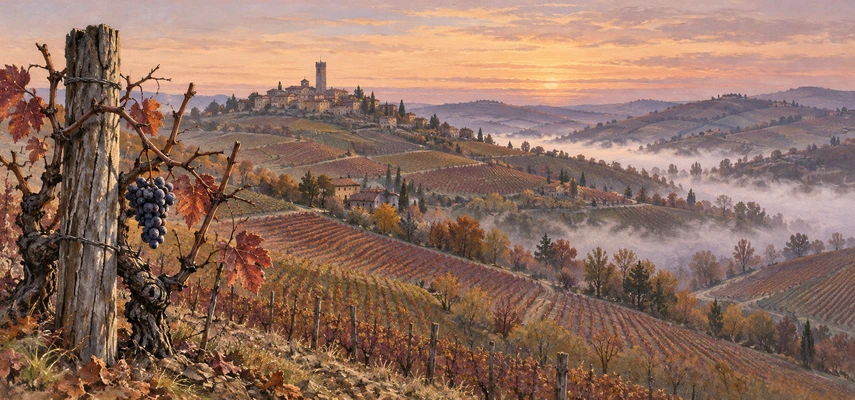

Nebbiolo can look disarmingly pale before delivering a firm grip of tannin and acidity. That contrast makes Barolo and Barbaresco useful Diploma wines: colour, power, fragrance and quality don’t move together on one simple scale. A lighter-looking glass can have considerable substance, while an expensive label still needs a balanced wine behind it.
Both appellations come from Piemonte’s Langhe hills and use Nebbiolo. Their differences involve place, vineyard conditions, production and maturation rules, but neither is a reliable shorthand for the other’s opposite. Barolo isn’t invariably massive, Barbaresco isn’t invariably gentle, and decades in a cellar aren’t compulsory for every successful bottle.
Put two Nebbiolo appellations around Alba
Piemonte is Italy’s northwestern regional setting; Barolo and Barbaresco occupy distinct areas within its Langhe wine country. The consorzio’s Barolo account describes an area involving eleven communes, with Barolo, Serralunga d’Alba and Castiglione Falletto wholly included and portions of others such as La Morra, Monforte d’Alba and Verduno.
The Barbaresco account identifies Barbaresco, Neive and Treiso, plus part of Alba. These are geographical distinctions, not two grape varieties. Langhe Nebbiolo and Nebbiolo d’Alba belong to other appellation frameworks; a wine doesn’t acquire Barolo identity simply because it tastes like Nebbiolo or comes from near Alba.
The consorzio’s climate and geology account describes subcontinental conditions, hill and valley differences, and influences from surrounding mountain and maritime air movements. Barbaresco’s setting can be comparatively milder, but site and vintage differences prevent a rule that every parcel ripens sooner or produces softer wine than every Barolo vineyard.
Explain why the slope matters to Nebbiolo
Temperature affects growth, ripening and acid retention. Sunlight supports photosynthesis and changes bunch conditions. Exposure, elevation and airflow modify the regional climate, helping explain why nearby parcels can deliver different fruit. A favourable exposure in a cool season may become a demanding hot site in another.
Water availability depends on rainfall, rooting, soil depth and drainage. Nutrient availability influences vigour, leaf function and crop balance. Sedimentary parent materials, marl, clay, sand and calcareous components vary across the Langhe. Their physical effects deserve explanation; a geological name doesn’t determine a compulsory rose or tar flavour in the glass.
The familiar contrast between supposedly perfumed western Barolo and powerful eastern Barolo can suggest useful comparisons, but it is too coarse to classify every bottle. Commune boundaries contain different exposures and soils, while producer choices and vintages add further variation. Compare actual sites before turning a regional tendency into a universal law.
The Nebbiolo grape profile describes early growth and late ripening, with a sensitivity to local conditions. That long season helps explain the importance of site and harvest decisions. It doesn’t mean every harvest must occur on one traditional October date.
Manage the long season rather than waiting blindly
Weather brings spring frost, hail, heat, drought and harvest rain. Early budburst can expose young growth to frost, while late ripening can leave fruit vulnerable to autumn conditions. Downy and powdery mildew and bunch rot require monitoring. The Monferrato consorzio’s Nebbiolo account also identifies frost and disease sensitivities; the grape isn’t immune because a site is famous.
Vineyard establishment considers access, slope stability, exposure, row arrangement and permitted training. Planting materials should suit variety, vigour, soil and water conditions. Guyot and upright training are important local references, but the production plan must respond to the actual parcel. Prestigious origin cannot compensate for unsuitable establishment or inaccessible work.
Nutrient and water management follows observation, analysis and applicable rules. Canopy management balances productive leaf area, airflow and bunch protection. Greater exposure can improve drying and maturity in one season, yet excessive leaf removal can increase fruit damage during heat. A canopy that looks tidy isn’t necessarily functioning well.
Harvest timing balances flavour, sugar, acidity, skin and seed maturity, health and the forecast. Hazard management includes erosion control, secure access and appropriate frost precautions. Pest and disease management combines monitoring, canopy measures and justified interventions. Waiting for softer tannin can improve one lot but sacrifice another to rain or declining fruit condition.
The consorzio’s 2025 harvest report records Nebbiolo picking beginning in late September. Use that as a particular season’s evidence against a fixed-date assumption, not a prediction for every future vintage or an automatic quality verdict on wines still developing.
Extract character without making hardness the objective
Winemaking approaches vary within both appellations. Careful grape transportation limits crushing, heat and oxidation. Reception should separate origin, ripeness and health, allowing different lots to receive appropriate treatment. Processing and pressing decisions influence seed condition, juice fractions and phenolic material. An indiscriminate blend at reception may remove useful options before fermentation starts.
Alcoholic fermentation decisions include yeast, temperature, nutrition, vessel and cap management. Skin contact before, during and after fermentation changes extraction. Longer maceration isn’t a universal synonym for better wine: extraction depends on the material, alcohol, temperature and handling as well as the calendar.
Extraction and pressing should seek integration between fruit and tannin. Separate press fractions can provide options for later trials. Aggressive extraction of a light or unevenly ripe lot may create a wine that stays hard after the fruit fades. The ability to endure a cellar isn’t the same as the ability to improve in it.
Malolactic conversion commonly forms part of the red-wine programme, changing acidity and microbial considerations. Lees maturation, oxygen exposure and vessel management need to match the lot. Blending eligible parcels can build balance and complexity; a multi-site wine isn’t automatically inferior to a named-site wine.
Vietti’s Barolo production account describes separate parcel vinification and maturation, submerged-cap work and subsequent assembly. The Produttori del Barbaresco production account describes long maceration and large-cask maturation. These are producer examples, not proof that all Barolo follows one modern recipe and all Barbaresco another traditional recipe.
Separate required maturation from the producer’s choices
The ministry’s Barolo specification gives a minimum 38 months of maturation, including 18 in wood; Riserva requires 62 months total, with the same 18-month wood minimum. The clock runs from 1 November of the harvest year. Don’t replace 62 months with the convenient but inaccurate shorthand of exactly five years.
The Barbaresco specification gives 26 months total, including nine in wood, or 50 months for Riserva with the same wood minimum, also counted from 1 November. These differing minimums create different release and inventory implications. They don’t prove a particular Barbaresco is ready sooner than a particular Barolo.
Large older casks can provide a maturation environment with relatively little new-wood flavour. Smaller or newer barrels can contribute more obvious wood character, depending on their use. Size, age, oxygen exposure, duration and the wine’s concentration all matter. A vanilla note doesn’t establish that a wine is modern, excellent or ready to drink.
Packaging and closures should protect the intended development period. Wine transportation requires suitable temperature and handling; a costly cellar programme can be undermined after bottling. Tannin, alcohol and price don’t make either appellation immune to heat or poor storage.
Read DOCG, MGA and Riserva as distinct claims
International and EU protection frameworks, national Italian law and local appellation specifications interact. A geographical indication links a place with defined production conditions. Barolo and Barbaresco are DOCG wines within the PDO framework; the initials don’t create a sensory guarantee that every bottle is outstanding.
The specifications permit named additional geographical mentions, commonly called MGA, under their conditions. Those names identify delimited origins rather than a Burgundy-style official hierarchy of premier and grand cru quality. A recognised name may carry considerable market reputation, but recognition of its boundary and evaluation of its wine are different tasks.
Riserva means the wine has met the applicable additional conditions, including longer maturation. It isn’t an instruction to award a higher tasting grade. Check vintage, origin, producer and the actual wine rather than assuming every longer-aged release has more desirable complexity than a standard bottling.
Industry associations such as the consorzio work on protection and promotion within their roles, alongside the authorities and authorised control bodies. A producer’s technical sheet explains its own practice; it cannot rewrite the denomination’s requirements. Conversely, meeting legal minimums doesn’t describe every decision an ambitious producer makes.
Connect prestige with a viable route to market
Supply depends on eligible vineyard fruit, usable harvest, selection and allocation between standard, named-origin and Riserva releases. Demand differs between recognised labels, individual producer followings and specialist vineyard names. Costs include hill-vineyard labour, selection, cellar resources, maturation and inventory. Holding wine longer ties up capital before a customer pays.
Legislation affects production, claims and destination compliance. Currency exchange changes an importer’s landed cost without altering wine quality. Importing adds freight, duties where applicable and intermediary costs. Retail needs clear information about style and drinking expectations; HoReCa buyers require staff able to explain tannin, maturity and serving context. Direct-to-consumer sales can retain revenue but require hospitality and fulfilment.
A grower may supply fruit, an estate can coordinate vineyard and cellar, and a winery provides production capacity. A merchant sources wine or grapes; a broker connects parties without necessarily owning stock. A cooperative can combine member fruit, shared resources and a coherent selection policy, as Produttori del Barbaresco illustrates. Ownership structure isn’t a tasting conclusion.
Mature and emerging markets contain varied buyers: collectors, restaurant guests and curious drinkers don’t necessarily want the same wine or release age. Wine brands can lead with appellation, producer, vineyard or style. A higher price needs customers willing to support it; limited origin and expensive farming don’t remove demand risk.
Compare the evidence here with the rest of Piemonte as a regional case, then apply the regional comparison framework to the comparison. Compare growing conditions, production decisions, style, quality and the commercial reasons for price. Establish the differences rather than assuming that one familiar name must be better.
Original Diploma practice
These original exercises and indicative points are teaching material, not official WSET questions or marking allocations.
Question 1: compare two maturation programmes
A fictional producer proposes identical new-oak maturation for a concentrated Nebbiolo lot and a lighter, less even lot. Evaluate the plan.
Indicative points: fruit, tannin, vessel, oxygen, integration, legal minimum and market.
Outline answer: Assess each lot before choosing wood. A concentrated wine may integrate a treatment that overwhelms the lighter lot. Legal duration establishes a minimum requirement, not an ideal recipe. Compare trials and judge whether fruit, tannin and wood form a complete wine rather than treating expenditure as quality evidence.
Question 2: evaluate a geographical ranking
A buyer expects every Barolo to outlive every Barbaresco and every MGA wine to beat every multi-site blend. Assess both claims.
Indicative points: regional tendency, site, vintage, producer, legal claim, quality and ageing.
Outline answer: Appellation and named origin provide useful context without ranking all wines. Assess concentration, balance, tannin quality, remaining fruit and development. A multi-site blend may achieve complexity and integration; a named-site wine may still disappoint. Further ageing requires positive development potential, not simply a famous address.
Question 3: explain a late-ripening risk
A fictional grower waits for an arbitrary October date despite mature fruit and a deteriorating forecast. Evaluate the decision.
Indicative points: variety, actual season, flavour, sugar, acidity, tannin, health and forecast.
Outline answer: Nebbiolo’s late-ripening tendency doesn’t establish a fixed picking date. Compare actual maturity and desired style with the risk of rain and declining health. Selective harvesting or separate lots may preserve options. Waiting has value only if its likely benefit exceeds the risk to usable fruit.
Analytical tasting preparation: use the northwest Italian programme
The official Diploma specification, PDF page 26, includes Barolo or Barbaresco of very good or outstanding quality within its essential northwest Italian selection. Either can satisfy that row; a proposed pair adds a useful comparison without becoming an extra compulsory requirement. The wider programme also includes Gavi, Barbera, Dolcetto and Nebbiolo d’Alba or Langhe Nebbiolo, addressed in the broader Piemonte lesson.
Propose suitable bottles and write full systematic descriptions blind before revealing identity. Record acidity, alcohol, body, tannin, fruit, floral or developed character and finish, without forcing familiar descriptors into a wine that doesn’t show them. Justify quality through balance, concentration, complexity and desirable persistence. Assess bottle-ageing suitability separately through retained fruit, tannin, acidity and existing development. These are proposed study wines, not actual tastings, automatic grades or examination predictions.












