











Bourbon can be made outside Kentucky. It can also smell of vanilla and caramel without either being added as flavouring. Those two facts make a useful starting point, because Bourbon is often described through associations that are mistaken for its definition.
Here is Bourbon explained through the decisions that matter: a corn-led grain recipe, fermentation, relatively low-strength distillation and storage in new charred oak. Kentucky is central to its production story, but the protected US identity is wider. Learn the requirements first, then use them to understand the familiar character.
Start with the grain recipe
Bourbon’s fermented grain mash must contain at least 51% corn. The remainder can include other grains. Corn leads the recipe, but the threshold doesn’t mean every Bourbon has the same composition or that the remaining proportion is irrelevant. Producers can choose different grain combinations while meeting the category minimum.
A mash bill is the grain recipe. It is not the same as the finished drink’s composition after fermentation, distillation and maturation. Saying “51% corn” doesn’t mean a glass contains 51% intact corn material. It describes the starting grain proportions within a production process that transforms those ingredients.
Rye, wheat and malted barley are familiar other grains in Bourbon production. They can serve different compositional and processing roles. It is useful to recognise that variation without assigning one guaranteed tasting note to every possible recipe. Ingredient proportions are a starting explanation, not a complete sensory forecast.
The corn minimum also distinguishes Bourbon from American rye whiskey, whose defining grain minimum concerns rye instead. Both belong to the larger grain-spirit family. The category names tell you which production conditions apply, rather than proving that one drink must always be sweeter, spicier or stronger than the other.
Corn does not bypass fermentation
Cereal material needs preparation so that its starch can supply fermentable sugars. Processing and conversion create a suitable mash for yeast. Fermentation then produces ethanol and carbon dioxide, alongside compounds relevant to aroma. The still receives an alcoholic feed; it doesn’t turn unfermented corn into alcohol by heat alone.
This sequence explains why the grain recipe matters without reducing production to a shopping list. Different materials and handling decisions influence the fermentation environment. The resulting alcoholic liquid carries material that distillation can concentrate or leave behind. The corn-led recipe is therefore a real production choice, even though no kernels arrive in the glass.
For revision, use the same framework as for other spirits: prepare sugar, ferment it, distil the alcoholic liquid, then manage later operations. Bourbon’s distinctive requirements sit within that framework. You don’t need a second theory of fermentation simply because the raw material is associated with a different country.
Lower-strength distillation retains character
The Level 1 syllabus associates Bourbon with a column still producing a lower-strength spirit. That is an important typical production model. It shouldn’t be restated as a universal legal requirement that every Bourbon must use exactly the same still design or equipment sequence.
The current US whisky standard limits Bourbon distillation to no more than 160 US proof, equivalent to 80% ABV. This is lower than the high-strength neutral-alcohol production associated with vodka. The contrast helps explain why the fermented grain base can remain more noticeable in the spirit.
The word “lower” is comparative, not a retail serving suggestion. An 80% production limit doesn’t mean the bottle must contain 80% alcohol. Later storage and bottling requirements concern different stages. Distillation strength, barrel-entry strength and bottling strength should not be collapsed into one number.
A column still is capable of making characterful spirit. Bourbon provides a memorable answer to the misconception that all continuous distillation produces neutral alcohol. The equipment’s capability and its operation matter together. A tall column isn’t proof that the producer has removed every trace of the fermented base.
New charred oak does a particular job
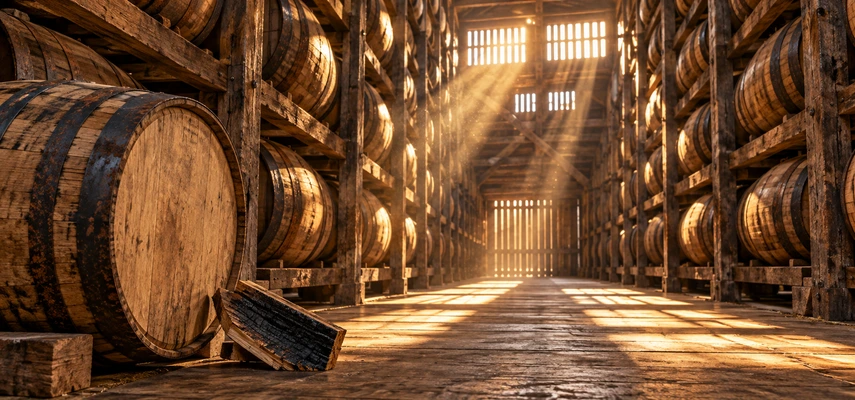
Bourbon is stored in new charred oak barrels. Each word matters. Oak identifies the wood; new identifies its use history for this requirement; charred identifies treatment of its interior. A used oak barrel is not interchangeable with a qualifying new barrel merely because both are brown and barrel-shaped.
Charring creates a blackened internal surface while heat also changes the nearby wood. Contact with that prepared oak helps shape colour, aroma and flavour as the spirit matures. Vanilla, toast, caramel-like and spice impressions are useful associations with Bourbon, although particular bottles differ in the balance and intensity of those characteristics.
The sensory word “caramel” needs care. A caramel-like aroma is not the same thing as caramel colouring or caramel flavouring added to the liquid. Wood treatment and maturation can produce associations with sweet foods. The description names a perception; the production claim names an operation. They require different evidence.
New wood generally offers a strong source of extractable material compared with repeatedly used wood. That helps explain why the requirement is consequential. It doesn’t mean a new barrel automatically produces a good result regardless of the spirit, time or storage conditions. Producers still have decisions to manage within the category.
A barrel’s storage environment can influence the way spirit and wood interact. Different locations within a warehouse may develop differently. For Level 1, the important point is that maturation is active and variable. The requirement identifies the container, while the finished character reflects how that container and its contents are managed.
Kentucky matters without being the border
Bourbon is a distinctive product of the United States and can be produced in different US states. Kentucky is the major state associated with its production in the syllabus. Those facts are compatible. A place can be central to a category’s identity without being its only legally permitted location.
A useful examination contrast is Cognac or Scotch, whose names tie production to their own defined origins. Bourbon’s geographical requirement is American, rather than exclusively Kentuckian. “Made outside Kentucky” therefore doesn’t settle eligibility. A producer still needs to satisfy the other applicable Bourbon requirements.
A state name on a label may add a more specific origin claim and its own conditions. It doesn’t erase the broader federal framework. At this introductory level, remember the US scope and Kentucky’s prominence, then resist inventing narrower boundaries that the category name itself doesn’t impose.
Age, straight and the danger of imported numbers
The ordinary Bourbon category does not carry the same fixed minimum age as Scotch. New charred oak storage is required, but one shouldn’t borrow Scotch’s three years or Cognac’s two-year baseline and apply it automatically. Different categories use different combinations of container and time requirements.
Straight Bourbon is a further designation with a minimum two-year maturation requirement under US rules. It is useful context for reading labels, even though the central Level 1 lesson concerns Bourbon’s core production identity. The extra word changes the claim being made. Ignoring it can make two apparently similar questions ask different things.
An age figure also doesn’t establish the full quality or character. A cask’s activity and storage conditions matter alongside time. A hypothetical older Bourbon isn’t necessarily the best choice for every drinker or purpose. Examination accuracy means identifying the rule, not turning the number into a universal preference ranking.
Barrel selection is not permission to add anything
Producers can combine suitable Bourbon barrels to achieve an intended bottling style. In the broad production sense, that selection and blending may support consistency or complexity. Individual barrels vary, so a familiar bottled result can require judgment about which components work together.
However, the legal label blended Bourbon whisky is a separately defined category under US rules. It should not be treated as a casual synonym for every Bourbon assembled from multiple barrels. Technical production language and a formal label designation can overlap without having identical meanings.
For ordinary Bourbon, the rules do not permit neutral spirits or added colouring and flavouring materials. That makes it especially important to distinguish wood-derived impressions from additions. A general spirits lesson listing sweetening, colouring and botanical methods is not permission to apply all of them while retaining the Bourbon name.
A practical label-reading exercise
Imagine a label describing Bourbon made in a US state outside Kentucky, with a corn-led mash bill and new charred oak maturation. The state alone gives no reason to reject the category. Next check the required grain proportion and other production conditions rather than substituting a geographical myth for the definition.
Now imagine a producer describing a vanilla-like aroma. That sensory note doesn’t imply vanilla was added. Ask whether the statement describes perception or an ingredient. If the claim instead says flavouring was added, classification requires attention. Similar words can tell quite different stories depending on how they are used.
Keep Bourbon’s corn and oak requirements distinct by comparing them with Scotch and Tennessee and rye whiskey.
What to remember
Build the Bourbon chain around at least 51% corn, other possible grains, fermentation, lower-strength distillation and new charred oak. Place production within the United States, with Kentucky as the major state highlighted in the syllabus. Keep the typical column-still model separate from a universal equipment mandate.
Finally, distinguish production stages and label terms. A distillation limit is not bottled ABV. A caramel-like aroma is not caramel colouring. Combining suitable barrels is not automatically the legal blended-Bourbon category. These distinctions make the rules easier to apply and the finished whiskey easier to understand.
Knowledge check: 12 original practice questions
Independent TFE questions, not official WSET examination items. Choose one answer per question; explanations follow separately.
1. Which description fits the typical Level 1 Bourbon distillation model?
- Neutral alcohol above 95% only
- A column still producing lower-strength spirit
- No alcoholic fermentation
- Only a grape press
2. Which statement about Kentucky is accurate in the syllabus?
- It is Bourbon’s only permitted state
- It replaces all other requirements
- It is irrelevant to production recognition
- It is the major producing state highlighted
3. What minimum maturation applies to straight Bourbon?
- One year
- Two years
- Four years
- Ten years
4. What does fermentation contribute before distillation?
- Ethanol in the alcoholic feed
- The charred barrel surface
- A state-of-origin label
- A completed age statement
5. Which container requirement applies to Bourbon?
- New charred oak
- Used oak only
- Stainless steel only
- Any wood without treatment
6. What is Bourbon’s minimum corn proportion in the grain mash?
- 40%
- 51%
- 75%
- 100%
7. Where can Bourbon be made?
- Only Kentucky
- Only Tennessee
- Within the United States, subject to the other requirements
- Anywhere if corn is used
8. What does a caramel-like aroma prove about additions?
- Caramel colour was added
- Sugar syrup was added
- No particular addition without further evidence
- The spirit cannot be Bourbon
9. Which statement about ordinary Bourbon and Scotch age rules is correct?
- Both must mature exactly three years
- Both always require ten years
- All Bourbon is automatically straight
- Their time requirements should not be assumed identical
10. What does 51% corn describe?
- The bottled liquid’s corn-kernel content
- The required alcohol strength
- The proportion of new oak
- The starting grain recipe proportion
11. Which statement about column stills follows from Bourbon’s typical production?
- They always produce neutral vodka
- They cannot retain character
- They can produce characterful lower-strength spirit
- They create ethanol without fermentation
12. What is a legitimate reason to combine suitable Bourbon barrels?
- Consistency of the intended bottling style
- Making foreign spirit American
- Avoiding the corn minimum
- Authorising arbitrary flavouring
Answers and explanations
1. B — A column still producing lower-strength spirit. The syllabus associates Bourbon with lower-strength column distillation while the legal definition does not mandate one universal still design. Mapping: LO2.
2. D — It is the major producing state highlighted. Kentucky is prominent without being the exclusive geographical boundary of Bourbon production. Mapping: LO2.
3. B — Two years. Straight Bourbon is a further designation with a two-year minimum under the US whisky standards. Mapping: LO2.
4. A — Ethanol in the alcoholic feed. Yeast fermentation creates ethanol that the still subsequently concentrates from the grain-derived liquid. Mapping: LO1.
5. A — New charred oak. New charred oak is a defining storage requirement, not interchangeable with any used oak barrel. Mapping: LO2.
6. B — 51%. At least 51% of the fermented grain mash must be corn; other grains may form the remainder. Mapping: LO2.
7. C — Within the United States, subject to the other requirements. Bourbon is a US product rather than a category restricted exclusively to Kentucky. Mapping: LO2.
8. C — No particular addition without further evidence. Wood-derived character can suggest caramel; a sensory association does not establish an ingredient addition. Mapping: LO2.
9. D — Their time requirements should not be assumed identical. Scotch has a three-year minimum; ordinary Bourbon and straight Bourbon have distinct US requirements. Mapping: LO2.
10. D — The starting grain recipe proportion. The threshold concerns the grain mash composition, not intact ingredient content in the finished spirit. Mapping: LO2.
11. C — They can produce characterful lower-strength spirit. Column operation can retain character at lower strength rather than invariably producing a neutral base. Mapping: LO1.
12. A — Consistency of the intended bottling style. Selection can balance barrel variation, while all relevant category and labelling rules continue to apply. Mapping: LO2.












