










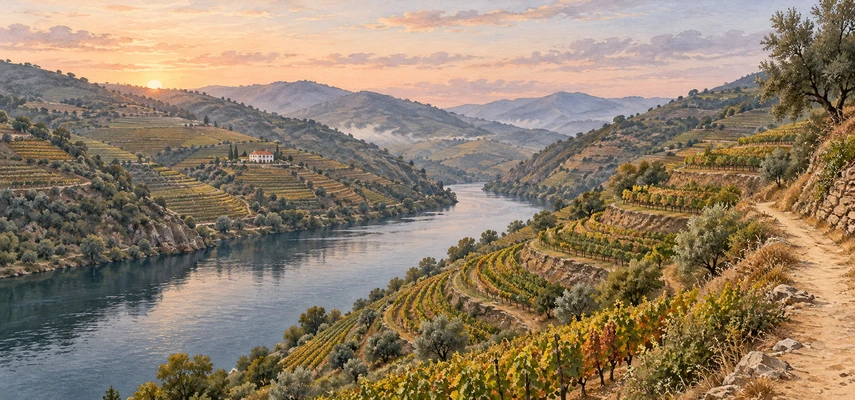

Vinho Verde and the Douro show how much can change within northern Portugal. Atlantic moisture helps frame one discussion; sheltered inland valleys and summer water stress shape the other. Both regions contain varied sites, local grapes and wines that deserve more than a two-word description.
For Diploma study, begin by separating origin from style. Vinho Verde isn’t a rule that every wine must be pale, low in alcohol and lightly fizzy. Douro doesn’t mean every bottle is Port. Their still wines offer useful comparisons of vineyard management, fermentation, blending, quality and commercial ambition.
Locate Vinho Verde and its internal differences
Vinho Verde occupies Portugal’s Atlantic northwest, where river valleys allow maritime influence to travel inland. The regional commission’s soils and climates account explains the interaction of rainfall, generally moderate temperatures and local shelter. Granitic-origin soils are important, alongside areas with other materials. Drainage and rooting matter more usefully than a promise that granite will appear as a flavour.
The DO’s official account identifies nine subregions: Monção e Melgaço, Amarante, Ave, Baião, Basto, Cávado, Lima, Paiva and Sousa. They don’t all receive identical Atlantic influence. Monção e Melgaço has greater shelter and more marked seasonal temperature contrasts than the broad maritime shorthand suggests.
Alvarinho, Loureiro, Arinto, Trajadura, Avesso and Azal provide different white materials and blending possibilities. The commission’s variety account also distinguishes subregional eligibility. Alvarinho is associated particularly with Monção e Melgaço, Loureiro with settings including Lima, and Avesso with inland references such as Baião. Association doesn’t mean a grape can never appear elsewhere under the applicable rules.
Vinhão and other red varieties remind us that the regional name doesn’t specify colour. More structured reds and rosés belong in the discussion alongside whites. Blending can combine complementary material, while varietal bottlings can emphasise a particular grape and site. Neither approach is inherently a higher quality category.
Explain Vinho Verde’s vineyard response
Temperature affects growth, ripening and acid retention. Sunlight supports photosynthesis, while aspect and bunch exposure change fruit conditions. Water availability depends on rainfall, soil depth, drainage and rooting; high annual rain doesn’t guarantee suitable root conditions throughout the season. Nutrient availability influences vigour and crop balance, with excessively vigorous growth potentially shading fruit and retaining humidity.
Weather creates frost, hail, heat, drought and harvest-rain risks in differing local combinations. Downy and powdery mildew and bunch rot need monitoring where moisture persists. Vineyard establishment considers exposure, drainage, access and training. Planting materials should match variety, soil and water conditions. Raised or upright training choices need to be understood through airflow, canopy organisation, labour and practicality rather than one picturesque regional image.
Nutrient and water management follows observation and analysis within applicable rules. Canopy management balances productive leaf area, airflow and fruit protection. Harvest timing balances flavour, sugar, acidity and health, with different aims for a light blend and a fuller selected-parcel wine. Hazard management includes drainage, erosion control and appropriate frost precautions. Pest and disease management combines monitoring, canopy work and proportionate intervention. Rainfall supports growth and can create work at the same time.
Give Vinho Verde more than one cellar destination
The commission’s wine-profile account distinguishes lighter fresh wines, sometimes with a little carbon dioxide and sweetness, from fuller and more ambitious white styles. Some examples use barrels or bottle development. Regional freshness doesn’t require every wine to be identical or suitable only for immediate drinking.
For an early-release white, prompt fruit handling, controlled fermentation and oxygen management can preserve delicate fruit and freshness. A more selected programme may use lees or another maturation route to build texture. Assess the resulting balance rather than assuming either a slight spritz or a fuller palate proves quality. Carbon dioxide, retained sugar and alcohol should be evaluated in the actual bottle.
Alvarinho isn’t a shortcut to a predetermined grade, and a Loureiro blend isn’t necessarily a lesser wine. Site, crop, fruit health, pressing, fermentation and condition can change the outcome. A category’s typical appeal helps choose a comparison; it doesn’t replace tasting it.
Locate the Douro beyond the Atlantic barrier
The Douro lies inland in northeastern Portugal, within the river basin and its tributary valleys. Mountain shelter reduces Atlantic influence, with broad differences between Baixo Corgo, Cima Corgo and Douro Superior. The national wine institute’s regional account describes increasingly dry, inland conditions moving upstream. Elevation and aspect still complicate that overall pattern.
Schist-influenced slopes, terraces and varied exposures create demanding vineyard environments. The IVDP’s regional account places those physical differences alongside fragmented holdings and access constraints. A low warm parcel and a higher exposed one can supply different fruit even within the same subregion. Don’t describe all Douro grapes as products of one valley-floor temperature.
Touriga Nacional, Touriga Franca, Tinta Roriz, Tinta Barroca, Tinto Cão and Sousão supply important red references. The IVDP’s variety account identifies their differing material, with Tinta Roriz the Portuguese name associated with Tempranillo. Rabigato, Viosinho, Malvasia Fina and other whites provide another side of the region. No list of principal grapes establishes the exact blend of a particular bottle.
Old mixed plantings and separately managed varieties create different harvest and blending opportunities. A mixed parcel can preserve useful diversity while making ripeness assessment and coordination more complicated. Old vines and a long list of varieties don’t automatically create complexity if fruit condition or cellar execution fails.
Connect Douro vineyard decisions with still-wine aims
For Douro vineyards, temperature and sunlight vary with elevation, aspect and shelter. Water availability and nutrient availability depend on rainfall, rooting, soil depth and drainage. Weather can bring heat, drought, hail, frost in vulnerable locations and disruptive harvest rain; downy mildew, powdery mildew and bunch rot remain possible. Vineyard establishment considers terrace stability, erosion, access and training, while planting materials need to suit site and water conditions. Nutrient and water management, canopy management, harvest timing, hazard management and pest and disease management should preserve healthy, balanced fruit for the intended wine.
Terrace layout and planting direction affect mechanisation, worker access and erosion control. They also require construction and maintenance. A slope that looks magnificent in a photograph may have a rather less glamorous labour bill. Compare workable systems and actual soil protection instead of assuming older or steeper always means better wine.
Harvest decisions for a dry still wine need their own balance of sugar, acidity, flavour and tannin. Port and Douro wines may draw on shared regional material, but they’re distinct products. A Port production allocation or vineyard classification shouldn’t be presented as an automatic sensory grade for every still red. The detailed fortified-wine route belongs in the later Port chapter.
Compare fermentation, maturation and finishing
Winemaking approaches begin with the target style in both northern regions. Careful grape transportation limits crushing, oxidation and unwanted fermentation. Reception should separate origins, varieties, health and ripeness. Processing and pressing affect yield and phenolic pickup. Vinho Verde whites need juice handling suited to their intended freshness or texture; Douro reds require extraction appropriate to the actual skins and seeds.
Pre-fermentation clarification adjusts white-juice solids for the intended fermentation. Must adjustments require analysis and legal permission. Alcoholic fermentation decisions include yeast, temperature, vessel and nutrient management. Extraction and pressing should suit skin and seed maturity in reds. Malolactic conversion and subsequent maturation should fit acidity, texture and microbial stability. A light white and a structured dry red don’t share a compulsory production programme merely because both come from northern Portugal.
The IVDP’s still-wine production account describes lagar and temperature-controlled tank routes. A lagar is a broad, shallow vessel associated with traditional extraction; its use doesn’t itself make the wine fortified. Equally, stainless steel doesn’t guarantee a light style or greater elegance. Cap management, temperature, duration and fruit condition remain important within either route.
Lees maturation can build texture in suitable Vinho Verde or Douro whites, with oxygen and microbiological condition monitored. Wood maturation can help some reds and whites develop, while vessel age, size and time affect flavour contribution. Blending eligible lots can improve balance while preserving origin and category entitlement. A producer may combine varieties, parcels or maturation lots; those are different blending decisions, not proof the wine lacks identity.
Finishing adjustments, sulfur dioxide and filtration depend on analysis and stability needs. Post-fermentation clarification removes unwanted material; stabilisation considers protein and tartrate risks. Microbiological safeguards should fit analysis, retained sugar and distribution. Packaging and closures should protect the intended drinking period. Wine transportation requires suitable temperature management, including storage and the final delivery leg. A fresh wine can lose its selling point after a technically sound bottling.
Relate origin, businesses and customers
International and EU protection frameworks, national Portuguese law and local appellation specifications interact. Industry associations and regional bodies communicate origin, while authorised controls establish compliance. A geographical indication links place with prescribed conditions. Vinho Verde and Douro operate within the PDO framework; PGI wines such as regional Minho have separate requirements, and wines without GI cannot borrow protected names. DOC, Reserva, subregion references and grape labels need their actual conditions rather than a generic promise of sensory quality.
Supply depends on healthy fruit, weather losses, permitted yields and stocks held for maturation. Demand differs between fresh Vinho Verde, selected varietal whites, accessible Douro reds and specialist mature wines. Costs include vineyard labour, disease management, terrace maintenance, sorting, temperature control, vessels and finance. Legislation affects sourcing and release choices; currency exchange changes export returns. Early-release stock and a longer-matured wine need different cash-flow planning.
A grower may supply fruit, while an estate can coordinate vineyard and cellar decisions. A broker connects parties; a merchant sources wine or grapes; a winery provides production capacity. A virtual winery contracts production, and a custom crush facility supplies agreed services. A cooperative can share equipment and market access; a conglomerate may coordinate businesses. These are possible functions, not a census claiming equal prevalence in every subregion. Contracts need to reflect traceability, fruit health, delivery and payment risk.
Importing adds freight, compliance and currency exposure. Retail needs clear style, grape and origin information; HoReCa buyers require service training. Direct-to-consumer sales can retain revenue but add hospitality and fulfilment work. Mature and emerging markets contain varied customers. A fuller Vinho Verde may need explanation to someone expecting only a light spritz, just as a dry Douro white can surprise a buyer who associates the region entirely with Port.
Wine brands can lead with producer, place or grape. Marketing concepts begin with a target customer; marketing options include comparative flights, technical notes and vineyard visits. The five Ps connect product, price, people, place and promotion. A useful regional story explains the wine’s purpose and actual evidence of quality rather than assigning a grade from the landscape.
Compare the evidence here with Dão and Bairrada as a regional case, then apply the regional comparison framework to the comparison. Compare growing conditions, production decisions, style, quality and the commercial reasons for price. Establish the differences rather than assuming that one familiar name must be better.
Original Diploma practice
These original exercises practise explanation and evaluation. They aren’t official examination questions, marking schemes or accounts of actual bottles tasted.
Question 1: compare two northern vineyard plans
Compare vineyard decisions for a humid Vinho Verde parcel and a warm, dry Douro slope intended for still wine.
Reasoned outline: Compare temperature, water, soil, rooting and exposure. Explain airflow, disease monitoring, heat protection, erosion control, access and harvest timing. Connect fruit condition with the intended cellar programme and costs. Regional contrast needs the actual parcel and season, rather than an assumption that one always has too much water and the other none.
Question 2: assess a Vinho Verde buying rule
A buyer rejects every fuller or matured Vinho Verde because the name must mean low-alcohol, lightly fizzy white wine. Evaluate the rule.
Reasoned outline: Establish protected origin and the range of colours, varieties and styles. Compare fruit selection, fermentation, lees, vessels and bottle condition. Assess balance and the intended customer instead of treating one familiar commercial profile as the entire designation. A broader regional identity doesn’t remove the need to explain the particular bottle.
Question 3: evaluate a Douro cellar claim
A producer says that lagar fermentation, old mixed vines and more new oak guarantee outstanding dry Douro quality. Assess the claim.
Reasoned outline: Explain fruit health and ripeness, crop variation, extraction, fermentation control and blending. Consider retained fruit, tannin integration and maturation cost. Distinguish vessel choice from fortification and legal origin from sensory quality. Recognisable traditions still need effective execution and a suitable market.
Analytical tasting preparation: compare northern Portugal
The official recommended-sample programme, printed page 23, includes Vinho Verde at good quality and a Douro red at very good or outstanding quality. Its broader Portuguese white selection asks for local and/or international varieties at good or very good quality; a suitable additional northern white can support that row if the actual bottle fits. Neither the origin nor the price automatically establishes the required quality. More selected Vinho Verde comparisons are additional study opportunities, not invented separate compulsory rows.
Write full systematic descriptions blind. Justify quality through balance, length, intensity and complexity using actual fruit, structure and development evidence. Assess bottle-ageing suitability separately, distinguishing refreshing immediate appeal from material likely to develop together. High acidity, strong tannin and obvious wood aren’t substitutes for retained fruit and integration. These are proposed selections and methods, not actual tasting results or official bottle grades.












