










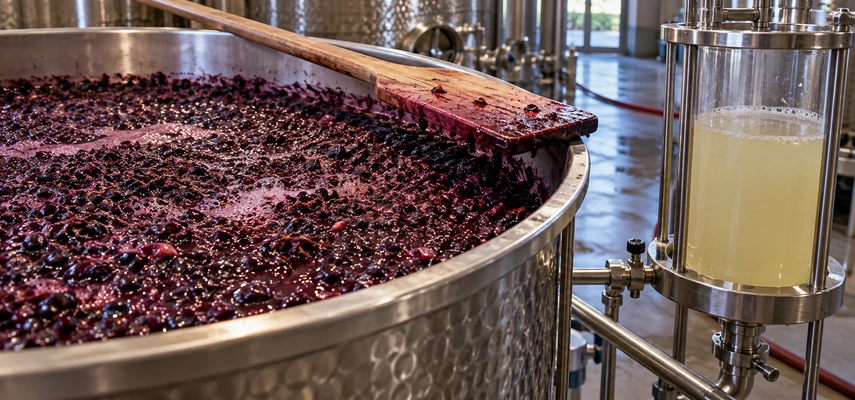

The colour of a grape doesn’t have to be the colour of its juice. That is the first useful surprise in understanding wine production. The second is that fermentation is doing two jobs at once: consuming sugar and producing both alcohol and a gas.
How wine is made becomes much easier to follow once those ideas are separated. Fermentation changes the juice chemically. Contact with grape skins changes the colour and texture available to the wine. White, red and rosé production arrange those processes differently.
What WSET Level 1 expects you to know
Learning Outcome 1 in the official Issue 1.2 specification requires the ingredients and products of alcoholic fermentation, plus the ordered stages of still white, red and rosé production. These are assessment criteria 4–5.
Learn sugar plus yeast, producing alcohol and carbon dioxide. Then connect each production sequence with its grapes and skin contact. Advanced machinery, fermentation chemistry and specialist techniques aren’t needed here. This independent TFE lesson isn’t official WSET teaching material; the questions below are original.
Fermentation: what yeast does with sugar
Yeast is a microorganism that can ferment sugar. In grape juice, that process produces alcohol and carbon dioxide. The alcohol remains an essential part of the wine; the gas generally escapes during ordinary still-wine fermentation.
The requirements aren’t “alcohol and grapes.” Alcohol is a product, while sugar is an ingredient. Reversing that relationship makes the process sound as though a winery pours alcohol into every fermentation tank. Ordinary wine obtains its alcohol through fermentation rather than fortification.
UC Davis’s overview of grape-juice fermentation explains sugar conversion by yeast. There is complicated chemistry underneath, but the beginner’s model is sufficient: yeast uses grape sugar, and alcohol and carbon dioxide result.
More starting sugar provides more potential alcohol if fermentation consumes it. Some wines retain sugar, so not every fermentation ends with the same balance. The point is to understand why sweet grapes can become dry wine: their sugar has changed into other substances.
Crushing and pressing aren’t the same action
Crushing breaks open grapes and releases juice. Pressing separates liquid from solid grape material by applying pressure. The two words belong to related operations, but they answer different questions: opening the berry versus separating the liquid.
Imagine gently breaking a berry so its juice can escape, then squeezing the wet material to collect more liquid. This is an explanatory comparison, not a recipe for making wine at home. In a winery, equipment performs those functions at an appropriate scale.
The timing of separation matters because skins contain colour and tannin. Juice separated early has a different opportunity to extract those ingredients than juice fermented together with the skins. That relationship is the backbone of the colour comparison.
White wine: separate the juice before fermentation
For the prescribed Level 1 still-white sequence, start with white grapes. The order is crushing, pressing, fermentation, maturation and bottling. Pressing comes before fermentation, so the juice ferments after separation from the grape solids.
Maturation is the period after fermentation when the wine is held and may develop before bottling. It doesn’t automatically mean new oak barrels. Wine can be held in vessels that don’t give obvious oak flavours. Bottling then puts the finished wine into its familiar package.
The important ordering fact is not whether the winery looks rustic or modern. It is that pressing occurs before fermentation in this introductory white-wine model. A photograph of a wooden barrel doesn’t tell the entire production story.
Some white wine can be made from black grapes by avoiding substantial colour extraction. That is useful context, supported by WSET’s explanation of wine colour, but the specification’s basic still-white sequence uses white grapes. Learn that prescribed starting point first.
Red wine: ferment with the skins
For red wine, start with black grapes. In wine vocabulary, black grapes include the dark red, purple and blue-black berries that may look simply purple in a fruit bowl. Their skins supply the red-wine colour.
The prescribed order is crushing, fermentation, draining, pressing, maturation and bottling. Fermentation occurs with the skins present. That contact allows extraction of colour and tannin before the wine is separated from the grape solids.
Draining removes liquid that can flow away from the solids. Pressing recovers additional liquid from the wet grape material. They aren’t two spellings for the same operation, and the sequence includes both. A memory aid is to follow what happens to the skins: they stay during fermentation and are separated afterward.
Tannin contributes drying grip rather than sugary sweetness. Red wine can therefore be fruity, dry and noticeably tannic at the same time. Those descriptors concern different features. Skin contact helps explain why comparing only the sweetness of red and white wines misses much of the production difference.
Rosé: black grapes, less colour extraction
Rosé is pink wine, but the simple explanation isn’t “half red wine and half white wine.” A common approach uses black grapes and a short period of skin contact, enough to extract some colour without following the red-wine pattern to the same extent.
The specification gives an intentionally compressed rosé sequence: crushing, fermentation, draining, maturation and bottling, starting with black grapes. Retain that order for syllabus recognition. It doesn’t describe every individual cellar decision or every rosé technique used commercially.
In practical short-contact production, the pink juice is separated from the skins early, and fermentation can continue after that separation. Therefore, don’t interpret the specification’s simplified “fermentation, draining” wording as an instruction to complete an entire red-style fermentation before removing skins. The key difference is limited contact and lighter colour extraction.
Other rosé methods exist, including particular blending practices, but they aren’t needed to understand the Level 1 model. Keeping the main method clear is more useful than collecting exceptions before the basic sequence has settled.
Put the three sequences side by side
| Wine | Prescribed grapes | Ordered Level 1 stages |
|---|---|---|
| White | White grapes | Crushing → pressing → fermentation → maturation → bottling |
| Red | Black grapes | Crushing → fermentation → draining → pressing → maturation → bottling |
| Rosé | Black grapes | Crushing → fermentation → draining → maturation → bottling |
These are study sequences, not copied production diagrams. The rosé line is the specification’s condensed model and needs the short-contact explanation above. In every case, bottling comes after maturation, and fermentation changes sugar into alcohol rather than merely changing grape colour.
The table also shows why pressing cannot be given one universal position for every wine. In the white sequence it precedes fermentation. In the red sequence it follows fermentation and draining. That difference is more useful to remember than the appearance of a particular machine.
Follow one hypothetical batch through the winery
Take pale juice and let yeast ferment it away from the skins. There is sugar conversion, but little opportunity to extract dark skin colour. Now imagine dark grape skins staying with the juice through red-wine fermentation: the chemical conversion still occurs, while skin contact adds another process.
These two changes happen together but aren’t identical. Fermentation produces alcohol; extraction transfers compounds from grape material into the liquid. Yeast doesn’t paint the wine red. Keeping those jobs separate makes the production sequence a cause-and-effect story rather than an arbitrary list.
Similarly, carbon dioxide production doesn’t mean every finished wine will be sparkling. A still-wine fermentation normally lets the gas escape. Sparkling production retains or introduces dissolved carbon dioxide under the relevant method. Detailed sparkling techniques belong to another lesson.
Common misconceptions and exam traps
Don’t list alcohol as a fermentation requirement. Don’t call carbon dioxide a type of grape sugar. Don’t assume pressing and crushing are interchangeable, or that red wine receives its colour from red juice alone.
Rosé isn’t automatically sweet; pink is a colour, not a sugar measurement. Maturation doesn’t require oak, and bottling doesn’t cause fermentation in every wine. Learn each process for what it does instead of attaching a familiar wine word to every stage.
If a question asks for an ordered sequence, follow the prescribed model. If it asks why red and rosé differ, explain skin contact and extraction. Those are related answers, but they aren’t interchangeable tasks.
Rebuild the order from the purpose
If the sequence slips from memory, ask where the skins should be while sugar is fermenting. For the basic white model, the juice has already been pressed away from solids. For red, the skins remain with the fermenting material before draining and pressing. Understanding that purpose gives the sequence an internal logic.
Then keep the final stages distinct. Maturation is time in a suitable vessel after fermentation; bottling is packaging later. Neither word means growing grapes, and neither automatically introduces additional alcohol. A producer might use several vessels or choices commercially, but those details shouldn’t obscure the specified beginner order.
Knowledge check: 10 original questions
1. Which pair is required for alcoholic fermentation in the Level 1 model?
- Sugar and yeast
- Alcohol and cork
- Carbon dioxide and oak
- Tannin and glass
2. Which pair results from alcoholic fermentation?
- Cork and oxygen
- Alcohol and carbon dioxide
- Sugar and yeast
- Skin and pulp
3. In the prescribed white-wine sequence, when does pressing occur?
- After maturation
- Only after red-wine blending
- Before fermentation
- After bottling
4. In the prescribed red-wine sequence, fermentation takes place with what?
- Only bottle labels present
- All skins already removed by white-style pressing
- Finished corks dissolving
- Black grape skins present
5. Which operation breaks grapes open to release juice?
- Crushing
- Bottling
- Maturation
- Labelling
6. Which comes immediately after draining in the prescribed red sequence?
- Bottling
- Pressing
- Crushing
- Flowering
7. Which grape colour begins the prescribed basic rosé model?
- Only brown dried grapes
- No grapes
- Black grapes
- Only white grapes
8. What is the main colour-related difference in common short-contact rosé production?
- No sugar exists
- Alcohol is always added
- Only blending equal red and white is permitted
- Less skin contact than the red-wine model
9. Does maturation necessarily mean new oak barrels?
- No, other suitable vessels can be used
- Yes, by definition
- Yes, but only for rosé
- No, maturation means flowering
10. Why is ordinary still wine not necessarily bubbly after fermentation?
- Bottles absorb all alcohol
- The fermentation gas generally escapes
- Yeast produces no gas
- Its grapes contain no sugar
Answers and explanations
1. A — Sugar and yeast. Sugar is the substrate and yeast performs the fermentation.
2. B — Alcohol and carbon dioxide. Yeast converts fermentable sugar into alcohol and carbon dioxide.
3. C — Before fermentation. The basic still-white model separates juice through pressing before fermentation.
4. D — Black grape skins present. Skin contact during fermentation helps extract red colour and tannin.
5. A — Crushing. Crushing opens berries; pressing is the distinct operation that separates liquid from solids.
6. B — Pressing. The red sequence is crushing, fermentation, draining, pressing, maturation and bottling.
7. C — Black grapes. Black grape skins provide the limited colour extracted for the basic rosé example.
8. D — Less skin contact than the red-wine model. Short skin contact allows some pink colour without full red-style extraction.
9. A — No, other suitable vessels can be used. Maturation is a stage after fermentation and does not require new oak.
10. B — The fermentation gas generally escapes. Carbon dioxide is produced, but ordinary still-wine fermentation generally lets it escape.
One-page revision summary
Sugar + yeast → alcohol + carbon dioxide. Crushing opens grapes; pressing separates liquid from solids. White wine is pressed before fermentation in the basic model. Red wine ferments with black grape skins, followed by draining and pressing. Rosé uses black grapes with limited skin contact; learn the specification’s condensed sequence without mistaking it for a complete cellar manual.












