










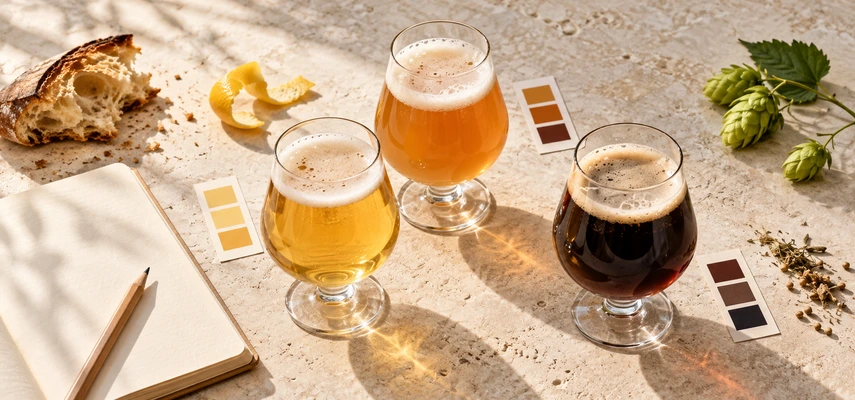

A beer can smell like grapefruit without containing grapefruit. Another can suggest toast without anyone dropping breakfast into the tank. Learning how to understand and describe beer begins with separating what a drink reminds you of from what actually went into it. Once that distinction clicks, a glass becomes easier to read.
This is Article #1 of The TFE Guide to WSET Level 1 Beer, an independent study series without WSET affiliation or endorsement. We’ll build a useful vocabulary first, then connect those observations to ingredients and brewing. You don’t need an expensive tasting kit, a collection of rare bottles, or an ability to detect seventeen different kinds of biscuit.
Understand beer by following its ingredients
Beer is a fermented drink made from grain-derived sugars, usually with hops. Its familiar foundations are malt, water, hops and yeast. Malt is grain that has been encouraged to begin growing and then dried; barley is a common starting point. Other grains and sugar sources can join the recipe, so the four ingredients are a starting framework rather than a rule banning everything else.
Each ingredient has a job. Malt supplies material for fermentation as well as color and flavor. Water provides the liquid environment. Hops contribute bitterness and aromas. Yeast transforms fermentable sugar into alcohol and carbon dioxide, while producing flavor compounds of its own. WSET’s ingredient introduction provides a useful foundation for connecting a beer’s recipe to its sensory character.
The missing link between grain and fermentation is mashing. Brewers mix crushed malt with hot water so enzymes can convert starch into sugars. The resulting sugary liquid is called wort. It is separated from the grain, boiled, then cooled before fermentation. That sequence explains why brewing involves more than putting dry barley in water and waiting. Cicerone’s brewing overview connects these essential steps.
Think of two dials: ingredients and treatment. Changing the malt changes the available colors and flavors; changing the yeast changes fermentation character. Temperature, timing and handling also influence the outcome. A recipe lists the materials, but the process tells you what happens to them. Later articles turn those dials one at a time.
Describe beer before trying to name it
A beer style is a recognizable pattern of ingredients, production choices and sensory characteristics. It helps set expectations, rather like a musical genre. Knowing that a recording is jazz offers clues; it doesn’t tell you every note. Similarly, a style name narrows the possibilities without making all examples identical.
At Level 1, the official syllabus organizes prescribed styles around malt, hops, yeast and sourness. These are teaching categories, not sealed compartments. A hop-driven beer still has malt, and a yeast-driven beer can also be bitter. We’ll examine the specified styles in later chapters rather than trying to memorize their entire family tree here.
For now, observation comes before identification. Write “amber, clear, toasty, moderately bitter” before deciding which style fits. This keeps the label from doing your thinking. Cicerone’s guide to beer evaluation explains how starting with individual observations can complement studying a style’s expected characteristics.
Start with appearance: color, clarity and foam
Look at the beer against a plain, light background. Describe color separately from clarity. A beer can be pale and hazy, or dark and clear. Words such as straw, gold, amber, brown and black give a useful starting range. Clarity asks a different question: how easily can you see through it?
Next, notice the foam, often called the head. Record what is present without treating a large head as an automatic quality medal. Pouring and glass conditions influence presentation, so compare samples under similar conditions. WSET’s practical tasting guidance treats color, clarity and foam as separate observations.
The important restraint is to stop sight from making unsupported promises. Dark doesn’t automatically mean strong. Hazy doesn’t automatically mean faulty. Appearance supplies clues to investigate with the other senses. If the glass looks like coffee, write down the color; don’t award it coffee flavor before smelling it.
Aroma: turn “beery” into something useful
Smell before taking a sip. Start broadly: grain-like, fruity, floral, spicy or roasted? Then get more specific if something recognizable appears. “Citrus” is already useful; “grapefruit peel” is an optional refinement. A familiar, accurate word beats a flamboyant guess.
Some malt aromas recall bread or caramel, while hops can suggest flowers, herbs or fruit. Fermentation can also create fruity or spicy impressions. That means a fruity aroma alone doesn’t identify its source. Your first task is description; explaining the cause comes next. Familiar kitchen aromas can help build reference points without requiring a drink in your glass.
An aroma comparison is also different from an ingredient claim. “Smells like chocolate” reports a resemblance; “contains chocolate” reports a recipe fact. The distinction matters when recommending beer, particularly if someone asks about ingredients. Verify the producer’s information rather than translating a tasting note into an ingredient list.
Flavor: separate sweetness, bitterness and aroma
Flavor brings taste and smell together. Sweetness and bitterness are tastes; many impressions we casually call flavors depend on aroma. A beer can smell fruity while tasting quite dry. Conversely, describing something as “malty” doesn’t tell a reader exactly how sweet it is. Give those observations their own words.
Take sweetness and bitterness separately, then consider how they sit together. Does sweetness remain noticeable? Is bitterness restrained, moderate or strong? Avoid turning either into a quality score. Someone else’s enjoyable bitterness can be more than you want, and that preference doesn’t make your observation wrong.
Food offers an easy comparison: an unsweetened drink may have a rich aroma without tasting sugary. Beer deserves the same separation. Instead of “sweet citrus beer,” a clearer note might be “citrus aroma, little sweetness, firm bitterness.” The second version tells the next reader which sensation belongs where.
Also notice the finish: what remains after the sip, and for how long? Cicerone explains why a glass helps by giving your nose access to aromas before and during drinking. A container that hides those aromas leaves part of the flavor experience out of reach.
Body and carbonation: what beer feels like
Body is the impression of weight or fullness in the mouth. Light-bodied beer feels comparatively slender; full-bodied beer feels more substantial. It isn’t a synonym for darkness, sweetness or alcohol strength. Those features may interact, but describing one doesn’t measure all the others.
Carbonation is the dissolved carbon dioxide that gives beer its fizz. Assess it independently: low, medium or high is enough to begin. Fermentation produces carbon dioxide, but brewers can also add it during carbonation. Producing gas and retaining enough dissolved gas for the finished beer are related, distinct matters. The Brewers Association’s beer-and-food course explains these carbonation routes.
Body and carbonation belong within mouthfeel, alongside sensations such as alcohol warmth or a drying texture. The BJCP’s discussion of beer characteristics makes that distinction useful: mouthfeel describes physical sensations as well as weight. A beer can therefore be light-bodied and highly sparkling. “Light” doesn’t necessarily mean “quiet.”
An optional comparison that trains attention
If you choose to taste alcohol, compare small samples of two contrasting beers in similar clean glasses. Follow local drinking-age rules. This is an optional learning activity, not an examination requirement. You can instead compare published descriptions or practice naming familiar food aromas without drinking beer.
Give both samples the same questions. Observe appearance, identify one or two aromas, distinguish sweetness from bitterness, then assess body and carbonation. Keep the setting free of strong odors. WSET’s palate-preparation advice explains how surroundings and expectations can influence sensory attention.
Here is a hypothetical note-taking example, not a report of beers we tasted:
| Observation | Sample A | Sample B |
|---|---|---|
| Appearance | Clear gold | Hazy amber |
| Aroma | Bread-like | Citrus-like |
| Sweetness and bitterness | Low sweetness, low bitterness | Low sweetness, stronger bitterness |
| Feel | Light body, lively fizz | Fuller body, gentler fizz |
The table separates observations without forcing a style diagnosis. Now hide the sample names and describe the biggest difference in one sentence. If that sentence helps another person imagine the contrast, the exercise has worked. There is no prize for the longest note.
What the WSET Level 1 Beer exam requires
The qualification covers ingredients and production, specified beer styles, and storage, service and pairing. The official Issue 1 specification sets out a closed-book examination containing 30 multiple-choice questions in 45 minutes. Each has one correct answer worth one mark. There is no negative marking, and the published pass threshold is 21 out of 30, or 70%.
The distribution is 13 questions on ingredients and production, 13 on styles, and four on storage, service and related principles, including pairing. Descriptive tasting supports learning, but there is no separately graded blind-tasting examination. People who choose not to consume alcohol can still complete the qualification. See the qualification information for course arrangements through approved providers.
Use that weighting to guide study without ignoring the smaller section. For ingredients, connect each material to its purpose. For styles, compare the characteristics that distinguish them. For service, faults and pairing, connect an action to its likely consequence. Understanding why gives memory something sturdier to hold onto than a stack of isolated labels.
One-page revision summary
Keep four distinctions clear: aroma resemblance isn’t proof of an added ingredient; color and clarity are separate; sweetness and bitterness deserve separate descriptions; body and carbonation describe different aspects of mouthfeel. Work from observation toward explanation, then toward style identification.
The aim is a short, useful description backed by a reason. “Gold, clear, bread-like, lightly bitter and lively” is a solid beginning. As the series develops, you’ll learn which ingredient and production choices make such a combination plausible. For now, noticing the differences is the skill to carry forward.
Knowledge check: 12 original practice questions
These are independent TFE practice questions, not official WSET questions. Choose one answer for each. The introductory vocabulary questions support later style study; they aren’t a claim that every sensory term is a separately listed assessment requirement.
1. Which ingredient converts fermentable sugar into alcohol during fermentation?
- Malt
- Yeast
- Hops
- Water
2. What is the main purpose of mashing in the process described here?
- Dissolving carbon dioxide into beer
- Developing yeast aromas after packaging
- Converting grain starch into sugars
- Removing all color from the wort
3. Which note describes clarity rather than color?
- Hazy
- Amber
- Brown
- Gold
4. A beer has a grapefruit-like aroma. What can you conclude from that observation alone?
- Grapefruit was added during boiling
- The beer must taste sweet
- The beer contains grapefruit juice
- Its aroma resembles grapefruit
5. Which term describes a beer’s perceived weight or fullness?
- Clarity
- Body
- Bitterness
- Carbonation
6. Which statement correctly distinguishes fruity aroma from sweetness?
- A fruity aroma always means high sweetness
- The strength of fruity aroma is measured as sweetness
- A beer can smell fruity while tasting dry
- A beer with little sweetness cannot have fruit-like aromas
7. What does carbonation describe?
- Dissolved carbon dioxide and its fizz
- The depth of a beer’s color
- The weight of dissolved malt alone
- The intensity of roasted aromas
8. Which approach best avoids letting a style label dictate your observations?
- Record only the aromas expected for that style
- Use the brewery name as the tasting note
- Decide its strength from its color
- Describe what you observe before identifying a style
9. How many questions in the official 30-question examination address ingredients and production?
- Four
- Thirteen
- Fifteen
- Twenty-one
10. What is the published passing score?
- Eighteen out of thirty
- Twenty out of thirty
- Twenty-one out of thirty
- Twenty-four out of thirty
11. Which statement about Level 1 assessment is correct?
- There is no separately graded blind-tasting examination
- Identifying three unlabeled beers is required to pass
- The tasting examination contributes half the marks
- Every candidate must consume beer to qualify
12. Which note most clearly separates several sensory dimensions?
- Dark, so strong and full-bodied
- Fruity, so sweet and lightly bitter
- Hazy, so faulty and heavily carbonated
- Amber and hazy, with citrus aroma and moderate bitterness
Answers and explanations
1. B — Yeast. Yeast consumes fermentable sugar and produces alcohol and carbon dioxide. Malt supplies material for fermentation; it doesn’t perform fermentation itself. Mapping: LO1, ingredient purpose.
2. C — Starch conversion. Enzymes act during mashing to turn grain starch into sugars. This is distinct from fermentation and from dissolving gas into finished beer. Mapping: LO1, production purpose.
3. A — Hazy. Haze describes how clear the beer appears. Amber, brown and gold describe color, which should be recorded separately. Mapping: introductory sensory vocabulary supporting LO2.
4. D — Aroma resemblance. A smell comparison reports a sensory impression. It doesn’t establish the recipe, the presence of juice, or sweetness. Mapping: introductory sensory reasoning supporting LO1 and LO2.
5. B — Body. Body describes weight or fullness in the mouth. Carbonation concerns fizz, while clarity concerns appearance and bitterness is a taste. Mapping: introductory sensory vocabulary supporting LO2.
6. C — Fruity and dry can coexist. Fruit-like aroma and sweet taste are different observations. Recording them separately avoids assuming that an aroma proves residual sweetness. Mapping: introductory sensory reasoning supporting LO2.
7. A — Dissolved carbon dioxide. Carbonation creates the fizzy sensation associated with dissolved carbon dioxide. It doesn’t measure color, roast character or body. Mapping: LO1 carbonation and introductory sensory vocabulary.
8. D — Observe before identifying. Recording the actual characteristics helps prevent expectations about the label from replacing evidence from the sample. Mapping: introductory comparison method supporting LO2.
9. B — Thirteen. The official distribution is 13 questions for LO1, 13 for LO2 and four for LO3. These add up to 30. Mapping: examination orientation.
10. C — Twenty-one. The published threshold is 70%, equivalent to 21 correct answers out of 30. Incorrect answers do not subtract marks. Mapping: examination orientation.
11. A — No separate blind-tasting grade. The qualification is assessed through its multiple-choice theory examination. Optional tasting can aid learning, but alcohol consumption isn’t necessary to complete the qualification. Mapping: assessment and accessibility orientation.
12. D — Independent observations. This note records color, clarity, aroma and bitterness separately. The other choices infer several characteristics from a single clue. Mapping: introductory sensory reasoning supporting LO2.












