










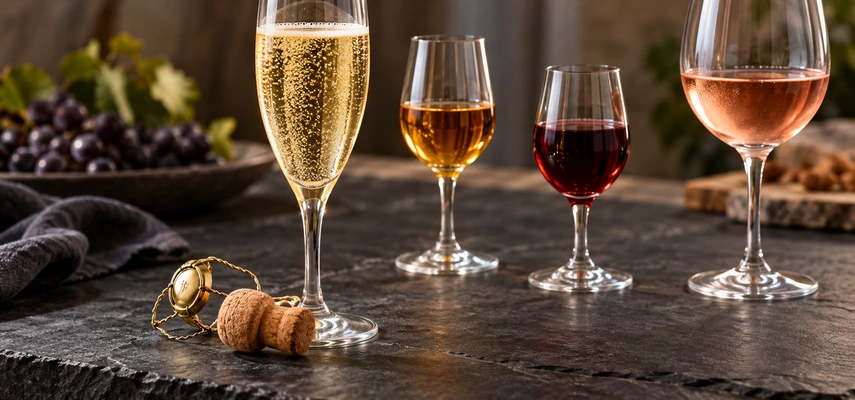

Pink tells you a colour. Bubbles tell you about dissolved gas. Fortified tells you that alcohol was added. Sweet tells you about sugar. Put those words in separate compartments and an intimidating part of the wine shelf becomes much easier to read.
Sparkling, sweet, rosé, and fortified wines explained together also reveal why categories can overlap. Port can be both sweet and fortified. White Zinfandel is usually pink despite its name. Champagne is sparkling, but it isn’t a generic word for every wine with bubbles.
What WSET Level 1 expects you to know
The official Issue 1.2 specification includes Champagne, Prosecco, Cava, Sauternes, White Zinfandel, Sherry and Port in Learning Outcome 2. Champagne also connects to principal grape varieties.
Learn the examples, origins and typical styles, while keeping colour, sweetness, alcohol and wine type separate. Detailed production methods and legal maturation requirements are optional background. This independent TFE guide isn’t WSET-affiliated; its questions are original.
Sparkling wine: why the bubbles appear
Sparkling wine contains dissolved carbon dioxide under pressure. When opened and poured, the gas comes out as bubbles. Fermentation can produce that carbon dioxide, but ordinary still-wine production generally allows the gas to escape instead of keeping it in the finished wine.
Bubbles don’t establish sweetness. Sparkling styles can range from dry to sweet, and the named examples below commonly appear in dry styles. The wine’s sugar and its dissolved gas are different characteristics.
WSET’s sparkling-wine overview explains the main production families. For Level 1, it is more useful to recognize the three prescribed names than to memorize a detailed flowchart of every method.
Champagne: a French origin with principal grapes
Champagne comes from the Champagne region of France. Chardonnay, Pinot Noir and Meunier are its principal grapes. Chardonnay and Pinot Noir are among the eight varieties studied elsewhere in this series; Meunier is additional useful context for the named wine.
Champagne can be white or rosé and is commonly dry. It often combines refreshing acidity with fruit and, in many examples, bread-like or toasty character developed through production. These are typical descriptions rather than requirements that every bottle smell exactly like toast.
White Champagne can include black grapes because dark skins don’t require dark juice. Limiting colour extraction allows pale wine production from varieties such as Pinot Noir. This connection links the featured example back to the grape-anatomy lesson rather than introducing a mysterious exception.
The regional name matters. A sparkling wine made elsewhere doesn’t become Champagne merely because it is expensive or uses a related method. Place and method are connected information, but they aren’t identical.
Prosecco: an Italian sparkling reference
Prosecco is an Italian wine associated with the Glera grape. The familiar sparkling style is typically fresh and fruity, often suggesting apple, pear or floral character. It commonly has less obvious bread-like character than a traditional-method example with substantial lees ageing.
Don’t read extra sweetness from the fruit aromas. Styles vary in sweetness, and the label’s terms need their own interpretation. The Level 1 anchor is the Italian sparkling example, not a promise that every Prosecco is sweeter than every Champagne.
Some less-sparkling or still forms exist within the wider Prosecco family, but the prescribed study example here is sparkling. Learn the main reference first while avoiding a universal claim about every permitted product.
Cava: a Spanish sparkling reference
Cava is the Spanish sparkling example. The familiar style is often dry, fresh and made by a bottle-fermentation method that can develop bread or toast notes. That method doesn’t make it Champagne because its origin is different.
There is no need at this level to memorize every permitted Cava grape. The important distinction is Spain–Cava, compared with Italy–Prosecco and France–Champagne. All three are sparkling examples, but they aren’t regional synonyms.
If a question asks which is Spanish, answer the origin task. If it asks what they share, sparkling wine is the useful category. A statement can be true at one level of comparison without making every aspect of the wines identical.
Sauternes: sweet white wine, not fortified
Sauternes is a French sweet white wine from Bordeaux. It is associated particularly with Sémillon and Sauvignon Blanc, with Sémillon important to the classic style. Typical flavours can suggest honey, dried apricot and ripe fruit, balanced by acidity.
Noble rot can help concentrate the grapes used for these wines. That is useful enrichment rather than an invitation to memorize the fungus’s biology. The essential classification is sweet white wine; its sweetness doesn’t mean it has had alcohol added.
Sauternes therefore makes an excellent contrast with Port. Both can be sweet, but Port is fortified while Sauternes is not. Sweetness answers a sensory question; fortification answers a production question.
White Zinfandel: the name is the trap
White Zinfandel is commonly a pink rosé wine made from the black Zinfandel grape, especially associated with California. The familiar style is light-bodied, fruity and medium-sweet or sweet, with red-fruit character.
The word White doesn’t turn it into a Chardonnay-like white wine. Learn the actual style rather than interpreting the name one word at a time. Pink colour comes from limited skin contact, while sweetness concerns the wine’s remaining sugar.
Not every rosé is sweet. White Zinfandel supplies one named sweeter reference, not a definition for the entire colour category. A dry rosé and a sweeter White Zinfandel can both be pink while offering different experiences.
Fortified wine: additional alcohol is the defining step
Fortification means adding alcohol to wine or fermenting grape material. The timing can influence whether natural grape sugar remains. This helps explain why fortified examples can differ substantially in sweetness as well as colour and flavour.
Their alcoholic strength is generally higher than ordinary still table wine, but strong-tasting doesn’t prove fortified. A robust dry red produced by fermentation alone is a different production case.
Port and Sherry provide the prescribed examples. Learning them together is useful only if their differences survive the comparison. They aren’t simply two labels for dark, sweet after-dinner wine.
Port: sweetness and fortification together
Port comes from Portugal’s Douro region. Fortification during fermentation stops yeast activity while substantial sugar remains, producing the familiar sweet, fortified style. The Port regulator’s introduction provides the official foundation.
Red Port styles can show rich berry fruit, while longer wood-aged tawny styles develop different dried-fruit and nut-like character. White and rosé Ports also exist, so Port isn’t exclusively one colour. At Level 1, the core anchor is sweet fortified wine from Portugal.
Notice the cause and effect. The grapes’ sugar hasn’t simply been assumed from a fruity smell; fermentation was interrupted by fortification, leaving sugar in the wine. That is a production explanation for sweetness.
Sherry: a range from dry to sweet
Sherry comes from southern Spain. The fortified style family includes dry examples such as Fino and Oloroso, alongside sweet styles and sweetened blends. Its regional council’s style guide explicitly separates dry, naturally sweet and blended categories.
Classic dry Sherry begins with a dry base wine, so added alcohol doesn’t automatically leave grape sugar behind. Maturation can produce distinctive nutty, yeasty or oxidative character, depending on the style. Those characteristics aren’t automatically evidence of a faulty bottle.
The key comparison is simple: Port is the familiar sweet fortified reference; Sherry may be dry or sweet. Neither sweetness nor brownish colour alone identifies the entire family.
Seven examples in a useful map
| Example | Main study type/style | Origin |
|---|---|---|
| Champagne | Sparkling; commonly dry; white or rosé | France |
| Prosecco | Sparkling reference; fresh/fruity | Italy |
| Cava | Sparkling; commonly dry | Spain |
| Sauternes | Sweet white, unfortified | Bordeaux, France |
| White Zinfandel | Usually sweeter pink rosé | Commonly California, USA |
| Sherry | Fortified, dry through sweet | Southern Spain |
| Port | Sweet fortified, several colours/styles | Douro, Portugal |
Common misconceptions and exam traps
Not all sparkling wine is Champagne. Sauternes isn’t fortified just because it is sweet. White Zinfandel is a pink reference despite its name. Sherry isn’t always sweet, and Port isn’t restricted to red.
Don’t use bubbles, colour, sugar and added alcohol as interchangeable clues. Identify which property the question asks about, then connect it to the named example. That approach makes an overlapping classification system manageable.
Classify a bottle in more than one dimension
Take familiar red Port as a thought experiment. Type: fortified. Colour: red. Sweetness: sweet. Origin: Portugal. Those four answers fit together, and none makes the others unnecessary. Now replace it with dry Fino Sherry: fortified remains the type, while colour, sweetness and origin differ.
This exercise is particularly useful for questions with tempting category errors. An answer can mention a real wine while assigning it the wrong type. Before selecting it, check whether the statement concerns bubbles, sugar, colour, origin or added alcohol. Knowing the names is only half the job; understanding what each name tells you supplies the other half.
Knowledge check: 10 original questions
1. Which sparkling example comes from Italy?
- Prosecco
- Cava
- Champagne
- Port
2. Which sparkling example comes from Spain?
- Chablis
- Cava
- Champagne
- Sauternes
3. Which list contains principal Champagne grapes?
- Only Gamay and Tempranillo
- Only Glera
- Chardonnay, Pinot Noir and Meunier
- Only Riesling and Merlot
4. Which classification best fits Sauternes?
- Dry red, fortified
- Sweet sparkling red
- Always rosé
- Sweet white, unfortified
5. What colour is the familiar White Zinfandel style?
- Pink rosé
- Always white
- Always black
- Always amber Sherry
6. What defines fortified wine?
- The grapes are always white
- Additional alcohol is added
- The wine must have bubbles
- It is served in a small glass
7. Which country is the Port association?
- Italy
- Germany
- Portugal
- Spain
8. Which statement about Sherry is correct?
- All Sherry is sweet
- All Sherry is red
- Sherry is unfortified Champagne
- Dry and sweet styles exist
9. Why is familiar Port sweet?
- Fortification interrupts fermentation with sugar remaining
- Its bubbles create sugar
- Its colour changes into sugar
- Every bottle is sweetened by cork
10. Does sparkling necessarily mean sweet?
- Only Cava must be sweet
- No, sparkling and sweetness are separate features
- Yes, bubbles are sugar
- Only Champagne must be sweet
Answers and explanations
1. A — Prosecco. Prosecco is the prescribed Italian sparkling reference.
2. B — Cava. Cava is the Spanish sparkling reference, distinct from French Champagne.
3. C — Chardonnay, Pinot Noir and Meunier. Champagne’s principal grapes include two of the eight studied varieties plus Meunier.
4. D — Sweet white, unfortified. Sauternes is the French sweet white example; sweetness does not make it fortified.
5. A — Pink rosé. Despite White in the name, the familiar style is a sweeter pink rosé.
6. B — Additional alcohol is added. Fortification is a production step, not a colour or service rule.
7. C — Portugal. Port comes from Portugal’s Douro region.
8. D — Dry and sweet styles exist. The Sherry family includes dry, naturally sweet and sweetened/blended styles.
9. A — Fortification interrupts fermentation with sugar remaining. Added alcohol stops yeast activity during fermentation, preserving natural grape sugar.
10. B — No, sparkling and sweetness are separate features. Dissolved carbon dioxide causes bubbles, while sugar determines sweetness.
One-page revision summary
Champagne–France, Prosecco–Italy and Cava–Spain are the sparkling references. Sauternes is sweet white and unfortified. White Zinfandel is commonly a sweeter rosé. Port is sweet fortified wine from Portugal; Sherry is Spanish fortified wine with dry and sweet styles. Type, colour and sweetness can overlap without meaning the same thing.












