










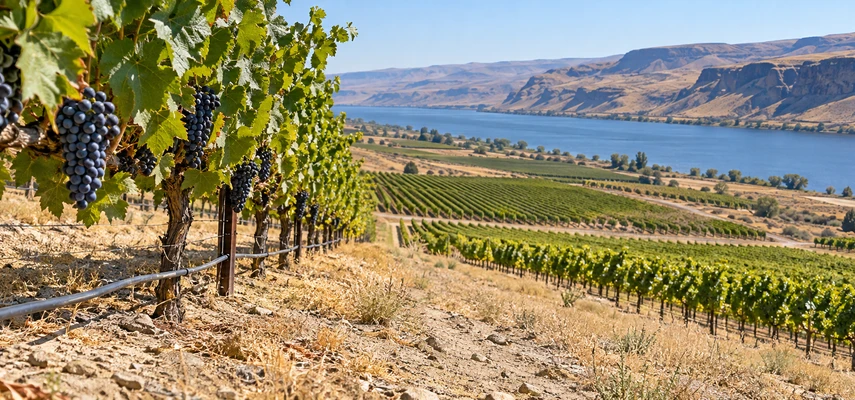

Washington State wines make more sense once you leave Seattle’s weather out of the vineyard plan. Most of the state’s wine grapes grow east of the Cascades, where dry conditions, warm summer days and irrigation are central considerations. A rainy-city stereotype explains remarkably little about a Cabernet parcel near the Columbia River.
The more useful Diploma question is how a particular site supports its chosen grape and wine style. Riesling, Cabernet Sauvignon and Syrah offer different ways into that discussion. Their shared state address doesn’t require the same harvest date, cellar recipe, price or quality conclusion.
Locate Columbia Valley before comparing its smaller regions
Columbia Valley extends across eastern Washington and into northern Oregon. The Wine Commission’s regional profile places it east of the Cascades, with a predominantly continental, arid or semi-arid setting. The AVA is much broader than an individual valley-side vineyard, and it isn’t confined entirely to Washington.
Puget Sound provides a contrasting western maritime reference. Columbia Gorge spans a transition near the Cascade corridor, while Lewis-Clark Valley crosses into Idaho. A winery’s tasting room can also be far from its grape source. Check the vineyard origin before using the weather outside a cellar door to explain the wine.
The current regional inventory includes Yakima Valley, Red Mountain, Horse Heaven Hills, Walla Walla Valley, Wahluke Slope, Ancient Lakes, Royal Slope and other AVAs. Beverly, Washington and the newer Columbia Hills also belong in the current picture. This is a set of geographical distinctions, not a league table, and an older fixed count can quietly become wrong.
Explain the climate and soil through their effects
The Commission’s growing-conditions account describes the Cascade rain shadow, warm eastern summers and cool nights. Long summer daylight supports photosynthesis; cooler nights can help retain acidity. Neither feature cancels heat stress, drought or the limits of a specific variety’s growing season.
Basalt bedrock, flood-deposited materials and windblown loess are useful geological references. Soil depth, texture, drainage and available water affect vine performance. A volcanic history doesn’t mean every root occupies bare basalt, and a rock name doesn’t establish a literal flavour in the finished wine.
Irrigation is important across much of the eastern growing area. It can help manage vine water status, but the existence of a large river isn’t a guarantee of unlimited legal or physical supply. Delivery infrastructure, water entitlement, pumping, soil and seasonal demand belong in the explanation. More control still requires good judgement.
Compare Yakima, warm red-wine sites and Walla Walla
Yakima Valley contains cooler foothill settings as well as warmer locations. Riesling and Chardonnay sit alongside important red varieties. A vineyard intended for a fresh aromatic white therefore needs a more precise explanation than simply calling all Yakima warm or all Washington cool.
Red Mountain and Horse Heaven Hills provide important Cabernet references within a wider range of red-wine growing settings. Exposure, wind, soil and water management help explain particular parcels. Cabernet can develop substantial fruit and tannin, but ripeness and strength don’t establish balance by themselves. A broad Columbia Valley blend can use complementary origins deliberately rather than merely concealing a supposedly inferior address.
Walla Walla Valley crosses Washington and Oregon, with rainfall and terrain changing towards the Blue Mountains. Cabernet Sauvignon, Merlot and Syrah are important references. The Rocks District of Milton-Freewater is on the Oregon side; it isn’t a Washington-only AVA simply because a Washington winery buys its fruit.
Ancient Lakes is a useful Riesling reference, while other inland areas offer their own combinations of heat, elevation and soils. Don’t turn a regional association into a compulsory planting rule. The comparison becomes useful when it explains why the chosen variety, crop level and intended style fit the actual parcel.
Connect grape choice with vineyard decisions
Temperature affects growth, ripening and acid retention. Sunlight supports photosynthesis, while aspect and exposure change bunch temperature. Water availability depends on supply, soil storage, rooting and irrigation decisions. Nutrient availability influences vigour and crop balance. For Cabernet, enough ripening opportunity must accompany a canopy and crop that preserve fruit condition; for Riesling, flavour development and retained acidity need their own balance.
Weather creates frost, hail, heat, drought and harvest-rain risks. Winter cold can damage buds and wood even where summer days are hot. Downy and powdery mildew and bunch rot remain possible where conditions allow; low rainfall doesn’t abolish disease. Vineyard establishment considers exposure, drainage, access, slope and training. Planting materials should match variety, clone, rootstock, soil and water conditions.
Nutrient and water management follows observation and analysis within applicable rules. Canopy management balances productive leaf area, airflow and fruit protection. Harvest timing balances flavour, sugar, acidity, phenolic maturity and health. Hazard management includes erosion control, appropriate frost precautions and access planning. Pest and disease management combines monitoring, canopy work and proportionate intervention.
Those choices change with the objective. An exposed red parcel may need protection from excessive bunch heating; a white programme needs harvest logistics that preserve its intended freshness. Smoke or damaged fruit requires assessment before acceptance. The Commission’s dated industry information also helps place grape supply within a real industry rather than assuming every planted tonne has an assured buyer.
Give Riesling and red wines different cellar plans
Winemaking approaches begin with the target style. Careful grape transportation limits crushing, oxidation and unwanted fermentation. Reception should separate origins, varieties, health and ripeness. Processing and pressing affect yield and phenolic pickup. Riesling generally needs a plan for aromatic preservation and the intended balance of acidity and sweetness, rather than a borrowed Cabernet extraction programme.
Pre-fermentation clarification adjusts white-juice solids for the intended fermentation. Must adjustments require analysis and legal permission. Alcoholic fermentation decisions include yeast, temperature, vessel and nutrient management. For a wine retaining sugar, fermentation management and later microbial stability are connected decisions. Sweetness doesn’t automatically mean low quality, and dry doesn’t guarantee balance.
Cabernet Sauvignon and Syrah require separate assessment of skins, seeds and desired texture. Extraction and pressing should suit skin and seed maturity. Cabernet’s structure can support maturation, while Syrah offers different fruit, spice and savoury possibilities depending on material and method. A very dark colour is evidence to describe, not a substitute for evaluating the palate.
Malolactic conversion and subsequent maturation should fit acidity, texture and microbial stability. Wood maturation involves vessel age, size, toast and time. A selected Cabernet lot may benefit from a different oak programme from a fragrant, earlier-drinking Syrah. Lees maturation can build texture, with oxygen and microbiological condition monitored. Blending eligible lots can improve balance while preserving origin and category entitlement.
Finishing adjustments, sulfur dioxide and filtration depend on analysis and stability needs. Post-fermentation clarification removes unwanted material; stabilisation considers protein and tartrate risks. Microbiological safeguards should fit analysis, retained sugar and distribution. Packaging and closures should protect the intended drinking period. Wine transportation requires suitable temperature management, including warehouses and final delivery. The route to a distant restaurant is part of preserving the quality created in the vineyard.
Separate Washington origin, AVA and variety claims
Under federal AVA conditions, at least 85% must come from the named AVA, with further finishing and regulatory requirements. The general single-variety threshold is a different question, explained by the TTB’s variety guidance. Don’t transplant Oregon’s stricter Pinot rule into every Washington varietal example.
Washington’s statute separately requires at least 95% Washington-grown grapes for a Washington origin claim. It also addresses labels combining Washington with wholly in-state or cross-border AVAs, with different wording for the latter. The law contains specified exceptions and a possible suspension mechanism. It doesn’t simply raise every federal AVA threshold to 95% grapes from that one AVA.
International recognition and trade rules, national US law, Washington requirements and local controls interact. Industry associations and regional bodies promote and represent producers, while authorised agencies establish legal entitlement. A geographical indication communicates origin under conditions; PDO and PGI are EU frameworks rather than classifications automatically assigned to Washington AVAs. Wines without a specific GI claim still face applicable production and labelling rules. Reserve, estate-related wording and sustainability expressions need their actual conditions rather than an automatic tasting grade.
Connect production scale with the customer
Supply depends on healthy fruit, weather losses, contracts and stocks held for maturation. Demand differs between accessible Riesling, regional red blends and selected-site Cabernet or Syrah. Costs include vineyard labour, water delivery, sorting, temperature control, vessels, storage, insurance and finance. Legislation affects sourcing, claims and distribution; currency exchange changes export returns. A long maturation plan delays revenue even when the eventual bottle price is attractive.
A grower may supply fruit, while an estate can coordinate vineyard and cellar decisions. A broker connects parties; a merchant sources wine or grapes; a winery provides production capacity. A virtual winery contracts production, and a custom crush facility supplies agreed services. A cooperative can share equipment and market access; a conglomerate may coordinate businesses. These are possible functions, not equal-prevalence claims. Contracts need to specify origins, crop expectations, fruit acceptance, delivery and payment.
Importing into another market adds freight, compliance and currency exposure. Retail needs clear origin, style and price information; HoReCa buyers require service training. Direct-to-consumer sales can retain revenue but add hospitality, customer acquisition and fulfilment costs. Mature and emerging markets contain varied customers. A Riesling’s actual sweetness needs especially clear communication when a buyer wants either a dry aperitif or a wine for a spicy meal.
Wine brands can lead with producer, grape, vineyard or AVA. Marketing concepts begin with a target customer; marketing options include comparative flights, technical notes and vineyard visits. The five Ps connect product, price, people, place and promotion. Reputation helps start a conversation, but the bottle still needs to deliver appropriate quality, condition and value for its intended occasion.
Compare the evidence here with New York State as a regional case, then apply the regional comparison framework to the comparison. Compare growing conditions, production decisions, style, quality and the commercial reasons for price. Establish the differences rather than assuming that one familiar name must be better.
Original Diploma practice
These original exercises practise explanation and evaluation. They aren’t official examination questions, marking schemes or accounts of actual bottles tasted.
Question 1: explain a Washington vineyard comparison
Compare a Riesling programme in a cooler eastern setting with Cabernet on a warmer exposed site. Include risks that a dry-summer description can hide.
Reasoned outline: Establish actual heat, exposure, soil and water arrangements. Compare canopy, crop, harvest maturity and handling, then the appropriate fermentation, sweetness, extraction and maturation choices. Include winter damage and commercial objectives. Dry summers don’t eliminate either vineyard risk or the need for a grape-specific plan.
Question 2: untangle two origin percentages
A buyer claims that Washington’s 95% rule means every Washington-labelled AVA wine must contain 95% grapes from that AVA. Evaluate the statement.
Reasoned outline: Distinguish federal AVA entitlement from state-origin requirements. Read the exact combined claim and any cross-border conditions, rather than treating Washington-grown and AVA-grown as synonyms. Keep origin separate from variety and sensory quality. The two percentages answer different sourcing questions.
Question 3: assess a Cabernet release plan
A producer proposes longer new-oak maturation for every Cabernet lot to secure a premium price. Evaluate the plan.
Reasoned outline: Assess fruit concentration, tannin, acidity, oak integration and actual development. Consider alternative vessels, blending, timing, storage, finance, customer expectations and likely sales. More time and expense need an identifiable benefit in the finished wine and its market.
Analytical tasting preparation: choose Washington examples
The official recommended-sample programme, printed page 23, includes a Washington red or white varietal wine or blend at very good quality as an essential selection. It doesn’t require separate compulsory bottles of Riesling, Cabernet and Syrah. Additional examples of those grapes can make a useful comparison when actual origin, style and bottle condition are checked.
Write full systematic descriptions blind. Justify quality through balance, length, intensity and complexity using actual fruit, structure and development evidence. Assess bottle-ageing suitability separately, considering retained fruit, integration and the intended style rather than assuming all dry Riesling or powerful Cabernet will improve. These are proposed selections and methods, not actual tasting results or predetermined official bottle grades.












