











Castilla y León and Galicia offer a particularly useful antidote to the idea that Spanish wine comes from one hot, dry landscape. A structured Ribera del Duero red, a fresh Rueda white, a Mencía from Bierzo and an Albariño from Rías Baixas ask different questions about temperature, water, grapes and cellar decisions. They also need different explanations at the point of sale.
For Diploma study, locate the four regions before comparing their wines. Bierzo belongs to Castilla y León, despite its western position and Atlantic influences. Rías Baixas is in Galicia. The Duero plateau and the Galician coast aren’t interchangeable settings just because both can supply wines with refreshing acidity.
Ribera del Duero: explain the elevated inland setting
Ribera del Duero follows the Duero valley in Castilla y León, including parts of Burgos, Valladolid, Soria and Segovia. The regulatory council’s altitude account places vineyards on the elevated northern plateau, with some above 1,000 metres. Height matters through its effect on growing conditions; it isn’t a quality certificate issued by the contour lines.
Continental influence brings cold winters, frost risk and hot summer days, with cool nights helping explain ripening and acid retention. Soil depth, clay, limestone, sand and gravel vary between parcels. Water stress, exposure and the available growing season therefore need individual assessment. A late-picked wine isn’t automatically riper in every useful sense if fruit health or freshness has already declined.
Tempranillo, locally associated with Tinto Fino or Tinta del País, leads red production. The official variety account also identifies other red material and Albillo Mayor for whites. Don’t confuse Albillo Mayor with every grape elsewhere called Albillo, or claim the designation produces only red wine because those bottles dominate its reputation.
For Ribera vineyard planning, connect temperature and sunlight with ripening and exposed-fruit heat. Water availability and nutrient availability depend on rainfall, rooting, soil depth and drainage. Weather can bring frost, hail, heat, drought or harvest rain; mildew and bunch rot remain possible. Vineyard establishment and planting materials need to suit the parcel, while nutrient and water management follows observation and applicable conditions. Canopy management, harvest timing, hazard management and pest and disease management must preserve healthy, balanced fruit for the intended extraction and maturation programme.
Rueda: give Verdejo a different plateau argument
Rueda lies on the plateau south of the Duero, with vineyards in Valladolid, Segovia and Ávila. Its official growing-conditions account describes continental influence, cold winters, late frost and hot dry summers. Stony surfaces and freely draining soils are important references, but neither the region’s soils nor its wines are entirely uniform.
Verdejo supplies the region’s central white identity. Herbal and fruit character, acidity, texture and a modest bitter edge can form useful discussion points without becoming compulsory notes in every bottle. Sauvignon Blanc and other permitted varieties also appear. The name Rueda shouldn’t be treated as a promise that every wine contains only Verdejo or follows one fermentation recipe.
Rueda’s vineyard response links temperature and sunlight with sugar accumulation, flavour and acid retention. Water availability and nutrient availability need checking in the actual rooting environment. Weather creates frost, hail, heat, drought and harvest-rain risks; downy mildew, powdery mildew and bunch rot still require monitoring. Vineyard establishment considers machinery access, drainage and exposure, with planting materials matched to soil and intended style. Nutrient and water management, canopy management, harvest timing, hazard management and pest and disease management should support healthy white fruit rather than simply maximum sugar.
Night harvesting can reduce fruit temperature and refrigeration demand, helping protected juice handling. It doesn’t eliminate oxidation or replace careful transport and reception. The DO’s wine account also gives space to matured whites and traditional Dorado and Pálido styles. Gran Vino de Rueda has defined production conditions; the words aren’t a free description of any expensive white. This chapter focuses on still-wine comparisons rather than treating every historic maturation route as the same product.
Bierzo: keep the western basin and its slopes distinct
Bierzo occupies a western part of León, within Castilla y León, around the Sil basin and surrounding slopes. Atlantic influence interacts with inland shelter, elevation and exposure. Valley-floor and hillside vineyards can experience different water, soil and ripening conditions. An inland western basin shouldn’t be described as a Galician coastal vineyard with a different postcode.
Mencía leads the red discussion, while Godello gives whites a substantial place. The council’s variety account helps identify material, but its introductory list is shorter than the varieties described further down the page. Use the current specification for exhaustive legal eligibility rather than reproducing an incomplete web summary.
In Bierzo, temperature and sunlight vary with elevation, aspect and shelter; water availability and nutrient availability depend on soil depth, drainage and rooting. Weather creates frost, hail, heat, drought and harvest-rain risks, with mildew and bunch rot requiring attention where moisture persists. Vineyard establishment and planting materials must fit slopes, access and soil. Nutrient and water management, canopy management, harvest timing, hazard management and pest and disease management should connect crop health and ripeness with the intended Mencía or Godello style. Old parcels can be valuable while remaining expensive and demanding to work.
Bierzo’s geographical classification account distinguishes municipal, named-place and parcel references under their own conditions. Greater precision of origin doesn’t replace evaluation of fruit, structure and integration. The council also supplies a 2026 consolidated specification. Its changes make current documents particularly useful when checking irrigation, maturation or production conditions; an older percentage table isn’t automatically today’s complete rule.
Rías Baixas: work with Atlantic moisture
Rías Baixas lies in Galicia’s Atlantic northwest. Its five subzones are Val do Salnés, O Rosal, Condado do Tea, Soutomaior and Ribeira do Ulla. The DO’s terroir account distinguishes coastal lowlands, river valleys and more inland influences. High rainfall doesn’t mean every parcel has abundant usable water throughout summer, especially where soils drain freely.
Albariño is central, but the designation isn’t identical to one grape name. The council’s Albariño explanation distinguishes Rías Baixas Albariño from permitted multivarietal wines. A discussion of blends needs the actual category and origin, rather than assuming every white must be either 100% Albariño or incorrectly labelled.
For Rías Baixas vineyards, temperature and sunlight influence ripening within a maritime setting. Water availability and nutrient availability depend on rainfall, soil and rooting; weather can bring rain during flowering or harvest, storms, heat, drought or occasional frost. Downy mildew, powdery mildew and bunch rot make airflow and monitoring important. Vineyard establishment considers drainage, access and training, with suitable planting materials. Nutrient and water management, canopy management, harvest timing, hazard management and pest and disease management need to preserve health without assuming a coastal breeze will do the job alone.
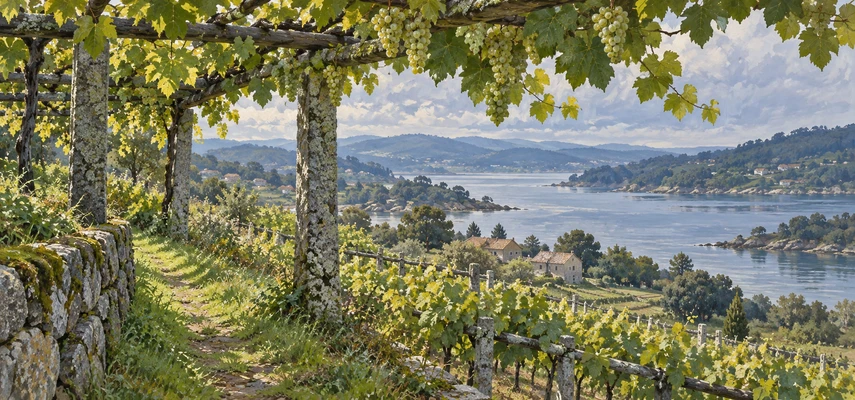
Raised pergola systems can separate fruit from damp ground and allow airflow, although they add labour and aren’t the only training approach. Granitic materials influence drainage and rooting; they don’t guarantee a literal mineral flavour. Small fragmented holdings can complicate coordination. The Gerardo Méndez producer profile illustrates working across numerous parcels with different exposures and microclimates, rather than a single uniform source of fruit.
Compare cellar choices through the actual material
Winemaking approaches begin with the target style across all four regions. Careful grape transportation limits crushing, oxidation and unwanted fermentation. Reception should separate origins, varieties, health and ripeness. Processing and pressing affect yield and phenolic pickup. A fresh Rueda white and an Albariño need attention to juice condition; Ribera Tempranillo and Bierzo Mencía require extraction decisions appropriate to their own skins and intended structure.
Pre-fermentation clarification adjusts white-juice solids for the intended fermentation. Must adjustments require analysis and legal permission. Alcoholic fermentation decisions include yeast, temperature, vessel and nutrient management. Extraction and pressing should suit skin and seed maturity in reds rather than following one forceful programme everywhere. Malolactic conversion and subsequent maturation should fit acidity, texture and microbial stability. Preserving freshness in one white and building a rounded red structure can require different decisions.
Lees maturation can build texture in suitable Verdejo, Godello, Albariño or Albillo Mayor, with oxygen and microbiological condition monitored. Red maturation depends on retained fruit, tannin and the intended drinking period. New oak can support a wine or obscure it; barrel age and size matter alongside time. A Mencía doesn’t need to imitate Ribera del Duero to be ambitious, and an expressive white doesn’t need obvious wood to justify its price.
Blending eligible lots can improve balance while preserving origin and category entitlement. Finishing adjustments, sulfur dioxide and filtration depend on analysis and stability needs. Post-fermentation clarification removes unwanted material; stabilisation considers protein and tartrate risks. Microbiological safeguards should fit analysis, retained sugar and distribution. Packaging and closures should protect the intended drinking period. Wine transportation requires suitable temperature management, whether stock leaves an inland warehouse or an Atlantic producer. A cool-climate origin doesn’t protect bottles once they’re in a hot delivery van.
Relate protected names to commercial decisions
International and EU protection frameworks, national Spanish law and local appellation specifications interact. Industry associations such as the regulatory councils communicate and defend origin, while authorised controls establish compliance. A geographical indication links place with prescribed conditions. These DOs operate within the PDO framework; PGI wines have separate requirements, and wines without GI cannot borrow protected names. Crianza, Reserva, regional place references and producer brands need their own contextual reading rather than one universal quality ladder.
Supply depends on suitable fruit, weather losses, permitted yields and maturation stocks. Demand differs between structured inland reds, fresh plateau whites, Mencía and Atlantic Albariño. Costs include vineyard labour, fragmented or sloping parcels, temperature control, vessels, storage and finance. Legislation affects sourcing and release choices; currency exchange changes export returns. A longer-matured Ribera red ties up capital differently from a fresh Rueda white, while parcel coordination and labour can matter sharply in Bierzo and Rías Baixas.
A grower may supply fruit, while an estate can coordinate vineyard and cellar decisions. A broker connects parties; a merchant sources wine or grapes; a winery provides production capacity. A virtual winery contracts production, and a custom crush facility supplies agreed services. A cooperative can share equipment and market access; a conglomerate may coordinate businesses. These are possible functions, not a census claiming equal prevalence in all four DOs. Contracts need to fit the actual fruit, traceability and payment risks.
Importing adds freight, compliance and currency exposure. Retail needs clear origin and style information; HoReCa buyers require service training. Direct-to-consumer sales can retain revenue but add hospitality and fulfilment work. Mature and emerging markets contain varied customers. A familiar Albariño name may help a listing, while Godello or a detailed Bierzo place reference can need more explanation. Neither situation establishes the wine’s actual margin or demand automatically.
Wine brands can lead with producer, grape or place. Marketing concepts begin with a target customer; marketing options include comparative flights, technical notes and vineyard visits. The five Ps connect product, price, people, place and promotion. Explain why a particular wine suits a customer and drinking occasion, rather than describing every Spanish white as refreshing and every Spanish red as powerful.
Compare the evidence here with Mediterranean and central Spain as a regional case, then apply the regional comparison framework to the comparison. Compare growing conditions, production decisions, style, quality and the commercial reasons for price. Establish the differences rather than assuming that one familiar name must be better.
Original Diploma practice
These original exercises practise causal explanation and evaluation. They aren’t official examination questions, marking schemes or accounts of actual bottles tasted.
Question 1: compare plateau and Atlantic whites
Compare vineyard and cellar decisions for a fresh Rueda white and Rías Baixas Albariño, including risks that the regional stereotypes overlook.
Reasoned outline: Compare inland temperature variation, frost and water stress with maritime moisture, drainage and disease pressure. Explain harvest, transport, pressing, clarification, fermentation and oxygen management. Discuss texture, stability and distribution without assuming either wine is necessarily simple or short-lived. Similar freshness can arise through different growing conditions and production decisions.
Question 2: evaluate a red-wine imitation strategy
A Bierzo producer proposes stronger extraction and more new oak to make every Mencía resemble a concentrated Ribera del Duero red. Evaluate the proposal.
Reasoned outline: Compare actual variety, site, crop, fruit condition and intended style. Explain extraction, tannin texture, retained fruit, malolactic conversion and maturation. Assess cost, differentiation and the customer rather than treating one region’s reputation as a universal recipe. Ambition needs suitable material and integration, rather than imitation alone.
Question 3: assess an old-parcel label claim
A seller argues that a named old vineyard guarantees outstanding quality and eliminates the need to discuss production costs. Assess the claim for Bierzo or Rías Baixas.
Reasoned outline: Establish the actual origin entitlement and vineyard condition. Explain access, slope or fragmentation, labour, yields, health and harvest choices. Connect the material with cellar decisions, bottle condition and customer value. A valuable parcel still needs competent production and a workable business.
Analytical tasting preparation: build the four-region comparison
The official recommended-sample programme, printed page 23, includes Rías Baixas Albariño at very good quality and Rueda at good or very good quality. Its red selections include Mencía from any DO at very good quality and Toro or Ribera del Duero at very good or outstanding quality. A suitable Bierzo Mencía and Ribera red can therefore support these rows without pretending both alternatives in an either/or row are compulsory. Godello from any DO at good or very good quality is optional; Albillo Mayor is an additional useful comparison, not a separate invented essential row.
Write full systematic descriptions blind. Justify quality through balance, length, intensity and complexity using actual fruit, structure and development evidence. Assess bottle-ageing suitability separately, considering retained fruit and likely integration rather than grape reputation, high alcohol or obvious oak alone. These are proposed selections and methods, not actual tasting results or predetermined official bottle grades.












