










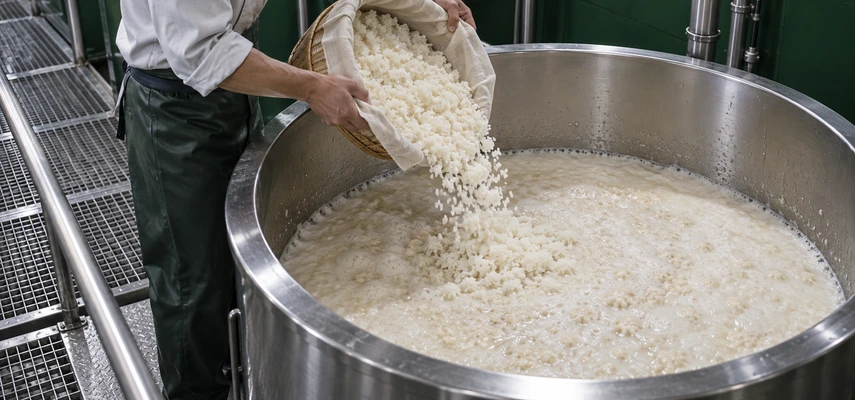

Why does a sake brewery build a fermentation mash in stages instead of adding everything at once? Multiple parallel fermentation already requires coordination between two biological jobs: kōji enzymes release fermentable sugar while yeast consumes it. Expanding that system gradually helps maintain a useful microbial environment as the amount of rice, kōji and water increases.
The main mash is called moromi. It contains the developing fermentation mixture, not simply the liquid sake that will eventually be separated from the solids. The WSET Level 3 specification asks candidates to understand the three-stage additions, parallel conversion and fermentation, temperature management and an optional fourth addition. Their purposes are connected, but they are not interchangeable.
Multiple parallel fermentation is two processes together
Rice starch is a large carbohydrate structure, while yeast needs available fermentable sugars. Kōji enzymes break down the prepared starch and release smaller sugars, including glucose. Yeast ferments that glucose into ethanol and carbon dioxide. In moromi, those activities overlap rather than requiring all starch conversion to finish before any alcoholic fermentation begins.
“Parallel” therefore describes concurrent processes within the mash. It doesn’t mean the enzymes and yeast perform the same reaction, or that the rice starch becomes alcohol in one direct step. The JSS production account explains the relationship between the cultivated rice, fermentation starter and expanding mash.
The important consequence is that glucose supply and glucose consumption influence one another through a shared environment. A glucose measurement shows the amount present at that moment, not all the sugar that has been released since fermentation began. A relatively small pool may reflect active consumption rather than an absence of enzyme activity.
The starter brings the yeast population into a larger system
Shubo or moto has already established useful yeast under managed conditions. The brewery then expands the fermentation by adding further prepared material. The starter’s acidity and population are valuable precisely because the new ingredients create a larger environment in which the desired yeast must continue to function.
Adding a large volume immediately would dilute the yeast and the starter environment before the population had a chance to respond. Gradual expansion reduces that abrupt change. This supports fermentation control and helps limit opportunities for unwanted microbial growth. It is not a guarantee that contamination becomes impossible, so clean handling and suitable conditions remain necessary.
For a simple analogy, imagine a well-established group doing a task while the workload grows. Increasing the workload in stages gives the group a chance to remain effective. The real starter works through cell growth and chemical conditions rather than teamwork, but the analogy captures why scale and concentration matter.
Three additions usually span four days
Sandan-jikomi means three-stage preparation. In the conventional sequence, the brewery adds steamed rice, kōji and water in three stages over four days. The day without the next major addition is odori, a resting interval after the first stage that supports the yeast’s development before further expansion.
The NRIB production overview states the three-portions-over-four-days structure. This is an important distinction because “three stages” is often incorrectly shortened to “three consecutive days.” The extra calendar day does not turn the process into four ingredient-addition stages.
| Conventional timing | Name | Main purpose in the sequence |
|---|---|---|
| Day 1 | First addition, hatsu-zoe or soe | Begin expanding the starter with further rice, kōji and water |
| Day 2 | Odori | Allow development before the next major expansion |
| Day 3 | Second addition, naka-zoe | Increase the mash in another managed step |
| Day 4 | Third addition, tome-zoe | Complete the conventional three-stage build |
These names describe points in the build, not three separate finished sakes. A complete answer should identify what is added and why the additions are staged. Merely listing Japanese names would leave the microbial purpose unexplained.
The odori interval also makes clear that an absence of major additions is not an absence of biological activity. Yeast continues developing while the brewery deliberately postpones the next expansion.
Rice, kōji and water change more than volume
Steamed rice brings prepared starch and other components into the mash. Kōji brings enzyme activity and its chemical contribution. Water changes the medium, ingredient balance and concentrations. Therefore, each addition changes both the size of the system and the conditions under which yeast and enzymes operate.
The ingredients must be prepared appropriately. Rice texture affects access and handling; kōji activity affects conversion; water affects the medium and mineral availability. Timing alone cannot make unsuitable material perform as intended. The brewery coordinates the additions with the particular rice, kōji and selected yeast rather than treating the schedule as an independent recipe for quality.
The NRIB and JSS guide provides broader production context for these relationships. Its value is not simply the list of ingredients. It helps explain why the same named stage can be managed differently when a brewer seeks a different fermentation course or sake expression.
Temperature is part of the expansion plan
Adding rice and water also changes the mash’s thermal condition. Prepared material therefore needs to fit the intended temperature course. A substantial addition of warm rice can disturb that plan even if its weight is correct. Cooling before addition is a link between rice preparation and fermentation control, not an unrelated housekeeping task.
Meanwhile, fermentation generates heat. As volume and activity change, the brewery must manage the actual mash rather than assume the room temperature describes it. The temperature affects yeast behavior and enzyme activity, which can respond differently. Its role cannot be reduced to “colder is always better.”
The detailed style implications belong in the next lesson. Here, the key chain is ingredient and timing decisions → changed thermal and chemical conditions → effects on conversion and fermentation. A stable process requires attention to all three steps instead of treating the additions as a purely numerical scaling exercise.
Distinguish standing concentrations from changing rates
Consider a mash in which glucose is being produced and consumed quickly. A low measured glucose concentration could mean yeast is keeping pace with a substantial supply. Alternatively, it could reflect limited release from the rice. The same single reading can therefore require different explanations depending on the rest of the evidence.
Likewise, a sweeter sample during fermentation doesn’t establish that the final sake will retain the same sweetness. Conversion and consumption continue, and later adjustments may occur. A useful interpretation looks at the course of development rather than treating one sample as the completed result. Time makes process measurements meaningful.
This is why the phrase “balance between saccharification and fermentation” is useful only when explained. The two rates do not need to be numerically identical at every moment. The brewer seeks a course that supports the intended outcome, with changes in substrate, yeast and conditions managed through the process.
The optional fourth addition serves a different purpose
Yodan-jikomi, the fourth addition, is distinct from the three-stage build and from the fourth calendar day of that build. It is a further addition used for a particular production purpose, commonly to adjust sweetness through additional rice-derived material. It should not be presented as an obligatory fourth ingredient stage in every sake.
The JSS Japanese glossary entries on yodan describes several approaches, including steamed rice and separately saccharified preparations. The intended effect depends on what is added and when it is added. “A fourth addition occurs” is therefore not yet a complete mechanism.
For example, a sweet, saccharified rice preparation supplies material differently from simply adding more water. Water additions can also appear within fourth-stage terminology in some accounts, but they need not have the same sweetness objective. Keep the specific material and purpose attached to the term rather than treating every yodan as chemically identical.
Follow the process into pressing
Moromi continues to develop after the conventional additions are complete. Enzymes, yeast, rice solids and the changing liquid remain part of the system until the brewer moves toward separation and finishing. The third addition is not the moment all fermentation automatically ends, and the optional fourth is not a synonym for pressing.
Later pressing separates sake from much of the solid material. Further decisions about clarification, alcohol adjustment, pasteurisation and other finishing can change what reaches the bottle. Consequently, understanding moromi explains a central part of style formation without claiming it is the entire production chain.
For a written answer, build the response around the problem posed. If asked why staged additions are used, explain dilution and yeast establishment. If asked about parallel fermentation, name the two transformations and their overlap. If asked about a fourth addition, distinguish its material and objective from the conventional build.
The mash begins with the starter environment and continues under temperature and fermentation management. Its liquid eventually reaches pressing and fraction selection, where another set of choices can change the expression.
One-page revision summary
Moromi is the main mash, where starch conversion and alcoholic fermentation overlap. Sandan-jikomi expands the starter through three additions over four days, with odori between the first and second. Rice, kōji, water and temperature shape the developing conditions. Optional yodan is a separate production choice, not another name for day four. Explain each through its purpose and mechanism.
Written practice: original TFE exercises
These suggested marks and indicative points are independent teaching guidance, not official WSET marking schemes.
Exercise 1: 5 suggested marks
Explain why the main mash is conventionally built through staged additions rather than one large addition to the starter. Mapping: Unit 1 LO1.
Indicative marking points:
- The starter contains an established useful yeast population.
- One large addition would abruptly dilute that population.
- It would also change the acidic starter environment.
- Staged expansion allows yeast development to remain effective.
- This supports fermentation control and limits opportunities for unwanted microbes.
Model answer: The starter brings an established yeast population and a managed acidic environment. One large addition would abruptly dilute them while increasing the material to be fermented. Staged additions allow the population and conditions to develop through a controlled expansion, supporting the intended fermentation and reducing opportunities for unwanted microbial growth.
Why it works: The response identifies the starting advantage, the dilution problem and the biological purpose of staging.
Common mistake: Claiming the stages are three separate alcoholic fermentations or a guarantee that contamination is impossible.
Exercise 2: 5 suggested marks
Explain the difference between three-stage preparation over four days and an optional fourth addition. Mapping: Unit 1 LO1.
Indicative marking points:
- Three-stage preparation has three principal ingredient additions.
- It conventionally spans four days because of odori.
- Odori occurs after the first addition before the second.
- Optional yodan is a further production addition outside that conventional build.
- Its effect depends on material and timing, commonly including sweetness adjustment.
Model answer: Sandan-jikomi has three ingredient additions over four conventional days because odori separates the first and second additions. The fourth calendar day contains the third addition. Optional yodan is a distinct further addition for a production objective, commonly sweetness adjustment with rice-derived material, and its effect depends on what is added and when.
Why it works: It separates stage count, calendar timing and the independent purpose of yodan without confusing their shared number.
Common mistake: Calling odori the fourth addition or saying all sake must receive yodan.
Knowledge check: 10 original practice questions
Independent TFE questions, not official WSET examination items. Choose one answer per question; explanations follow separately.
1. How many conventional calendar days are used for the three-stage build?
2. Why should the temperature of added rice be managed?
3. Why are additions staged?
4. What does multiple parallel fermentation describe?
5. What is moromi?
6. What follows completion of the three-stage build?
7. Which materials are involved in the conventional additions?
8. Which statement about yodan is accurate?
9. Why does a single low glucose reading need context?
10. What happens during odori in this framework?
Answers and explanations
1. C — Four, including the odori interval.. Three additions are conventionally made over four days because odori follows the first addition. Mapping: Unit 1 LO1 Range 4; LO2 Range 4.
2. C — The addition changes the mash’s thermal conditions and biological activity.. Ingredient temperature and fermentation heat both affect the process course. Mapping: Unit 1 LO1 Range 4; LO2 Range 4.
3. A — To avoid abrupt dilution and support useful yeast and conditions during expansion.. Gradual expansion supports the microbial environment established in the starter. Mapping: Unit 1 LO1 Range 4; LO2 Range 4.
4. B — Concurrent starch conversion and alcoholic fermentation in the mash.. Kōji enzymes release sugars while yeast consumes available fermentable sugar in the shared system. Mapping: Unit 1 LO1 Range 4; LO2 Range 4.
5. D — The main fermentation mash.. Moromi includes the developing mixture rather than only the eventual separated liquid. Mapping: Unit 1 LO1 Range 4; LO2 Range 4.
6. D — Moromi continues developing before the brewer moves toward separation and finishing.. The addition sequence builds the main fermentation; it is not itself the endpoint of all brewing activity. Mapping: Unit 1 LO1 Range 4; LO2 Range 4.
7. D — Steamed rice, kōji and water.. The materials expand substrate, enzyme contribution and medium around the starter population. Mapping: Unit 1 LO1 Range 4; LO2 Range 4.
8. B — It is a separate optional addition with an effect dependent on material and timing.. Yodan is a further production choice, commonly related to sweetness, distinct from the conventional build. Mapping: Unit 1 LO1 Range 4; LO2 Range 4.
9. A — Glucose may be produced and consumed concurrently at different rates.. A standing concentration is not the cumulative glucose released or a complete description of process rates. Mapping: Unit 1 LO1 Range 4; LO2 Range 4.
10. B — The mash develops before the next principal addition.. Odori is the interval after the first addition that supports development before further expansion. Mapping: Unit 1 LO1 Range 4; LO2 Range 4.












