










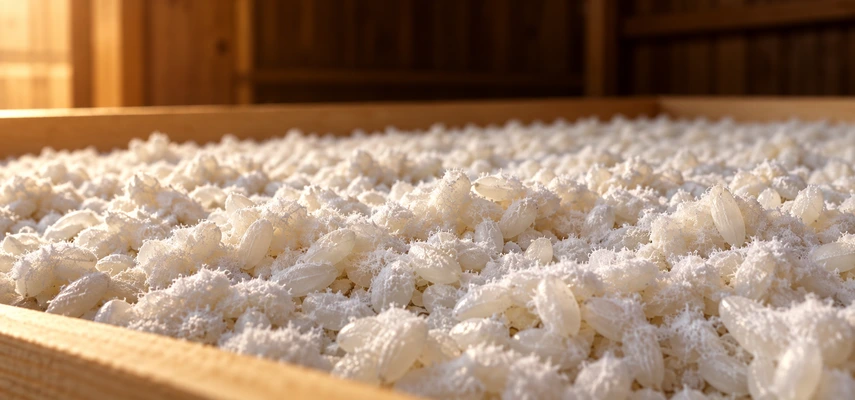

Rice is full of potential alcohol, but yeast cannot collect it directly. The starch is packaged in molecules that ordinary brewing yeast cannot ferment. Kōji, also written koji, provides the missing tool: enzymes that cut starch into sugars. Without that preparation, putting yeast beside rice would be like hiring a pianist and handing over a locked piano.
The mould is not the musician playing the alcohol-producing part. It prepares the instrument. Once that division is clear, sake production becomes much easier to follow: brewers cultivate kōji on rice, then use that enzyme-rich ingredient to support the yeast’s separate work in the mash.
What kōji means in sake
In sake brewing, kōji is steamed rice on which a selected mould has been cultivated. The mould usually used is Aspergillus oryzae. The term can cause confusion because people sometimes use it casually for the organism, the cultivated rice or the process. Here, kōji means the prepared rice ingredient; kōji mould means the organism growing on it.
That distinction is practical. A brewer adds kōji rice to a mash, bringing rice material and a supply of enzymes together. The brewer is not simply pouring an abstract microorganism into a tank. The ingredient has been deliberately prepared, monitored and brought to a useful stage before fermentation begins.
Not all steamed rice becomes kōji. A portion receives the mould and cultivation treatment, while other steamed rice is used elsewhere in production. The enzyme supply from the kōji can act on starch from the wider rice addition. This explains how a comparatively small cultivated portion can help transform a much larger mash.
Enzymes make rice starch usable
Starch is a large carbohydrate built from linked sugar units. Saccharification is the process of breaking starch down into sugars. For beginner purposes, enzymes are the biological tools that make those cuts. They are not the same thing as the organisms that produce them.
Kōji mould produces enzymes during cultivation. Those enzymes can subsequently act in the mash. Yeast then converts available fermentable sugar into alcohol and carbon dioxide. Keep that sequence of functions clear even though the two transformations can overlap in time during main fermentation.
The JSS brewing overview separates these jobs. An enzyme does not have to become a yeast cell to help fermentation. It changes the material around the yeast so that the yeast has something suitable to use. Ingredient preparation and alcoholic fermentation therefore cooperate without becoming identical processes.
Begin with properly prepared steamed rice
Kōji cultivation starts with rice that has been polished, washed, soaked and steamed. Those earlier stages influence moisture and texture. Mould grows on a physical material, not on a recipe written on paper, so the condition of that material affects what happens next.
Picture two trays: one has individual grains at a suitable moisture level, while another is a wet, compacted mass. They do not offer the same environment for controlled cultivation. This is a conceptual comparison, not a home-cultivation guide. Commercial brewing relies on selected cultures, hygiene and practiced control rather than encouraging unidentified household mould.
Preparation also explains why this lesson belongs after rice processing. Kōji cannot repair every earlier mistake automatically. Brewers manage an interconnected chain: rice condition influences cultivation, cultivation influences enzymes, and enzyme activity influences the material available to fermentation.
Cooling rice before spreading mould
Freshly steamed rice is too hot for appropriate inoculation. Cooling brings it into a condition suitable for the intended mould growth. Cooling is therefore a deliberate production stage, not merely waiting until the tray is comfortable to carry.
Temperature and moisture are connected. As rice is handled and cooled, its surface condition changes. The brewer wants material that supports controlled growth, not rice that is either excessively hot or carelessly dried out. Level 1 study requires understanding the purpose, rather than memorizing a single temperature for every brewery.
The order is worth saying aloud: steam, cool, then inoculate. If a practice answer says spores are sprinkled on boiling-hot rice, ask whether the living organism would receive the conditions it needs. Thinking through the mechanism is more reliable than memorizing the words as an arbitrary list.
Spreading mould and starting growth
Selected kōji mould spores are spread over the cooled steamed rice and distributed through it. This inoculation introduces the desired organism. Distribution matters because the brewer wants reasonably consistent cultivation, rather than a few concentrated patches and large untreated areas.
Initial growth follows. Spores germinate and the mould develops through and around the rice. During this stage it uses the material and produces enzymes. The finished appearance can include fine white growth, but appearance alone is not a complete measure of the ingredient’s suitability.
The JSS professional process description describes cultivation in a specially managed room. The useful lesson is that kōji does not simply happen because rice was left on a shelf. The brewer selects the culture and manages its environment with a specific brewing purpose.
Controlling mould growth
Living mould generates heat as it grows. If the rice mass becomes too warm, the environment can drift away from what the brewer intended. Temperature control is therefore active management. Spreading, mixing and arranging the rice can help regulate how heat and moisture move through it.
Moisture also needs attention. The organism requires an appropriate environment, yet a wet, compacted mass is different from suitably prepared grains. The brewer monitors the rice and adjusts handling. A cultivation room is less like a cupboard and more like a workshop whose material is changing while the work continues.
There is no useful beginner rule that more growth always makes better sake. The goal is the right enzyme-rich ingredient for the intended style. Brewers may seek different growth patterns and enzyme balances. Level 1 students need not memorize the advanced alternatives to understand that control serves a design rather than maximum visible fluff.
Stopping mould growth at the useful stage
Once cultivation has reached the desired point, brewers stop or check further growth through handling and cooling. This prevents the ingredient from continuing to develop without control. The production stage ends when the kōji is ready for its brewing role, not when every possible part of the rice has been consumed.
Stopping mould growth does not mean destroying all the enzymes that were just produced. Those enzymes are the point of the ingredient. If cultivation stopping erased their usefulness, the next stage would lose the tool it needs. Distinguish control of a living culture from complete removal of its useful products.
Nor should this step be confused with pasteurising finished sake. Pasteurisation is a later heat treatment with a different purpose. The same general idea of controlling biological activity can appear at different stages, but the material, method and immediate goal are not interchangeable.
From cultivation room to fermentation tank
Kōji joins steamed rice, water and yeast within the brewing system, including the starter and main mash. Its enzymes release sugar while yeast ferments available sugar. During main fermentation, the two transformations occur concurrently: multiple parallel fermentation.
Imagine two workers on adjacent tasks. One cuts a long roll of material into pieces; the other uses the pieces as they arrive. The second does not have to wait for the entire roll to be cut. Equally, the first worker does not magically perform the second worker’s task. This is an analogy for timing and division of labor, not a complete biochemical model.
That overlapping supply helps explain why the mash can develop over time. It is not simply grape juice with all its fermentable sugar already present at the start. The brewer manages the continuing relationship between enzyme action, rice dissolution and yeast activity. Detailed fermentation temperature choices belong to the following lesson.
How kōji influences sake character
The most immediate effect is enabling sugar supply and fermentation. Kōji also supplies enzymes that can break down protein into smaller components, including amino acids. Those components contribute to the broader flavor picture, including savory impressions. Its contribution therefore reaches beyond a single imagined sweet taste.
However, kōji does not prescribe a finished sweetness level by itself. Sugar release and sugar consumption work together. A useful sugar supply can support yeast activity rather than simply remaining in the bottle. Finished balance also depends on fermentation, finishing and the brewer’s intentions.
Avoid the equally tempting shortcut that stronger visible growth means stronger aroma. Aroma results from several linked decisions, including yeast and fermentation conditions. A sake smelling of melon is not evidence that the kōji smelled like melon or that fruit was added. Keep the causal chain specific and resist turning one ingredient into an explanation for everything.
Practice explaining the partnership
Try teaching the process to someone in four sentences. Rice provides starch. Kōji mould grows on some steamed rice and produces enzymes. Those enzymes release sugars from starch. Yeast ferments the sugars into alcohol and carbon dioxide. If each sentence has a clear subject and job, the core idea has survived the simplification.
Then add the cultivation sequence: cooling, spreading mould, initial growth, controlling growth and stopping growth. Each stage has a purpose. Cooling makes the environment suitable; inoculation introduces the selected organism; growth produces the useful ingredient; control and stopping keep its development aligned with brewing needs.
One-page revision summary
Kōji is cultivated rice, not the alcohol-producing yeast. Its mould produces starch-breaking enzymes that make sugars available. Learn the cultivation order and the reason for each stage. Growth needs management because temperature, moisture and rice condition change. Stopping cultivation preserves a useful brewing ingredient rather than cancelling its enzymes. In the main mash, enzyme-driven sugar release can overlap with yeast-driven fermentation.
Continue your sake studies
Knowledge check: 10 original practice questions
Independent TFE questions, not official WSET examination items. Choose one answer per question; explanations follow separately.
1. What is kōji in the context of sake brewing?
- Steamed rice cultivated with selected mould
- A distilled spirit
- The bottle sediment from all wine
- A yeast-free finished sake grade
2. Which substance do kōji enzymes help break down?
- Glass
- Rice starch
- Bottle labels
- Carbon dioxide into rice
3. What follows steaming before inoculation?
- Bottling
- Adding finished sparkling sake
- Cooling the rice appropriately
- Distilling all the rice
4. What is introduced when mould is spread over prepared rice?
- Compulsory milk
- A final examination grade
- Finished alcohol
- Selected mould spores
5. Why is growth temperature controlled?
- Growing mould produces heat and conditions must remain suitable
- Heat never changes
- The goal is always to boil the rice
- Temperature alone sets the bottle label
6. Which organism converts sugar into alcohol?
- The rice grain itself
- Yeast
- The wooden tray
- Polishing residue
7. What does stopping cultivation need to preserve?
- A mandatory layer of green mould
- All the original rice bran
- A useful enzyme-rich brewing ingredient
- A fully bottled drink
8. Which statement about kōji is correct?
- More visible growth always guarantees better sake
- Kōji is the same as pasteurisation
- It makes rice starch directly fermentable without change
- Its preparation depends on rice condition and controlled growth
9. Why can sugar release and fermentation overlap?
- Enzymes and yeast perform separate jobs in the same mash
- Yeast becomes a polishing mill
- Rice is distilled continuously
- Sugar cannot be consumed
10. Does kōji alone determine finished sweetness?
- Yes, regardless of yeast activity
- No, sugar release and consumption must both be considered
- Yes, if the bottle is clear
- No, because sake never contains sugar
Answers and explanations
1. A — Steamed rice cultivated with selected mould. Kōji refers here to the cultivated rice ingredient, which carries useful enzymes. Mapping: LO1.
2. B — Rice starch. Enzymes release smaller sugars from the starch so yeast can ferment them. Mapping: LO1.
3. C — Cooling the rice appropriately. The steamed rice must be brought to conditions suitable for mould cultivation. Mapping: LO1.
4. D — Selected mould spores. Inoculation introduces the selected organism that grows and produces enzymes. Mapping: LO1.
5. A — Growing mould produces heat and conditions must remain suitable. Active growth changes the rice environment, so the brewer monitors and manages it. Mapping: LO1.
6. B — Yeast. Yeast performs alcoholic fermentation; kōji supplies the enzymes enabling sugar release. Mapping: LO1.
7. C — A useful enzyme-rich brewing ingredient. The aim is controlled kōji development while retaining enzymes for the mash. Mapping: LO1.
8. D — Its preparation depends on rice condition and controlled growth. Rice preparation, moisture and temperature affect cultivation and the intended ingredient. Mapping: LO1.
9. A — Enzymes and yeast perform separate jobs in the same mash. Kōji enzymes can release sugar while yeast ferments sugar already available. Mapping: LO1.
10. B — No, sugar release and consumption must both be considered. Available sugars may be fermented; final sweetness depends on the wider brewing and finishing process. Mapping: LO1.












