











The number that looks most like a score on a sake bottle is not a score. If sake rice has a polishing ratio of 60%, that does not mean 60% was removed, and it certainly does not mean the drink earned six marks out of ten. It means 60% of the original rice weight remains after polishing.
That small reversal explains a great deal. Lower numbers mean more material removed. More polishing changes the ingredients available to the brewing process, but it does not automatically deliver a drink everyone will prefer. Follow the grain through polishing, washing, soaking and steaming, and the label starts describing work rather than mystery.
Sake rice is a source of starch
Rice supplies the starch from which sake’s fermentable sugars are produced. Ordinary brewing yeast cannot directly ferment that starch. Later, enzymes supplied by kōji will break it down into smaller sugars that yeast can use. Rice preparation therefore sets up two later jobs: successful kōji cultivation and effective fermentation.
Not every grain entering a brewery becomes kōji. A portion is cultivated with kōji mould, while other steamed rice goes into the starter and main mash. Both routes depend on well-prepared rice. Treating kōji rice as the only rice that matters overlooks much of the material being transformed.
Sake can be made from rice varieties grown specifically for brewing and from suitable table rice. Some sake-brewing varieties have large grains with a starch-rich, opaque central region. Variety matters, but Level 1 understanding begins with the material’s function. A list of famous rice names is less useful than explaining why the brewer wants accessible starch.
What rice polishing removes
Polishing mechanically wears away the outside of the grain. Those outer portions contain relatively more protein, fat and other components than the starchy interior. Removing more of them changes the balance of material available to enzymes, yeast and later flavor development.
The grain is not a perfectly divided onion with pure starch inside and everything else outside. Components are distributed through it. Think of polishing as changing proportions, rather than purifying rice until it becomes a flavorless chemical. The remaining grain still has structure and a biological composition.
Protein breakdown contributes amino acids and other compounds that can affect flavor. Rice preparation therefore influences more than potential alcohol. More removal often supports a lighter, more delicate style, especially alongside appropriate kōji, yeast and fermentation choices. Less removal can suit a fuller, more rice-derived or savory expression.
Those are tendencies, not a reliable way to predict a finished bottle from one number. Imagine two cooks handed differently trimmed vegetables. The trimming influences what they can make, but the final dish still depends on treatment. Sake polishing is a production decision within a much longer chain.
Read 70%, 60% and 50% correctly
The polishing ratio expresses the weight of polished rice as a percentage of its original brown-rice weight. With 100 kilograms of starting rice, a 70% ratio leaves approximately 70 kilograms for brewing. About 30 kilograms have been removed. A 60% ratio leaves 60 kilograms; 40 kilograms have been removed.
At 50%, about half the original weight remains. The denominator is always the original amount, not the quantity remaining after an earlier polishing stage. Going from 70 kilograms to 50 kilograms removes another 20 kilograms from the original 100, not half of the 70 kilograms.
| Polishing ratio | Rice remaining from 100 kg | Rice removed |
|---|---|---|
| 70% | 70 kg | 30 kg |
| 60% | 60 kg | 40 kg |
| 50% | 50 kg | 50 kg |
These are mass illustrations, not claims that every individual grain shrinks in an identical geometric pattern. The distinction matters because a percentage describing weight cannot simply be read as the same percentage of grain length or diameter.
Polishing ratios connect to grades
For the Level 1 classification, honjōzō requires a ratio of 70% or less. Ginjō and junmai ginjō use 60% or less; daiginjō and junmai daiginjō use 50% or less. These are ceilings on the remaining ratio, not minimum percentages removed. The official specification sets out that study table.
Junmai has no fixed legal minimum polishing requirement of 70%. The specification expresses its ratio as 100% or less and notes that the rice is typically polished to 70% or less. Typical practice and a compulsory threshold are different statements. Do not turn the typical figure into a rule.
Nor does a qualifying ratio alone prove a complete grade. Ingredient restrictions and other controlled production conditions also matter. A 50% figure cannot, by itself, tell whether a sake is junmai daiginjō. Read it as one piece of classification evidence, then check the rest of the label and production information.
Why more polishing is not a quality guarantee
Removing more rice can increase cost because less of the original material reaches brewing. It also demands careful handling. Neither fact makes a lower ratio a universal taste ranking. Someone seeking savory depth may prefer a style that retains more of the grain’s components.
The JSS brewing explanation explicitly separates polishing ratio from an automatic judgment of quality. Use the number to ask about style and production, rather than allowing it to make a purchasing decision alone.
For a practical comparison, imagine one sake described as delicate, floral and light, and another as rounded, grainy and savory. If both are well made, the question is which fits the occasion and the drinker’s preference. Ranking them solely by polishing percentage discards the very differences the brewers worked to create.
Washing removes polishing residue
After polishing, rice carries powder from the milling process. Washing removes that residue. This is a physical cleaning stage, not the point where yeast produces alcohol or where the finished sake is filtered. Keeping those jobs separate makes the sequence easier to reconstruct.
Water management already matters here. Rice begins taking up water during handling, so washing and soaking are connected operations rather than unrelated kitchen chores. The brewer wants consistent preparation across the batch, because unevenly hydrated grains will behave differently when steamed and used later.
Do not confuse washing rice with washing away all its flavor. The purpose is to remove milling residue and prepare the grain properly. The starch needed for brewing must remain. An exam answer that says washing turns starch into alcohol assigns the correct general destination to the wrong production stage.
Soaking controls water uptake
During soaking, rice absorbs water. Hydration prepares the grain for steaming and affects how it behaves afterward. The brewer controls the process to reach a suitable condition, rather than assuming that longer is always better. A grain that has taken up too much or too little water presents a different brewing material.
Highly polished rice can demand particularly careful timing and handling. However, exact soaking times depend on rice condition and brewery practice. Memorizing one universal number would be less accurate than understanding the goal: controlled, reasonably consistent water uptake before steaming.
A familiar comparison is dried pasta. Water changes how it behaves when heated, although rice preparation for brewing is not pasta cooking. The useful part of the comparison is that dry material and hydrated material respond differently. The brewer is managing physical condition before asking microorganisms and enzymes to do their work.
Steaming prepares rice for the next stages
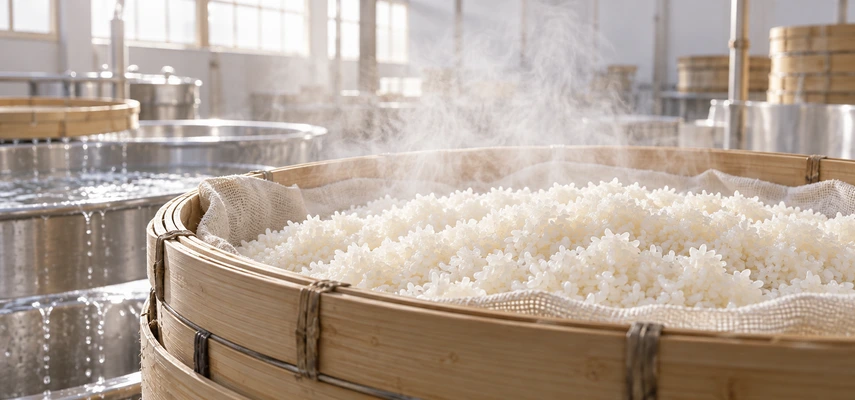
Steaming cooks the hydrated rice and changes its starch structure, making it more accessible to later enzymatic action. It also helps produce an appropriate texture for kōji cultivation and the mash. The aim is prepared individual grains, not a pot of heavily waterlogged rice porridge.
Steaming and boiling are different treatments. Steam supplies heat without immersing the rice in the same way as a saucepan of water. That distinction helps explain why breweries use equipment and handling designed for brewing rice, rather than simply enlarging a domestic dinner recipe.
After steaming, rice is cooled to an appropriate temperature for its next use. Rice destined for kōji needs conditions suitable for mould cultivation. Rice used elsewhere must also be prepared for its role. Hot steamed rice is not simply tipped indiscriminately onto living cultures without regard to temperature.
Follow the decision through to the glass
The complete logic is now visible. Polishing changes ingredient proportions. Washing removes milling residue. Soaking controls water uptake. Steaming prepares the starch and physical grain. Later kōji cultivation and fermentation operate on the result. Each stage influences the next, rather than directly printing a single guaranteed aroma onto the sake.
When studying a bottle, try a three-sentence explanation: the ratio states how much rice remains; the preparation makes that rice suitable for brewing; the final style also depends on subsequent decisions. That explanation works whether the bottle says 70%, 60% or 50%. It leaves room for real brewing skill and individual preference.
One-page revision summary
Sake rice supplies starch. Polishing removes outer material and changes the balance of components; a lower ratio means more removed. Washing clears milling residue, soaking manages hydration, and steaming prepares rice for kōji and brewing. From 100 kilograms, 60% means 60 kilograms remain and 40 are removed. Remember the 70/60/50 grade thresholds, the junmai exception, and the difference between a stylistic tendency and a quality guarantee.
Continue your sake studies
Knowledge check: 10 original practice questions
Independent TFE questions, not official WSET examination items. Choose one answer per question; explanations follow separately.
1. A 60% polishing ratio means what?
- 60% of original rice weight remains
- 60% was removed
- 60% alcohol
- 60% of grains become yeast
2. How much remains from 100 kg at a 70% ratio?
- 30 kg
- 70 kg
- 50 kg
- 7 kg
3. Which batch has undergone more removal?
- 80% ratio
- 70% ratio
- 50% ratio
- 90% ratio
4. What does washing chiefly remove?
- All starch
- All yeast from finished sake
- Bottle labels
- Residue from polishing
5. What is the main purpose of soaking?
- Manage water uptake
- Distil the rice
- Pasteurise finished sake
- Create bubbles in bottles
6. Why is steaming useful?
- It replaces kōji
- It prepares the rice and starch for subsequent brewing
- It removes all water
- It directly creates bottled alcohol
7. Which components are relatively concentrated in the grain’s outer portions?
- Bottle closures
- Dissolved carbon dioxide
- Protein and fat
- Only pure alcohol
8. Which statement about junmai is accurate?
- It must always use exactly 70% rice
- It must be below 50%
- It has compulsory added alcohol
- It has no compulsory 70% polishing ceiling
9. Which ceiling applies to ginjō and junmai ginjō?
- 60%
- 80%
- 90%
- 100% exactly
10. Why is a lower polishing ratio not automatically a better purchase?
- Ratios have no meaning
- Quality and personal preference involve more than polishing
- All rice is identical
- Lower ratios prohibit fermentation
Answers and explanations
1. A — 60% of original rice weight remains. The ratio measures the remaining polished rice against its original weight. Mapping: LO1.
2. B — 70 kg. Seventy percent of the original 100 kilograms is 70 kilograms remaining. Mapping: LO1.
3. C — 50% ratio. The lowest remaining ratio represents the greatest proportion removed. Mapping: LO1.
4. D — Residue from polishing. Washing cleans polishing powder from rice before soaking and steaming. Mapping: LO1.
5. A — Manage water uptake. Soaking hydrates rice in preparation for steaming and later brewing work. Mapping: LO1.
6. B — It prepares the rice and starch for subsequent brewing. Steaming changes the rice’s physical condition and starch accessibility. Mapping: LO1.
7. C — Protein and fat. Polishing changes proportions by removing outer material relatively rich in protein and fat. Mapping: LO1.
8. D — It has no compulsory 70% polishing ceiling. Junmai is typically polished to 70% or less, but that typical figure is not its fixed legal threshold. Mapping: LO2.
9. A — 60%. Both ginjō categories use rice polished to 60% or less in the Level 1 table. Mapping: LO2.
10. B — Quality and personal preference involve more than polishing. The number describes production and helps indicate style; it does not settle individual preference. Mapping: LO2.











