










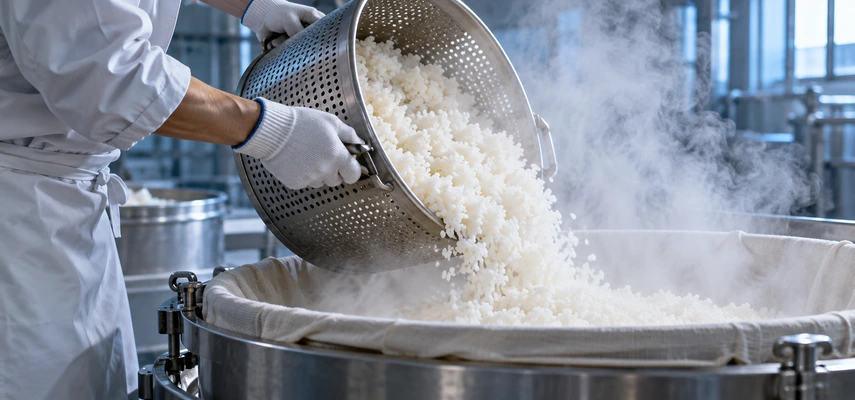

The number gets smaller as the work increases. A rice polishing ratio of 60% means the brewery has kept 60% of the original brown rice by weight, not removed 60%. Rice polishing and preparation begins with that easily reversed calculation, then moves into a subtler problem: getting each grain ready for mould and enzymes without turning it into a sticky dinner.
The sequence is polishing, washing, soaking and steaming. Each operation changes something different. Polishing changes which parts remain. Washing removes surface residue. Soaking controls water uptake. Steaming changes the hydrated starch so that later biological processes can work effectively. Treating them as four names for cleaning rice would miss nearly the whole point.
Rice polishing and preparation starts with what remains
Seimai-buai is the polishing ratio: the weight of polished rice expressed as a percentage of the original brown-rice weight. Brown rice here has already lost its husk but retains bran layers and germ. Brewing polishing goes beyond preparing an ordinary bowl of white rice, removing material from the outer part of the grain according to the intended sake style.
Use an imaginary 100-kilogram lot to keep the arithmetic visible. At 70%, 70 kilograms remain and 30 have been removed. At 60%, 60 remain and 40 have been removed. At 50%, half remains. The smaller the percentage, the greater the proportion removed, assuming the same starting basis.
For a different starting weight, multiply by the ratio divided by 100. A 200-kilogram lot polished to 60% leaves a nominal 120 kilograms of polished rice. The removed proportion is 40%, or 80 kilograms. Real brewery accounting can involve practical losses and specifications, but that does not change the definition being tested.
Why the outside changes the brewing possibilities
Rice is not chemically uniform from surface to center. Outer regions and the germ contain substantial amounts of proteins, lipids, minerals and other nutrients relative to the starchy interior. Removing more outer material changes the balance of what is available to mould, enzymes and yeast. It does more than make the rice smaller.
This matters because nutrient availability and protein breakdown can influence fermentation and flavor. Amino acids and peptides can contribute desirable savory character, but the brewer may want to restrain their contribution for a delicate aromatic style. Polishing helps shape the starting material for that aim; it does not perform the whole job on its own.
The JSS production guide connects the removal of outer material with style differences while warning against treating polishing ratio as a universal quality ranking. A fuller style can be intentional. Elegance is not the same as removing the greatest possible amount of rice.
Imagine two briefs. One asks for a restrained, fragrant sake, the other for a rounder drink with more grain and savory character. The brewer can choose different polishing strategies because the goals differ. Yeast, kōji and fermentation still have to cooperate with either plan. A ratio describes a decision, rather than guaranteeing the finished outcome.
Gentle removal protects a useful grain
Polishing uses controlled abrasion. The brewery wants to remove the planned material while preserving grains suitable for subsequent preparation. Excessive heat and breakage are practical concerns because damaged grains can behave differently when washed, soaked and steamed. Achieving a target weight is not the only measure of a successful milling operation.
Think of shaping a small piece of wood. Removing material is easy; removing the right material while preserving the useful shape takes control. The comparison explains the task without implying rice behaves exactly like timber. Grain variety, dimensions, strength and the chosen polishing equipment all affect the practical challenge.
Meanwhile, the bran generated during polishing is a separate material, not something the brewer wants clinging unpredictably to the finished white rice. After polishing, the process therefore turns from subtraction to preparation. What happens at the surface and inside the grain now needs careful control.
Washing clears the surface before absorption takes over
Washing removes rice powder and other surface residue left by polishing. That is its central function. The brewery is not trying to dissolve the entire grain, and washing does not replace the physical removal of material achieved by milling. It is a later operation dealing with the rice that remains.
Water contact also starts absorption. The boundary between a cleaning operation and the beginning of hydration is therefore a practical one rather than a biological stop sign. Water does not wait politely until the brewer declares the soaking stage open. This is one reason consistent handling matters.
Suppose two identical portions are washed for different lengths of time, then given the same stated soak. They may not finish with identical water content because their earlier contact differed. A reliable preparation routine considers the whole water-contact sequence. Simply timing the soak while ignoring washing would leave a source of variation uncontrolled.
Soaking puts water where steaming will need it
Soaking lets water enter the rice. The aim is an appropriate moisture level and distribution for the intended use, not maximum absorption at any cost. The grain must later steam properly and remain suitable for kōji production or addition to the fermentation mash. Those uses can call for carefully selected handling.
Absorption depends on the material and conditions. Grain size, polishing, dryness, water temperature and contact time can all affect the result. A highly polished lot should not automatically receive the same treatment as a less polished one. A clock reading is a control tool; it is not a universal recipe independent of the rice.
The NRIB/JSS technical guide places preparation within a connected brewing system. For study, the transferable lesson is moisture control. For actual production, a brewery uses experience, measurements and lot-specific decisions. This article is an explanation of the mechanism rather than a household instruction to manufacture alcohol.
Consider why both too much and too little water can cause trouble. Insufficiently hydrated rice may not develop the desired internal condition during steaming. Overly wet rice can be harder to handle as separate grains and may not support the intended kōji growth. The brewer is aiming for a useful condition between those extremes.
Steaming changes the starch rather than fermenting it
Hydrated starch undergoes gelatinisation when heated appropriately: its organized granule structure is disrupted, making it more accessible to enzymes. Steaming supplies heat and additional moisture under controlled conditions. It prepares the rice for subsequent processes; it does not itself turn starch into alcohol.
This is a useful place to separate three transformations. Gelatinisation changes starch’s physical organization. Saccharification uses enzymes to release sugars. Alcoholic fermentation uses yeast to produce alcohol from those sugars. They belong to the same production chain but are not interchangeable words for cooking.
Raw starch can be difficult for the later enzyme system to use effectively. A grain can contain plenty of potential carbohydrate without making that potential readily available. Heat and moisture therefore help convert agricultural material into a practical brewing substrate. The next lesson explains how kōji supplies the enzymes that take advantage of that preparation.
Steaming also differs from simply boiling rice in excess liquid. A brewery seeks a controlled grain condition, often described as firm enough externally for handling with a properly cooked interior. This supports the next task. The aim isn’t to recreate the soft cohesive texture that might be welcome at the dinner table.
Batch and continuous systems solve the same problem differently
In batch steaming, a defined quantity of rice is loaded and steamed as a batch. The vessel, loading pattern and timing need to produce a suitably consistent result. A traditional vessel is often called a koshiki. Its familiar appearance does not remove the need to control heat and moisture.
Continuous steaming moves rice through equipment as an ongoing flow. It can suit a brewery’s scale and production organization. The process still has to deliver the right degree of cooking and moisture, with adequate control over how long material spends in the heated environment. Continuous does not mean unmonitored.
Neither word is a quality grade. Batch and continuous describe production arrangements. To evaluate the result, ask whether the system prepares the rice consistently for the intended sake. The exam distinction is the method; the underlying aim remains properly prepared steamed white rice.
Cooling connects the steamer to the next living stage
Freshly steamed rice is too hot to use indiscriminately with living organisms. Cooling brings it toward conditions appropriate to its next destination. Rice intended for kōji cultivation needs to suit mould establishment. Rice intended for starter or main mash additions must suit that fermentation plan.
Cooling is therefore part of managing the transition from physical processing to biological activity. The brewer has already chosen how much grain to retain, how much water it should take up and how it should be heated. Those choices now meet the needs of mould and yeast. A mistake early in preparation can carry forward into several later stages.
One-page revision summary
Seimai-buai records rice remaining: 60% means 60% kept and 40% removed. Polishing changes component balance; it doesn’t award quality automatically. Washing removes surface powder, soaking controls moisture, and steaming gelatinises starch. Batch and continuous steaming are different equipment approaches to a shared aim. Properly prepared and cooled rice is the starting material for controlled kōji growth and fermentation, not a finished source of alcohol.
Knowledge check: 10 original practice questions
Independent TFE questions, not official WSET examination items. Choose one answer per question; explanations follow separately.
1. A 60% seimai-buai means what?
- 60% was removed
- 60% of original brown rice weight remains
- The sake contains 60% alcohol
- 60% of starch has fermented
2. How much nominal polished rice remains from 200 kg at 60%?
- 80 kg
- 60 kg
- 120 kg
- 140 kg
3. What is a principal aim of washing?
- Remove surface rice powder
- Produce alcohol
- Grow the starter yeast
- Determine the premium grade
4. What is the central purpose of soaking?
- Add lactic acid
- Remove every protein
- Create carbon dioxide
- Control water absorption before steaming
5. What happens during starch gelatinisation?
- Yeast distils alcohol
- Heat and moisture disrupt starch granule organization
- Charcoal removes color
- All proteins become sugars
6. Which process turns sugars into alcohol?
- Polishing
- Gelatinisation
- Alcoholic fermentation
- Washing
7. Which correctly contrasts steaming systems?
- Batch treats a defined load; continuous moves an ongoing flow
- Only batch can use rice
- Continuous guarantees a higher grade
- Batch means boiling in excess water
8. Why remove differing amounts of outer grain?
- To eliminate any need for water
- To ensure all sake tastes alike
- To make starch directly fermentable by polishing
- To adjust available components for the intended style
9. Which statement about polishing and quality is sound?
- The lowest percentage always wins
- The desired style and execution matter, not ratio alone
- All ratios produce identical material
- Only 50% rice can ferment
10. Why cool steamed rice before its next use?
- To reverse all gelatinisation immediately
- To remove the remaining husk
- To reach conditions suitable for the next production stage
- To add alcohol without yeast
Answers and explanations
1. B — 60% of original brown rice weight remains. The ratio expresses polished rice remaining relative to the original brown-rice weight. Mapping: LO1.
2. C — 120 kg. Multiply 200 by 0.60 to obtain 120 kilograms remaining; 80 kilograms were removed. Mapping: LO1.
3. A — Remove surface rice powder. Washing removes residue after polishing, while water absorption also starts during contact. Mapping: LO1.
4. D — Control water absorption before steaming. Soaking brings moisture into the grain so it can be prepared appropriately during steaming. Mapping: LO1.
5. B — Heat and moisture disrupt starch granule organization. Gelatinisation makes hydrated starch more accessible to later enzyme activity. Mapping: LO1.
6. C — Alcoholic fermentation. Yeast performs alcoholic fermentation; preparation and enzyme starch conversion are different steps. Mapping: LO1.
7. A — Batch treats a defined load; continuous moves an ongoing flow. The methods organize rice movement differently but must both deliver appropriate cooking and moisture. Mapping: LO1.
8. D — To adjust available components for the intended style. Outer regions differ in composition from the interior, so removal affects brewing possibilities. Mapping: LO1.
9. B — The desired style and execution matter, not ratio alone. Polishing is one production choice, and more removal does not prove a better finished sake. Mapping: LO1.
10. C — To reach conditions suitable for the next production stage. Mould establishment and fermentation additions require appropriate conditions after heating. Mapping: LO1.
Continue studying sake
Article #2: Sake Rice Explained: Varieties, Growing Conditions, and Grain Structure · Article #4: Kōji Production Explained: Enzymes, Mould Cultivation, and Brewing Science · Article #5: Sō-haze vs. Tsuki-haze Kōji: How Mould Growth Influences Sake · Article #11: Sake Categories Explained: Futsū-shu, Premium Sake, and Classification Rules












