










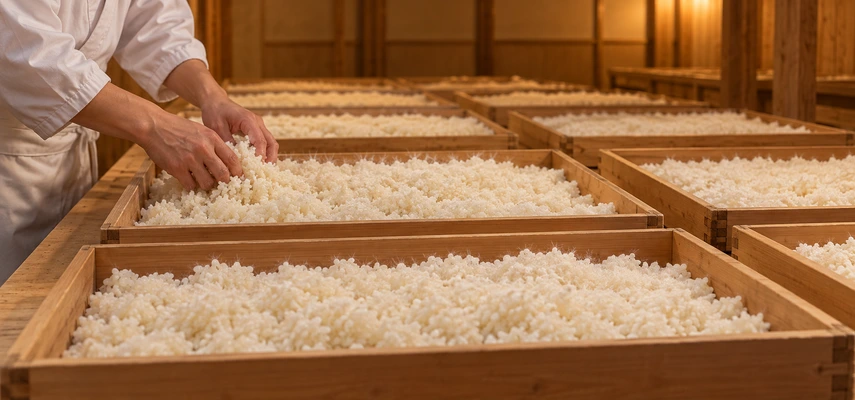

The rice looks quiet. The brewer keeps checking it anyway. In kōji production, a small living population is building an enzyme supply that will help determine how a much larger fermentation behaves. A room full of trays can therefore be one of the most consequential places in a sake brewery, even when nothing appears to be bubbling.
Kōji is steamed rice on which a selected mould has been cultivated. The mould is commonly Aspergillus oryzae in sake brewing. Its job here is different from yeast’s job in the fermentation mash. It produces enzymes that make rice components available for later transformations. Thinking of the room as an enzyme workshop keeps that distinction clear.
Kōji production prepares tools for another stage
An enzyme speeds a particular chemical reaction. Different enzymes act on different materials, so kōji is not supplying one all-purpose substance that simply dissolves rice. Its enzyme mixture helps break down starch and proteins through different routes. The brewer wants the right capabilities for the intended style, not just the largest visible mass of mould.
Amylases act on starch. Their combined activity helps release smaller carbohydrates, including glucose, which yeast can ferment. Protein-breaking enzymes produce smaller nitrogen-containing components, including peptides and amino acids. Those can influence fermentation nutrition and the savory dimension of the drink. Starch breakdown and protein breakdown therefore have different consequences.
The official Level 2 specification includes both enzyme functions, as well as a contribution to colour. Kōji’s effect reaches beyond a simple sugar supply. Later choices, including charcoal treatment and maturation, can also affect appearance, so the finished colour should not be attributed to kōji alone.
Imagine preparing a toolbox for a specific repair. More tools are useful only if they are appropriate and available where the work needs doing. Similarly, the amount and distribution of enzymes matters. The brewery is cultivating something that must perform a later task under the conditions of the starter and main fermentation.
Four requirements make a workable environment
The basic requirements are steamed white rice, kōji mould, warmth and humidity. Steaming has already changed the hydrated starch and prepared the grain. The rice now needs to support mould establishment rather than arrive as a hot, wet mass that overwhelms the planned conditions. The previous preparation stage and this one are tightly connected.
Warmth encourages growth within a useful range. Humidity helps manage the rice’s moisture and surface conditions. Too much or too little of either can move cultivation away from the brewery’s target. There is no reason to assume that a wetter or hotter environment always produces better kōji.
Rice moisture itself also matters. Room humidity and the water contained inside a grain are related controls but not identical measurements. A humid room cannot be treated as a guarantee that every grain has the intended internal condition. The brewer must consider the material and its surroundings together.
Clean handling and a selected mould culture help establish the desired organism. This is controlled food production, rather than leaving cooked rice on a shelf and hoping a useful mould appears. Appearance alone does not make an unidentified household mould suitable for consumption or brewing. The instructional point is cultivation control, not a home fermentation recipe.
Cooling comes before encouraging growth
Freshly steamed rice must reach a suitable temperature before the mould culture is applied and encouraged to grow. Cooling also interacts with surface moisture and how easily grains separate. The brewer is preparing a consistent environment at the scale that matters to the organism: the individual grain and the space around it.
The Japanese National Tax Agency’s illustrated kōji-making account shows cooled rice spread on a work surface before further cultivation. The photographs help explain why rice preparation is an active operation rather than a waiting period. Handling can alter temperature and moisture distribution at the same time.
If one portion is much warmer or wetter than another, an identical inoculation need not lead to an identical result. Consistency therefore begins before obvious mould growth. A brewery that checks its finished kōji carefully still needs to manage these initial conditions, because later correction has limits.
Establishing mould growth means distributing an opportunity
Mould spores are applied to the prepared rice and mixed through it. A spore is a reproductive starting unit, not a ready-made enzyme factory of full size. Under suitable conditions, growth begins and the fungus develops fine filaments. The culture can grow on the surface and into the grain.
Distribution matters because the brewer wants suitable development across the material being cultivated. A heavily inoculated patch beside a poorly reached patch creates different starting conditions. Merely measuring the total amount of spores doesn’t prove that they reached the rice evenly or produced the intended growth pattern.
Early handling may conserve warmth and moisture to encourage establishment. Later handling may do almost the opposite, releasing heat and changing exposure. Those actions are not contradictory. They respond to different stages of a living process, much as a greenhouse may need heating at one time and ventilation at another.
Managing growth means responding to heat from within
Growing mould produces heat. Once cultivation becomes active, the rice is not simply following the room thermometer. The temperature inside a pile or tray can differ from the air around it. This explains why a brewer can be concerned about overheating even in a room set to a reasonable temperature.
Breaking up clumps, mixing, spreading rice and rearranging trays can help manage differences. Material near a surface can experience different conditions from material in the center. A tray at one position in a stack can behave differently from its neighbor. The work aims to bring those differences under control rather than pretend they don’t exist.
Meanwhile, enzyme production and growth are affected by the cultivation conditions over time. A single temperature reading is only a snapshot. What happened earlier and how long conditions persisted also matter. The brewer is guiding a progression rather than choosing one thermostat setting and leaving for the weekend.
The JSS process explanation connects moisture, spores and temperature with the resulting kōji. That interaction is the important mechanism. Memorizing a numerical temperature without understanding what is being controlled would give a much thinner explanation of the work.
Hand methods put observation close to the material
Making kōji by hand can involve direct assessment of rice condition and repeated adjustments to piles, trays or boxes. The brewer can observe how the rice feels and how growth is progressing, then respond. Shallow wooden trays are one recognizable arrangement, but the principle is attentive control rather than a requirement that every brewery use identical furniture.
Hand production doesn’t mean the organisms are somehow different. The mould still needs appropriate conditions and produces enzymes through the same biological processes. The equipment and human judgment determine how those conditions are managed. Traditional appearance alone is not proof of a better enzyme profile or a better finished sake.
An instructive hypothetical comparison is two trays with the same rice and spores but different moisture histories. A skilled worker may adjust them differently because the material demands it. Treating every tray identically can be less useful than bringing each toward the intended result. Consistency of outcome need not mean identical intervention.
Machines can manage all or part of the work
Fully machine-made kōji uses equipment to manage the cultivation process to a substantial extent. Partially machine-made approaches combine mechanical control with manual handling or other human-managed phases. The Level 2 syllabus requires both distinctions alongside hand production. None is a separate premium grade.
Machines can help control environmental conditions and make a chosen process repeatable at the brewery’s scale. People still establish targets, monitor performance and evaluate results. Automation is a means of controlling the same heat, moisture and growth relationships. It does not remove biology from the process.
Likewise, hand work does not remove the need for measurement. The useful contrast is how control is organized, not a contest between soulful tradition and anonymous machinery. Ask what the brewery is trying to achieve and how reliably its method produces that kōji. The finished sake depends on many subsequent decisions too.
Stopping growth preserves the chosen endpoint
Once the intended condition has been reached, the kōji is removed from the cultivation environment and cooled or spread as appropriate to halt further active development. Stopping growth means bringing cultivation to its chosen endpoint. It does not mean destroying every enzyme that was produced, because those enzymes are needed afterward.
This is an easy distinction to miss. If stopping cultivation always meant eliminating enzyme activity, the next fermentation stage would lose an essential tool. Later pasteurisation serves a different purpose and can inactivate enzymes in the finished liquid. Cooling finished kōji and heat-treating sake belong to different stages with different aims.
One-page revision summary
Kōji production cultivates mould on steamed white rice to create a useful enzyme supply. Amylases support starch-to-glucose conversion; protein breakdown supplies peptides and amino acids. Warmth and humidity matter, but so do rice moisture and heat generated by growth. Follow cooling, establishing, managing and stopping growth. Hand, partially machine-made and fully machine-made methods manage the same biology. The next lesson compares two deliberately different patterns of mould development.
Knowledge check: 10 original practice questions
Independent TFE questions, not official WSET examination items. Choose one answer per question; explanations follow separately.
1. What is kōji in sake brewing?
- Steamed rice cultivated with selected mould
- The finished fermentation alcohol
- A rice-growing fertilizer
- A charcoal filter
2. What do amylases act on?
- Only alcohol
- Starch
- Glass
- Carbon dioxide
3. Which products can result from protein breakdown?
- Only carbon dioxide
- Husks and bran
- Peptides and amino acids
- Distilled spirits
4. Which combination lists basic cultivation requirements?
- Rice, charcoal, frost and darkness
- Grapes, yeast and boiling water
- Dry husks and alcohol
- Steamed white rice, mould, warmth and humidity
5. Why may rice become warmer than the surrounding air?
- Growing mould generates heat
- Polishing continues inside every tray
- Yeast distils the rice
- The air thermometer measures sugar
6. Why mix or spread rice during cultivation?
- To eliminate all enzymes
- To manage temperature, moisture and differences within the material
- To add bottled sake
- To remove the rice germ mechanically
7. What distinguishes fully and partially machine-made kōji?
- They require different premium grades
- Only one contains enzymes
- How much of cultivation is managed mechanically
- One uses no rice
8. What is the aim of stopping mould growth?
- Destroy every useful enzyme
- Create a new rice cultivar
- Finish alcoholic fermentation
- Preserve the chosen cultivation endpoint for subsequent use
9. Why is the amount of mould alone an incomplete target?
- The amount and distribution of enzymes must suit the intended style
- Only color matters
- Mould never produces enzymes
- All growth conditions produce identical kōji
10. Which sequence best follows the cultivation phases?
- Stopping, inoculating, steaming, polishing
- Cooling, establishing growth, managing growth, stopping growth
- Fermenting, distilling, carbonating, freezing
- Polishing, bottling, maturing, harvesting
Answers and explanations
1. A — Steamed rice cultivated with selected mould. Kōji is the cultivated rice substrate and mould system that supplies important brewing enzymes. Mapping: LO1.
2. B — Starch. Amylases help break starch into smaller carbohydrates, supporting glucose availability. Mapping: LO1.
3. C — Peptides and amino acids. Protein-degrading enzymes release smaller nitrogen-containing components with brewing and flavor roles. Mapping: LO1.
4. D — Steamed white rice, mould, warmth and humidity. These are the basic requirements specified for making kōji, rather than for finishing sake. Mapping: LO1.
5. A — Growing mould generates heat. Biological activity generates heat within the material, requiring attention beyond room temperature. Mapping: LO1.
6. B — To manage temperature, moisture and differences within the material. Handling changes exposure and releases heat, helping guide cultivation conditions. Mapping: LO1.
7. C — How much of cultivation is managed mechanically. These are approaches to process control, not different biological definitions of kōji. Mapping: LO1.
8. D — Preserve the chosen cultivation endpoint for subsequent use. Cultivation is brought to its endpoint while the produced enzymes remain useful later. Mapping: LO1.
9. A — The amount and distribution of enzymes must suit the intended style. Brewing needs suitable enzyme capability, rather than simply maximum visible growth. Mapping: LO1.
10. B — Cooling, establishing growth, managing growth, stopping growth. The prescribed phases guide rice from appropriate starting conditions to finished kōji. Mapping: LO1.
Continue studying sake
Article #3: Rice Polishing and Preparation Explained: Washing, Soaking, and Steaming · Article #5: Sō-haze vs. Tsuki-haze Kōji: How Mould Growth Influences Sake · Article #6: Sake Yeast and Water Explained: Strains, Minerals, and Aroma · Article #8: Multiple Parallel Fermentation Explained: How Sake Produces Alcohol












