










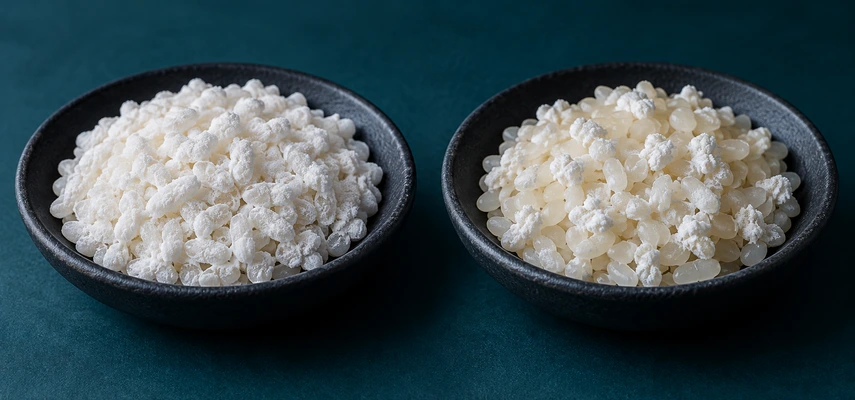

A rice grain covered in white growth can be exactly what a brewer wants. A grain with white growth in separated patches can also be exactly what a brewer wants. Sō-haze vs. tsuki-haze kōji is a comparison between deliberate growth patterns, not a quick test in which the whitest grain wins.
The previous lesson explained cultivation: prepare rice, establish mould, manage its development and stop at a chosen endpoint. This lesson asks what sort of development the brewery is aiming for. The answer connects the visible grain to enzyme activity, nutrient availability and the kind of fermentation the brewer intends to run.
Sō-haze vs. tsuki-haze kōji starts with distribution
Sō-haze describes kōji with extensive growth across the grain surface and into the rice. Tsuki-haze describes a more localized surface pattern with growth penetrating from those areas. The distinction is about distribution and development. It is not simply full-grown mould versus mould that someone forgot to finish cultivating.
Surface appearance is the part most easily photographed. Internal penetration matters too, even though it is harder to see in a whole grain. A patchy-looking exterior does not necessarily mean the culture remained entirely outside. Conversely, a white surface alone cannot tell you every detail of how the grain has been colonized or which enzymes it contains.
The Level 2 specification names both styles within kōji production and links production choices to finished sake style. Learn the visual contrast, then explain what it is for. A pair of vocabulary flashcards is only the beginning of the lesson.
A useful growth pattern supplies a useful enzyme system
Kōji supplies enzymes that help make rice components available in the fermentation mash. Starch-degrading activity supports sugar release; protein breakdown supplies smaller nitrogen-containing components. A brewer seeking different balances of these effects can adjust cultivation rather than treating every kōji batch as the same ingredient.
The amount of activity and how it is distributed through the rice influence the material’s later behavior. More vigorous breakdown can support a more robust fermentation environment. More restrained nutrient supply and carefully managed sugar release can be useful in a different plan. Neither description means that one activity disappears completely in either style.
Consider two kitchens preparing stock for different dishes. A concentrated stock may suit one recipe, while a lighter one suits another. Calling either universally superior ignores its use. Kōji is not stock, but the comparison captures the point: an intermediate ingredient is judged partly by the task it is supposed to perform.
Sō-haze supports a broader, more vigorous approach
With sō-haze, extensive growth is associated with substantial enzyme and nutrient contributions. The JSS brewing account describes broad coverage, strong rice breakdown and a robust fermentation tendency. That can fit a plan for sake with fuller body and more substantial flavor.
Why might these things connect? Readily available carbohydrates help sustain yeast, while the availability of nutrients affects yeast growth and metabolism. Protein breakdown can contribute compounds that influence savory character and the general flavor profile. The result depends on how all of this fits with water, yeast, temperature and timing.
It would be a mistake to turn that relationship into a fixed tasting guarantee. Sō-haze does not mean every resulting sake must be sweet, coarse or high in alcohol. Sugar released is not necessarily sugar left in the bottle. Yeast may consume it, and later finishing can alter the strength and balance that the drinker experiences.
The useful statement is conditional: this cultivation approach can support a richer, more vigorous production plan. To explain a particular bottle, the rest of the process still matters. That qualification adds precision rather than weakening the explanation.
Tsuki-haze fits a more restrained aromatic plan
Tsuki-haze has separated areas of visible surface growth rather than an uninterrupted white coat. Growth reaches into the grain from those areas. Its enzyme and nutrient profile is managed to support the intended brewing behavior, commonly in the production of delicate ginjō styles. Patchiness here can reflect control and purpose.
The aim is not to starve yeast until it gives up. Ginjō brewing requires a successful fermentation with carefully managed conditions. Restrained nutrient availability is one part of a coordinated approach involving polishing, rice preparation, yeast choice and fermentation temperature. If the system is poorly balanced, an attractive kōji pattern alone will not rescue it.
A delicate aromatic result also needs more than reduced visible mould. The yeast has to create appropriate aroma compounds, and the process must help retain and express them. Calling tsuki-haze the source of melon aroma would skip the organism that actually makes much of that aroma during fermentation.
The NRIB/JSS guide places kōji-making alongside rice and yeast choices in its discussion of style development. Use that integrated view. Tsuki-haze is a cultivation choice supporting a broader plan, not an independent aromatic ingredient that tastes fruity before it meets the mash.
Moisture and preparation help determine where growth develops
The mould grows on prepared rice, so cultivation cannot be separated from what happened earlier. Polishing changes the grain and its available components. Washing, soaking and steaming influence moisture and texture. Those conditions affect how the culture establishes and how the rice behaves during growth.
Think about the difference between changing a seed and changing the conditions in which it grows. The mould culture matters, but the prepared substrate matters too. A brewery that wants a different growth pattern can work on the rice and cultivation environment together. There is no single knob labelled tsuki-haze that replaces the rest of preparation.
Moisture control is particularly useful for understanding this relationship. The surface and interior are not interchangeable spaces. A grain with one moisture history can support a different course of growth from a grain with another. Therefore, the brewer’s timing and handling before inoculation can influence the pattern seen later.
Spores, warmth and handling are coordinated controls
The amount and distribution of spores affects where growth begins. Warmth, humidity and cultivation time influence how it develops. Mixing, spreading and managing the material also change temperature and exposure. These factors interact, so a simple rule such as add more spores to get better kōji is inadequate.
Growing mould generates heat. A fuller coating can change alongside the grain’s developing conditions rather than appearing in a perfectly static environment. The brewer must watch the material and its temperature history. A desired visual pattern is the result of a managed progression, not a decoration added at the end.
Meanwhile, room humidity does not tell the whole story about water inside the rice. A cultivation plan must suit both the room and the substrate. This is why an explanation that names temperature alone is incomplete. It leaves out the very material on which the organism is being asked to grow.
Appearance is evidence, not an enzyme assay
A photograph can illustrate extensive white coverage versus localized white patches. It cannot measure how much of each enzyme is present. Nor can it demonstrate internal penetration with the same confidence as examining a cut grain or using appropriate analytical methods. Keep the claim matched to the evidence.
This matters when comparing educational images. A fuzzy grain may look impressively biological while being a poor representation of actual sake kōji. Fine growth and the shape of the rice deserve attention. The featured image here is an original conceptual surface comparison, not a laboratory measurement or an authenticated sample from a named brewery.
For exam preparation, practice describing the distinction in words before attaching a style tendency. Sō-haze: extensive growth, substantial enzyme and nutrient contribution, useful for more vigorous and fuller-style plans. Tsuki-haze: localized surface growth with penetration, useful in a controlled, restrained ginjō plan. Then add that other production decisions remain necessary.
Don’t confuse cultivation style with a legal grade
Neither sō-haze nor tsuki-haze is one of the eight premium grades. They describe how kōji has developed. Junmai, honjōzō and the ginjō-related names describe other production requirements. A cultivation term cannot independently establish the finished sake’s legal classification.
For example, identifying tsuki-haze in a production description does not tell you whether brewing alcohol was added. Identifying sō-haze does not reveal the final dilution decision. Each fact belongs at its own point in the cause-and-effect chain. Treating them separately helps explain how they can work together.
The same caution applies to quality. A well-executed richer style should not be penalized for lacking the delicacy of a different brief. Judge whether the production choices support a convincing result. A preference for fruity sake is a preference, not proof that kōji used for a savory style was inferior.
A comparison exercise without needing alcohol
Take two imaginary production briefs. One asks for a fuller, savory expression with robust fermentation. The other asks for restrained fruit-led ginjō. Assign a plausible kōji approach to each, then add two other choices that would need to support it. You might consider rice preparation and fermentation management before attempting the later yeast lesson.
Next, change one detail. Suppose the second brief uses a different yeast or a warmer fermentation. Does the original kōji choice still guarantee the same result? No. This simple exercise trains the distinction between a contributing factor and a complete explanation. It can be done with a notebook and no tasting samples at all.
One-page revision summary
Sō-haze and tsuki-haze are deliberate kōji-growth patterns. Extensive coverage differs from localized surface growth, but internal penetration also matters. Their enzyme and nutrient contributions support different brewing plans; they do not dictate sweetness, grade or quality by themselves. Rice moisture, spores, warmth, humidity and handling work together. Link a growth pattern to its intended fermentation role, then keep the rest of the brewer’s decisions in the explanation.
Knowledge check: 10 original practice questions
Independent TFE questions, not official WSET examination items. Choose one answer per question; explanations follow separately.
1. What principally distinguishes the two kōji styles?
- The distribution and development of mould growth
- The bottle size
- The use of grapes instead of rice
- The final alcohol label
2. Which description best fits sō-haze?
- No mould growth
- Extensive surface growth and development into the grain
- Only dissolved yeast
- A charcoal-treated sake
3. What is a key caution about tsuki-haze?
- It never contains enzymes
- It means cultivation failed
- Localized surface growth can still penetrate the grain
- It is one of the eight grades
4. Which brewing plan commonly uses tsuki-haze?
- A plan with no yeast
- Only a sparkling process
- Only a deliberately oxidized style
- A controlled delicate ginjō plan
5. Why can sō-haze suit a fuller production plan?
- Its enzyme and nutrient contributions can support vigorous fermentation
- It removes all amino acids
- It guarantees residual sugar
- It contains distilled alcohol
6. What can a photograph of whole kōji grains establish most directly?
- Exact enzyme concentrations
- Visible surface growth distribution
- Final sake alcohol strength
- The yeast strain
7. Which factor can help shape growth?
- Only the finished bottle color
- Only the serving vessel
- Rice moisture together with cultivation conditions
- The exam grade threshold
8. Does tsuki-haze alone guarantee a fruity ginjō result?
- Yes, irrespective of yeast
- Yes, irrespective of temperature
- Yes, because mould is distilled
- No, other production decisions must support the plan
9. Are these terms legal premium grades?
- No, they describe kōji development
- Yes, they replace junmai and honjōzō
- Only sō-haze is a grade
- Only tsuki-haze is a grade
10. Why is maximizing visible mould an incomplete aim?
- Mould has no brewing function
- The enzyme system must suit the intended style
- All rice must remain uncultivated
- Visible growth proves exact sweetness
Answers and explanations
1. A — The distribution and development of mould growth. The terms describe growth patterns, including surface distribution and penetration into rice. Mapping: LO1.
2. B — Extensive surface growth and development into the grain. Sō-haze is associated with broad growth rather than the separated surface pattern of tsuki-haze. Mapping: LO1.
3. C — Localized surface growth can still penetrate the grain. A patchy external pattern does not mean that growth is confined to the surface. Mapping: LO1.
4. D — A controlled delicate ginjō plan. Tsuki-haze supports restrained aromatic production when coordinated with other choices. Mapping: LO1.
5. A — Its enzyme and nutrient contributions can support vigorous fermentation. The connection concerns breakdown and nutrition; it does not fix sweetness or final strength. Mapping: LO1.
6. B — Visible surface growth distribution. Surface pattern can be illustrated, but enzyme activity requires different evidence. Mapping: LO1.
7. C — Rice moisture together with cultivation conditions. Prepared rice, spores, temperature, humidity and handling interact during cultivation. Mapping: LO1.
8. D — No, other production decisions must support the plan. Aroma development depends on a coordinated system including yeast and fermentation management. Mapping: LO1.
9. A — No, they describe kōji development. Cultivation terminology and premium-grade definitions describe different aspects of production. Mapping: LO2.
10. B — The enzyme system must suit the intended style. Brewers want an appropriate amount and distribution of useful activity, not simply maximum coverage. Mapping: LO1.
Continue studying sake
Article #3: Rice Polishing and Preparation Explained: Washing, Soaking, and Steaming · Article #4: Kōji Production Explained: Enzymes, Mould Cultivation, and Brewing Science · Article #6: Sake Yeast and Water Explained: Strains, Minerals, and Aroma · Article #8: Multiple Parallel Fermentation Explained: How Sake Produces Alcohol











